Looking for classes? Ksquare Career Institute, Bengaluru →

Biology
Human Reproduction
116 questions from 38 papers, each with its answer.
- 116 questions
- 38 papers
- 3.29% of Biology
Menstrual Cycle
-
If mammalian ovum fails to get fertilized, which one of the following is unlikely -If the ovum is not fertilised, the corpus luteum degenerates (disintegrates) towards the end of the luteal phase; this is likely.
With the degeneration of the corpus luteum, the secretion of progesterone declines rapidly; this is likely.
The corpus luteum also secretes oestrogen, so the oestrogen level falls further; this is likely. The fall of these hormones leads to menstruation.
Primary follicles are formed in the ovary during foetal life, and their numbers only decline afterwards; no new primary follicles are formed in the adult.
According to the answer key, the statement that a primary follicle starts developing is therefore the unlikely one; what begins in the next cycle under FSH is the growth of already existing follicles into Graafian follicles.
Note: some books treat the start of development of a new follicle as a normal event after failure of fertilisation, so this question is open to interpretation.
Hormonal Regulation of Spermatogenesis
-
Identify the correct option (A), (B), (C), (D) with respect to spermatogenesis.
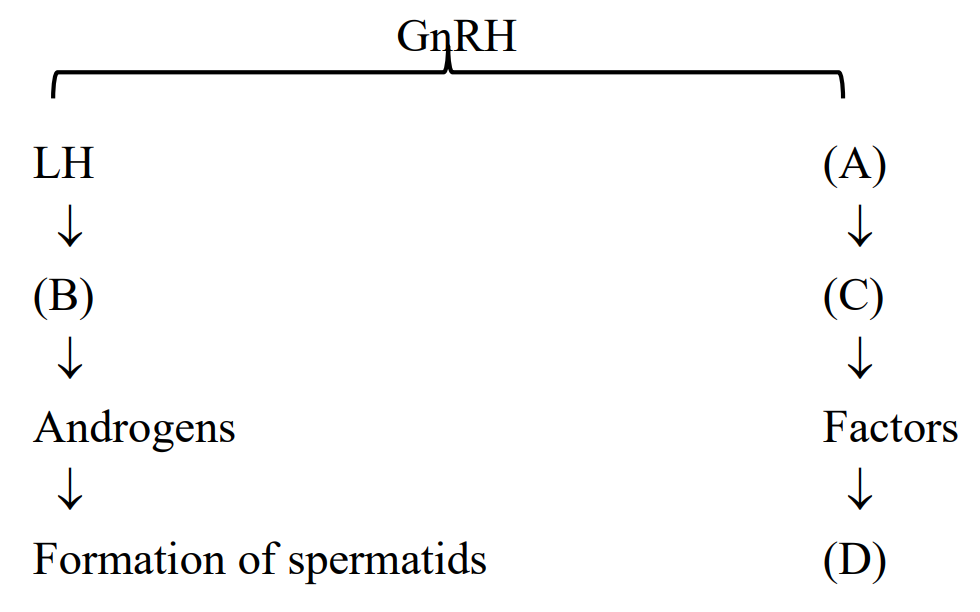 GnRH from the hypothalamus acts on the anterior pituitary to release LH and FSH, so (A) = FSH.
LH acts on the Leydig cells and stimulates synthesis and secretion of androgens, so (B) = Leydig cells.
FSH acts on the Sertoli cells and stimulates secretion of factors that help in spermiogenesis, so (C) = Sertoli cells and (D) = spermiogenesis.
So the correct option is FSH, Leydig cells, Sertoli cells, spermiogenesis.
Gametogenesis – Spermatogenesis and Oogenesis
-
Which of the following statements are true for spermatogenesis but do not hold true for Oogensis? A. It results in the formation of haploid gametes B. Differentiation of gamete occurs after the completion of meiosis C. Meiosis occurs continuously in a mitotically dividing stem cell population D. It is controlled by the Luteinising hormone (LH) and Follicle Stimulating Hormone (FSH) secreted by the anterior pituitary E. It is initiated at puberty Choose the most appropriate answer from the options given below.
Embryonic and foetal development timeline
-
Match List I with List II related to embryonic development at various months of pregnancy:
Pick the matching item from Column II for each row.
Column I
- i. The foetus movement starts and hair appears on the head
- ii. The foetus develops limbs and digits
- iii. The foetus develops external genital organs
- iv. The foetus body is covered with fine hair
Column II
- a. 24 weeks of pregnancy
- b. 20 weeks of pregnancy
- c. 8 weeks of pregnancy
- d. 12 weeks of pregnancy
Correct answer: i → b, ii → c, iii → d, iv → a
Embryonic development
-
During embryonic development, the establishment of polarity along anterior/posterior, dorsal/ventral or medial/lateral axis is called : -Early in development, the embryo must establish its body axes: anterior–posterior (head–tail), dorsal–ventral (back–belly) and medial–lateral (left–right).
Spemann and Mangold showed in amphibian embryos that a special region, the dorsal lip of the blastopore (the organizer), induces and organises the formation of the main body axis and the neural tube. When it was grafted into another embryo, a second body axis formed.
This inducing and organising action of the organizer, which sets up the polarity of the embryo, is called the organizer phenomenon.
As per the answer key, the establishment of polarity along these axes is called the organizer phenomena. (In modern textbooks the term axis formation is also used for this process.)
Fertilisation and Early Development
-
Grey crescent is the area -The grey crescent is seen in the fertilised eggs of amphibians such as the frog.
The upper (animal) hemisphere of the egg is pigmented black and the lower (vegetal) hemisphere is yolky and pale.
After the sperm enters, the outer cortical cytoplasm rotates towards the point of sperm entry.
As a result, a crescent-shaped grey area of intermediate pigmentation appears on the side of the egg just opposite to the point of entry of the sperm.
The grey crescent marks the future dorsal side of the embryo; the dorsal lip of the blastopore forms here and it acts as the primary organiser.
So the grey crescent is the area just opposite to the site of entry of the sperm into the ovum.
That is every question in Human Reproduction for this filter.
Want a score?
Answers here are not saved. Practise as a test to be marked and see your progress.
Practise as a test