Looking for classes? Ksquare Career Institute, Bengaluru →

Biology
Biodiversity and Conservation
95 questions from 36 papers, each with its answer.
- 95 questions
- 36 papers
- 2.69% of Biology
Contributions of Ecologists to Biodiversity Theory
-
Match List-I with List-II regarding ecologists and their contributions to biodiversity science.
Pick the matching item from Column II for each row.
Column I
- A. Robert May
- B. Alexander von Humboldt
- C. Paul Ehrlich
- D. David Tilman
Column II
- I. Species area relationship
- II. Long term ecosystem experiment using outdoor plots
- III. Global species diversity at about 7 million
- IV. Rivet popper hypothesis
Correct answer: A → III, B → I, C → IV, D → II
Robert May – estimated global species diversity at about 7 million Alexander von Humboldt – species-area relationship Paul Ehrlich – rivet popper hypothesis David Tilman – long-term ecosystem experiments using outdoor plots Correct match: A-III, B-I, C-IV, D-II.
Species Diversity
-
The table below gives the populations (in thousands) of ten species (A-J) in four areas (a-d) consisting of the number of habitats given within brackets against each. Study the table and answer the question which follows:
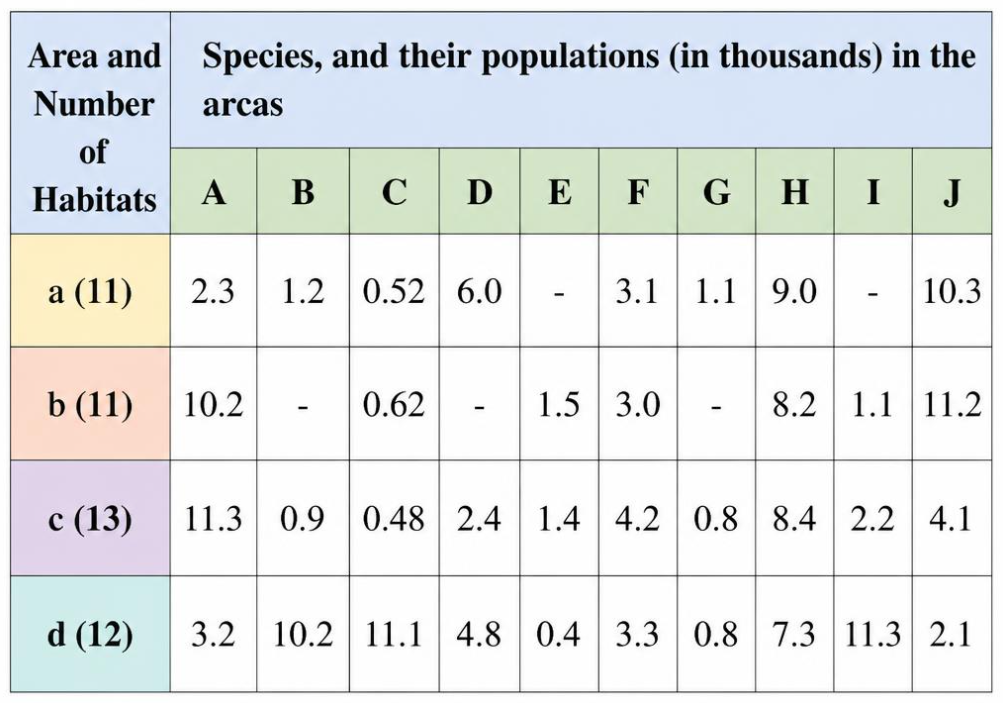
Which area out of a to d shows maximum species diversity?Species diversity depends on two things: species richness (the number of species present) and species evenness (how evenly the individuals are distributed among the species).
Area a has only 8 of the ten species (E and I are absent).
Area b has only 7 of the ten species (B, D and G are absent).
Areas c and d both have all 10 species, so they have the highest species richness.
Between c and d: in area c the populations are very unequal, with one species (A = 11.3) dominating and several species below 1.0.
In area d the total population is larger and it is shared more evenly, with several species (B = 10.2, C = 11.1, I = 11.3, H = 7.3) being abundant, and the ten species are packed into fewer habitats (12 against 13).
So area d, with all ten species and a more even distribution, shows the maximum species diversity, as given in the answer key.
Loss of Biodiversity: Threatened Species
-
Which group of vertebrates comprises the highest number of endangered species : -The IUCN Red List classifies species by their risk of extinction.
Reptiles such as turtles, tortoises, crocodiles and many lizards and snakes are threatened by habitat loss, hunting for skins, meat and eggs, the pet trade, and their slow reproduction and restricted ranges.
As per the answer key, reptiles are taken as the vertebrate group with the highest number of endangered species.
(The ranking depends on which list and which year is used, and on whether numbers or the proportion of species assessed are compared; in many later assessments amphibians, which are not among the options here, have the highest proportion of threatened species.)
So the answer is reptiles.
That is every question in Biodiversity and Conservation for this filter.
Want a score?
Answers here are not saved. Practise as a test to be marked and see your progress.
Practise as a test