Looking for classes? Ksquare Career Institute, Bengaluru →

Biology
Principles of Inheritance and Variation
198 questions from 38 papers, each with its answer.
- 198 questions
- 38 papers
- 5.62% of Biology
Pedigree Analysis
-
With the help of given pedigree, find out the probability for the birth of a child having no disease and being a carrier (has the disease mutation in one allele of the gene) in $F_{3}$ generation.
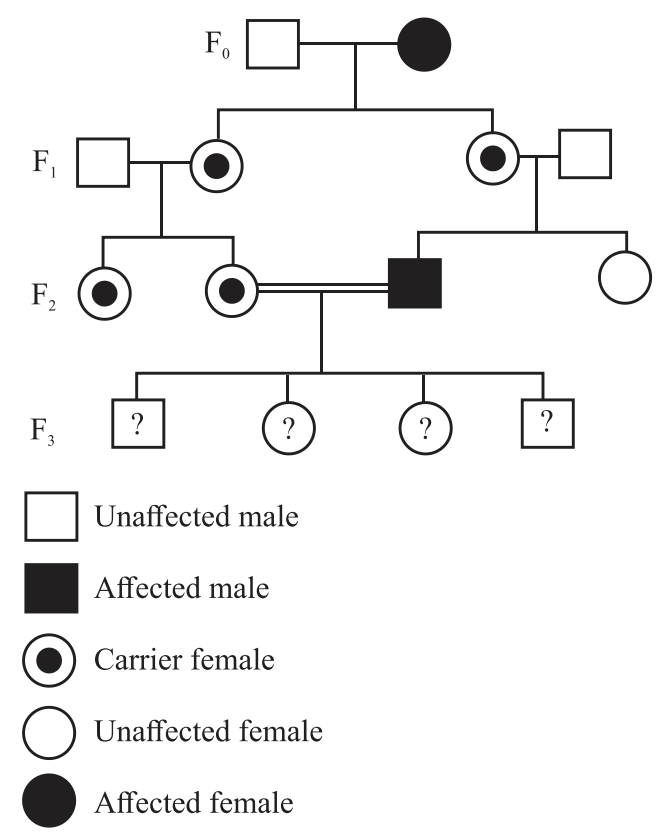
Probability of a carrier female child ($X^C X$) from a carrier mother ($X^C X$) and normal father ($XY$) is 1/4.
The pedigree shows X-linked recessive inheritance. In $F_2$, the mother is a carrier female ($X^C X$) and the father is unaffected ($XY$). The offspring genotypes are: $X^C X$ (carrier female, 1/4), $XX$ (normal female, 1/4), $X^C Y$ (affected male, 1/4), $XY$ (normal male, 1/4). The probability of an unaffected child being a carrier is 1/4.
Chromosomal Basis of Genetic Disorders
-
Match List-I with List-II regarding genetic disorders and the chromosome involved.
Pick the matching item from Column II for each row.
Column I
- A. Down's syndrome
- B. $\alpha$-Thalassemia
- C. $\beta$-Thalassemia
- D. Klinefelter's
Column II
- I. 11th chromosome
- II. 'X' chromosome
- III. 21st chromosome
- IV. 16th chromosome
Correct answer: A → III, B → IV, C → I, D → II
Down's syndrome – additional copy of chromosome 21 (trisomy 21) $\alpha$-Thalassemia – controlled by two closely linked genes HBA1 and HBA2 on chromosome 16 $\beta$-Thalassemia – controlled by a single gene HBB on chromosome 11 Klinefelter's syndrome – additional copy of the X chromosome (47, XXY) Correct match: A-III, B-IV, C-I, D-II.
ABO Blood Group Genetics (Multiple Alleles)
-
As per ABO blood grouping system, the blood group of fathers is $B^+$, mother is $A^+$ and child is $O^+$. Their respective genotype can be A. $I^Bi/I^Ai/ii$ B. $I^BI^B/I^AI^A/ii$ C. $I^AI^B/iI^A/I^Bi$ D. $I^Ai/I^Bi/I^Ai$ E. $iI^B/iI^A/I^AI^B$ Choose the most appropriate answer from the options given below:For an $O^+$ child (genotype ii), each parent must carry the recessive allele i. Father with blood group $B^+$ must be $I^Bi$, and mother with blood group $A^+$ must be $I^Ai$; child is ii. So only combination A ($I^Bi / I^Ai / ii$) is possible.
Linkage and Recombination – Gene Mapping
-
The recombination frequency between the genes a & c is 5%, b & c is 15%, b & d is 9%, a & b is 20%, c & d is 24% and a & d is 29%. What will be the sequence of these genes on a linear chromosome?
Linkage and Recombination – Genetic Maps
-
The linkage map of X-chromosome of fruitfly has 66 units, with yellow body gene (y) at one end and bobbed hair (b) gene at the other end. The recombination frequency between these two genes (y and b) should be : -Map distances are obtained by adding the recombination frequencies between closely placed genes. So the total length of a map (here 66 units) can be more than 50.
However, the recombination frequency actually observed between two genes can never exceed 50 percent. This is because multiple crossovers between distant genes cancel each other's effect (a double crossover restores the parental combination), and crossing over involves only two of the four chromatids.
A recombination frequency of 50 percent means the genes behave as if they assort independently.
So between y and b, at opposite ends of the chromosome, the recombination frequency should be $\leq$ 50%.
Haplodiploidy - sex determination in honeybees
-
Which of the following statements are true with reference to the sex-determination in honeybees? I. An offspring formed from the union of a sperm and an egg, develops as a female (queen or worker). II. An unfertilized egg develops as a male by parthenogenesis. III. A male has half the number of chromosomes than that of a female. IV. Males produce sperms by meiosis. V. Honeybees have a haplodiploid sex-determination system. Choose the CORRECT answer from the options given below:
Sex determination in humans
-
Male XX and female XY sometimes occur due toMaleness in humans is determined by the SRY gene (sex-determining region of Y), located near the tip of the Y chromosome's short arm.
During meiosis in the father, an abnormal crossing over between the X and Y chromosomes can transfer the SRY region from Y to X.
An XX zygote that receives an X carrying SRY develops as a male (XX male), while an XY zygote whose Y has lost SRY develops as a female (XY female).
So these conditions occur due to transfer of segments between the X and Y chromosomes.
Mendel's Laws: Independent Assortment
-
The genes controlling the seven pea characters studied by Mendel are now known to be located on how many different chromosomes : -The garden pea has 7 pairs of chromosomes (2n = 14).
Later studies showed that the genes for the seven characters studied by Mendel lie on only four different chromosomes (chromosomes 1, 4, 5 and 7).
Some of them are on the same chromosome but far apart, so crossing over is frequent and they still assort nearly independently. Mendel also did not test every pair of characters together, so he did not detect linkage.
So the genes are located on four different chromosomes.
That is every question in Principles of Inheritance and Variation for this filter.
Want a score?
Answers here are not saved. Practise as a test to be marked and see your progress.
Practise as a test