Looking for classes? Ksquare Career Institute, Bengaluru →

Biology
Principles of Inheritance and Variation
198 questions from 38 papers, each with its answer.
- 198 questions
- 38 papers
- 5.62% of Biology
Polygenic Inheritance
-
Given below are two statements: Statement I: When many alleles of a single gene govern a character, it is called polygenic inheritance. Statement II: In Polygenic inheritance, the effect of each allele is additive. In the light of the above statements, choose the correct answer from the options given below.Statement I incorrectly describes multiple alleles (many alleles of a single gene); polygenic inheritance actually refers to a character governed by more than one gene (multiple genes), so Statement I is false. In polygenic inheritance, the contribution of each gene/allele is additive, producing a continuous range of phenotypes, so Statement II is true.
Pedigree Analysis
-
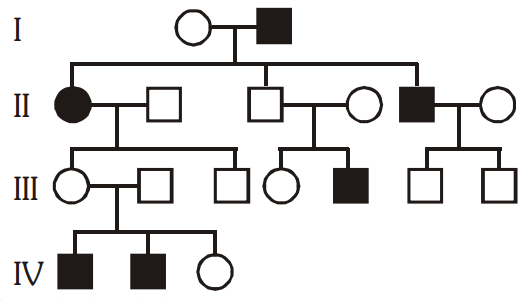
In the following human pedigree, the filled symbols represent the affected individuals. Identify the type of given pedigree.
-
Study the pedigree chart of a certain family given below and select the correct conclusion which can be drawn for the character.
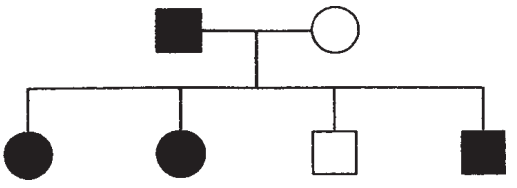 In the chart the father is affected and the mother is unaffected; among the four children, two daughters and one son are affected and one son is unaffected.
Take the trait as recessive: the affected father is homozygous recessive (aa).
Affected children (aa) must receive one recessive allele from each parent, so the unaffected mother must carry the recessive allele: she is heterozygous (Aa).
The cross $aa \times Aa$ gives affected (aa) and unaffected (Aa) children in a 1 : 1 ratio, as seen. So a normal daughter (Aa) was also possible.
The same pattern fits an X-linked recessive trait such as colour-blindness (father $X^cY$, mother $X^CX^c$), so colour-blindness cannot be ruled out; and the father, being affected, cannot be homozygous dominant.
Hence the correct conclusion is that the female parent is heterozygous. -
Study the pedigree chart given below:
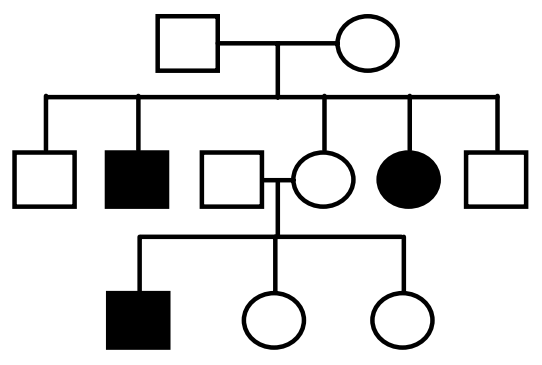
What does it show?In the chart, unaffected parents have affected children; this is possible only if the trait is recessive and both parents are heterozygous carriers.
The affected individuals include a female born to an unaffected father. For an X-linked recessive trait an affected daughter ($X^aX^a$) must have an affected father ($X^aY$), so sex-linked inheritance like haemophilia is ruled out.
The trait is therefore autosomal recessive: carrier parents $Aa \times Aa$ give affected children (aa) of either sex.
Phenylketonuria is an inborn error of metabolism inherited as an autosomal recessive trait (it is not sex-linked).
Hence the chart shows inheritance of a condition like phenylketonuria as an autosomal recessive trait. -
A man and a woman, who do not show any apparent signs of a certain inherited disease, have seven children (2 daughters and 5 sons). Three of the sons suffer from the given disease but none of the daughters are affected. Which of the following modes of inheritance do you suggest for this diseaseThe parents are both unaffected, but some children are affected, so the disease is recessive; a dominant disease would appear in at least one parent.
Only sons are affected and the daughters are normal, which points to a sex-linked (X-linked) recessive trait.
The mother must be a carrier ($X^aX$) and the father normal ($XY$).
Each son receives his only X chromosome from the mother, so half the sons are expected to be affected ($X^aY$); here 3 out of 5 sons are affected.
The daughters receive the father's normal X, so none of them is affected (half of them are carriers).
So the suggested mode of inheritance is sex-linked recessive (like haemophilia).
Test Cross
-
A common test to find the genotype of a hybrid is by
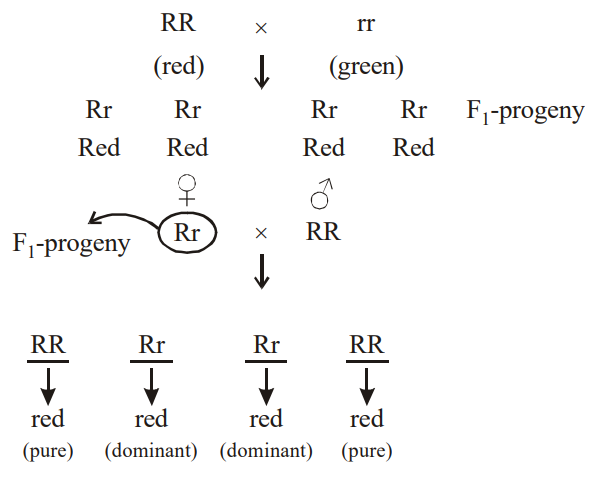
An individual showing the dominant phenotype may be homozygous dominant or heterozygous, and this cannot be told from its appearance.
To find the genotype, the hybrid (F1 progeny) is crossed back with one of its parents. Such a cross is called a back cross.
When the F1 hybrid is crossed with the recessive parent, the cross is called a test cross; here the male parent is taken as the recessive parent.
If the hybrid is heterozygous (Rr), the cross Rr x rr gives dominant and recessive offspring in the ratio 1 : 1.
If the individual tested is homozygous dominant (RR), the cross RR x rr gives all dominant offspring.
So from the ratio of the offspring the genotype of the hybrid is known.
Hence the common test is the crossing of one F1 progeny with the male parent, as given in the answer key.
Incomplete Dominance in Snapdragon
-
A pink flowered Snapdragon plant was crossed with a red flowered Snapdragon plant. What type of phenotype/s is/are expected in the progeny?Flower colour in snapdragon shows incomplete dominance: RR = red, Rr = pink, rr = white. Pink (Rr) × Red (RR) gives RR (red) and Rr (pink) in a 1 : 1 ratio. So both red flowered and pink flowered plants are expected.
Genetics Terminology (Allele, Test Cross, Back Cross, Ploidy)
-
Match List I with List II regarding genetics terminology.
Pick the matching item from Column II for each row.
Column I
- A. Two or more alternative forms of a gene
- B. Cross of F1 progeny with homozygous recessive parent
- C. Cross of F1 progeny with any of the parents
- D. Number of chromosome sets in plant
Column II
- I. Back cross
- II. Ploidy
- III. Allele
- IV. Test cross
Correct answer: A → III, B → IV, C → I, D → II
Two or more alternative forms of a gene – allele Cross of $F_1$ progeny with homozygous recessive parent – test cross Cross of $F_1$ progeny with any of the parents – back cross Number of chromosome sets in a plant – ploidy Correct match: A-III, B-IV, C-I, D-II.
Mendel's Law of Dominance
-
Which one of the following can be explained on the basis of Mendel's Law of Dominance? A. Out of one pair of factors one is dominant and the other is recessive. B. Alleles do not show any expression and both the characters appear as such in F2 generation. C. Factors occur in pair in normal diploid plants. D. The discrete unit controlling a particular character is called factor. E. The expression of only one of the parental characters is found in a monohybrid cross. Choose the correct answer from the options given below:The Law of Dominance explains that characters are controlled by discrete units called factors (D), that factors occur in pairs in normal diploid plants (C), that of a pair of dissimilar factors one is dominant and the other recessive (A), and that only one of the parental characters is expressed in a monohybrid cross (E). Statement B is not explained by the law of dominance. So A, C, D and E only are correct.
Chromosomal Disorders – Klinefelter's Syndrome
-
Which of the following statements are correct about Klinefelter's Syndrome? A. This disorder was first described by Langdon Down (1866). B. Such an individual has overall masculine development. However, the feminine development is also expressed. C. The affected individual is short stature. D. Physical, psychomotor and mental development is retarded. E. Such individuals are sterile. Choose the correct answer from the options given below:
Klinefelter's individuals (47, XXY) are masculine with some feminine development and are sterile.
Klinefelter's Syndrome is a genetic disorder that is caused due to the presence of an additional copy of X chromosome resulting into a karyotype of $47, XXY$. Such an individual has overall masculine development, however, the feminine development (development of breast, i.e., gynaecomastia) is also expressed. Such individuals are sterile. Down syndrome was first described by Langdon Down (1866). In this disorder the affected individual is physically, psychomotorly and mentally retarded.
Chromosomal Disorders – Down's Syndrome
-
Down's syndrome is caused by an extra copy of chromosome number 21. What percentage of offspring produced by an affected mother and a normal father would be affected by this disorder :-An affected mother has three copies of chromosome 21 (trisomy 21).
During meiosis, the three chromosomes 21 are distributed so that half of her eggs receive two copies of chromosome 21 and half receive one copy.
The normal father gives one chromosome 21 in every sperm.
Egg with two copies + sperm with one = trisomy 21 (Down's syndrome); egg with one copy + sperm with one = normal.
So about 50% of the offspring would be affected.
Mendel's Laws of Inheritance
-
Given below are two statements: Statement I: Mendel studied seven pairs of contrasting traits in pea plants and proposed the Laws of Inheritance Statement II: Seven characters examined by Mendel in his experiment on pea plants were seed shape and colour, flower colour, pod shape and colour, flower position and stem height In the light of the above statements, choose the correct answer from the options given below.
Sex Determination
-
Select the incorrect statement.
-
Match the items of Column I with Column II. Select the correct option.
Pick the matching item from Column II for each row.
Column I
- A. XX-XO method of sex determination
- B. XX-XY method of sex determination
- C. Karyotype-45
- D. ZW-ZZ method of sex determination
Column II
- I. Turner's syndrome
- II. Female heterogametic
- III. Grasshopper
- IV. Female homogametic
Correct answer: A → III, B → IV, C → I, D → II
-
Which one of the following conditions correctly describes the manner of determining the sex in the given example?Grasshopper has XO type sex determination: females have a pair of X chromosomes (XX) and males have only one X chromosome (XO), so XO determines the male sex. This is correct.
In $Drosophila$, XX individuals are females and XY individuals are males.
In birds the females are heterogametic (ZW) and the males are homogametic (ZZ), so ZZ determines the male sex.
In humans sex is determined by the XX–XY mechanism; XO (Turner's syndrome) is an abnormal condition (a sterile female with rudimentary ovaries) and is not the manner in which female sex is normally determined.
Hence the correct description is that the XO type determines male sex in grasshopper. -
In Drosophila the XXY condition leads to femaleness whereas in human beings the same condition leads to Klinefelter's syndrome in male. It proves :In Drosophila, sex is decided by the ratio of X chromosomes to sets of autosomes (genic balance). XXY with two sets of autosomes has X/A = 1, so it is female; the Y chromosome does not decide sex.
In humans, XXY individuals are male (Klinefelter's syndrome), because the Y chromosome carries the SRY gene that determines maleness, regardless of the number of X chromosomes.
So this proves that in human beings the Y chromosome is active in sex determination.
Mendelian Disorders
-
Which of the following occurs due to the presence of autosome linked dominant trait?
-
Select the correct match.Phenylketonuria – autosomal recessive disorder Sickle cell anaemia – autosomal recessive trait, due to mutation in the gene on chromosome 11 Thalassemia – autosomal recessive disorder Haemophilia – X-linked recessive disorder So the correct match is sickle cell anaemia – autosomal recessive trait, chromosome 11.
-
Sickle cell anemia isSickle-cell anaemia is caused by a point mutation: a single base substitution at the sixth codon of the β-globin gene, from GAG to GUG. So it is caused by a change in a single base pair of DNA.
As a result glutamic acid (Glu) is replaced by valine (Val) at the sixth position of the β-globin chain; the given statement has this the wrong way round.
It is an autosome-linked recessive trait; only homozygous individuals ($Hb^SHb^S$) show the disease.
The mutant haemoglobin polymerises under low oxygen tension and changes the RBC from a biconcave disc to an elongated sickle shape; human RBCs have no nucleus.
Hence the correct statement is that it is caused by a change in a single base pair of DNA.
Linkage and Recombination
-
Mendel's law of Independent assortment does not hold good for the genes that are located closely on the same chromosome.Reason: Closely located genes assort independently.
-
Which of the following statements is not true of two genes that show 50% recombination frequency?A 50% recombination frequency means the genes assort independently: they are on different chromosomes or very far apart on the same one.
Tightly linked genes show very low recombination, so that statement is not true. -
Two genes R and Y are located very close on the chromosomal linkage map of maize plant. When RRYY and rryy genotypes are hybridized, the F2 segregation will showGenes located on the same chromosome are linked and tend to be inherited together.
The strength of linkage depends on the distance between the genes: the closer the two genes are, the smaller the chance of crossing over between them.
R and Y are located very close together, so they are tightly linked and the chances of crossing over are highly reduced.
The F1 hybrid (RrYy) therefore forms a large number of parental gametes (RY and ry) and only a few recombinant gametes (Ry and rY).
This results in a higher number of parental types in the F2 generation as compared with the recombinant types.
The 9 : 3 : 3 : 1 ratio would be obtained only if the two genes assorted independently, which they do not.
So the F2 segregation will show a higher number of the parental types.
Sex-linked Inheritance – Colour Blindness
-
If a colour blind female marries a man whose mother was also colour blind, what are the chances of her progeny having colour blindness?
Mendelian Disorders – Sickle-cell Anaemia
-
In a cross between a male and female, both heterozygous for sickle cell anaemia gene, what percentage of the progeny will be diseased?
Inheritance of One Gene – Multiple Alleles and Codominance
-
Identify the wrong statement with reference to the gene $I$ that controls ABO blood groups.The ABO blood group gene I has three alleles: $I^A$, $I^B$ and i. $I^A$ and $I^B$ produce slightly different forms of the sugar (they are codominant), while allele i does not produce any sugar. Since humans are diploid, each person has at most two of the three alleles. So 'when $I^A$ and $I^B$ are present together, they express same type of sugar' is wrong.
Chromosomal Theory of Inheritance
-
Chromosomal theory of inheritance was proposed byThe chromosomal theory of inheritance, proposing that chromosomes are the carriers of genetic material and behave in a manner parallel to Mendelian factors, was proposed by Sutton and Boveri.
Linkage and Recombination – Genetic Maps
-
What map unit (Centimorgan) is adopted in the construction of genetic maps?
Inheritance of One Gene – Incomplete Dominance
-
In $Antirrhinum$ (Snapdragon), a red flower was crossed with a white flower and in $F_1$ generation, pink flowers were obtained. When pink flowers were selfed, the $F_2$ generation showed white, red and pink flowers. Choose the incorrect statement from the following:
Types of gene interaction/inheritance patterns
-
Match List I with List II:
Pick the matching item from Column II for each row.
Column I
- i. Incomplete dominance
- ii. Co-dominance
- iii. Pleiotropy
- iv. Polygenic inheritance
Column II
- a. Human skin colour
- b. Inheritance of flower colour in $Antirrhinum$ sp.
- c. Phenylketonuria disease in humans
- d. ABO blood groups
Correct answer: i → b, ii → d, iii → c, iv → a
Sickle-cell anaemia - molecular basis (point mutation)
-
The sixth mutant codon of beta globin gene causing polymerization of Haemoglobin and change in RBC shape is _______.
ABO blood group inheritance
-
What is the probability of having children with 'O' blood group, where both mother and father are heterozygous for 'A' and 'B' blood group, respectively?
-
The mother has $A^+$ blood group the father has $B^+$ and the child is $A^+$. What can be the possibility of genotypes of all three, respectively?Since the child is $A^+$ and the father is $B^+$, the child must have received the $I^Bi$ allele combination from the father contributing $i$, meaning the father's genotype must include $i$ (i.e. $I^Bi$). The mother, being $A^+$, can be $I^AI^A$ or $I^Ai$. Consistent possibilities for (mother, father, child) genotypes are: $I^AI^A\,|\,I^Bi\,|\,I^Ai$ (option B) and $I^Ai\,|\,I^Bi\,|\,I^Ai$ (option E) — so the answer is B and E.
Chromosomal sex determination (XO type)
-
In a population of a grasshopper species, the chromosome number of some members is 23 and some other members possess 24 chromosomes. The 23 and 24 chromosome-bearing members in this species are _______.
Haplodiploidy - gamete formation in male honeybees
-
In which animal do haploid cells divide mitotically to produce gametes?
Patterns of inheritance and their examples
-
Match List-I (Type of Inheritance) with List-II (Example) and choose the correct answer from the options given below:
Pick the matching item from Column II for each row.
Column I
- A. Incomplete dominance
- B. Co-dominance
- C. Pleiotropy
- D. Polygenic inheritance
Column II
- I. Blood groups in human
- II. Flower colour in Antirrhinum
- III. Skin colour in human
- IV. Phenylketonuria
Correct answer: A → II, B → I, C → IV, D → III
Incomplete dominance is exemplified by flower colour in Antirrhinum (A-II); Co-dominance is exemplified by blood groups in humans (B-I); Pleiotropy is exemplified by phenylketonuria (C-IV); Polygenic inheritance is exemplified by skin colour in humans (D-III).
Aneuploidy and polyploidy
-
Given below are two statements: Statement I: Failure of segregation of chromatids during cell cycle resulting in the gain or loss of whole set of chromosome in an organism is known as aneuploidy. Statement II: Failure of cytokinesis after anaphase stage of cell division results in the gain or loss of a chromosome is called polyploidy. In the light of the above statements, choose the correct answer from the options given below:Statement I is incorrect: failure of segregation of chromatids resulting in the gain or loss of a whole set of chromosomes describes polyploidy, not aneuploidy (aneuploidy involves the gain or loss of one or a few chromosomes, not the whole set). Statement II is also incorrect: failure of cytokinesis after the anaphase stage causes doubling of the whole chromosome set (polyploidy), not simply the gain or loss of a single chromosome.
Monohybrid/dihybrid cross - genotype determination
-
When a tall pea plant with round seeds was selfed, it produced the progeny of: (a) Tall plants with round seeds and (b) Tall plants with wrinkled seeds. Identify the genotype of the parent plant.Since all progeny are tall (no short plants appear), the parent must be homozygous tall, TT. Since the progeny show both round and wrinkled seed phenotypes (segregation), the parent must be heterozygous for seed shape, Rr. Hence the parent genotype is TTRr.
Chromosomal aberrations - aneuploidy
-
Aneuploidy is a chromosomal disorder where chromosome number is not the exact copy of its haploid set of chromosomes, due to: A. Substitution B. Addition C. Deletion D. Translocation E. Inversion. Choose the most appropriate answer from the options given below:Aneuploidy (gain or loss of one or more individual chromosomes from the normal set) arises due to failure of segregation of chromatids, resulting in addition or deletion of one or more chromosomes.
Mendel's experiments on garden pea
-
The number of contrasting characters studied by Mendel for his experiments wasMendel studied seven pairs of contrasting characters (traits) in the garden pea (Pisum sativum) for his hybridization experiments.
Pleiotropy
-
The best example for pleiotropy is:Phenylketonuria (PKU) is a classic example of pleiotropy, where a single mutant gene affects multiple phenotypic traits (affecting mental development, pigmentation, etc.), all traced back to a single gene defect.
-
Which of the following is the example of pleiotropic gene ; -A pleiotropic gene is a single gene that affects several different characters (phenotypic traits).
In sickle cell anaemia, a single mutant gene ($Hb^S$) changes the $\beta$-globin chain of haemoglobin. This one change causes many effects: sickle shaped RBCs, anaemia, blockage of blood vessels, pain, damage to organs such as the spleen, kidneys and brain, and resistance to malaria.
(Phenylketonuria is another classic example.)
So sickle cell anaemia is an example of a pleiotropic gene.
Phenotypic ratios for different cross types
-
Match List-I with List-II.
Pick the matching item from Column II for each row.
Column I
- A. Monohybrid Cross
- B. Dihybrid Cross
- C. Incomplete dominance
- D. Test Cross
Column II
- I. 1:1
- II. 1:2:1
- III. 3:1
- IV. 9:3:3:1
Correct answer: A → III, B → IV, C → II, D → I
Monohybrid Cross gives a phenotypic ratio of 3:1 (A-III); Dihybrid Cross gives 9:3:3:1 (B-IV); Incomplete dominance gives 1:2:1 (C-II); Test Cross gives 1:1 (D-I).
Induction of polyploidy
-
Doubling of the number of chromosomes can be achieved by disrupting mitotic cell division soon after:Disrupting mitotic cell division soon after metaphase (e.g. by preventing spindle formation with colchicine) prevents chromosome separation and cytokinesis, resulting in a cell with a doubled number of chromosomes (polyploidy).
Test cross - expected phenotypic ratio
-
A heterozygous pea plant with violet flowers was crossed with homozygous pea plant with white flower. Violet is dominant over white. Which one of the following represents the expected combinations among 40 progenies formed?Crossing a heterozygous plant (Vv) with a homozygous recessive plant (vv) is a test cross, which is expected to give a 1:1 ratio of the two phenotypes. Among 40 progeny, this is expected to yield 20 violet and 20 white flowered plants.
Sickle cell anemia - point mutation
-
In which disorder change of single base pair in the gene for beta globin chain results in change of glutamic acid to valine?Sickle cell anemia results from a point mutation (single base pair substitution) in the gene for the beta chain of haemoglobin, causing glutamic acid to be replaced by valine at the sixth position.
Dihybrid cross with one gene showing incomplete dominance
-
A certain plant homozygous for yellow seeds and red flowers was crossed with a plant homozygous for green seeds and white flowers. The $F_1$ plants had yellow seeds and pink flowers. The $F_1$ plants were selfed to get $F_2$ progeny. Assuming independent assortment of the two characters, how many phenotypic categories are expected for these characters in the $F_2$ generation?Seed colour (yellow dominant over green) follows simple dominance, giving 2 phenotypic categories in $F_2$ (3:1 ratio). Flower colour shows incomplete dominance ($F_1$ pink, an intermediate between red and white), giving 3 phenotypic categories in $F_2$ (1:2:1 ratio: red, pink, white). With independent assortment, total phenotypic categories $=2\times3=6$.
Molecular basis of sickle cell anaemia
-
Select the correct statements about sickle cell anaemia. (A) There is a change in gene for beta globin. (B) In the beta globin, there is valine in the place of Lysine. (C) It is an example of point mutation. (D) In the normal gene U is replaced by A. Choose the correct answer from the options given below:Sickle cell anaemia results from a mutation in the gene for the beta chain of haemoglobin (A is correct), and this substitution is a classic example of a point mutation (C is correct). However, the actual substitution is valine replacing glutamic acid (not lysine, so B is incorrect), and it is the DNA base (not simply 'A' replacing 'U', which is an RNA-level statement rather than the correct DNA-level base change) — so D as stated does not correctly represent the mutation. Correct: A and C only.
XO type of sex determination in grasshopper
-
Select the correct statement/s with respect to mechanism of sex determination in Grasshopper. (A) It is an example of female heterogamety. (B) Male produces two different types of gametes either with or without X chromosome. (C) Total number of chromosomes (autosomes and sex chromosomes) is same in both males and females. (D) All eggs bear an additional X chromosome besides the autosomes. Choose the correct answer from the options given below:In grasshoppers, sex is determined by the XO mechanism: males produce two types of sperm, either bearing an X chromosome or lacking a sex chromosome altogether (B is correct); this is an example of male heterogamety (not female heterogamety; A is incorrect). Since males have one fewer chromosome (XO) than females (XX), the total chromosome number differs between males and females (C is incorrect). All eggs (from XX females) do bear an X chromosome (D is correct, though it's the females producing uniform X-bearing eggs, not stated to be 'additional' beyond the normal complement — matching the source key's selection). So B and D only.
Dihybrid cross
-
What is the expected percentage of F2 progeny with yellow and inflated pod in dihybrid cross experiment involving pea plants with green coloured, inflated pod and yellow coloured constricted pod?Green inflated $\times$ yellow constricted gives F1 all green inflated. F2 shows 9 : 3 : 3 : 1 - 9 green inflated, 3 green constricted, 3 yellow inflated, 1 yellow constricted. Yellow inflated $=\frac{3}{16}=18.75\%$.
-
In Mendel's experiments with garden pea, round seed shape (RR) was dominant over wrinkled seeds (rr), yellow cotyledon (YY) was dominant over green cotyledon (yy). What are the expected phenotypes in the $F_2$ generation of the cross RRYY $\times$ rryy ?Parents: RRYY (round, yellow) $\times$ rryy (wrinkled, green). Gametes: RY and ry.
$F_1$: all RrYy, i.e. all round seeds with yellow cotyledons.
The $F_1$ plants form four kinds of gametes (RY, Ry, rY and ry) by independent assortment, and selfing gives the $F_2$.
$F_2$ phenotypes: round yellow, round green, wrinkled yellow and wrinkled green in the ratio 9 : 3 : 3 : 1.
So the $F_2$ never consists of only one phenotype; the three options beginning with 'Only' are wrong.
The remaining option names round seeds with yellow cotyledons and wrinkled seeds with yellow cotyledons, both of which do appear in the F2 (together with round green and wrinkled green).
So that is the answer intended by the paper, although the complete answer is all four phenotypes in the ratio 9 : 3 : 3 : 1.
Pedigree analysis symbols
-
Select the incorrect match regarding the symbols used in Pedigree analysisConsanguineous mating (mating between relatives) is shown by a double line between the male and female symbols. The symbol in option (4) uses a single line, which represents ordinary mating, so it is the incorrect match.
Sex-linked inheritance - haemophilia
-
A normal girl, whose mother is haemophilic marries a male with no ancestral history of haemophilia. What will be the possible phenotypes of the offsprings? (a) Haemophilic son and haemophilic daughter. (b) Haemophilic son and carrier daughter. (c) Normal daughter and normal son. (d) Normal son and haemophilic daughter. Choose the most appropriate answer from the options given below:Haemophilia is X-linked recessive. The girl receives $X^h$ from her mother, so she is a carrier ($X^hX$). Crossing $X^hX \times XY$ gives carrier daughter ($X^hX$), haemophilic son ($X^hY$), normal daughter ($XX$) and normal son ($XY$). So (b) and (c) are possible.
Multiple alleles - ABO blood groups
-
In a marriage between male with blood group A and female with blood group B, the progeny had either blood group AB or B. What could be the possible genotype of parents?
-
The genotypes of a Husband and Wife are $I^AI^B$ and $I^Ai$. Among the blood types of their children, how many different genotypes and phenotypes are possible?
Four genotypes collapse into three phenotypes (A, AB, B).
Husband $I^AI^B$ × Wife $I^Ai$ Offspring: $I^AI^A$, $I^AI^B$, $I^Ai$, $I^Bi$ Number of genotypes = 4 $I^AI^A$ and $I^Ai$ = A; $I^AI^B$ = AB; $I^Bi$ = B Number of phenotypes = 3
Chromosomal disorders
-
An abnormal human baby with 'XXX' sex chromosomes was born due toAn abnormal ovum carrying an extra X chromosome (22 + XX), fertilised by a normal X-bearing sperm, gives a 44 + XXX baby.
So the cause is formation of abnormal ova in the mother.
Pleiotropy, co-dominance and sex determination
-
Which of the following pairs is wrongly matched?
Starch synthesis in pea is an example of pleiotropy.
Starch synthesis in pea is controlled by a pleiotropic gene, not by multiple alleles. The other three pairs are correctly matched.
History of genetics – scientists and contributions
-
Select the correct statement
R.C. Punnett, a British geneticist, devised the Punnett square.
Punnett square was developed by a British geneticist, Reginald C. Punnett. Franklin Stahl proved the semi-conservative mode of replication. Transduction was discovered by Zinder and Lederberg. Spliceosome formation is part of post-transcriptional change in eukaryotes.
Sex-linked inheritance
-
A colour blind man marries a woman with normal sight who has no history of colour blindness in her family. What is the probability of their grandson being colour blind?
-
A man whose father was colour blind marries a woman who had a colour blind mother and normal father. What percentage of male children of this couple will be colour blind?The man gets his Y chromosome from his father, so his X is normal: $XY$.
The woman's mother was colour blind ($X^cX^c$) and her father normal, so she is a carrier: $XX^c$.
Sons get their X from the mother: half receive $X$ and half receive $X^c$, so 50% of the male children will be colour blind. -
A normal-visioned man whose father was colour-blind, marries a woman whose father was also colour-blind. They have their first child as a daughter. What are the chances that this child would be colour-blind?Colour blindness is X-linked recessive. The man is normal-visioned, so his genotype is $XY$ (he received Y, not X, from his colour-blind father).
The woman received $X^c$ from her colour-blind father, so she is a carrier: $XX^c$.
A daughter gets the normal X from her father and either $X$ or $X^c$ from her mother: $XX$ (normal) or $XX^c$ (carrier).
No daughter can be colour-blind, so the chance is zero percent. -
Represented below is the inheritance pattern of a certain type of traits in humans. Which one of the following conditions could be an example of this pattern?
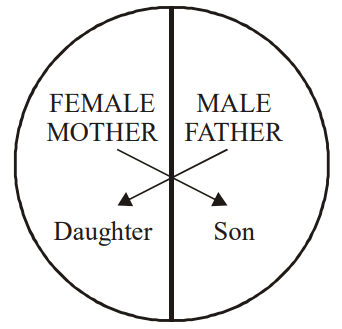 The diagram shows the trait passing from the mother to the son and from the father to the daughter, i.e., a criss-cross pattern of inheritance.
Such a pattern is characteristic of genes located on the X chromosome: a son receives his only X chromosome from his mother, while a father passes his X chromosome only to his daughters.
Haemophilia is a sex-linked (X-linked) recessive disorder and follows this pattern.
Thalassemia, phenylketonuria and sickle cell anaemia are autosomal recessive disorders; they are inherited equally by sons and daughters from both parents and do not show criss-cross inheritance.
Hence the condition that could be an example of this pattern is haemophilia. -
A woman with normal vision, but whose father was colour blind, marries a colour blind man. Suppose that the fourth child of this couple was a boy. This boy -Colour blindness is an X-linked recessive trait. Let $X^c$ carry the allele for colour blindness.
The woman has normal vision, but her father was colour blind, so she received $X^c$ from him. She is a carrier: $X^cX$.
The colour blind man is $X^cY$.
A son receives the Y chromosome from his father and one X chromosome from his mother.
The mother gives either $X^c$ or $X$ with equal probability, so each son has a 50 percent chance of being $X^cY$ (colour blind) and a 50 percent chance of being $XY$ (normal).
The birth order of the child has no effect on this probability.
A male has only one X chromosome, so he cannot be heterozygous for this trait.
So the boy may be colour blind or may have normal vision.
ABO blood groups – multiple alleles and co-dominance
-
Which of the following characteristics represent 'Inheritance of blood groups' in humans? a. Dominance b. Co-dominance c. Multiple allele d. Incomplete dominance e. Polygenic inheritance
ABO inheritance shows dominance, co-dominance and multiple alleles.
$I^AI^O$, $I^BI^O$ – dominant–recessive relationship $I^AI^B$ – co-dominance $I^A$, $I^B$ and $I^O$ – three different allelic forms of a gene (multiple allelism) So dominance, co-dominance and multiple alleles (a, b and c) are shown.
Mendelian disorders – thalassemia and sickle-cell anaemia
-
Thalassemia and sickle cell anemia are caused due to a problem in globin molecule synthesis. Select the correct statement.
Thalassemia = too little globin; sickle cell = faulty globin.
Thalassemia differs from sickle-cell anaemia in that the former is a quantitative problem of synthesising too few globin molecules, while the latter is a qualitative problem of synthesising an incorrectly functioning globin.
Genetic disorders
-
Pick out the correct statements. I. Haemophilia is a sex-linked recessive disease. II. Down's syndrome is due to aneuploidy. III. Phenylketonuria is an autosomal recessive gene disorder. IV. Sickle cell anaemia is an X-linked recessive gene disorder.
Sickle-cell anaemia is autosomal, not X-linked.
Sickle-cell anaemia is an autosomal recessive disorder caused by a point mutation replacing glutamic acid with valine in the haemoglobin β-chain, forming abnormal haemoglobin. So statement IV is wrong; the remaining three statements are correct.
Chromosomal aberrations – translocation
-
The mechanism that causes a gene to move from one linkage group to another is called:
Multiple alleles and codominance
-
A man with blood group 'A' marries a woman with blood group 'B'. What are all the possible blood groups of their offspring?
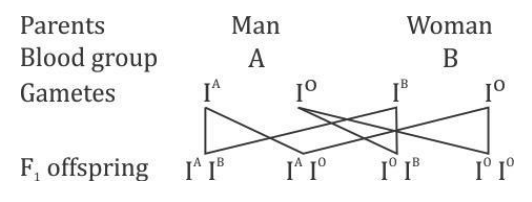
If the parents are heterozygous: man $I^Ai$, woman $I^Bi$.
Gametes: $I^A$, $i$ and $I^B$, $i$.
Offspring: $I^AI^B$ (AB), $I^Ai$ (A), $I^Bi$ (B), $ii$ (O).
So all four blood groups A, B, AB and O are possible.
Gene interaction
-
Fruit colour in squash is an example of:In summer squash a dominant allele (W) masks the effect of the colour gene, giving a 12 : 3 : 1 ratio. This is dominant epistasis.
Mendel's laws
-
Which one of the following cannot be explained on the basis of Mendel's Law of Dominance?The Law of Dominance states: (i) characters are controlled by discrete units called factors; (ii) factors occur in pairs; (iii) in a dissimilar pair of factors one member dominates (dominant) the other (recessive).
So the first three statements are all parts of the Law of Dominance.
The fact that alleles do not blend, and that both the parental characters are recovered as such in the $F_2$ generation, is explained by the Law of Segregation: the two factors of a pair separate during gamete formation so that each gamete receives only one.
Hence the statement about non-blending of alleles and recovery of both characters in $F_2$ cannot be explained by the Law of Dominance.
Sex-influenced and sex-limited traits
-
Select the incorrect statement from the following.Baldness is a sex-influenced trait, not a sex-limited one: the gene is autosomal and is present in both sexes, but it behaves as dominant in males and recessive in females because of the influence of male sex hormones.
Sex-limited traits are expressed in only one sex, e.g., milk production in females or beard in males.
Linkage: genes on the same chromosome tend to be inherited together and do not assort independently, so it is an exception to independent assortment (true).
Galactosemia is caused by the lack of an enzyme of galactose metabolism; it is an inborn error of metabolism (true).
Genetic drift, the random change in allele frequency, is significant in small populations (true).
Hence the incorrect statement is that baldness is a sex limited trait.
Biostatistics and Variation
-
If the mean and the median pertaining to a certain character of a population are of the same value, which of the following is most likely to occurThe mean is the arithmetic average of all the values, and the median is the middle value when the values are arranged in order.
In a normal distribution the values are distributed symmetrically on both sides of the central value, giving a bell-shaped curve.
Because of this symmetry, the mean, the median and the mode coincide in a normal distribution.
In a skewed curve the distribution is not symmetrical, and the mean is pulled towards the longer tail, so the mean and the median differ.
A bi-modal distribution has two peaks, and a T-shaped curve is not a frequency distribution of this kind.
Many characters of a population, such as height, show this kind of continuous variation.
So when the mean and the median have the same value, a normal distribution is most likely.
Extranuclear Inheritance
-
Genes for cytoplasmic male sterility in plants are generally located in -Cytoplasmic male sterility (CMS) is a condition in which the plant fails to produce functional pollen, while the female parts remain normal.
It is inherited only through the female parent (maternal inheritance), which shows that the responsible genes are outside the nucleus.
The genes responsible are located in the mitochondrial genome; rearrangements in mitochondrial DNA produce abnormal proteins that disturb pollen development.
CMS is very useful in hybrid seed production (for example in maize, sorghum and rice), because it avoids the laborious emasculation of flowers.
Nuclear 'restorer of fertility' genes can restore pollen production in the hybrid.
So the genes for cytoplasmic male sterility are generally located in the mitochondrial genome.
Special Chromosomes: Polytene Chromosomes
-
The salivary gland chromosomes in the dipteran larvae are useful in gene mapping because -The salivary gland cells of dipteran larvae (such as Drosophila and Chironomus) contain giant chromosomes called polytene chromosomes.
They are formed by endoreduplication: the chromosomes replicate repeatedly without any separation or cell division, so each chromosome comes to have about 1000 or more chromatids lying side by side.
Because the chromatids are aligned exactly, they show a characteristic pattern of dark bands and light interbands, and the bands correspond to particular genes.
Changes such as deletions, duplications and inversions can be seen directly in the band pattern, so the genes can be located (mapped) cytologically.
The great length and ease of staining are consequences of this polyteny; the basic reason is endoreduplication.
So they are useful in gene mapping because they have endoreduplicated chromosomes.
Gamete Formation and Independent Assortment
-
A male human is heterozygous for autosomal genes A and B and is also hemizygous for hemophilic gene h. What proportion of his sperms will be abh :-Genotype of the man: Aa Bb $X^hY$ (heterozygous for A and B, and hemizygous for h, i.e. one $X^h$ and a Y).
Assuming independent assortment, each gene pair separates independently into the sperms.
Probability of a sperm getting a $= \dfrac{1}{2}$ (A or a)
Probability of getting b $= \dfrac{1}{2}$ (B or b)
Probability of getting the X with h $= \dfrac{1}{2}$ (the other half of the sperms carry Y)
Probability of an abh sperm $= \dfrac{1}{2} \times \dfrac{1}{2} \times \dfrac{1}{2} = \dfrac{1}{8}$
The man forms $2^3 = 8$ types of sperms in equal proportions (ABh, ABY, Abh, AbY, aBh, aBY, abh and abY), and abh is one of them.
So $\dfrac{1}{8}$ of his sperms will be abh.
Inheritance of Three Genes
-
A self-fertilizing trihybrid plant forms :-A trihybrid plant is heterozygous for three genes, e.g. AaBbCc.
Number of types of gametes $= 2^n$, where n is the number of heterozygous gene pairs: $2^3 = 8$ (ABC, ABc, AbC, Abc, aBC, aBc, abC, abc).
On self-fertilisation, each of the 8 types of male gametes can fuse with each of the 8 types of female gametes.
Number of zygote combinations $= 8 \times 8 = 64$ (the squares of the Punnett square).
(These give 27 different genotypes and 8 phenotypes in the ratio 27 : 9 : 9 : 9 : 3 : 3 : 3 : 1.)
So the plant forms 8 different gametes and 64 different zygotes.
Dihybrid Cross and Test Cross
-
In a plant red fruit (R) is dominant over yellow fruit (r) and tallness (T) is dominant over shortness (t). If a plant with RRTt genotype is crossed with a plant that is rrttGametes of RRTt: RT and Rt (in equal proportion, 1/2 each).
Gametes of rrtt: rt only.
Offspring: RT $\times$ rt = RrTt (red, tall); Rt $\times$ rt = Rrtt (red, short).
So all offspring have red fruit (Rr), because the RRTt parent is homozygous for red.
For height, Tt $\times$ tt gives 1/2 Tt (tall) and 1/2 tt (short).
Ratio: 1 red tall : 1 red short.
So 50% of the offspring will be tall with red fruit.
Cytoplasmic (Maternal) Inheritance
-
One of the parents of a cross has a mutation in its mitochondria. In that cross, that parent is taken as a male. During segregation of $F_2$ progenies that mutation is found in -Mitochondrial DNA is inherited through the cytoplasm.
During fertilisation, the egg contributes almost all of the cytoplasm (and mitochondria) to the zygote. The sperm contributes mainly its nucleus; its few mitochondria are lost or destroyed.
So mitochondrial traits show maternal (uniparental) inheritance: they are passed only through the female parent.
Here the parent with the mitochondrial mutation is the male, so its mitochondria are not transmitted to the $F_1$, and therefore not to the $F_2$ either.
So the mutation is found in none of the progenies.
Mutation: Induced Mutations
-
Which of the following discoveries resulted in a Nobel Prize : -H. J. Muller showed in 1927, working with Drosophila, that X-rays induce mutations, including sex-linked recessive lethal mutations, which he detected with his ClB method.
For this discovery of the production of mutations by X-ray irradiation, Muller received the Nobel Prize in Physiology or Medicine in 1946.
Cytoplasmic inheritance (Correns) and recombination of linked genes as such were not awarded Nobel Prizes; genetic engineering is a technology rather than a single discovery.
So the discovery that X-rays induce sex-linked recessive lethal mutations resulted in a Nobel Prize.
Cytoplasmic Inheritance
-
Genes for cytoplasmic male sterility in plants are generally located in : -Cytoplasmic male sterility (CMS) is the inability of a plant to produce functional pollen, inherited through the female parent (maternally).
It is caused by changes (rearrangements forming new open reading frames) in the mitochondrial genome, which affect the energy supply needed for pollen development.
Nuclear restorer (Rf) genes can restore fertility.
CMS is widely used in producing hybrid seeds (e.g. maize, rice, sorghum), as it removes the need for manual emasculation.
So genes for cytoplasmic male sterility are generally located in the mitochondrial genome. -
Extranuclear inheritance occurs in : -In killer strains of Paramecium aurelia, the killer trait is due to kappa particles, which are present in the cytoplasm (they are symbiotic bacteria).
Kappa particles produce a toxin (paramecin) that kills sensitive strains. They are inherited through the cytoplasm, not through nuclear genes, though a nuclear gene K is needed to maintain them (studied by Sonneborn).
So extranuclear (cytoplasmic) inheritance occurs in killer Paramecium.
Sex-limited and Sex-influenced Traits
-
Pattern baldness, moustaches and beard in human males are examples of : -Sex-limited traits are controlled by autosomal genes, but they are expressed in only one sex, because their expression depends on the sex hormones.
The genes for beard and moustache growth are present in both men and women, but they are expressed only in males under the influence of testosterone.
Pattern baldness is also autosomal and expressed mainly in males because of the male hormones (strictly it is described as sex-influenced, since it is dominant in males and recessive in females).
Sex-linked traits, such as haemophilia and colour blindness, are due to genes on the X chromosome.
So these are examples of sex limited traits.
Sex Determination: Genic Balance
-
In Drosophila, the sex is determined by : -In Drosophila, sex is determined by the genic balance mechanism proposed by C. B. Bridges.
Sex depends on the ratio of the number of X chromosomes (X) to the number of sets of autosomes (A), i.e. the X/A ratio. The Y chromosome does not decide sex (it is needed only for male fertility).
X/A = 1 (e.g. XX + 2A): female. X/A = 0.5 (e.g. XY + 2A): male. X/A between 0.5 and 1: intersex. X/A greater than 1: metafemale; less than 0.5: metamale.
Determination by fertilised or unfertilised egg (haplodiploidy) occurs in honeybees.
So in Drosophila, sex is determined by the ratio of the number of X chromosomes to the sets of autosomes.
Linkage Maps
-
There are three genes a, b and c. The percentage of crossing over between a and b is 20%, b and c is 28% and a and c is 8%. What is the sequence of genes on chromosomeMap distance is proportional to the frequency of crossing over: a–b = 20 units, b–c = 28 units, a–c = 8 units.
The largest distance (b–c = 28) is between the two genes at the ends.
The third gene, a, lies between them: b–a + a–c = 20 + 8 = 28 = b–c.
[add image: linkage map b ---20--- a --8-- c]
So the sequence of genes on the chromosome is b, a, c.
X-linked Dominant Inheritance
-
A diseased man marries a normal woman. They get three daughters and five sons. All the daughters were diseased and sons were normal. The gene of this disease is : -A father gives his X chromosome to all his daughters and his Y chromosome to all his sons.
If the disease gene is on the X chromosome and is dominant, the affected father ($X^AY$) passes $X^A$ to every daughter, so all daughters are affected, even with a normal mother ($X^aX^a$).
Sons receive the father's Y and the mother's normal X, so all sons are normal.
Cross: $X^AY \times X^aX^a \rightarrow X^AX^a$ (all daughters affected) and $X^aY$ (all sons normal).
This exactly matches the family. An autosomal or X-linked recessive gene would not give this pattern with a normal mother.
So the gene of this disease is sex linked dominant.
Molecular Basis of Mendel's Traits
-
Mendel obtained wrinkled seeds in pea due to deposition of sugars instead of starch. It was due to which enzyme : -The R gene of pea codes for starch branching enzyme (SBE1), which converts amylose into amylopectin.
In rr plants, a mutation (a transposon insertion) makes this enzyme non-functional. Less starch is made and more sugar accumulates in the seed.
The extra sugar draws in water by osmosis while the seed develops; when the seed matures and dries, it loses this water and shrinks, so it becomes wrinkled.
So wrinkled seeds were due to the absence of the starch branching enzyme.
Gene Interaction: Complementary Genes
-
Ratio of complementary genes is : -Complementary genes are two non-allelic dominant genes that produce a character only when both are present together (e.g. purple flower colour in sweet pea, studied by Bateson and Punnett).
In the $F_2$ of a dihybrid cross: 9 $A\_B\_$ show the character, while 3 $A\_bb$ + 3 $aaB\_$ + 1 aabb (= 7) do not.
So the ratio is 9 : 7.
(9 : 3 : 4 is recessive epistasis and 12 : 3 : 1 is dominant epistasis.)
Linkage: Test Cross
-
A and B genes are linked. What shall be genotype of progeny in a cross between AB/ab and ab/ab : -With complete linkage, the heterozygote AB/ab forms only parental gametes: AB and ab.
The homozygous recessive parent ab/ab forms only ab gametes.
Progeny: AB $\times$ ab = AB/ab (AaBb) and ab $\times$ ab = ab/ab (aabb), in a 1 : 1 ratio.
(If crossing over occurred, a few recombinants Aabb and aaBb would also appear.)
So the progeny genotypes are AaBb and aabb.
That is every question in Principles of Inheritance and Variation for this filter.
Want a score?
Answers here are not saved. Practise as a test to be marked and see your progress.
Practise as a test