Biology

Ecosystem

85 questions from 36 papers, each with its answer.

  • 85 questions
  • 36 papers
  • 2.41% of Biology
Showing Remove filter: Medium 28 of 85 questions

Decomposition

3 questions Practise Decomposition
  1. 1 2023 Medium
    Identify the correct statements: A. Detritivores perform fragmentation B. The humus is further degraded by some microbes during mineralization. C. Water soluble inorganic nutrients go down into the soil and get precipitated by a process called leaching. D. The detritus food chain begins with living organisms. E. Earthworms break down detritus into smaller particles by a process called catabolism. Choose the correct answer from the options given below:
  2. 2 2022 Medium
    Given below are two statements: Statement I: Decomposition is a process in which the detritus is degraded into simpler substances by microbes. Statement II: Decomposition is faster if the detritus is rich in lignin and chitin In the light of the above statements, choose the correct answer from the options given below.
  3. 3 2008 AIPMT Medium
    The slow rate of decomposition of fallen logs in nature is due to their:

Nutrient Cycling – Phosphorus Cycle

1 question
  1. 4 2022 Medium
    Which one of the following will accelerate phosphorus cycle?

Ecological Pyramids

3 questions Practise Ecological Pyramids
  1. 5 2026 Medium
    Ecological pyramids represent the relationship between the organisms at different trophic levels and they are generally inverted for:
  2. 6 2012 AIPMT-PRE Medium
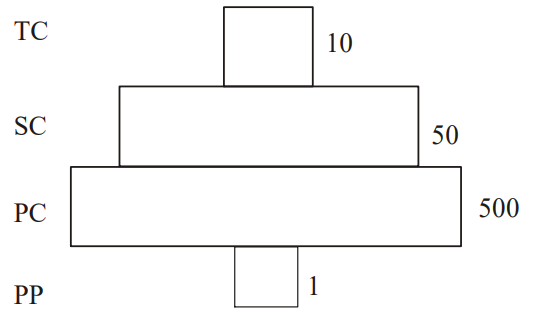
    Given below is an imaginary pyramid of numbers. What could be one of the possibilities about certain organisms at some of the different levels?
  3. 7 2010 AIPMT-MAINS Medium
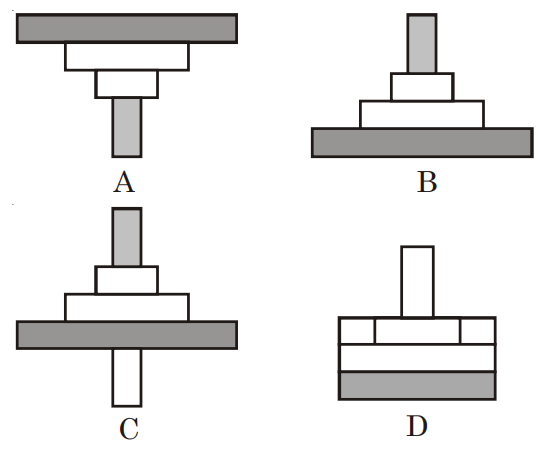
    Which of the following representations shows the pyramid of numbers in a forest ecosystem?

Primary and secondary productivity

1 question
  1. 8 2026 Medium
    Match List I with List II:

    Pick the matching item from Column II for each row.

    Column I

    • i. Productivity
    • ii. Net primary productivity
    • iii. Gross primary productivity
    • iv. Secondary productivity

    Column II

    • a. Gross primary productivity minus respiration losses
    • b. Rate of formation of new organic matter by consumers
    • c. Rate of biomass production
    • d. Rate of production of organic matter during photosynthesis

Decomposition process

1 question
  1. 9 2026 Medium
    Match List I with List II:

    Pick the matching item from Column II for each row.

    Column I

    • i. Decomposition
    • ii. Detritus
    • iii. Mineralisation
    • iv. Humification

    Column II

    • a. Accumulation of dark coloured amorphous colloidal substance
    • b. Release of inorganic nutrients by the activity of microbes in soil
    • c. Breaking down of complex organic matter into inorganic substances
    • d. Dead remains of plants and animals including fecal matter

Pyramid of energy and the 10 percent law

1 question
  1. 10 2024 Re-NEET Medium
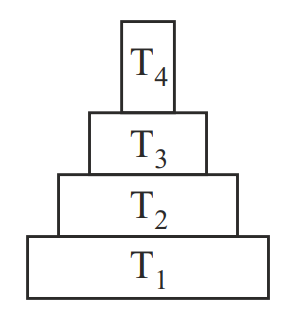
    Consider the pyramid of energy of an ecosystem given below

    is equivalent to 1000 J, what is the value at $T_1$?
Limitations of ecological pyramids

1 question
  1. 11 2024 Re-NEET Medium
    Which one of the following is not a limitation of ecological pyramids?

Ecological pyramids - energy, biomass, numbers

1 question
  1. 12 2020 Phase-2 Medium
    Which of the following statements is incorrect?

Biogeochemical cycles - phosphorus cycle

1 question
  1. 13 2020 Phase-2 Medium
    Which of the following statements is incorrect regarding the phosphorus cycle?

Factors affecting rate of decomposition

1 question
  1. 14 2020 Phase-2 Medium
    The rate of decomposition is faster in the ecosystem due to following factors EXCEPT:

Types of ecological succession

1 question
  1. 15 2023 Manipur Medium
    Match List-I with List-II.

    Pick the matching item from Column II for each row.

    Column I

    • A. Hydrarch succession
    • B. Xerarch succession
    • C. Ecological succession
    • D. Secondary succession

    Column II

    • I. Gradual change in the species composition
    • II. Faster and climax reached quickly
    • III. Lichens to mesic conditions
    • IV. Phytoplankton to mesic conditions

Eutrophication

1 question
  1. 16 2023 Manipur Medium
    Nitrates and phosphates flowing from agricultural farms into water bodies are a significant cause of:

Nutrient cycling terminology

1 question
  1. 17 2023 Manipur Medium
    The amount of nutrients such as carbon, nitrogen, potassium and calcium present in the soil at any given time is referred to as:

Ecological succession

3 questions Practise Ecological succession
  1. 18 2012 AIPMT-MAINS Medium
    The second stage of hydrosere is occupied by plants like
  2. 19 2011 AIPMT-PRE Medium
    Which one of the following statements is correct for secondary succession?
  3. 20 2009 AIPMT Medium
    The correct sequence of plants in a hydrosere is

Carbon cycle, PAR and productivity

1 question
  1. 21 2022 Phase 2 Medium
    Match List - I with List - II. Choose the correct answer.

    Pick the matching item from Column II for each row.

    Column I

    • A. Carbon dissolved
    • B. Annual fixation of Carbon through Photosynthesis
    • C. PAR captured by Plants
    • D. Productivity of oceans

    Column II

    • I. 55 billion tons
    • II. 71%
    • III. $4\times10^{13}$ kg
    • IV. 2 to 10%

Food chains

1 question
  1. 22 2015 AIPMT-II Medium
    Most animals that live in deep oceanic waters are:

Ecological terms

1 question
  1. 23 2014 AIPMT Medium
    Match the following and select the correct option:

    Pick the matching item from Column II for each row.

    Column I

    • a. Earthworm
    • b. Succession
    • c. Ecosystem service
    • d. Population growth

    Column II

    • i. Pioneer species
    • ii. Detritivore
    • iii. Natality
    • iv. Pollination

Phosphorus cycle

1 question
  1. 24 2014 AIPMT Medium
    Given below is a simplified model of phosphorus cycling in a terrestrial ecosystem with four blanks (A-D). Identify the blanks: [add image]

Food web

1 question
  1. 25 2012 AIPMT-MAINS Medium
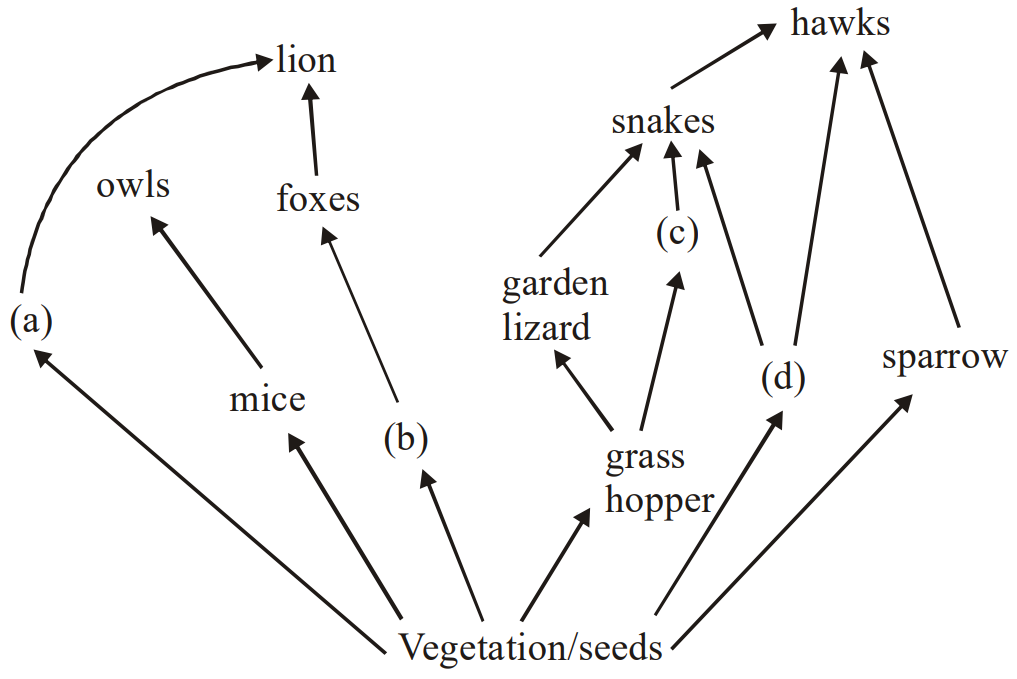
    Identify the likely organisms (a), (b), (c) and (d) in the food web shown below.

Trophic levels

1 question
  1. 26 2009 AIPMT Medium
    Which one of the following types of organisms occupy more than one trophic level in a pond ecosystem?

Food Chains and Energy Flow

1 question
  1. 27 2008 AIPMT Medium
    Consider the following statements concerning food chains:
    (i) Removal of 80% tigers from an area resulted in greatly increased growth of vegetation
    (ii) Removal of most of the carnivores resulted in an increased population of deers
    (iii) The length of food chains is generally limited to 3-4 trophic levels due to energy loss
    (iv) The length of food chains may vary from 2 to 8 trophic levels
    Which two of the above statements are correct?

Ecological Stability and Resilience

1 question
  1. 28 2004 AIPMT Medium
    An ecosystem which can be easily damaged but can recover after some time if damaging effect stops will be having -

That is every question in Ecosystem for this filter.

Show all 85 questions Next: Biodiversity and Conservation

Want a score?

Answers here are not saved. Practise as a test to be marked and see your progress.

Practise as a test