Looking for classes? Ksquare Career Institute, Bengaluru →

Biology
Mineral Nutrition
63 questions from 32 papers, each with its answer.
- 63 questions
- 32 papers
- 1.79% of Biology
Role of Micronutrients
-
Match List-I with List-II
Pick the matching item from Column II for each row.
Column I
- A. Iron
- B. Zinc
- C. Boron
- D. Molybdenum
Column II
- I. Synthesis of auxin
- II. Component of nitrate reductase
- III. Activator of catalase
- IV. Cell elongation and differentiation
Correct answer: A → III, B → I, C → IV, D → II
Iron activates catalase, zinc is needed for auxin synthesis, boron for cell elongation, and molybdenum for nitrate reductase.
Iron: It activates catalase enzyme, and is essential for the formation of chlorophyll. Zinc: It is needed in the synthesis of auxin. Boron: It is required for uptake and utilisation of $Ca^{2+}$, cell elongation, cell differentiation, membrane functioning, pollen germination and carbohydrate translocation. Molybdenum: It is a component of several enzymes, including nitrogenase and nitrate reductase. -
Match the following concerning essential elements and their functions in plants:
Pick the matching item from Column II for each row.
Column I
- A. Iron
- B. Zinc
- C. Boron
- D. Manganese
Column II
- I. Photolysis of water
- II. Pollen germination
- III. Required for chlorophyll biosynthesis
- IV. IAA biosynthesis
Correct answer: A → III, B → IV, C → II, D → I
-
The deficiencies of micronutrients, not only affect growth of plants but also vital functions such as photosynthetic and mitochondrial electron flow. Among the list given below, which group of three elements shall affect most, both photosynthetic and mitochondrial electron transport -Iron (Fe) is a constituent of cytochromes and ferredoxin (iron-sulphur proteins), which carry electrons in both the photosynthetic and the mitochondrial electron transport chains.
Copper (Cu) is a constituent of plastocyanin in the photosynthetic chain and of cytochrome oxidase (complex IV) in the mitochondrial chain.
Manganese (Mn) is essential for the splitting of water (photolysis) in photosystem II, which supplies electrons to the photosynthetic chain, and it activates several respiratory enzymes.
So a deficiency of Cu, Mn and Fe affects both photosynthetic and mitochondrial electron flow the most.
Ca, K and Na are not electron carriers, and Co, Ni and Mo have other roles (for example Mo in nitrogenase and nitrate reductase).
So the group is Cu, Mn, Fe.
Role of Macro- and Micronutrients
-
Match List-I with List-II.
Pick the matching item from Column II for each row.
Column I
- A. Manganese
- B. Magnesium
- C. Boron
- D. Iron
Column II
- I. Activates the enzyme catalase
- II. Required for pollen germination
- III. Activates enzymes of respiration
- IV. Functions in splitting of water during photosynthesis
Correct answer: A → IV, B → III, C → II, D → I
Metabolism of Nitrogen – Nitrogen Cycle
-
Match Column - I with Column - II.
Pick the matching item from Column II for each row.
Column I
- A. Nitrococcus
- B. Rhizobium
- C. Thiobacillus
- D. Nitrobacter
Column II
- I. Denitrification
- II. Conversion of ammonia to nitrite
- III. Conversion of nitrite to nitrate
- IV. Conversion of atmospheric nitrogen to ammonia
Correct answer: A → II, B → IV, C → I, D → III
-
$Thiobacillus$ is a group of bacteria helpful in carrying out:
Metabolism of Nitrogen – Nitrogen Fixation
-
The product(s) of reaction catalyzed by nitrogenase in root nodules of leguminous plants is/are:$N_2 + 8e^- + 8H^+ + 16ATP \xrightarrow{nitrogenase,\ Mg^{2+}} 2NH_3 + H_2 + 16ADP + 16P_i$ So the products are ammonia and hydrogen.
Mycorrhizal Association
-
$Pinus$ seed cannot germinate and establish without fungal association. This is because:
Biological nitrogen fixation - transport form
-
In Glycine max, the product of biological nitrogen fixation is transported from the root nodules to other parts asIn Glycine max (soybean), the fixed nitrogen is transported from the root nodules to the rest of the plant in the form of ureides.
Role of mineral elements
-
Which of the following elements helps in maintaining the structure of ribosomes?Magnesium plays a role in maintaining the structural integrity of ribosomes (holding ribosomal subunits together), in addition to being a component of chlorophyll and an activator of many enzymes.
Mobility of mineral elements in plants
-
Which of the following mineral ion is not remobilized in plants?Calcium is a relatively immobile mineral element in plants and is generally not remobilized from older to younger tissues, unlike potassium, nitrogen, and phosphorus, which are readily mobilized.
Nitrogen cycle - roles of nitrifying and denitrifying bacteria
-
Match Column-I with Column-II.
Pick the matching item from Column II for each row.
Column I
- A. Nitrococcus
- B. Rhizobium
- C. Thiobacillus
- D. Nitrobacter
Column II
- I. Denitrification
- II. Conversion of ammonia to nitrite
- III. Conversion of nitrite to nitrate
- IV. Conversion of atmospheric nitrogen to ammonia
Correct answer: A → II, B → IV, C → I, D → III
Nitrococcus converts ammonia to nitrite (A-II); Rhizobium converts atmospheric nitrogen to ammonia (B-IV); Thiobacillus is involved in denitrification (C-I); Nitrobacter converts nitrite to nitrate (D-III).
Micronutrients – iron
-
In which of the following forms is iron absorbed by plants?
As per NCERT, iron is absorbed as ferric ions.
Iron is absorbed by plants in the form of ferric ions (according to NCERT). Note: the source key marks 'Ferric' as per NCERT but notes that plants actually absorb iron in both forms, $Fe^{2+}$ and $Fe^{3+}$ (preferably $Fe^{2+}$).
Biological nitrogen fixation
-
Select the mismatch:
$Rhodospirillum$ is a free-living N-fixer, not a mycorrhizal fungus.
$Rhodospirillum$ is an anaerobic, free-living nitrogen fixer. Mycorrhiza is a symbiotic association between fungi and roots of higher plants. So '$Rhodospirillum$ – Mycorrhiza' is the mismatch. -
Which of the following is a symbiotic nitrogen fixer?$Frankia$ is a nitrogen-fixing microbe (an actinomycete) that produces nitrogen-fixing nodules on the roots of non-leguminous plants such as $Alnus$; it is a symbiotic nitrogen fixer.
$Azotobacter$ is a free-living aerobic nitrogen fixer of the soil.
$Glomus$ is a mycorrhizal fungus that helps in phosphorus absorption; it does not fix nitrogen.
$Azolla$ is a water fern; it does not fix nitrogen itself (the cyanobacterium $Anabaena$ living in its leaves does).
Hence the symbiotic nitrogen fixer is $Frankia$. -
Which of the following is a flowering plant with nodules containing filamentous nitrogen-fixing micro-organismCasuarina equisetifolia is a flowering plant (angiosperm), although its needle-like branchlets with scale leaves make it look like a pine; it is often called the Australian pine, she-oak or horsetail tree.
Its roots bear nodules that contain Frankia, a filamentous nitrogen-fixing actinomycete.
So it is a flowering plant with nodules containing a filamentous nitrogen-fixing micro-organism.
Crotalaria juncea (sunn hemp) and Cicer arietinum (gram) are legumes; their root nodules contain Rhizobium, which is a rod-shaped bacterium and not filamentous.
Cycas revoluta has coralloid roots containing the filamentous cyanobacteria Anabaena and Nostoc, but Cycas is a gymnosperm and not a flowering plant.
So the answer is Casuarina equisetifolia. -
If by radiation all nitrogenase enzyme are inactivated, then there will be no :-Nitrogenase is the enzyme that reduces atmospheric nitrogen to ammonia in biological nitrogen fixation:
$N_2 + 8e^- + 8H^+ + 16ATP \xrightarrow{nitrogenase} 2NH_3 + H_2 + 16ADP + 16P_i$
In legumes, nitrogen fixation takes place in the root nodules formed by Rhizobium, where nitrogenase is protected from oxygen by leghaemoglobin.
If all nitrogenase is inactivated, the fixation of nitrogen in legumes will stop.
Conversion of nitrate to nitrite is done by nitrate reductase, and conversion of ammonium to nitrate in soil (nitrification) is done by Nitrosomonas and Nitrobacter. These processes do not need nitrogenase, so they will continue.
So, as per the answer key, there will be no fixation of nitrogen in legumes. (Biological fixation of atmospheric nitrogen by free-living microbes would also stop, but nitrogen is still fixed by lightning and industrial processes, which do not use nitrogenase.)
Role of calcium
-
Which is essential for the growth of root tip?
Essential elements
-
Which one of the following is wrong statement?Phosphorus is a constituent of cell membranes, certain proteins, all nucleic acids and nucleotides.
The statement reverses this (certain nucleic acids and all proteins), so it is wrong.
The other three statements are correct.
Mineral nutrition and transport
-
Which one of the following is correctly matched?Bakanae (foolish seedling) disease of rice was studied by E. Kurosawa; Skoog worked on cytokinins.
Passive transport does not use ATP.
The apoplast is the system of cell walls and intercellular spaces; plasmodesmata belong to the symplast.
Potassium is a readily mobilised element in plants, so this is the pair accepted as correctly matched.
Nitrogen cycle
-
Study the cycle shown below and select the option which gives correct words for all the four blanks A, B, C and D.
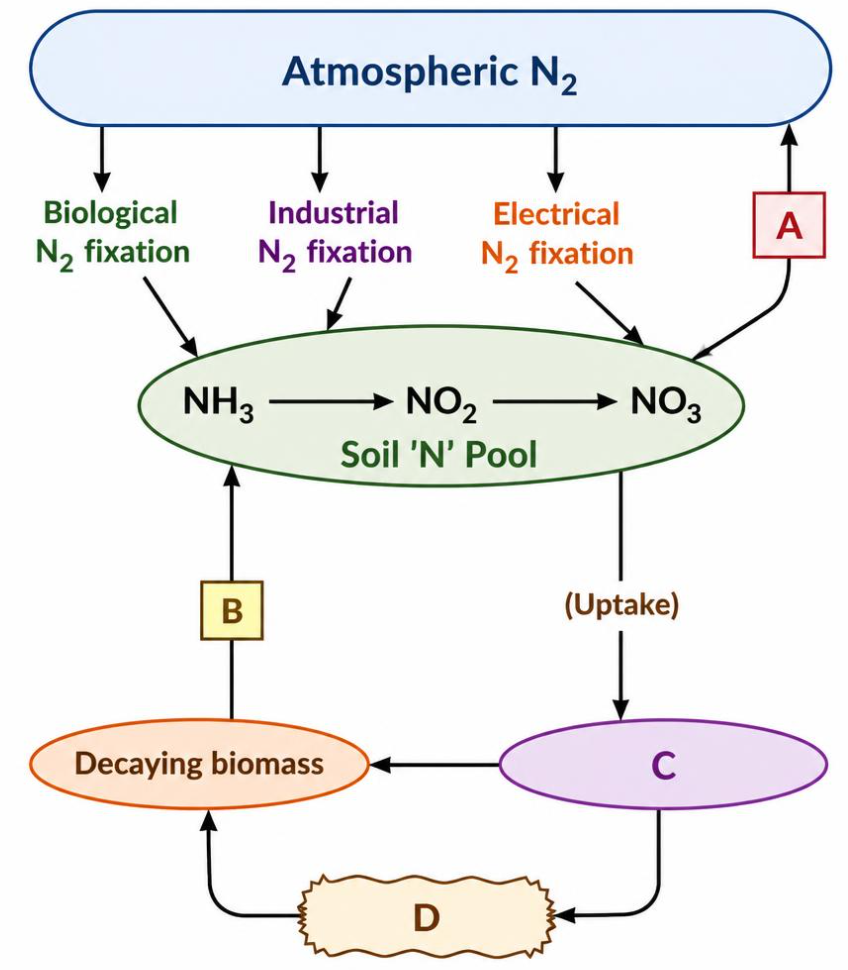 The figure is the nitrogen cycle, showing atmospheric $N_2$, the soil nitrogen pool ($NH_3 \rightarrow NO_2^- \rightarrow NO_3^-$) and the biomass.
A is the arrow from nitrate in the soil back to atmospheric $N_2$: reduction of nitrate to nitrogen by bacteria such as $Pseudomonas$ and $Thiobacillus$ is denitrification.
B is the arrow from decaying biomass to $NH_3$: decomposition of the organic nitrogen of dead plants and animals into ammonia is ammonification.
C receives nitrate/ammonia from the soil by 'uptake': these are the plants.
D is the group that obtains its nitrogen from plants and returns it to the decaying biomass: the animals.
Hence A – denitrification, B – ammonification, C – plants, D – animals.
Deficiency symptoms of essential elements
-
Farmers in a particular region were concerned that pre-mature yellowing of leaves of a pulse crop might cause decrease in the yield. Which treatment could be most beneficial to obtain maximum seed yield ?Premature yellowing of leaves is chlorosis, i.e. the loss or non-formation of chlorophyll.
Magnesium is a constituent of the chlorophyll molecule, and iron is essential for the formation of chlorophyll (it activates the enzymes of chlorophyll synthesis).
Deficiency of either element causes chlorosis, which lowers photosynthesis and hence the seed yield.
Applying iron and magnesium promotes the synthesis of chlorophyll, keeps the leaves green and photosynthetically active, and so gives the maximum seed yield.
A pulse crop fixes its own nitrogen through root nodules, so nitrogenous fertiliser is not the main need.
Frequent irrigation does not correct chlorosis, and 2,4,5-T is a herbicide (defoliant) that would damage the crop.
So the most beneficial treatment, as given in the answer key, is the application of iron and magnesium to promote synthesis of chlorophyll. -
When the plants are grown in magnesium deficient but urea rich soil, the symptoms expressed are :Magnesium is the central atom of the chlorophyll molecule.
Even if nitrogen (from urea) is plentiful, chlorophyll cannot be made without magnesium. So the leaves lose their green colour and turn yellow (chlorosis), first in the older leaves, because Mg is mobile and moves to the young leaves.
So the plants show yellowish leaves.
Role of Macronutrients
-
Sulphur is an important nutrient for optimum growth and productivity in -Plants obtain sulphur in the form of sulphate ($SO_4^{2-}$).
Sulphur is present in the amino acids cysteine and methionine, and is a constituent of several coenzymes, vitamins (thiamine, biotin, coenzyme A) and ferredoxin.
Oilseed crops have a particularly high requirement of sulphur, because it is needed for the synthesis of oil and of sulphur-containing compounds.
For example, the pungent oils of mustard and other crucifers (glucosinolates) contain sulphur.
An adequate supply of sulphur increases both the seed yield and the oil content of oilseed crops such as mustard, groundnut and sunflower.
Pulses also respond to sulphur, but its importance for productivity is greatest in oilseeds.
So sulphur is an important nutrient for optimum growth and productivity in oilseed crops.
Role of Nitrogen
-
In which one of the following nitrogen is not a constituent : -Bacteriochlorophyll, like chlorophyll, has a porphyrin ring made of four pyrrole rings, each containing nitrogen.
Invertase and pepsin are enzymes, i.e. proteins, built of amino acids, which contain nitrogen.
An idioblast is not a molecule but a type of cell: an isolated cell that differs from the surrounding cells in shape, size or content (e.g. cells containing crystals of calcium oxalate, tannins or oil).
So idioblast is the item in which nitrogen is not listed as a constituent (it is a cell, not a nitrogen-containing compound).
Deficiency Symptoms of Elements
-
Gray spots of oat are caused by deficiency of : -Grey speck (gray spot) disease of oats is a physiological disorder caused by manganese deficiency. Grey-brown spots and streaks appear on the leaves.
Manganese activates many enzymes of photosynthesis, respiration and nitrogen metabolism, and is needed for the splitting of water in photosynthesis.
Other examples: marsh spot of peas is also due to Mn deficiency; little leaf is due to Zn deficiency; reclamation disease is due to Cu deficiency; and chlorosis of young leaves is due to Fe deficiency.
So gray spots of oat are caused by deficiency of Mn.
That is every question in Mineral Nutrition for this filter.
Want a score?
Answers here are not saved. Practise as a test to be marked and see your progress.
Practise as a test