Looking for classes? Ksquare Career Institute, Bengaluru →

Biology
Human Reproduction
116 questions from 38 papers, each with its answer.
- 116 questions
- 38 papers
- 3.29% of Biology
Pregnancy and Embryonic Development
-
Find the correct statements:
A. In human pregnancy, the major organ systems are formed at the end of 12 weeks.
B. In human pregnancy the major organ systems are formed at the end of 8 weeks.
C. In human pregnancy heart is formed after one month of gestation.
D. In human pregnancy, limbs and digits develop by the end of second month.
E. In human pregnancy the appearance of hair usually observed in the fifth month.
Choose the correct answer from the options given below:Statements A, C, D, and E are correct embryological milestones from NCERT.
During human gestation: Heart is formed after 1 month (C); limbs and digits develop by end of 2nd month (D); major organ systems and external genitalia are formed by end of 12 weeks/first trimester (A); first movements and hair on head appear during the 5th month (E). Thus, A, C, D, and E are correct.
Gametogenesis (Spermatogenesis vs Oogenesis)
-
Consider the following:
A. The reductive division for the human female gametogenesis starts earlier than that of the male gametogenesis.
B. The gap between the first meiotic division and the second meiotic division is much shorter for males compared to females.
C. The first polar body is associated with the formation of the primary oocyte.
D. Luteinizing Hormone (LH) surge leads to disintegration of the endometrium and onset of menstrual bleeding.
Choose the correct answer from the options given below:A and B are true: female meiosis starts in fetal life; gap between meiosis I and II spans years in females vs hours/days in males.
Oogenesis initiates embryonic life before birth, whereas spermatogenesis starts only at puberty (A is true). In females, meiosis I arrests in prophase I until ovulation decades later, so the interphase gap between meiosis I and II is dramatically prolonged compared to males (B is true). First polar body forms during secondary oocyte formation, and LH surge triggers ovulation, not endometrial breakdown.
Menstrual Cycle
-
Which of the following events is not associated with ovulation in human female?
-
Which of the following is the correct matching of the events occurring during menstrual cycle?After ovulation the remaining part of the Graafian follicle changes into the corpus luteum, which secretes large amounts of progesterone essential for maintaining the endometrium. This is the luteal or secretory phase. So this matching is correct.
Menstruation is due to the breakdown of the endometrial lining of the uterus and its blood vessels; the myometrium (the muscular layer) does not break down.
At ovulation LH and FSH do attain peak levels, but progesterone is not falling sharply then; it rises afterwards, when the corpus luteum forms.
In the proliferative (follicular) phase it is the endometrium that regenerates, not the myometrium.
Hence the correct matching is development of corpus luteum – secretory phase and increased secretion of progesterone. -
Which one of the following statements is incorrect about menstruation?Menstrual fluid consists of blood, mucus and the broken down endometrial tissue of the uterus.
Menstrual blood does not clot easily. The fibrin formed is broken down by the enzyme fibrinolysin (plasmin) released from the degenerating endometrium, so the fluid normally stays liquid.
So the statement that the menstrual fluid can easily clot is incorrect.
The first menstruation, which begins at puberty, is called menarche; this statement is correct.
About 40 ml of blood (roughly 30 to 80 ml) is lost in a normal menstruation; this statement is correct.
At menopause the ovaries stop responding and oestrogen falls, so the negative feedback on the pituitary is removed and the gonadotropins (FSH and LH) rise sharply; this statement is also correct.
Hormonal Regulation of Gametogenesis (FSH action)
-
Assertion A: FSH acts upon ovarian follicles in female and Leydig cells in male.Reason: Reason R: Growing ovarian follicles secrete estrogen in female while interstitial cells secrete androgen in male human being.Assertion: In males, FSH acts on the Sertoli cells (not Leydig cells) and stimulates secretion of factors that help in spermiogenesis; LH acts on the Leydig cells. So the Assertion is false. Reason: Growing ovarian follicles secrete estrogen in females, while interstitial (Leydig) cells secrete androgens in males – true. So A is false but R is true.
Male and Female Reproductive Systems
-
Given below are two statements: Statement I: Vas deferens receives a duct from seminal vesicle and opens into urethra as the ejaculatory duct. Statement II: The cavity of the cervix is called cervical canal which along with vagina forms birth canal. In the light of the above statements, choose the correct answer from the options given below:
The ejaculatory duct forms from the vas deferens and seminal vesicle duct; the cervical canal and vagina form the birth canal.
Each ejaculatory duct is formed by the union of the duct from the seminal vesicle and the vas deferens. They open into the prostatic urethra. Cervical canal (interior of the cervix) along with vagina forms the birth canal.
Menstrual Cycle and Implantation
-
Endometrium is necessary for implantation of blastocyst.Reason: In the absence of fertilization, the corpus luteum degenerates that causes disintegration of endometrium.
Both are true, but the corpus luteum degeneration does not explain why the endometrium is needed for implantation.
Both assertion and reason are correct but reason is not the correct explanation why endometrium is necessary for implantation of blastocyst. The attachment of a blastocyst to the endometrium is called the implantation. It occurs about 6 days after fertilisation. The endometrium is necessary for implantation as it serves as a key place not only for supporting foetal growth through supplementation of oxygen and nutrients but also for protecting the embryo and later the foetus from microbial invasion during pregnancy. If fertilisation does not occur, the levels of progesterone and estrogens decline due to degeneration of the corpus luteum. Withdrawal of progesterone and estrogens causes disintegration of the endometrium leading to menstruation.
Gametogenesis – Spermatogenesis
-
Given below are two statements: Statement I: The release of sperms into the seminiferous tubules is called spermiation Statement II: Spermiogenesis is the process of formation of sperms from spermatogonia In the light of the above statements, choose the most appropriate answer from the options given below.
Fertilisation
-
Receptors for sperm binding in mammals are present on:
Parturition and Lactation
-
Which of these is not an important component of initiation of parturition in humans?
-
Which of these is not an important component of initiation of parturition in humans?Prolactin from the anterior pituitary stimulates breast development and milk secretion after delivery; it does not initiate parturition.
Pregnancy – Hormones
-
Which of the following secretes the hormone, relaxin during the later phase of pregnancy?
-
Select the correct option describing gonadotropin activity in a normal pregnant female:hCG from the placenta maintains the corpus luteum and stimulates the synthesis of estrogen and progesterone during pregnancy.
FSH and LH stay low in pregnancy because of negative feedback. -
In a normal pregnant woman, the amount of total gonadotropin activity was assessed. The result expected wasDuring pregnancy the placenta secretes human chorionic gonadotropin (hCG).
hCG maintains the corpus luteum and stimulates the synthesis of estrogen and progesterone.
High estrogen and progesterone suppress FSH and LH by negative feedback, so their levels are low.
Menstrual Cycle – Hormonal Control
-
Which of the following hormone levels will cause release of ovum (ovulation) from the graffian follicle?A high level of estrogen sends positive feedback to the anterior pituitary for the release of LH. The LH surge in the middle of the cycle (about day 14) induces rupture of the Graafian follicle and release of the ovum (ovulation). So a high concentration of estrogen causes ovulation.
-
No new follicles develop in the luteal phase of the menstrual cycle because
Gametogenesis – Oogenesis and Fertilisation
-
Meiotic division of the secondary oocyte is completed:The secondary oocyte completes its meiotic (second) division only after the entry of a sperm, i.e. at the time of fusion of a sperm with the ovum. This leads to the formation of a large ovum and a tiny second polar body.
Human Reproductive System – Structures and Functions
-
Match the following columns and select the correct option.
Pick the matching item from Column II for each row.
Column I
- A. Placenta
- B. Zona pellucida
- C. Bulbo-urethral glands
- D. Leydig cells
Column II
- I. Androgens
- II. Human Chorionic Gonadotropin (hCG)
- III. Layer of the ovum
- IV. Lubrication of the Penis
Correct answer: A → II, B → III, C → IV, D → I
Male Reproductive System – Path of Sperm
-
Select the correct sequence of transport of sperm cells in male reproductive system:
Fertilisation and Implantation
-
Extrusion of second polar body from egg nucleus occurs:
Spermatogenesis
-
Spermatogonia undergo a series of cell divisions to produce sperms. Select the correct statements from the following: I. Spermatogonia always undergo meiotic cell division. II. Primary spermatocytes divide mitotically to produce secondary spermatocytes. III. Secondary spermatocytes, through their second meiotic division, produce haploid spermatids. IV. Spermatids produce spermatozoa through mitosis. V. Spermatids transform into spermatozoa by spermiogenesis. Choose the CORRECT answer from the options given below:
Structure of the ovum and its investing layers
-
Arrange the following cell layers/structures around the female gamete, from outer to inner side: I. Zona pellucida II. Perivitelline space III. Corona radiata IV. Plasma membrane of ovum Choose the CORRECT answer from the options given below:
Menstrual cycle and ovulation
-
During menstrual cycle, the ovulation takes place approximately on 14th day.Reason: Rapid secretion of LH in the middle of menstrual cycle induces rupture of Graafian follicle and thereby the release of ovum.During a 28-day menstrual cycle, rapid secretion of LH reaching its maximum (LH surge) at mid-cycle induces the rupture of the Graafian follicle, causing ovulation on approximately the 14th day. Both Assertion and Reason are true, and the Reason correctly explains the Assertion.
Structure of the mammary gland
-
Arrange the following parts in human Mammary gland, traversing the route of milk ejection. A. Mammary duct B. Lactiferous duct C. Mammary alveolus D. Ampulla E. Mammary tubule. Choose the correct answer from the options given below:Milk is produced in the mammary alveoli (C), flows into the mammary tubules (E), then into the mammary ducts (A), which converge and dilate to form ampullae (D), which are connected to the lactiferous ducts (B) opening at the nipple. So the correct route is C → E → A → D → B.
Female external genitalia
-
Match List-I (Structures) with List-II (Features) relating to human female external genitalia and choose the correct answer from the options given below:
Pick the matching item from Column II for each row.
Column I
- A. Mons pubis
- B. Clitoris
- C. Hymen
- D. Labia majora
Column II
- I. A fleshy fold of tissue surrounding the vaginal opening
- II. Fatty cushion of cells covered by skin and hair
- III. Tiny finger-like structure above labia minora
- IV. A thin membrane-like structure covering vaginal opening
Correct answer: A → II, B → III, C → IV, D → I
Mons pubis is a fatty cushion of cells covered by skin and hair (A-II); Clitoris is a tiny finger-like structure above the labia minora (B-III); Hymen is a thin membrane-like structure covering the vaginal opening (C-IV); Labia majora are fleshy folds of tissue surrounding the vaginal opening (D-I).
Reproductive events and structures
-
Match List-I with List-II and choose the correct answer from the option given below:
Pick the matching item from Column II for each row.
Column I
- A. Parturition
- B. Placenta
- C. Colostrum
- D. Fimbriae
Column II
- I. Several antibodies for new-born babies
- II. Collection of ovum after ovulation
- III. Foetal ejection reflex
- IV. Secretion of the hormone hCG
Correct answer: A → III, B → IV, C → I, D → II
Parturition is associated with the foetal ejection reflex (A-III); Placenta secretes the hormone hCG (B-IV); Colostrum contains several antibodies for the new-born baby (C-I); Fimbriae are involved in the collection of ovum after ovulation (D-II).
Gametogenesis - haploid and diploid stages
-
Select the correct option of haploid cells from the following groups:Secondary spermatocytes (formed after meiosis I), the first polar body (formed after meiosis I in oogenesis), and the ovum (the mature haploid female gamete) are all haploid. (Primary spermatocytes/oocytes and spermatogonia are diploid.)
Hormones of the reproductive system
-
Match the following columns and select the correct option:
Pick the matching item from Column II for each row.
Column I
- a. Ovary
- b. Placenta
- c. Corpus luteum
- d. Leydig cells
Column II
- i. Human chorionic Gonadotropin
- ii. Estrogen and Progesterone
- iii. Androgens
- iv. Progesterone only
Correct answer: a → ii, b → i, c → iv, d → iii
Ovary secretes Estrogen and Progesterone (a-ii); Placenta secretes Human Chorionic Gonadotropin (b-i); Corpus luteum secretes Progesterone only (c-iv); Leydig cells secrete Androgens (d-iii).
Rh incompatibility - erythroblastosis foetalis
-
Which of the following conditions cause erythroblastosis foetalis?Erythroblastosis foetalis occurs when an Rh-negative mother carries an Rh-positive foetus; if foetal Rh-positive blood enters the mother's circulation, she develops anti-Rh antibodies, which can attack the RBCs of a subsequent Rh-positive foetus.
Embryonic development - first trimester
-
In Human beings, at the end of 12 weeks (first trimester) of pregnancy, the following is observed:By the end of the first trimester (12 weeks) of pregnancy, most of the major organ systems of the foetus are formed.
Hormonal control of gametogenesis
-
Arrange the sequence of different hormones for their role during gametogenesis. (A) Gonadotropin LH stimulates synthesis and secretion of Androgen (B) Gonadotropin releasing hormone from hypothalamus (C) Androgen stimulates spermatogenesis (D) Gonadotropin FSH helps in the process of spermiogenesis (E) Gonadotropins from anterior pituitary gland. Choose the correct answer from the options given below:Correct sequence: Gonadotropin releasing hormone (GnRH) is released from the hypothalamus (B) → this stimulates the anterior pituitary to release Gonadotropins (LH and FSH) (E) → LH stimulates synthesis and secretion of Androgen (A) → Androgen stimulates spermatogenesis (C) → FSH helps in the process of spermiogenesis (D). Order: B, E, A, C, D.
Follicular development during oogenesis
-
Given below are two statements regarding oogenesis:- Statement I: The primary follicles get surrounded by more layers of granulosa cells, a theca and shows fluid filled cavity antrum. Now it is called secondary follicle. Statement II: Graffian follicle ruptures to release the secondary oocyte from the ovary by the process called ovulation. In the light of the above statements, choose the correct answer from the options given below:The follicle stage described (with granulosa cells, theca, and a fluid-filled antrum) is actually termed the tertiary follicle in standard terminology, not the secondary follicle — so Statement I is incorrect. Statement II correctly describes ovulation as the rupture of the Graafian follicle to release the secondary oocyte.
Structure of mammary gland
-
Arrange the components of mammary gland (from proximal to distal). (a) Mammary duct (b) Lactiferous duct (c) Alveoli (d) Mammary ampulla (e) Mammary tubules Choose the most appropriate answer from the options given below.Milk flows: alveoli $\rightarrow$ mammary tubules $\rightarrow$ mammary duct $\rightarrow$ mammary ampulla $\rightarrow$ lactiferous duct.
Male reproductive system
-
Vasa efferentia are the ductules leading fromThe male accessory ducts are the rete testis, vasa efferentia, epididymis and vas deferens.
The seminiferous tubules of the testicular lobules open into the rete testis through the tubuli recti.
The vasa efferentia are the fine ductules that leave the rete testis, carry the sperms out of the testis and open into the epididymis, which leads on to the vas deferens.
Path of sperms: seminiferous tubules → rete testis → vasa efferentia → epididymis → vas deferens.
Among the given choices, the one that starts correctly at the rete testis and leads on along this duct system is 'rete testis to vas deferens' (the epididymis lying in between); this is the answer accepted in the key.
Embryonic development – extraembryonic membranes
-
The amnion of mammalian embryo is derived from
Amnion = ectoderm (inside) + mesoderm (outside).
The extraembryonic or foetal membranes are amnion, chorion, allantois and yolk sac. Amnion is formed from mesoderm on the outer side and ectoderm on the inner side. Chorion is formed from trophoectoderm and mesoderm, whereas allantois and yolk sac membranes have mesoderm on the outer side and endoderm on the inner side.
Hormonal control of the menstrual cycle
-
Changes in GnRH pulse frequency in females is controlled by circulating levels of
Ovarian steroids (estrogen and progesterone) feed back on GnRH pulses.
At puberty, GnRH stimulates the anterior pituitary to secrete FSH and LH, which stimulate follicular growth and estrogen secretion.
Rising estrogen gives negative feedback on FSH and LH secretion. After ovulation, the corpus luteum secretes large amounts of progesterone.
Both estrogen and progesterone change the GnRH pulse frequency in females during every menstrual cycle.
Menstrual cycle – gonadotropin levels
-
Select the incorrect statement.
LH and FSH increase through the follicular phase.
During the follicular phase, higher levels of estrogen stimulate the anterior pituitary to raise the secretion of FSH and LH; FSH and LH rise steadily during the follicular phase, so the statement that they decrease is incorrect.
Reproductive structures – match
-
Match Column-I with Column-II and select the correct option using the codes given below:
Pick the matching item from Column II for each row.
Column I
- a. Mons pubis
- b. Antrum
- c. Trophectoderm
- d. Nebenkern
Column II
- i. Embryo formation
- ii. Sperm
- iii. Female external genitalia
- iv. Graafian follicle
Correct answer: a → iii, b → iv, c → i, d → ii
Sperm
-
Which one of the following statements is false in respect of viability of mammalian sperm?Sperm survival depends on the pH of the medium; sperms are more active in an alkaline medium, and motility indicates viability.
Human sperms remain viable in the female reproductive tract for about 48 to 72 hours, not just 24 hours.
So the statement that sperm is viable for only up to 24 hours is false.
Embryonic development and implantation
-
Identify the human developmental stage shown below as well as the related right place of its occurrence in a normal pregnant woman, and select the right option for the two together.
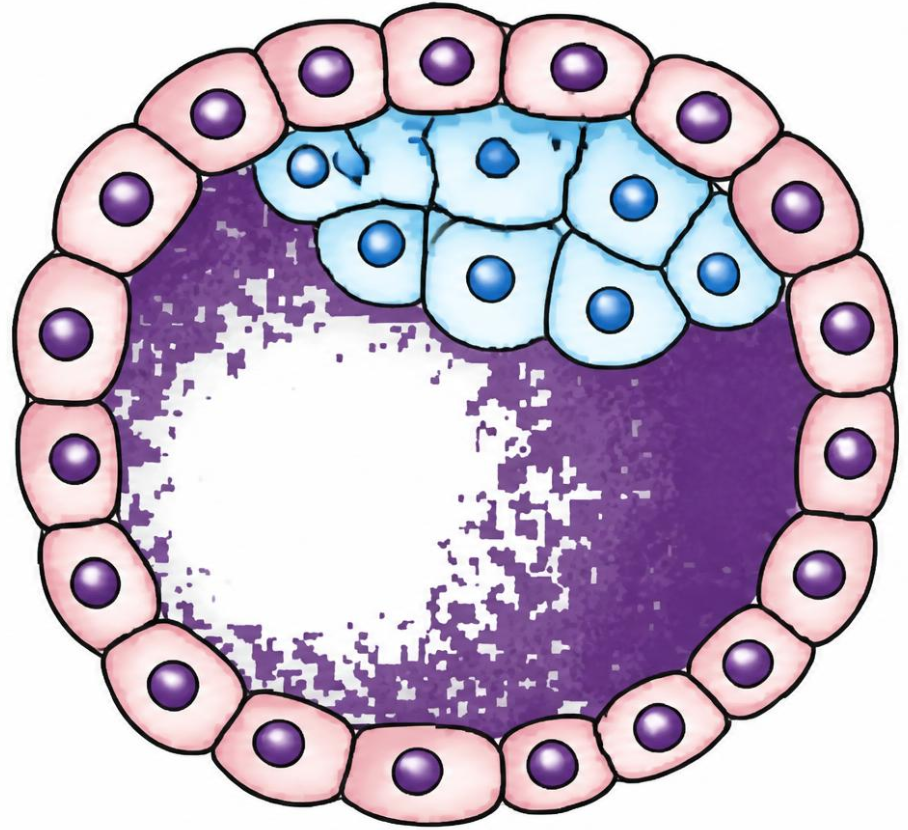 The figure shows a hollow stage with an outer layer of cells (trophoblast), a group of cells attached to one side inside (inner cell mass) and a fluid-filled cavity; this is the blastocyst.
A morula is a solid ball of 8–16 blastomeres without any cavity, so the figure is not a morula.
Cleavage occurs while the embryo moves through the Fallopian tube; the morula continues to divide and becomes a blastocyst as it moves further into the uterus.
The trophoblast layer of the blastocyst attaches to the endometrium and the blastocyst becomes embedded in the uterine wall (implantation).
Hence the stage is the blastocyst and its site of occurrence is the uterine wall.
Female reproductive system
-
The figure given below depicts a diagrammatic sectional view of the female reproductive system of humans. Which one set of three parts out of I – VI have been correctly identified?
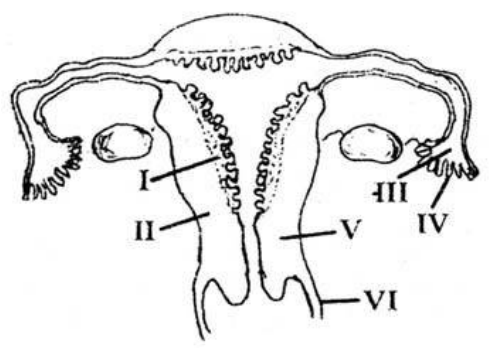 In the diagram, III points to the funnel-shaped part of the Fallopian tube lying close to the ovary: the infundibulum.
IV points to the finger-like projections at the edge of the infundibulum, which help in collecting the ovum after ovulation: the fimbriae.
V points to the narrow lower part of the uterus that opens into the vagina: the cervix.
The other sets each contain a wrong identification: III is the infundibulum rather than the Fallopian tube as a whole, IV is the fimbriae and not the oviducal funnel, V is the cervix and not the uterus, and VI marks the vagina and not the cervix.
Hence the correctly identified set is (III) infundibulum, (IV) fimbriae, (V) cervix.
Implantation
-
In human female the blastocystThe blastocyst has an outer layer of cells called the trophoblast and an inner group of cells called the inner cell mass.
The trophoblast layer gets attached to the endometrium; the uterine cells then divide rapidly and cover the blastocyst, so that it becomes embedded in the endometrium. This is implantation.
Implantation occurs about 7 days after fertilisation, not 3 days after ovulation.
The placenta is formed only after implantation, from the chorionic villi and uterine tissue.
Even before implantation the blastocyst is nourished by uterine secretions, so it does not get this nutrition 'only after' implantation.
Hence the blastocyst gets implanted in the endometrium by the trophoblast cells.
Embryonic development
-
Which one of the following statements about morula in humans is correct?The morula is the solid ball of 8–16 blastomeres formed by cleavage of the zygote.
Cleavage divisions are rapid mitotic divisions without any growth phase in between; the zygote is simply partitioned into smaller and smaller cells, so the total amount of cytoplasm stays almost the same as in the zygote.
Before each division, however, the DNA is replicated, so every blastomere has a full diploid set.
A morula with 16 cells therefore contains about 16 times the DNA of the uncleaved zygote.
Hence the morula has almost equal quantity of cytoplasm as an uncleaved zygote but much more DNA. -
A change in the amount of yolk and its distribution in the egg will affectYolk is inert, stored food; it slows down or even prevents the division of the cytoplasm in the region where it is concentrated.
Eggs with little, evenly distributed yolk (as in mammals) divide completely: holoblastic, nearly equal cleavage.
Eggs with a moderate amount of yolk concentrated at one pole (as in frogs) show holoblastic but unequal cleavage.
Eggs with a very large amount of yolk (as in birds and reptiles) show meroblastic cleavage, in which only a small disc of cytoplasm divides.
So the amount and distribution of yolk decide the pattern of cleavage; fertilisation and zygote formation are not affected.
Hence it will affect the pattern of cleavage.
Oogenesis and fertilisation
-
The second maturation division of the mammalian ovum occursThe first meiotic division of the primary oocyte is completed in the tertiary follicle just before ovulation, forming a large secondary oocyte and a tiny first polar body.
The secondary oocyte begins the second meiotic division but is arrested at metaphase II, and it is released in this state at ovulation.
The second division is completed only when a sperm enters the cytoplasm of the secondary oocyte: the entry of the sperm induces the completion of meiosis II, forming the second polar body and a haploid ovum (ootid).
Only after this do the haploid nuclei of the sperm and the ovum fuse to form the zygote.
Hence the second maturation division does not occur until after the ovum has been penetrated by a sperm.
Menstrual cycle and pregnancy
-
Which one of the following is the most likely root cause why menstruation is not taking place in a regularly cycling human female?Menstruation occurs only if the released ovum is not fertilised: the corpus luteum then degenerates, progesterone falls and the endometrium breaks down.
If the ovum is fertilised, the developing embryo and placenta produce hCG, which maintains the corpus luteum.
The corpus luteum continues to secrete progesterone, so the endometrial lining is maintained and menstruation stops; lack of menstruation may be indicative of pregnancy.
Thus the retention of the corpus luteum, the maintained endometrium and the high hormone levels are all consequences; their root cause is the fertilisation of the ovum.
Hence the most likely root cause is fertilisation of the ovum.
Hormonal Control of Menstrual Cycle
-
In the human female, menstruation can be deferred by the administration ofThe endometrium of the uterus is built up by oestrogen and is maintained by progesterone during the secretory phase.
Menstruation occurs when the corpus luteum degenerates and the levels of progesterone and oestrogen fall, so that the endometrium breaks down.
If a combination of oestrogen and progesterone is administered, their levels in the blood remain high and the endometrium continues to be maintained, so menstruation is deferred.
These hormones also inhibit the release of FSH and LH from the pituitary by negative feedback, so that no additional follicles develop.
This is the principle of the combined oral contraceptive pill; menstruation occurs only when the pills are stopped.
FSH and LH act on the ovary and do not directly maintain the endometrium.
So menstruation can be deferred by a combination of estrogen and progesterone.
Menstrual Cycle: Ovarian Events
-
Which set is similar : -After ovulation, the ruptured Graafian follicle is transformed into the corpus luteum, which secretes progesterone. So the corpus luteum and the Graafian follicle are structurally related (one develops from the other).
Sebum (oily secretion of sebaceous glands) and sweat (watery secretion of sweat glands) are different secretions.
The bundle of His conducts the impulse, while the pacemaker (SA node) starts it.
Vitamin $B_7$ is biotin, while niacin is vitamin $B_3$.
So the similar set is corpus luteum – Graafian follicles.
That is every question in Human Reproduction for this filter.
Want a score?
Answers here are not saved. Practise as a test to be marked and see your progress.
Practise as a test