Looking for classes? Ksquare Career Institute, Bengaluru →

Biology
Human Reproduction
116 questions from 38 papers, each with its answer.
- 116 questions
- 38 papers
- 3.29% of Biology
Menstrual Cycle
-
The first menstruation is called:
The onset of menstruation at puberty in human females is menarche.
The initiation of the first menstrual cycle at puberty in human females is termed menarche. Permanent cessation around age 50 is known as menopause. -
Which of the following statements are correct regarding female reproductive cycle? A. In non-primate mammals cyclical changes during reproduction are called oestrus cycle. B. First menstrual cycle begins at puberty and is called menopause. C. Lack of menstruation may be indicative of pregnancy. D. Cyclic menstruation extends between menarche and menopause. Choose the most appropriate answer from the options given below:
The first menstrual cycle at puberty is menarche, not menopause, so statement B is wrong.
All statements are correct except B. The first menstrual cycle begins at puberty and is called menarche, not menopause. -
The main function of mammalian corpus luteum is to produce:The corpus luteum secretes large amounts of progesterone, which is essential for maintenance of the endometrium.
-
Menstrual flow occurs due to lack of:If fertilisation does not occur the corpus luteum degenerates. The fall in progesterone causes the endometrium to break down, giving menstrual flow.
-
The secretory phase in the human menstrual cycle is also calledA menstrual cycle of about 28 days has: the menstrual phase (days 1–5), the follicular or proliferative phase (up to day 13), ovulation (about day 14) and the luteal phase (days 15–28).
After ovulation the ruptured Graafian follicle changes into the corpus luteum, which secretes large amounts of progesterone.
Under progesterone the endometrial glands become secretory to prepare for implantation, so this phase is called the secretory phase; it is the same as the luteal phase.
It extends from about day 15 to day 28, i.e., it lasts for about 13–14 days.
The follicular phase is the proliferative phase, not the secretory phase.
Hence the secretory phase is the luteal phase and lasts for about 13 days. -
About which day in a normal human menstrual cycle does rapid secretion of LH (popularly called LH surge) normally occur?During the follicular phase the secretion of gonadotropins (LH and FSH) increases gradually and stimulates follicular development and oestrogen secretion.
Both LH and FSH attain a peak in the middle of the cycle, i.e., about the 14th day of a 28-day cycle.
This rapid secretion of LH leading to its maximum level is called the LH surge.
The LH surge induces rupture of the Graafian follicle and release of the ovum (ovulation).
Hence the LH surge normally occurs about the 14th day. -
Withdrawal of which of the following hormones is the immediate cause of menstruation ?After ovulation the ruptured follicle forms the corpus luteum, which secretes large amounts of progesterone.
Progesterone is essential for the maintenance of the thickened, secretory endometrium of the uterus.
If fertilisation does not occur, the corpus luteum degenerates towards the end of the cycle.
The level of progesterone in the blood then falls sharply.
Without progesterone the endometrium cannot be maintained; it disintegrates and is shed along with blood, which is menstruation.
The fall of oestrogen also contributes, but the immediate cause is the withdrawal of progesterone.
So the hormone is progesterone. -
Ovulation in the human female normally takes place during the menstrual cycle -The menstrual cycle (about 28 days) has a menstrual phase (days 1–5), a follicular or proliferative phase (days 5–14) and a luteal or secretory phase (days 15–28).
During the proliferative phase, the Graafian follicle grows and secretes estrogen, which rebuilds the endometrium.
Around day 14, a surge of LH (with FSH) causes the Graafian follicle to rupture and release the secondary oocyte. This is ovulation.
After ovulation the follicle becomes the corpus luteum and the secretory phase begins.
So ovulation normally takes place at the end of the proliferative phase (around the middle of the cycle). -
Mainly which hormones control menstrual cycle in human beings : -The menstrual cycle is controlled by hormones of the pituitary and the ovary.
FSH (follicle stimulating hormone) stimulates the growth of ovarian follicles, which secrete estrogen.
Estrogen causes proliferation of the endometrium. A peak of LH (luteinising hormone), together with FSH, causes ovulation and formation of the corpus luteum, which secretes progesterone.
So the cycle is controlled mainly by FSH, LH and estrogen together (with progesterone in the luteal phase); a single hormone alone cannot control it.
So the answer is FSH, LH and estrogen.
Fertilization and Twinning
-
Twins are born to a family that lives next door to you. The twins are a boy and a girl. Which of the following must be true?
Opposite-sex twins must arise from two separate ova and sperm, making them fraternal (dizygotic) twins.
Monozygotic (identical) twins develop from a single zygote and must have the same sex and karyotype (both male or both female). A boy and a girl twin set must arise from two distinct fertilizations (dizygotic/fraternal twins).
Structure of Sperm
-
Match List-I with List-II.
Pick the matching item from Column II for each row.
Column I
- A. Head
- B. Middle piece
- C. Acrosome
- D. Tail
Column II
- I. Enzymes
- II. Sperm motility
- III. Energy
- IV. Genetic material
Correct answer: A → IV, B → III, C → I, D → II
A-IV, B-III, C-I, D-II.
The sperm head houses the haploid genetic nucleus (IV). The middle piece contains mitochondria producing ATP energy (III). The acrosome contains hydrolytic enzymes for fertilization (I). The tail provides flagellar motility (II). -
Which one of the following statements about human sperm is correct?The head of the sperm contains an elongated haploid nucleus, the anterior portion of which is covered by a cap-like structure, the acrosome.
The acrosome is filled with enzymes (sperm lysins such as hyaluronidase and acrosin) that help in the fertilisation of the ovum.
These enzymes dissolve the egg envelopes (corona radiata and zona pellucida), allowing the sperm to reach the plasma membrane of the ovum.
So penetration is enzymatic, not by mechanical piercing, and the acrosome is neither functionless nor a sensory structure.
Hence the correct statement is that the sperm lysins in the acrosome dissolve the egg envelope, facilitating fertilisation.
Myths about the Hymen and Virginity
-
Given below are two statements: Statement I: The presence or absence of hymen is not a reliable indicator of virginity. Statement II: The hymen is torn during the first coitus only. In the light of the above statements, choose the correct answer from the options given below:Statement I is true: the presence or absence of the hymen is not a reliable indicator of virginity or sexual experience. Statement II is false: the hymen is often torn during the first coitus, but it can also be broken by a sudden fall or jolt, insertion of a tampon, or active sports such as horse-riding and cycling; in some women it persists even after coitus. So Statement I is true but Statement II is false.
Colostrum and Passive Immunity in Newborns
-
Assertion A: Breast-feeding during initial period of infant growth is recommended by doctors for bringing a healthy babyReason: Reason R: Colostrum contains several antibodies absolutely essential to develop resistance for the new born baby.Breast-feeding during the initial period of infant growth is recommended by doctors for bringing up a healthy baby – Assertion is true. Colostrum, the yellowish fluid secreted during the initial days of lactation, contains abundant antibodies (IgA) essential to develop resistance in the new-born baby – Reason is true and correctly explains the Assertion. So both A and R are correct and R is the correct explanation of A.
Anatomy of the Female Reproductive Tract (Fallopian Tube)
-
Which of the following is not a component of Fallopian tube?The fallopian tube (oviduct) consists of the infundibulum (part closer to the ovary), ampulla (wider part) and isthmus (last narrow part that links to the uterus). The uterine fundus is the upper dome-shaped part of the uterus, above the openings of the fallopian tubes, so it is not a part of the fallopian tube.
Gametogenesis – Oogenesis
-
At which stage of life the oogenesis process is initiated?
Gametogenesis – Spermatogenesis
-
The difference between spermiogenesis and spermiation is
Spermiogenesis forms sperm; spermiation releases them.
Spermiogenesis is the transformation of spermatids into spermatozoa, whereas spermiation is the release of the sperms from Sertoli cells into the lumen of the seminiferous tubule.
Fertilisation
-
Capacitation refers to changes in theCapacitation is the set of changes in the mammalian sperm (in the female tract) that makes it ready to fertilise the ovum.
-
What happens during fertilisation in humans after many sperms reach close to the ovum?Many sperms reach the ovum in the ampullary region, but only one fertilises it.
When a sperm comes in contact with the zona pellucida layer of the ovum, it induces changes in the membrane that block the entry of additional sperms.
The secretions of the acrosome (hydrolytic enzymes) help the sperm to enter the cytoplasm of the ovum through the zona pellucida and the plasma membrane.
The corona radiata does not trap the other sperms, two sperms do not enter, and the other sperms do not lose their tails.
Hence the secretions of the acrosome help one sperm to enter the cytoplasm of the ovum through the zona pellucida.
Parturition and Lactation
-
Which of the following hormones is responsible for both the milk ejection reflex and the foetal ejection reflex?
Spermatogenesis
-
How many secondary spermatocytes are required to form 400 million spermatozoa?Each secondary spermatocyte undergoes meiosis II to form two spermatids, which differentiate into two spermatozoa. So 200 million secondary spermatocytes form 400 million spermatozoa.
-
What is the correct sequence of sperm formation?Spermatogonia → primary and secondary spermatocytes → spermatids → spermatozoa (by spermiogenesis).
-
The correct sequence of spermatogenetic stages leading to the formation of sperms in a mature human testis isSpermatogonia (2n) on the inside wall of the seminiferous tubules multiply by mitosis.
Some spermatogonia grow into primary spermatocytes (2n), which undergo the first meiotic division to form two haploid secondary spermatocytes.
The secondary spermatocytes undergo the second meiotic division to form four haploid spermatids.
The spermatids are transformed into spermatozoa (sperms) by the process of spermiogenesis.
Correct sequence: spermatogonia – spermatocyte – spermatid – sperms -
In humans, at the end of the first meiotic division, the male germ cells differentiate into the:The spermatogonia (male germ cells) on the inside wall of the seminiferous tubules are diploid and multiply by mitosis.
Some of the spermatogonia grow into primary spermatocytes, which are also diploid (46 chromosomes).
A primary spermatocyte completes the first meiotic division (reduction division), leading to the formation of two equal, haploid cells called secondary spermatocytes, which have only 23 chromosomes each.
The secondary spermatocytes undergo the second meiotic division to produce four equal, haploid spermatids.
The spermatids are transformed into spermatozoa (sperms) by the process called spermiogenesis.
So at the end of the first meiotic division the male germ cells differentiate into secondary spermatocytes.
Male reproductive system
-
Which of the following structure is not a part of the male reproductive system?Reference: NCERT Class XII, page 29.
-
The shared terminal duct of the reproductive and urinary system in the human male is:In the human male the urethra carries both urine and semen, and opens outside through the urethral meatus.
-
The Leydig cells as found in the human body are the secretory source ofLeydig cells (interstitial cells) lie in the spaces outside the seminiferous tubules of the testis.
They synthesise and secrete testicular hormones called androgens, mainly testosterone. -
The testes in humans are situated outside the abdominal cavity inside a pouch called scrotum. The purpose served is forSpermatogenesis requires a temperature slightly lower than the normal internal body temperature.
The scrotum keeps the testes outside the abdominal cavity and helps in maintaining their temperature about 2–2.5 $^\circ C$ lower than the internal body temperature.
At the normal body temperature of the abdomen, sperm formation would be impaired.
The other suggested purposes (display of sex, avoiding compression, space for the epididymis) are not the reason for this position.
Hence the purpose is maintaining the scrotal temperature lower than the internal body temperature. -
If for some reason the vasa efferentia in the human reproductive system get blocked, the gametes will not be transported fromThe male accessory ducts are the rete testis, vasa efferentia, epididymis and vas deferens.
Path of sperms: seminiferous tubules → rete testis → vasa efferentia → epididymis → vas deferens → ejaculatory duct → urethra.
The vasa efferentia leave the testis and open into the epididymis, which lies along the posterior surface of each testis.
If the vasa efferentia are blocked, sperms cannot pass from the testis to the epididymis.
Hence the gametes will not be transported from testes to epididymis. -
Given below is a diagrammatic sketch of a portion of human male reproductive system. Select the correct set of the names of the parts labelled A, B, C, D.
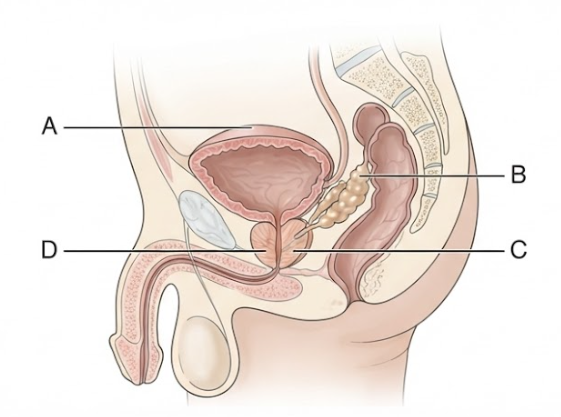 A is the duct that comes up from the epididymis, loops over the urinary bladder and joins the duct of the seminal vesicle: the vas deferens. (The ureter comes from the kidney and opens into the bladder; it is not part of this duct system.)
B is the elongated, sac-like gland lying behind the bladder, whose duct joins the vas deferens to form the ejaculatory duct: the seminal vesicle.
C is the single gland surrounding the urethra just below the urinary bladder: the prostate.
D is the small, paired gland lying below the prostate and opening into the urethra: the bulbourethral (Cowper's) gland.
Hence A – vas deferens, B – seminal vesicle, C – prostate, D – bulbourethral gland.
Menstrual cycle - ovulation and corpus luteum
-
Given below are two statements: Statement I: Ovulation is caused by LH surge leading to rupture of Graafian follicles. Statement II: Graafian follicle remaining after ovulation transform into corpus luteum and secretes large amount of estrogen. In the light of the above statements, choose the most appropriate answer from the options given below:Reference: NCERT Class XII, page 35.
Placenta - hormones
-
Which of the following hormone is not secreted by human placenta?Reference: NCERT Class XII, page 37.
Ovum - membranes
-
The covering of ovum at ovulation is _________.Reference: NCERT Class XII, page 33.
Pregnancy – placental hormones
-
Hormones secreted by the placenta to maintain pregnancy are
Placenta secretes hCG, hPL, estrogens and progestogens.
The placenta releases human chorionic gonadotropin (hCG), which stimulates the corpus luteum during pregnancy to release estrogen and progesterone and also rescues the corpus luteum from regression. Human placental lactogen (hPL) is involved in growth of the body of the mother and breast. Progesterone maintains pregnancy and keeps the uterus silent by increasing the uterine threshold to contractile stimuli. -
Several hormones like hCG, hPL, estrogen, progesterone are produced by:
Menstrual cycle – phases
-
Match the items given in Column I with those in Column II and select the correct option given below:
Pick the matching item from Column II for each row.
Column I
- a. Proliferative Phase
- b. Secretory Phase
- c. Menstruation
Column II
- i. Breakdown of endometrial lining
- ii. Follicular Phase
- iii. Luteal Phase
Correct answer: a → ii, b → iii, c → i
Proliferative = follicular, secretory = luteal, menstruation = endometrial breakdown.
During the proliferative phase, the follicles start developing, hence it is called the follicular phase. The secretory phase is also called the luteal phase, mainly controlled by progesterone secreted by the corpus luteum. Estrogen further thickens the endometrium, maintained by progesterone. Menstruation occurs due to decline in progesterone level and involves breakdown of the overgrown endometrial lining. Correct match: a-ii, b-iii, c-i.
Fertilisation – capacitation of sperm
-
Capacitation occurs in
Sperm are capacitated in the female tract.
Capacitation is the increase in fertilising capacity of sperms, which occurs in the female reproductive tract.
Fertilisation – site
-
Fertilisation in humans is practically feasible only if
Fertilisation occurs at the ampullary–isthmic junction.
Fertilisation in humans is practically possible only when the ovum and sperms are transported simultaneously to the ampullary–isthmic junction of the fallopian tube.
Male reproductive system – sperm pathway
-
Which of the following depicts the correct pathway of transport of sperms?
Gametogenesis
-
Which of the following cells during gametogenesis is normally diploid?The germinal epithelium of the seminiferous tubules gives rise to spermatogonia, which are diploid sperm mother cells.
Spermatogonia later undergo meiosis to form haploid cells.
Oogenesis
-
In human females, meiosis-II is not completed until?
Ovarian follicle
-
Which of the following layers in an antral follicle is acellular?
Placenta
-
Which one of the following is not the function of placenta? It:The placenta supplies oxygen and nutrients, removes carbon dioxide and wastes, and secretes hCG, hPL, estrogens and progestogens.
Oxytocin is released by the maternal pituitary, not by the placenta.
Parturition
-
Signals for parturition originate fromThe signals for parturition originate from the fully developed foetus and the placenta.
They induce mild uterine contractions called the foetal ejection reflex, which triggers release of oxytocin from the maternal pituitary.
Oxytocin is released in response to these signals; it is not their origin. -
Signals from fully developed foetus and placenta ultimately lead to parturition which requires the release ofThe signals for parturition originate from the fully developed foetus and the placenta and induce mild uterine contractions, called the foetal ejection reflex.
This triggers the release of oxytocin from the maternal pituitary.
Oxytocin acts on the uterine muscle and causes stronger uterine contractions, which in turn stimulate further secretion of oxytocin.
This stimulatory reflex continues, giving stronger and stronger contractions, until the baby is expelled through the birth canal.
Hence parturition requires the release of oxytocin from the maternal pituitary. -
The signals for parturition originate fromParturition is induced by a complex neuroendocrine mechanism.
The signals for parturition originate from the fully developed foetus and the placenta; they induce mild uterine contractions called the foetal ejection reflex.
This reflex triggers the release of oxytocin from the maternal pituitary.
Oxytocin acts on the uterine muscle and causes stronger contractions, which in turn stimulate further secretion of oxytocin, until the baby is expelled.
So oxytocin release is a result of the signals, not their origin.
Hence the signals originate from the placenta as well as the fully developed foetus. -
Foetal ejection reflex in human female is induced byParturition is induced by a complex neuroendocrine mechanism.
The signals for parturition originate from the fully developed foetus and the placenta; they induce mild uterine contractions called the foetal ejection reflex.
This reflex then triggers the release of oxytocin from the maternal pituitary, which causes stronger uterine contractions.
So the release of oxytocin is a result of the reflex, not its cause.
Hence the foetal ejection reflex is induced by the fully developed foetus and placenta.
Female reproductive system
-
The part of Fallopian tube closest to the ovary isEach Fallopian tube (oviduct) is about 10–12 cm long and extends from the periphery of the ovary to the uterus.
The part closest to the ovary is the funnel-shaped infundibulum; its edges have finger-like projections called fimbriae, which help in collecting the ovum after ovulation.
The infundibulum leads to a wider part called the ampulla.
The last part, the isthmus, has a narrow lumen and joins the uterus.
The cervix is the narrow lower part of the uterus, not a part of the Fallopian tube.
Hence the part closest to the ovary is the infundibulum.
Male accessory glands
-
Secretions from which one of the following are rich in fructose, calcium and some enzymes?The male accessory glands include the paired seminal vesicles, the prostate and the paired bulbourethral glands.
Their secretions constitute the seminal plasma, which is rich in fructose, calcium and certain enzymes.
Fructose provides energy to the sperms.
The liver secretes bile, the pancreas secretes pancreatic juice and the salivary glands secrete saliva; none of these is rich in fructose.
Hence the secretions are from the male accessory glands. -
Seminal plasma in human males is rich inThe male accessory glands are the paired seminal vesicles, the prostate and the paired bulbourethral glands.
Their secretions together constitute the seminal plasma, which is rich in fructose, calcium and certain enzymes.
Fructose, from the seminal vesicles, is the source of energy for the sperms.
The secretions of the bulbourethral glands also help in the lubrication of the penis.
Hence seminal plasma is rich in fructose and calcium. -
Seminal plasma in humans is rich inThe male accessory glands are the paired seminal vesicles, the prostate and the paired bulbourethral glands.
The secretions of these glands constitute the seminal plasma.
NCERT states that the seminal plasma is rich in fructose, calcium and certain enzymes.
Fructose is the energy source for the sperms; the sugar present is not glucose.
Hence seminal plasma is rich in fructose, calcium and certain enzymes.
Embryonic development
-
The first movements of the foetus and appearance of hair on its head are usually observed during which month of pregnancy?After one month of pregnancy the heart of the embryo is formed.
By the end of the second month the foetus develops limbs and digits.
By the end of 12 weeks (first trimester) most of the major organ systems are formed.
The first movements of the foetus and the appearance of hair on the head are usually observed during the fifth month.
By the end of 24 weeks (second trimester) the body is covered with fine hair, the eyelids separate and eyelashes are formed.
Hence the answer is the fifth month.
Structure of testis
-
Sertoli cells are found inEach seminiferous tubule of the testis is lined on its inside by two types of cells: male germ cells (spermatogonia) and Sertoli cells.
Sertoli cells provide nutrition to the germ cells; the sperm heads become embedded in them after spermiogenesis, and they also secrete factors that help in spermiogenesis under the influence of FSH.
The regions outside the tubules contain the interstitial (Leydig) cells, which secrete androgens.
Cholecystokinin is secreted by the duodenal mucosa, progesterone by the corpus luteum and adrenaline by the adrenal medulla.
Hence Sertoli cells are found in seminiferous tubules and provide nutrition to germ cells.
Extraembryonic Membranes
-
Which extraembryonic membrane in humans prevents desiccation of the embryo inside the uterus?The amnion is the innermost extraembryonic membrane, which surrounds the embryo and encloses the amniotic cavity.
This cavity is filled with amniotic fluid, in which the embryo floats.
The amniotic fluid keeps the embryo moist and so prevents its desiccation; it also acts as a shock absorber and protects the embryo from mechanical injury.
The chorion is the outermost membrane, which takes part in the formation of the placenta.
The allantois contributes to the blood vessels of the umbilical cord, and the yolk sac is the early site of blood cell formation in humans.
So the membrane that prevents desiccation of the embryo is the amnion.
Ovarian Cycle
-
Which part of ovary in mammals acts as an endocrine gland after ovulation?The ovary contains follicles at various stages of development; a mature follicle is called a Graafian follicle and contains the ovum surrounded by layers of follicle cells.
At ovulation the Graafian follicle ruptures and releases the ovum.
The remaining part of the ruptured Graafian follicle is transformed, under the influence of LH, into a yellow body called the corpus luteum.
The corpus luteum acts as a temporary endocrine gland: it secretes large amounts of progesterone (and some oestrogen), which is essential for the maintenance of the endometrium.
The stroma is the connective tissue of the ovary and the germinal epithelium is its outer covering; the vitelline membrane is the membrane of the ovum itself.
So the part that acts as an endocrine gland after ovulation is the Graafian follicle (as the corpus luteum).
Hormonal Control of Spermatogenesis
-
Sertoli cells are regulated by the pituitary hormone known as -The seminiferous tubules of the testis are lined by two types of cells: the male germ cells and the Sertoli cells, which provide nutrition to the developing germ cells.
The anterior pituitary secretes two gonadotropins, LH and FSH, under the influence of GnRH from the hypothalamus.
FSH (follicle stimulating hormone) acts on the Sertoli cells and stimulates them to secrete certain factors, such as androgen binding protein and inhibin, which help in the process of spermiogenesis.
LH (luteinising hormone) acts on the Leydig (interstitial) cells and stimulates the synthesis and secretion of androgens.
GH controls body growth and prolactin controls milk formation.
So Sertoli cells are regulated by FSH.
Pregnancy and Placenta
-
Which of the following hormones is not a secretion product of human placenta -The placenta acts as a temporary endocrine gland during pregnancy.
It secretes human chorionic gonadotropin (hCG), human placental lactogen (hPL), estrogens, progesterone and (later) relaxin.
Prolactin is secreted by the anterior pituitary gland, not by the placenta. Its level rises during pregnancy and it stimulates milk production after birth.
So prolactin is not a secretion product of the human placenta.
Female Reproductive System: Accessory Glands
-
Bartholin's glands are situated : -Bartholin's glands (greater vestibular glands) are a pair of small glands in the human female, situated on either side of the vaginal opening.
They secrete a mucus-like fluid that lubricates the vagina, especially during sexual intercourse.
Their counterparts in males are the bulbourethral (Cowper's) glands, which are located near the urethra, not the vas deferens.
So Bartholin's glands are situated on either side of the vagina in humans.
Embryonic Development: Cleavage
-
What is true for cleavage : -Cleavage is the series of rapid mitotic divisions of the zygote that form a multicellular embryo (morula and then blastula).
There is no growth between the divisions (the interphase is very short), so the overall size of the embryo remains about the same as that of the zygote.
As the same volume is divided into more and more cells (blastomeres), each cell becomes smaller.
So during cleavage the size of the cells decreases. -
Cleavage in mammals :The mammalian (human) egg is alecithal (has very little yolk), so the cleavage furrows divide the whole egg completely. This is holoblastic cleavage.
The blastomeres formed are nearly equal in size, so it is described as holoblastic and nearly equal (in detail, slightly unequal and rotational).
Discoidal cleavage occurs in the yolky eggs of birds and reptiles, and superficial cleavage in insects.
So, as per the answer key, cleavage in mammals is holoblastic equal.
Embryonic Development: Gastrulation
-
Blastopore is the pore of :During gastrulation, cells move inward (invagination), forming a new cavity called the archenteron (primitive gut).
The opening of the archenteron to the outside is the blastopore. (It becomes the mouth in protostomes and the anus in deuterostomes.)
The blastocoel is the cavity of the blastula, which gets obliterated during gastrulation.
So the blastopore is the pore of the archenteron.
That is every question in Human Reproduction for this filter.
Want a score?
Answers here are not saved. Practise as a test to be marked and see your progress.
Practise as a test