Looking for classes? Ksquare Career Institute, Bengaluru →

Biology
Organisms and Populations
90 questions from 35 papers, each with its answer.
- 90 questions
- 35 papers
- 2.55% of Biology
Population Interactions
-
Match List-I with List-II.
Pick the matching item from Column II for each row.
Column I
- A. Both species are harmed
- B. One species is harmed and the other is benefited
- C. Both species are benefited
- D. One is benefited while the other has no effect
Column II
- I. Predation
- II. Mutualism
- III. Competition
- IV. Commensalism
Correct answer: A → III, B → I, C → II, D → IV
Reference: NCERT Class XII, page 197. -
Epiphytes that are growing on a mango branch is an example of which of the following?
Epiphytes on trees exhibit commensalism (+, 0).
An epiphyte (e.g., an orchid) growing on the branch of a mango tree derives physical support without harming or taking nourishment from the host tree, representing commensalism. -
Match List-I (Interaction) with List-II (Species A And B)
Pick the matching item from Column II for each row.
Column I
- A. Mutualism
- B. Commensalism
- C. Amensalism
- D. Parasitism
Column II
- I. +(A), O(B)
- II. -(A), O(B)
- III. +(A), -(B)
- IV. +(A), +(B)
Correct answer: A → IV, B → I, C → II, D → III
Mutualism is +/+, commensalism +/0, amensalism -/0 and parasitism +/-.
Mutualism: This interaction confers benefits on both the interacting species. Commensalism: This is the interaction in which one species benefits (+) and the other is neutral (0). Amensalism: In this interaction one species is harmed (–) whereas the other is unaffected (0). Parasitism: In this interaction one species benefits (+) and the other is harmed (–). -
While explaining interspecific interaction of population, (+) sign is assigned for beneficial interaction, (–) sign is assigned for detrimental interaction and (0) for neutral interaction. Which of the following interactions can be assigned (+) for one species and (–) for another species involved in the interaction?
-
Between which among the following, the relationship is not an example of commensalism?
-
If '+' sign is assigned to beneficial interaction '–' sign to detrimental and '0' sign to neutral interaction, then the population interaction represented by '+' '–' refers to:
-
In which of the following interactions both partners are adversely affected?
-
A sedentary sea anemone gets attached to the shell lining of hermit crab. The association is:The sea anemone benefits (it is carried to new feeding sites) while the hermit crab is neither harmed nor benefited, so this is treated as commensalism.
-
$Cuscuta$ is an example of$Cuscuta$ (dodder) is a parasitic plant commonly found growing on hedge plants.
It has lost its chlorophyll and leaves during evolution and derives its nutrition from the host plant through haustoria.
It lives on the external surface of the host, twining around its stem, so it is an ectoparasite.
Endoparasites live inside the host body (e.g., tapeworm, liver fluke); brood parasitism is shown by birds such as the cuckoo laying eggs in the nest of the crow; predation involves killing and eating the prey.
Hence $Cuscuta$ is an example of ectoparasitism. -
Which one of the following is most appropriately defined?A predator is an organism that captures, kills and eats another organism (its prey) for food; this definition is appropriate.
'Host' is used specifically for the organism that harbours a parasite; merely providing food does not define it (a prey or a producer also provides food).
In amensalism one species is harmed and the other is unaffected; the relationship in which one is benefited and the other unaffected is commensalism.
Parasites do not always live inside the host: ectoparasites such as lice and ticks live on the surface.
Hence the most appropriately defined term is predator. -
A high density of elephant population in an area can result inCompetition occurs when organisms need the same resources that are in short supply.
Competition among the individuals of the same species is called intraspecific competition; competition between individuals of different species is interspecific competition.
All members of a species have the same requirements of food, water, space and mates, and similar adaptations for getting them.
When the density of the elephant population in an area is high, the elephants compete with one another for these limited resources.
This is intraspecific competition, and it is usually more severe than interspecific competition because the needs are identical.
Elephants are herbivores and do not prey on one another, and mutualism is a beneficial interaction between two different species.
So a high density of elephant population can result in intraspecific competition.
Ecologist Contribution / Introduction
-
Who is known as the father of Ecology in India?
Prof. Ramdeo Misra is reverently called the Father of Ecology in India.
Prof. Ramdeo Misra obtained his PhD in Ecology under W.H. Pearsall from the University of Leeds and established teaching and research in tropical ecology at Banaras Hindu University, earning the title Father of Ecology in India.
Mutualism (Co-evolution of Fig and Wasp)
-
Given below are two statements:
Statement I: Fig fruit is a non-vegetarian fruit as it has enclosed fig wasps in it.
Statement II: Fig wasp and fig tree exhibit mutual relationship as fig wasp completes its life cycle in fig fruit and fig fruit gets pollinated by fig wasp.
In the light of the above statements, choose the most appropriate answer from the options given below:Statement I is scientifically false; Statement II correctly describes obligate mutualism between fig and wasp.
Statement I is scientifically incorrect because a plant fruit cannot be classified as non-vegetarian simply due to symbiotic internal pollination. Statement II is correct: fig trees and partner fig wasps exhibit an obligate one-to-one mutualism where the wasp pollinates the inflorescence and uses developing seeds/ovaries as oviposition sites.
Population Growth Models - Logistic Growth
-
Which one of the following equations represents the Verhulst-Pearl Logistic Growth of population?
Verhulst-Pearl logistic growth equation is $\frac{dN}{dt} = rN\left(\frac{K-N}{K}\right)$.
The Verhulst-Pearl Logistic Growth equation describes sigmoid population dynamics where resources are limiting: $\frac{dN}{dt} = rN\left(\frac{K-N}{K}\right)$, where $N$ is population density, $r$ is intrinsic rate of natural increase, and $K$ is carrying capacity.
Population Interactions – Competition
-
Inspite of interspecific competition in nature, which mechanism the competing species might have evolved for their survival?
Population Interactions – Predation
-
Which one of the following statements cannot be connected to Predation?
Population Attributes – Mortality
-
If '8' Drosophila in a laboratory population of '80' died during a week, the death rate in the population is _________ individuals per Drosophila per week.
Population Interactions – Amensalism
-
Amensalism can be represented as:
-
Which one of the following population interactions is widely used in medical science for the production of antibiotics?
Antibiotic production is amensalism: one harmed, the other unaffected.
Amensalism/antibiosis (0, –). Antibiotics are chemicals secreted by one microbial group (e.g. $Penicillium$) which harm other microbes (e.g. $Staphylococcus$). It has no effect on $Penicillium$, the organism which produces it.
Population Growth – Exponential Growth
-
In the exponential growth equation $N_t=N_0e^{rt}$, $e$ represents:
Population Attributes
-
Which of the following is not an attribute of a population?Natality, mortality and sex ratio are attributes of a population. Species interaction is a population interaction (between populations), not an attribute of a single population.
-
What type of human population is represented by the following age pyramid?
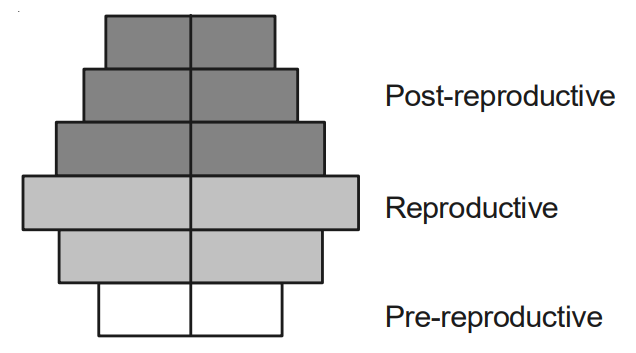 An age pyramid shows the proportion of pre-reproductive, reproductive and post-reproductive individuals in a population.
The given pyramid is urn-shaped: the pre-reproductive group at the base is the smallest and is narrower than the reproductive group above it.
Fewer young individuals means that fewer will enter the reproductive age in future, so the population will decrease.
An expanding population has a triangular pyramid with a broad base, and a stable population has a bell-shaped pyramid with nearly equal pre-reproductive and reproductive groups.
Hence the pyramid represents a declining population. -
Geometric representation of age structure is a characteristic ofA population has certain attributes that an individual organism does not have, such as birth rate, death rate, sex ratio and age distribution.
A population at any given time is composed of individuals of different ages.
If the age distribution (percentage of individuals of a given age or age group) is plotted for the population, the resulting structure is called an age pyramid.
The age pyramid is thus a geometric representation of the age structure, with the pre-reproductive, reproductive and post-reproductive groups shown one above the other.
The shape of the pyramid shows whether the population is growing (triangular), stable (bell shaped) or declining (urn shaped).
So the geometric representation of age structure is a characteristic of a population.
Competition - resource partitioning
-
Two butterfly species are competing for the same nectar of a flower in a garden. To survive and coexist together, they may avoid competition in the same garden byTwo species competing for the same resource can coexist by resource partitioning, e.g. choosing different times or different foraging patterns.
-
Carnivorous animals - lions and leopards, occupy the same niche but lions predate mostly larger animals and leopards take smaller ones. This mechanism of competition is referred to as
Population growth - intrinsic rate
-
Consider a population of 10 million cells. Given the per-capita birth rate of 0.002 (per unit time) and the per-capita death rate of 0.002 (per unit time), the expected number of cells after 10 generations is ______.Reference: NCERT Class XII, page 193. r = b - d = 0.002 - 0.002 = 0. $N_t=N_0e^{rt}=N_0e^{0\times10}=N_0=10$ million.
Population growth models
-
The logistic growth model of populations is considered more realistic than the exponential growth model.Reason: Resources are finite.Reference: NCERT Class XII, page 195.
-
The formula for exponential population growth is -When resources (food and space) are unlimited, each species can realise fully its innate potential to grow in number; the population then grows in an exponential or geometric fashion.
If $N$ is the population size, $b$ the per capita birth rate and $d$ the per capita death rate, then the change in $N$ during time $t$ is $\dfrac{dN}{dt} = (b - d) \times N$
Let $(b - d) = r$, the intrinsic rate of natural increase.
Then $\dfrac{dN}{dt} = rN$
Its integral form is $N_t = N_0 e^{rt}$, and plotting $N$ against time gives a J-shaped curve.
So the formula for exponential population growth is $\dfrac{dN}{dt} = rN$.
Competition
-
Abingdon tortoise in Galapagos islands became extinct within a decade after goats were introduced.Reason: Goats were more efficient at browsing than Abingdon tortoise.Reference: NCERT Class XII, page 199.
Population interactions – mutualism
-
Which one of the following plants shows a very close relationship with a species of moth, where none of the two can complete its life cycle without the other?
$Yucca$ and the moth $Pronuba$ are obligate mutualists.
$Yucca$ has an obligate mutualism with a species of moth, i.e. $Pronuba$. -
Mycorrhizae are the example of
Both fungus and plant benefit.
Mycorrhiza is a symbiotic association of fungi with the roots of higher plants (mutualism). -
Which type of association is found in between entomophilous flower and pollinating agent : -Entomophilous flowers are pollinated by insects.
The insect gets food (nectar and pollen) from the flower, and the flower gets its pollen carried to another flower, i.e. it is pollinated.
Since both partners benefit, the relationship is mutualism. (Plants and their pollinators have also co-evolved, e.g. fig and fig wasp, but co-evolution is the process, while the association itself is mutualism.)
So the association between an entomophilous flower and its pollinator is mutualism.
Population attributes – natality
-
Natality refers to
Natality = birth rate.
Natality refers to birth rate. Death rate – mortality; number of individuals entering a habitat – immigration; number of individuals leaving the habitat – emigration.
Ecological niche
-
Niche is
Niche is the functional role of an organism in its habitat.
The term ecological niche was coined by J. Grinnell. It refers to the functional role played by the organism where it lives.
Population attributes – age pyramids
-
In a growing population of a country,
An expanding population has a broad pre-reproductive base.
Whenever the pre-reproductive individuals, i.e. the younger population, are larger in number than the reproductive group, the population will be an increasing population.
Plant adaptations – halophytes
-
Plants which produce characterstic pneumatophores and show vivipary belong to
Mangrove halophytes show vivipary and pneumatophores.
Halophytes growing in saline soils show (i) vivipary, which is in-situ seed germination, and (ii) pneumatophores for gaseous exchange.
Competition – Gause's principle
-
Gause's principle of competitive exclusion states that
Two species cannot share one niche indefinitely.
Gause's competitive exclusion principle states that two closely related species competing for the same limiting resources in the same niche cannot co-exist; the inferior one is eliminated. -
The principle of competitive exclusion was stated by:
Life history – r and K selection
-
Which of the following is correct for r-selected species?
Levels of organisation
-
An association of individuals of different species living in the same habitat and having functional interactions is:
Responses to abiotic factors
-
Just as a person moving from Delhi to Shimla to escape the heat for the duration of hot summer, thousands of migratory birds from Siberia and other extremely cold northern regions move to:Every winter Keoladeo National Park (Bharatpur, Rajasthan) hosts thousands of migratory birds from Siberia and other extremely cold northern regions.
Population growth
-
A biologist studied the population of rats in a barn. He found that the average natality was 250, average mortality 240, immigration 20 and emigration 30. The net increase in population is:Net increase = (natality + immigration) − (mortality + emigration) = (250 + 20) − (240 + 30) = 0
-
The logistic population growth is expressed by the equationWhen resources are unlimited, a population grows exponentially: $\frac{dN}{dt} = rN$ (J-shaped curve).
In nature resources are limited, and a habitat can support only a maximum number of individuals, the carrying capacity K.
Such a population shows a lag phase, then acceleration, deceleration and finally an asymptote when N reaches K (sigmoid curve). This is Verhulst–Pearl logistic growth.
It is described by $\frac{dN}{dt} = rN\left(\frac{K - N}{K}\right)$, where N is the population density at time t and r is the intrinsic rate of natural increase.
The factor $\frac{K - N}{K}$ is the environmental resistance term; as N approaches K it becomes zero and growth stops.
Hence the logistic equation is $dN/dt = rN\left(\frac{K - N}{K}\right)$. -
Two opposite forces operate in the growth and development of every population. One of them relates to the ability to reproduce at a given rate. The force opposing it is called : -Biotic potential is the maximum capacity of a population to increase in number under ideal conditions (the intrinsic rate of natural increase, r). It relates to the ability to reproduce at a given rate.
In nature, population growth is checked by limiting factors such as shortage of food and space, predation, competition, disease and unfavourable climate. The sum of these factors is called environmental resistance.
Environmental resistance prevents a population from reaching its biotic potential and leads to a sigmoid (logistic) growth curve with a carrying capacity K.
Morbidity is the incidence of disease, and fecundity is the reproductive capacity itself.
So the opposing force is environmental resistance. -
In a population, unrestricted reproductive capacity is called as -Biotic potential is the maximum reproductive capacity of a population under ideal conditions, i.e. when there is no limitation of food, space or other resources (unrestricted reproduction). It is measured by the intrinsic rate of natural increase, r.
Carrying capacity (K) is the maximum population size the environment can support. Birth rate and fertility are the actual rates observed under real conditions.
So unrestricted reproductive capacity is called biotic potential.
Adaptations
-
Consider the following four conditions (a – d) and select the correct pair of them as adaptation to environment in desert lizards.
The conditions:
(a) Burrowing in soil to escape high temperature
(b) Losing heat rapidly from the body during high temperature
(c) Bask in sun when temperature is low
(d) Insulating body due to thick fatty dermisDesert lizards lack the physiological ability that mammals have to deal with the high temperatures of their habitat.
They manage to keep their body temperature fairly constant by behavioural means.
They bask in the sun and absorb heat when their body temperature drops below the comfort zone, so (c) is correct.
They move into shade, or burrow into the soil, when the ambient temperature starts increasing, so (a) is correct.
They cannot lose heat rapidly by a physiological mechanism such as sweating, so (b) is wrong; a thick layer of fat (blubber) for insulation is an adaptation of aquatic mammals of cold seas such as seals, so (d) is wrong.
Hence the correct pair is (a) and (c). -
Which two of the following changes (a–d) usually tend to occur in the plain dwellers when they move to high altitudes (3,500 m or more)?
(a) Increase in red blood cell size
(b) Increase in red blood cell production
(c) Increased breathing rate
(d) Increase in thrombocyte count
Changes occurring areAt high altitude the atmospheric pressure is low, so the body does not get enough oxygen and the person may suffer from altitude sickness (nausea, fatigue, heart palpitations).
The body gradually gets acclimatised and compensates for the low oxygen availability by: increasing red blood cell production, decreasing the binding affinity of haemoglobin, and increasing the breathing rate.
So (b) and (c) occur.
The size of red blood cells and the thrombocyte (platelet) count are not part of this response, so (a) and (d) do not occur.
Hence the changes are (b) and (c). -
Reduction in vascular tissue, mechanical tissue and cuticle is characteristic ofHydrophytes live in water, which surrounds them and buoys them up.
They can absorb water over their whole surface, so there is little need for conduction; the vascular tissue, especially xylem, is poorly developed.
Water supports the plant body, so mechanical tissue (sclerenchyma) is reduced; instead there is abundant aerenchyma for buoyancy and gas storage.
There is no danger of losing water, so the cuticle is thin or absent.
Xerophytes show the opposite features: thick cuticle and well-developed vascular and mechanical tissues.
Hence these reductions are characteristic of hydrophytes.
Major Biomes
-
Quercus species are the dominant component in:Quercus is the genus of oak trees.
Oaks are broad-leaved trees that shed their leaves in autumn and are typical of regions with a moderate climate and well-defined seasons.
They are the dominant trees of temperate deciduous (broad-leaved) forests, along with trees such as maple, beech and chestnut.
In India, oak forests occur in the temperate zone of the Himalayas.
Tropical rain forests are dominated by tall evergreen trees, scrub forests by thorny shrubs, and alpine forests by conifers such as fir and by rhododendrons.
So Quercus species are the dominant component in temperate deciduous forests. -
Which one of the following pairs is mismatched -Savanna is a tropical grassland with scattered trees, typically Acacia; correctly matched.
Coniferous forests (taiga) are dominated by evergreen trees such as pine, spruce and fir; correctly matched.
Tundra is the treeless cold region where the subsoil remains permanently frozen (permafrost); correctly matched.
Prairie is a temperate grassland dominated by grasses with very few trees.
Epiphytes (plants growing on other plants, such as orchids) are characteristic of tropical rain forests, not of grasslands.
So the mismatched pair is prairie - epiphytes.
Adaptations: Camouflage and Mimicry
-
Praying mantis is a good example of -Camouflage (cryptic appearance) is the ability of an animal to blend with its surroundings in colour and shape so that it is not easily noticed.
The praying mantis is green or brown, and its body and wings resemble the leaves and twigs among which it lives.
This hides it from its predators and also from its prey, which it catches by lying in wait.
Warning colouration is the opposite: bright, conspicuous colours that advertise that the animal is distasteful or poisonous.
Mullerian mimicry is the resemblance between two or more unpalatable species.
The praying mantis is a solitary insect, not a social insect like bees, ants and termites.
So the praying mantis is a good example of camouflage.
Ecological Niche and Competition
-
Niche overlap indicates -The ecological niche of a species is its functional role in the community, including all the resources it uses and the conditions it needs.
When the niches of two species overlap, it means that the two species use one or more of the same resources, such as food, space or nesting sites.
The greater the overlap, the greater the competition between them when the shared resource is limited.
According to Gause's competitive exclusion principle, two closely related species competing for the same resources cannot co-exist indefinitely; one is eliminated unless they partition the resource.
Niche overlap therefore does not indicate cooperation or mutualism.
So niche overlap indicates the sharing of one or more resources between the two species.
Major Abiotic Factors: Temperature
-
In which one of the following habitats does the diurnal temperature of soil surface vary most ?Diurnal variation means the difference between day and night temperatures.
In a desert there is very little vegetation cover and almost no water vapour or clouds in the air. The sandy soil heats up very quickly during the day under strong sunlight, and loses heat very quickly at night by radiation.
So soil surface temperatures can exceed $50^\circ C$ by day and drop close to freezing at night.
In forests, grasslands and shrublands, the plant cover, humus and moisture moderate these changes.
So the diurnal temperature of the soil surface varies most in the desert.
Population Interactions: Predation and Defence
-
Significance of mimicry is -Mimicry is the resemblance of one organism to another organism or to an object in its surroundings.
Its main significance is protection from predators. For example, in Batesian mimicry the harmless Viceroy butterfly looks like the distasteful Monarch butterfly, so predators avoid it.
Many insects resemble leaves or twigs (leaf insect, stick insect), which also helps them hide from predators.
(Some predators also use mimicry to catch prey, but its main significance, as per the answer key, is defence.)
So the significance of mimicry is protection (defence).
Population Growth Curves
-
Choose the correct sequence of stages of growth curve for Bacteria : -When bacteria are introduced into a fresh medium, their growth follows four phases:
1. Lag phase: cells adjust to the new medium, synthesise enzymes; little increase in number.
2. Log (exponential) phase: rapid division; the number doubles at regular intervals.
3. Stationary phase: nutrients become limited and toxic wastes accumulate; the rate of cell division equals the rate of death.
4. Decline (death) phase: death rate exceeds division rate, and the number of living cells falls.
So the correct sequence is lag, log, stationary and decline phase.
Population Interactions: Parasitism
-
Which of the following is a correct pair : -Cuscuta (dodder) is a leafless, yellowish, rootless plant that winds around host plants and draws food and water from them through haustoria. It is a total stem parasite; correctly matched.
Dischidia is an epiphyte with pitcher-like leaves that collect water and debris; it is not a true insectivorous plant.
Opuntia is a xerophyte (cactus), not a predator.
Capsella (shepherd's purse) is a mesophyte, not a hydrophyte.
So the correct pair is Cuscuta – parasite.
That is every question in Organisms and Populations for this filter.
Want a score?
Answers here are not saved. Practise as a test to be marked and see your progress.
Practise as a test