Looking for classes? Ksquare Career Institute, Bengaluru →

Biology
Locomotion and Movement
65 questions from 35 papers, each with its answer.
- 65 questions
- 35 papers
- 1.84% of Biology
Joints
-
Match List-I (Type of Joint) with List-II (Found between).
Pick the matching item from Column II for each row.
Column I
- A. Cartilaginous Joint
- B. Ball and Socket Joint
- C. Fibrous Joint
- D. Saddle Joint
Column II
- I. Between flat skull bones
- II. Between adjacent vertebrae in vertebral column
- III. Between carpal and metacarpal of thumb
- IV. Between Humerus and Pectoral girdle
Correct answer: A → II, B → IV, C → I, D → III
Fibrous joints are between skull bones; saddle joints are between carpal and metacarpal of the thumb.
Cartilaginous Joints – Between adjacent vertebrae in vertebral column. Ball and socket Joint – Between humerus and pectoral girdle. Fibrous Joint – Between flat skull bones. Saddle Joint – Between carpal and metacarpal of thumb. -
Which of the following joints would allow no movement?
-
Select the correct matching of the type of the joint with the example in human skeletal system:The joints between the carpals are gliding joints.
Skull bones have fibrous joints, the pivot joint is between atlas and axis, and humerus with the pectoral girdle is a ball and socket joint. -
Elbow joint is an example ofSynovial joints have a fluid-filled synovial cavity between the articulating bones and allow considerable movement.
A hinge joint allows movement in one plane only, like the hinge of a door; examples are the elbow joint and the knee joint.
Ball and socket joint: between the humerus and pectoral girdle (shoulder) and between the femur and pelvic girdle (hip).
Pivot joint: between the atlas and the axis. Gliding joint: between the carpals.
Hence the elbow joint is a hinge joint. -
What will happen if ligaments are cut or broken : -Ligaments are bands of dense regular connective tissue (with elastic fibres) that connect bone to bone at joints.
They hold the bones together and keep the joint stable, allowing movement only in certain directions and within limits.
If ligaments are cut or broken, the bones are no longer held firmly in place, so they will move freely (loosely) at the joint, which can lead to dislocation.
So, as per the answer key, bones will move freely at joints. -
What is the name of joint between ribs and sternum :The ribs are joined to the sternum through costal cartilages (hyaline cartilage).
Joints in which bones are held together by cartilage and allow only slight movement are cartilaginous joints.
This slight movement allows the rib cage to expand during breathing.
So the joint between the ribs and sternum is a cartilaginous joint.
Disorders of Muscular and Skeletal System
-
Gout is a type of disorder which leads to:Gout is inflammation of joints due to the accumulation of uric acid crystals.
-
Chronic auto immune disorder affecting neuromuscular junction leading to fatigue, weakening and paralysis of skeletal muscle is called as:
-
Which of the following muscular disorders is inherited?
-
Which of the following diseases is an autoimmune disorder?
-
Select the correct statement with respect to locomotion in humans:Gout is inflammation of joints caused by accumulation of uric acid crystals.
Joints between vertebrae are cartilaginous, osteoporosis is linked to low estrogen, and there are 12 thoracic vertebrae. -
Select the correct statement regarding the specific disorder of muscular or skeletal systemOsteoporosis is an age-related disorder with decreased bone mass and increased chances of fractures; decreased estrogen is a common cause.
Gout is due to deposition of uric acid crystals, muscular dystrophy is a genetic disorder with progressive degeneration of skeletal muscle, and myasthenia gravis is an autoimmune disorder affecting the neuromuscular junction. -
Low $Ca^{++}$ in the body fluid may be the cause ofTetany is the rapid spasms (wild contractions) in muscle due to low $Ca^{++}$ in the body fluid.
Gout is inflammation of joints due to accumulation of uric acid crystals.
Anaemia is a deficiency of haemoglobin or RBCs.
Angina pectoris is acute chest pain that occurs when not enough oxygen reaches the heart muscle.
Hence low $Ca^{++}$ in the body fluid may cause tetany.
Sliding filament theory of muscle contraction
-
According to the sliding filament theoryDuring contraction the thin (actin) filaments slide over the thick (myosin) filaments towards the centre; the Z lines come closer and the sarcomere shortens. The I-band gets reduced while the A-band retains its length.
Types of synovial joints
-
Match the following joints with the bones involved. Select the correct option.
Pick the matching item from Column II for each row.
Column I
- A. Gliding joint
- B. Hinge joint
- C. Pivot joint
- D. Saddle joint
Column II
- I. Between carpal and metacarpal of thumb
- II. Between Atlas and Axis
- III. Between the carpals
- IV. Between Humerus and Ulna
Correct answer: A → III, B → IV, C → II, D → I
Axial skeleton - vertebral column
-
The number of vertebrae in a human is ________.Reference: NCERT Class XI, page 225.
Appendicular skeleton
-
Which of the following represents the correct sequence of arrangement of bones in the lower limb of humans?Reference: NCERT Class XI, page 226.
-
An acromion process is characteristically found in the -Each half of the pectoral girdle of mammals consists of a clavicle and a scapula.
The scapula is a large, flat, triangular bone on the dorsal side of the thorax.
It has a slightly elevated ridge called the spine, which projects as a flat, expanded process called the acromion.
The clavicle articulates with this acromion.
Below the acromion is a depression called the glenoid cavity, which articulates with the head of the humerus to form the shoulder joint.
The acrosome (not acromion) is the cap-like structure on the head of a sperm.
So the acromion process is found in the pectoral girdle of mammals.
Types of movement
-
Sperm motility is due to ___________.Reference: NCERT Class XI, page 218.
Mechanism of muscle contraction
-
Muscle contraction is initiated by a signal sent by the central nervous system by the release of _____.Reference: NCERT Class XI, page 222.
-
Calcium is important in skeletal muscle contraction because it
$Ca^{2+}$ binds troponin C, unmasking actin's myosin-binding sites.
The signal for contraction increases the $Ca^{2+}$ level many-fold in the sarcoplasm. $Ca^{2+}$ binds with the subunit of troponin (troponin C) which is masking the active site on the actin filament, and displaces it. Once the active site is exposed, the head of myosin attaches and initiates contraction by sliding the actin over myosin. -
Name the ion responsible for unmasking of active sites for myosin for cross–bridge activity during muscle contraction.
-
ATPase enzyme needed for muscle contraction is located in -The thick filaments of a myofibril are made of myosin. Each myosin molecule has a globular head (heavy meromyosin).
The myosin head has ATPase activity and binding sites for both ATP and actin.
It hydrolyses ATP to ADP and $P_i$, and uses the energy released to bind to actin, form a cross bridge and pull the thin filaments towards the centre of the sarcomere (sliding filament theory).
Actin, troponin and tropomyosin form the thin filaments and have no ATPase activity; actinin anchors actin at the Z line.
So the ATPase enzyme needed for muscle contraction is located in myosin.
Vertebral column
-
Which of the following is the correct order of arrangement of vertebrate column from the head to toe?Reference: NCERT Class XI, page 225.
Joints – synovial joints
-
The pivot joint between atlas and axis is a type of
The atlas–axis pivot joint is synovial.
Synovial joints are freely movable joints that allow considerable movement. A pivot joint is a type of synovial joint that provides rotational movement, as between the atlas and axis vertebrae.
Skeletal system – ribs
-
Out of 'X' pairs of ribs in humans only 'Y' pairs are true ribs. Select the option that correctly represents values of X and Y and provides their explanation:
12 pairs of ribs; first 7 pairs are true ribs.
In humans, 12 pairs of ribs are present, of which 7 pairs ($1^{st}$ to $7^{th}$) are attached dorsally to the vertebral column and ventrally to the sternum (true ribs).
Muscle contraction – tetanus
-
Lack of relaxation between successive stimuli in sustained muscle contraction is known as
Fused sustained contraction from rapid stimuli is tetanus.
Sustained contraction of muscles due to repeated stimuli without relaxation is called tetanus.
Disorders of skeletal system – osteoporosis
-
Osteoporosis, an age–related disease of skeletal system, may occur due to:
Muscle contraction
-
Sliding filament theory can be best explained asDuring muscle contraction the actin filaments slide over the myosin filaments; neither filament shortens.
-
Stimulation of a muscle fiber by a motor neuron occurs at:A motor neuron meets the sarcolemma of a muscle fibre at the neuromuscular junction (motor end plate), where acetylcholine is released and generates an action potential.
Pectoral girdle
-
Glenoid cavity articulatesThe glenoid cavity is a cup-like depression of the scapula that articulates with the head of the humerus.
Skeletal system
-
Which of the following is not a function of the skeletal system?
-
Three of the following pairs of the human skeletal parts are correctly matched with their respective inclusive skeletal category and one pair is not matched. Identify the non-matching pair.The clavicle (collar bone) and the scapula form the pectoral girdle; the glenoid cavity is the depression of the scapula that articulates with the head of the humerus to form the shoulder joint.
So the clavicle and glenoid cavity belong to the pectoral girdle, not the pelvic girdle. (The pelvic girdle is made of the coxal bones and has the acetabulum.)
Humerus and ulna are bones of the fore limb, which is part of the appendicular skeleton (correct).
Malleus, incus and stapes are the three ear ossicles (correct).
The sternum and ribs, with the skull and vertebral column, form the axial skeleton (correct).
Hence the non-matching pair is clavicle and glenoid cavity – pelvic girdle. -
Which one of the following items gives its correct total number?Humans have 12 pairs of ribs.
The first seven pairs are true ribs (attached directly to the sternum), and the 8th, 9th and 10th pairs are false or vertebrochondral ribs (attached to the seventh rib through hyaline cartilage).
The last 2 pairs (11th and 12th) are not connected ventrally and are called floating ribs. Two pairs means 4 floating ribs in total, so this item is correct.
The number of cervical vertebrae in humans, as in almost all mammals, is 7, not 8.
The number of amino acids found in proteins is 20, not 16.
Diabetes is generally of two types: diabetes mellitus and diabetes insipidus.
So the item with the correct total number is floating ribs in humans - 4. -
In human body, which one of the following is anatomically correct?
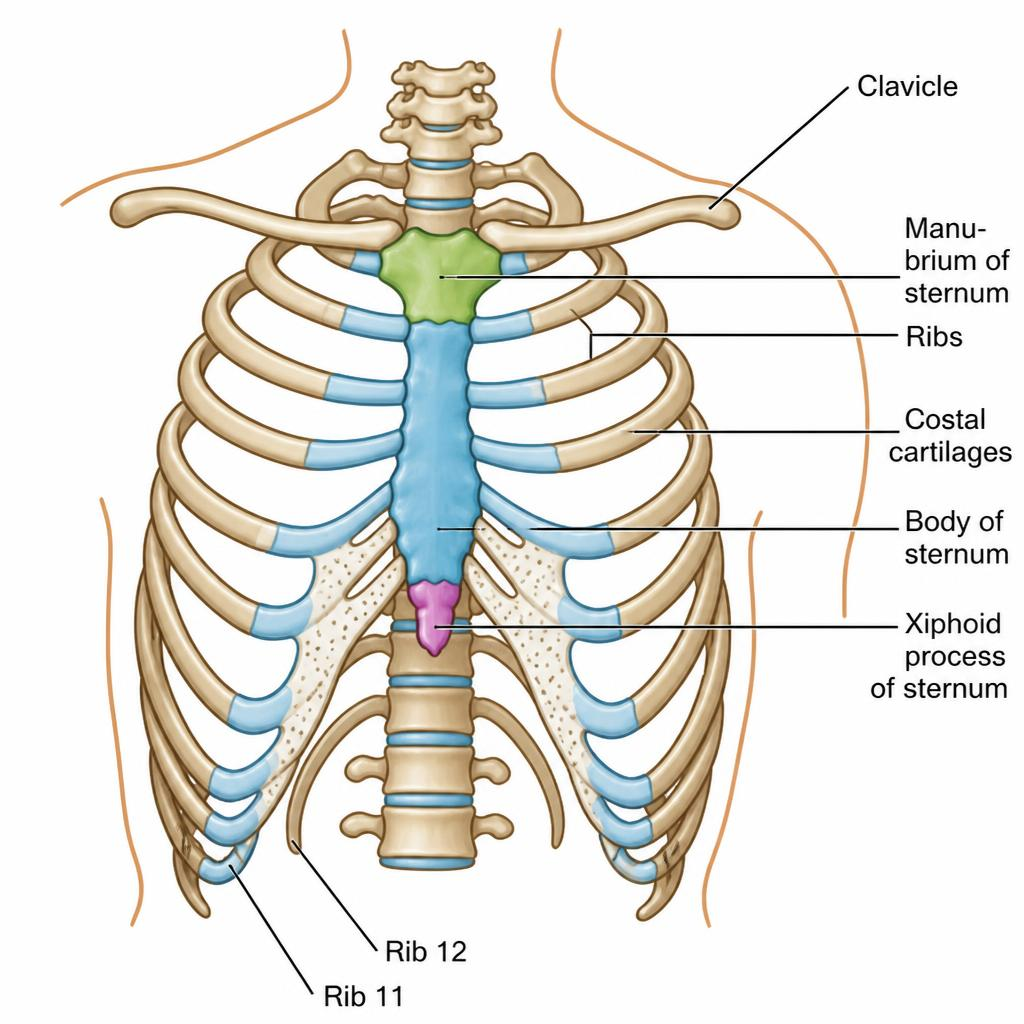
Humans have 12 pairs of ribs: 7 pairs of true ribs, 3 pairs of false (vertebrochondral) ribs and 2 pairs of floating ribs.
The floating ribs are the 11th and 12th pairs, which are not attached to the sternum ventrally. So floating ribs - 2 pairs is correct.
The collar bones (clavicles) are 1 pair, not 3 pairs.
The salivary glands are 3 pairs (parotid, sub-maxillary or sub-mandibular, and sub-lingual), not 1 pair.
The cranial nerves in humans are 12 pairs, not 10 pairs.
So the anatomically correct statement is floating ribs - 2 pairs.
Types of muscle
-
The type of muscles present in ourMuscles of the limbs, such as those of the thigh and upper arm, are skeletal muscles: they are attached to bones, have a striped appearance (striated) and are under the control of the will (voluntary).
So 'thigh muscles are striated and voluntary' is correct, and the upper arm does not have smooth muscle.
Heart muscle is cardiac muscle: it is involuntary but striated, not unstriated.
Intestinal muscle is visceral (smooth) muscle: it is unstriated and involuntary, with spindle-shaped (fusiform) fibres.
Hence the correct statement is that the muscles of the thigh are striated and voluntary. -
Which one of the following is the correct pairing of a body part and the kind of muscle tissue that moves it?The iris contains circular and radial smooth muscle fibres that change the size of the pupil; they are not under the control of the will. So 'iris – involuntary smooth muscle' is correct.
The heart wall is made of cardiac muscle, which is involuntary but striated.
The biceps of the upper arm is a skeletal muscle: striated and voluntary.
The muscles of the abdominal wall are also skeletal (striated, voluntary) muscles.
Hence the correct pairing is iris – involuntary smooth muscle.
Structure of Contractile Proteins
-
The contractile protein of skeletal muscle involving ATPase activity is -The thick filaments of a myofibril are made of the protein myosin, and the thin filaments are made of actin along with tropomyosin and troponin.
Each myosin molecule (meromyosin) has a globular head with a short arm and a tail.
The globular head is an active ATPase enzyme; it has binding sites for ATP and active sites for actin.
It hydrolyses ATP, and the energy released is used to form cross bridges with actin and to pull the thin filaments towards the centre of the A band (sliding filament theory).
Actin has no ATPase activity in contraction.
Tropomyosin and troponin are regulatory proteins: they mask the active sites on actin in the resting state and uncover them when $Ca^{2+}$ binds to troponin.
So the contractile protein with ATPase activity is myosin.
Skeletal System: Cartilage
-
Which cartilage is present on the end of long bones -The ends (articular surfaces) of long bones at synovial joints are covered with hyaline cartilage, called articular cartilage.
Its smooth, glassy surface reduces friction and absorbs shock during movement.
Elastic cartilage is found in the pinna and epiglottis, fibrous cartilage in intervertebral discs and the pubic symphysis, and calcified cartilage in parts of long bones of frogs and in the suprascapula.
So hyaline cartilage is present at the ends of long bones.
Structure of Skeletal Muscle
-
What is sarcomere : -A myofibril shows alternate dark (A) bands and light (I) bands. A thin Z-line runs through the middle of each I-band.
The portion of the myofibril between two successive Z-lines is called a sarcomere. It is the functional (contractile) unit of the muscle.
So a sarcomere is the part between two Z-lines.
Structure of Bone
-
What happens if bone of frog is kept in dilute hydrochloric acid :Bone consists of an organic matrix (mainly the protein ossein/collagen) hardened by inorganic salts, chiefly calcium phosphate and calcium carbonate.
Dilute HCl dissolves the calcium salts (decalcification), leaving only the organic matrix.
Without the minerals, the bone keeps its shape but becomes soft and flexible (it can even be tied in a knot).
So the bone will become flexible.
That is every question in Locomotion and Movement for this filter.
Want a score?
Answers here are not saved. Practise as a test to be marked and see your progress.
Practise as a test