Looking for classes? Ksquare Career Institute, Bengaluru →

Biology
Body Fluids and Circulation
83 questions from 38 papers, each with its answer.
- 83 questions
- 38 papers
- 2.35% of Biology
Regulation of Cardiac Activity
-
Cardiac activities of the heart are regulated by:
A. Nodal tissue
B. A special neural centre in the medulla oblongata
C. Adrenal medullary hormones
D. Adrenal cortical hormones
Choose the correct answer from the options given below:Heart activities are regulated intrinsically by nodal tissue and extrinsically by medulla oblongata and adrenal medullary hormones.
Cardiac activities are auto-regulated intrinsically by nodal musculature (myogenic heart). Extrinsic neural regulation occurs via the cardiac centre in the medulla oblongata (ANS), and hormonal regulation is mediated by catecholamines from the adrenal medulla. Cortical hormones do not regulate heart rate directly. -
How do parasympathetic neural signals affect the working of the heart?Parasympathetic signals (through the vagus nerve) decrease the rate of heartbeat and the speed of conduction of the action potential, and so reduce the cardiac output.
Electrocardiograph (ECG)
-
The QRS complex in a standard ECG represents:In a standard ECG, the QRS complex represents the depolarisation of the ventricles, which initiates ventricular contraction. (P wave – depolarisation of atria; T wave – repolarisation of ventricles.)
Cardiac Cycle
-
Blood pressure in the mammalian aorta is maximum duringDuring left ventricular systole, blood is pumped into the aorta with great force, so aortic pressure is maximum then.
Blood – Coagulation
-
Which enzyme is responsible for the conversion of inactive fibrinogens to fibrins?
Blood Groups
-
Persons with 'AB' blood group are called 'Universal recipients'. This is due to:
-
Person with blood group AB is considered as universal recipient because he has:Blood group AB has both A and B antigens on the RBCs and no anti-A or anti-B antibodies in the plasma, so it can receive blood of any group.
-
A certain road accident patient with unknown blood group needs immediate blood transfusion. His one doctor friend at once offers his blood. What was the blood group of the donor?Blood group O has no A or B antigens on the RBCs, so it is not agglutinated by the recipient's antibodies.
It can be given to persons of any blood group, so O is the universal donor. -
A person with unknown blood group under ABO system has suffered much blood loss in an accident and needs immediate blood transfusion. His one friend, who has a valid certificate of his own blood type, offers for blood donation without delay. What would have been the type of blood group of the donor friend?Blood groups are decided by the antigens A and B on the surface of RBCs; the plasma of the recipient contains antibodies against the antigens that are absent from his own RBCs.
A transfusion is safe only if the donor's RBCs carry no antigen that the recipient's antibodies can attack.
Group O RBCs have neither antigen A nor antigen B, so they are not clumped by anti-A or anti-B antibodies of any recipient.
Therefore group O blood can be given to persons of any ABO group; O is the universal donor.
Since the recipient's group is unknown and the friend could donate without delay, the friend's blood group must be type O. -
The most popularly known blood grouping is the ABO grouping. It is named ABO and not ABC, because "O" in it refers to havingABO grouping is based on the presence or absence of two surface antigens, A and B, on the RBCs.
Group A has antigen A, group B has antigen B and group AB has both antigens.
Group O has neither antigen A nor antigen B on its RBCs ('O' stands for nil or zero); its plasma has both anti-A and anti-B antibodies.
Since it lacks both antigens, group O blood can be donated to all groups (universal donor).
Hence 'O' refers to having no antigens A and B on RBCs. -
What is correct for blood group 'O' : -Blood group O has neither antigen A nor antigen B on the RBCs.
Its plasma contains both anti-A (a) and anti-B (b) antibodies.
(Group A has antigen A and anti-B; group AB has both antigens and no antibodies.)
So group O has no antigens but both a and b antibodies.
Hepatic portal system
-
A unique vascular connection between the digestive tract and liver is calledThe hepatic portal system is a unique vascular connection that carries blood from the digestive tract to the liver via the hepatic portal vein.
-
The hepatic portal vein drains blood to liver from
The hepatic portal vein brings blood from the intestine to the liver.
In the hepatic portal system, the hepatic portal vein carries the maximum amount of nutrients from the intestine to the liver.
Formed elements of blood
-
Which type of white blood cells are concerned with the release of histamine and the natural anti-coagulant heparin?Basophils are the least abundant white blood cells, forming only about 0.5 to 1 percent of the total leucocytes.
They are granulocytes whose granules stain with basic dyes.
Basophils secrete histamine, serotonin and heparin, and are involved in inflammatory reactions.
Histamine dilates the blood vessels during inflammation and allergic reactions, and heparin is a natural anti-coagulant that prevents the clotting of blood inside the vessels.
Eosinophils resist infections and are associated with allergic reactions, while neutrophils and monocytes are phagocytic cells.
So the cells concerned with the release of histamine and heparin are the basophils. -
The most active phagocytic white blood cells are:Phagocytosis is the engulfing and destruction of foreign organisms and particles by cells.
Neutrophils are the most abundant white blood cells (60 to 65 percent of the total WBCs) and are phagocytic.
Monocytes (6 to 8 percent) are also phagocytic; they leave the blood and change into macrophages in the tissues.
Neutrophils and monocytes are the phagocytic cells that destroy foreign organisms entering the body.
Eosinophils resist infections and are associated with allergic reactions, and lymphocytes (B and T cells) are responsible for the specific immune responses; they are not the main phagocytes.
So the most active phagocytic white blood cells are neutrophils and monocytes.
Nodal tissue - SA node
-
All the components of the nodal tissue are autoexcitable. Why does the SA node act as the normal pacemaker?
Cardiac cycle - SA node
-
The number of action potentials generated by sino-atrial node (SAN) in a healthy human is _______ per minute.Reference: NCERT Class XI, page 199.
Coagulation of blood
-
Which of the following statements is incorrect?Reference: NCERT Class XI, page 186.
-
A drop of each of the following, is placed separately on four slides. Which of them will not coagulate?Coagulation needs the clotting factors, the most important being fibrinogen, which is converted into insoluble fibrin threads.
Blood serum is plasma without the clotting factors: it is the pale yellow fluid left after the blood has clotted.
Since serum has no fibrinogen and other clotting materials, it cannot take part in clotting and will not coagulate.
Blood plasma contains fibrinogen, so it coagulates.
Whole blood from the pulmonary vein contains all the clotting factors and platelets, so it coagulates.
Lymph from the thoracic duct also contains fibrinogen and can clot, though slowly.
So the drop that will not coagulate is blood serum. -
Which of the following substances, if introduced into the blood stream, would cause coagulation of blood at the site of its introduction -Thromboplastin (thrombokinase) is released from injured tissues and platelets and initiates the clotting process.
In the presence of $Ca^{2+}$, thromboplastin activates the conversion of inactive prothrombin into active thrombin.
Thrombin converts the soluble plasma protein fibrinogen into insoluble fibrin threads, which form a network that traps blood cells and forms the clot.
So if thromboplastin is introduced into the blood stream, it will start this sequence and cause coagulation at the site of its introduction.
Fibrinogen and prothrombin are already present in normal blood in the inactive state, so adding them does not start clotting.
Heparin is an anticoagulant that prevents clotting.
So the substance is thromboplastin. -
Continuous bleeding from an injured part of body is due to deficiency of ; -Vitamin K is needed by the liver for the synthesis of prothrombin and other clotting factors (VII, IX and X).
In its deficiency, these factors are not formed in sufficient amounts, so blood does not clot properly and bleeding from an injury continues for a long time.
Vitamin A deficiency causes night blindness, vitamin B deficiencies cause beri-beri and pellagra, and vitamin E deficiency affects fertility.
So continuous bleeding is due to deficiency of vitamin K.
Human heart - valves
-
The opening between the right atrium and the right ventricle is guarded by _________.Reference: NCERT Class XI, page 198.
-
Match the items given in Column I with those in Column II and select the correct option given below:
Pick the matching item from Column II for each row.
Column I
- a. Tricuspid valve
- b. Bicuspid valve
- c. Semilunar valve
Column II
- i. Between left atrium and left ventricle
- ii. Between right ventricle and pulmonary artery
- iii. Between right atrium and right ventricle
Correct answer: a → iii, b → i, c → ii
Tricuspid = right AV, bicuspid = left AV, semilunar = at arterial exits.
Tricuspid valves are AV valves present between the right atrium and right ventricle. Bicuspid valves are AV valves present between the left atrium and left ventricle. Semilunar valves are present at the openings of the aorta and pulmonary artery. Correct match: a-iii, b-i, c-ii.
Blood – plasma proteins
-
Match the items given in Column I with those in Column II and select the correct option given below:
Pick the matching item from Column II for each row.
Column I
- a. Fibrinogen
- b. Globulin
- c. Albumin
Column II
- i. Osmotic balance
- ii. Blood clotting
- iii. Defence mechanism
Correct answer: a → ii, b → iii, c → i
Fibrinogen = clotting, globulin = defence, albumin = osmotic balance.
Fibrinogen forms fibrin strands during coagulation. These strands form a network whose meshes are occupied by blood cells; this structure finally forms a clot. Antibodies are derived from the $\gamma$-globulin fraction of plasma proteins, which means globulins are involved in defence mechanisms. Albumin is a plasma protein mainly responsible for blood colloidal osmotic pressure (osmotic balance). Correct match: a-ii, b-iii, c-i.
Formed elements – platelets
-
Name the blood cells, whose reduction in number can cause clotting disorder, leading to excessive loss of blood from the body.
Plasma and serum
-
Serum differs from blood in:
Composition of blood
-
Which one of the following is correct?Blood is a fluid connective tissue made of about 55% plasma and 45% formed elements (RBCs, WBCs and platelets).
Double circulation
-
Which one of the following animals has two separate circulatory pathways?
Plasma proteins
-
If you suspect major deficiency of antibodies in a person, to which of the following would you look for confirmatory evidence?
-
If you suspect major deficiency of antibodies in a person, to which of the following would you look for confirmatory evidence?The major proteins of blood plasma are fibrinogen, globulins and albumins.
Globulins are primarily involved in the defence mechanisms of the body.
Antibodies are immunoglobulins; they belong to the $\gamma$-globulin (gamma globulin) fraction of the serum globulins, while the $\alpha$ and $\beta$ globulins transport hormones and other substances.
So a major deficiency of antibodies will show up as a low level of serum globulins, which is the confirmatory evidence.
Fibrinogen is needed for the clotting or coagulation of blood.
Albumins help in maintaining the osmotic balance of the blood.
Haemocytes are blood cells, not the proteins that make up antibodies.
Heart sounds
-
Doctors use stethoscope to hear the sound produced during each cardiac cycle. The second sound is heard when:
Electrocardiograph
-
The diagram given here is the standard ECG of a normal person. The P-wave represents the:
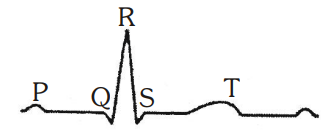 The P-wave represents the electrical excitation (depolarisation) of the atria, which leads to the contraction of both atria.
-
In a standard ECG which one of the following alphabets is the correct representation of the respective activity of the human heart?The P-wave represents the electrical excitation (depolarisation) of the atria, which leads to the contraction of both atria. This is correct.
The QRS complex (including R and S) represents the depolarisation of the ventricles, which initiates ventricular contraction; the contraction starts shortly after Q and marks the beginning of systole. So R is not repolarisation, and S is not the start of systole.
The T-wave represents the return of the ventricles from the excited to the normal state (repolarisation); the end of the T-wave marks the end of systole, not of diastole.
Hence the correct representation is P – depolarisation of the atria.
Formed elements
-
Which one of the following human organs is often called the “graveyard” of RBCs?RBCs have an average life span of about 120 days.
Old and worn-out RBCs are trapped and destroyed by the macrophages of the spleen.
Because the destruction of RBCs takes place mainly here, the spleen is called the graveyard of RBCs.
The liver only processes the haemoglobin breakdown products into bile pigments, the gall bladder stores bile and the kidney filters blood; none of them is the main site of RBC destruction.
Hence the organ is the spleen.
Blood vessels
-
Arteries are best defined as the vessels whichArteries are defined by the direction of blood flow: they carry blood away from the heart to the different organs.
They cannot be defined by the type of blood they carry, because the pulmonary artery carries deoxygenated blood from the heart to the lungs.
A vessel that carries blood from one visceral organ to another is a portal vein (e.g., the hepatic portal vein).
Breaking up into capillaries that reunite to form a vein is not a defining feature; it does not distinguish an artery from a portal vessel.
Hence arteries are best defined as vessels that carry blood away from the heart to different organs. -
Fastest distribution of some injectible material/medicine and with no risk of any kind can be achieved by injecting it into theA substance injected into a vein enters the blood stream directly; it is carried to the heart and then pumped to the whole body within a very short time. So intravenous injection gives the fastest distribution.
Veins are superficial, thin-walled and carry blood at low pressure, so they can be punctured safely and the bleeding stops easily.
Arteries are deep-seated and carry blood at high pressure; puncturing them is risky, and the material would reach mainly the organ supplied by that artery.
From muscles the absorption is slow (intramuscular injections are used for a slower or local effect), and lymph flows very slowly.
Hence the material should be injected into the veins.
Human heart
-
'Bundle of His' is a part of which one of the following organs in humans?The heart has a specialised nodal (cardiac) musculature that generates and conducts the impulse.
It consists of the sino-atrial node (SAN), the atrio-ventricular node (AVN), the atrio-ventricular bundle, its right and left branches and the Purkinje fibres.
The atrio-ventricular bundle continues from the AVN, passes through the atrio-ventricular septa and divides into right and left bundles; together with the Purkinje fibres these are known as the bundle of His.
It conducts the impulse from the AVN to the ventricular muscles.
Hence the bundle of His is a part of the heart.
Blood
-
Which one of the following plasma proteins is involved in the coagulation of blood?The major plasma proteins are fibrinogen, globulins and albumins.
Fibrinogen is needed for clotting (coagulation) of blood: the enzyme thrombin converts soluble fibrinogen into insoluble fibrin threads, which form a network that traps the formed elements to make the clot.
Albumins help in maintaining the osmotic balance.
Globulins are primarily involved in the defence mechanisms of the body.
Serum amylase is an enzyme and has no role in clotting.
Hence the plasma protein involved in coagulation is fibrinogen. -
The haemoglobin content per 100 ml of blood of a normal healthy human adult isRBCs contain the red, iron-containing complex protein haemoglobin, which carries the respiratory gases.
NCERT states that a healthy individual has 12–16 g of haemoglobin in every 100 ml of blood.
Values below this range indicate anaemia.
Hence the haemoglobin content is 12 – 16 g per 100 ml of blood. -
Globulins contained in human blood plasma are primarily involved inThe major proteins of plasma are fibrinogen, globulins and albumins.
Fibrinogen is needed for the clotting (coagulation) of blood.
Globulins are primarily involved in the defence mechanisms of the body (the antibodies are gamma globulins, i.e., immunoglobulins).
Albumins help in maintaining the osmotic balance.
Oxygen is transported by the haemoglobin of RBCs, not by plasma proteins.
Hence globulins are primarily involved in the defence mechanisms of the body.
Disorders of circulatory system
-
Which one of the following statements is correct regarding blood pressure?Normal blood pressure is 120/80 mm Hg (systolic/diastolic).
If repeated checks show a blood pressure of 140/90 mm Hg or higher, it is hypertension.
190/110 mm Hg is very high blood pressure; high blood pressure leads to heart diseases and also affects vital organs like the brain and kidney. This statement is correct.
130/90 mm Hg is below the 140/90 limit for hypertension, so it is not regarded as high blood pressure requiring treatment.
100/55 and 105/50 mm Hg are low values (hypotension); they are neither ideal nor do they make a person very active.
Hence the correct statement is that 190/110 mm Hg may harm vital organs like brain and kidney.
Blood vessels, blood groups and clotting
-
Given below are four statements (a–d) regarding human blood circulatory system
(a) Arteries are thick-walled and have narrow lumen as compared to veins
(b) Angina is acute chest pain when the blood circulation to the brain is reduced
(c) Persons with blood group AB can donate blood to any person with any blood group under ABO system
(d) Calcium ions play a very important role in blood clotting
Which two of the above statements are correct?(a) is correct: arteries have a thick tunica media and a narrow lumen because they carry blood at high pressure; veins have thinner walls and a wider lumen.
(b) is wrong: angina (angina pectoris) is acute chest pain that appears when not enough oxygen reaches the heart muscle, i.e., when blood flow to the heart, not the brain, is reduced.
(c) is wrong: persons with blood group AB can accept blood from all groups (universal recipients); the universal donors are persons with group O.
(d) is correct: calcium ions play a very important role in clotting; they are needed for the formation of thrombokinase and the conversion of prothrombin into thrombin.
Hence the correct statements are (a) and (d).
Lymph
-
Compared to blood our lymph hasAs blood passes through the capillaries, some water and small water-soluble substances move out into the spaces between the cells, leaving the larger proteins and most of the formed elements in the blood vessels. This fluid is the tissue fluid; when it enters the lymphatic system it is called lymph.
Lymph is a colourless fluid; it has the same mineral distribution as plasma but fewer proteins.
It contains no RBCs (hence no colour), but it contains specialised lymphocytes, which are responsible for the immune responses of the body.
So lymph does have a fluid part with some proteins, and it lacks RBCs.
Hence, compared to blood, lymph has more WBCs (lymphocytes) and no RBCs. -
Which of the following statement is true for lymph : -As blood passes through capillaries, some water and small solutes filter out into the tissue spaces, forming tissue fluid. This fluid is collected by lymph vessels as lymph.
RBCs and large plasma proteins cannot pass through the capillary walls, so they are absent (or present only in small amounts) in lymph.
Lymph contains plasma-like fluid with fewer proteins, and many white blood cells (especially lymphocytes); platelets are also usually absent.
So lymph contains all components of blood except RBCs and some proteins.
Erythrocytes
-
Which one of the following mammalian cells is not capable of metabolising glucose to carbon-dioxide aerobically?The complete aerobic oxidation of glucose to $CO_2$ and water takes place through the Krebs cycle and the electron transport system, which are located in the mitochondria.
Mature mammalian red blood cells lack a nucleus, mitochondria and other cell organelles; this leaves more room for haemoglobin.
Since they do not have mitochondria, the red blood cells cannot carry out the Krebs cycle.
They obtain their energy only by anaerobic glycolysis, in which glucose is converted to lactic acid, so they respire only anaerobically.
This also ensures that they do not use up the oxygen they carry.
Unstriated muscle cells, liver cells and white blood cells all have mitochondria and can oxidise glucose aerobically.
So the cells that cannot metabolise glucose to carbon dioxide aerobically are the red blood cells.
Open and Closed Circulatory Systems
-
Which one of the following has an open circulatory system ?In an open circulatory system the blood pumped by the heart passes through large vessels into open spaces or body cavities called sinuses, so the tissues are bathed directly in the blood.
It is found in arthropods and in most molluscs.
Periplaneta (the cockroach) is an arthropod; its body cavity is a haemocoel filled with haemolymph, and its blood vessels are poorly developed. So it has an open circulatory system.
Pheretima (the earthworm) is an annelid with a closed circulatory system.
Hirudinaria (the leech) is also an annelid; its blood flows in closed haemocoelomic channels.
Octopus is a cephalopod mollusc; unlike other molluscs, cephalopods have a closed circulatory system.
So the animal with an open circulatory system is Periplaneta.
Conducting System of Heart
-
The cardiac pacemaker in a patient fails to function normally. The doctors find that an artificial pacemaker is to be grafted in him. It is likely that it will be grafted at the site of -The human heart is myogenic: the heart beat starts in the heart muscle itself.
The sinoatrial (SA) node, a patch of nodal tissue in the right upper corner of the right atrium, generates the maximum number of action potentials (70–75 per minute). It initiates and maintains the rhythm of the heart, so it is called the pacemaker.
From the SA node the impulse spreads through the atria to the AV node, then along the bundle of His (AV bundle) and the Purkinje fibres to the ventricles. These parts conduct the impulse but do not normally set the rhythm.
When the natural pacemaker fails, the artificial pacemaker takes over its function. So it is placed to act at the site of the sinoatrial node.
So it will be grafted at the site of the sinuatrial node.
Cardiac Cycle: Conducting System
-
Impulse of heart beat originates from : -The human heart is myogenic: the heartbeat starts in the heart muscle itself, not from nerves.
The sinoatrial (SA) node, in the wall of the right atrium near the opening of the superior vena cava, generates the maximum number of action potentials (70–75 per minute) and starts each heartbeat. It is called the pacemaker.
The AV node only relays the impulse to the ventricles. The vagus and cardiac (sympathetic) nerves only change the rate of the beat.
So the impulse of the heartbeat originates from the S.A. node.
Formed Elements: Leucocytes
-
Which statement is true for WBC :White blood cells (leucocytes) are nucleated and are produced mainly in the red bone marrow (some lymphocytes mature in the thymus).
They can change shape and squeeze out through the walls of blood capillaries into the tissues. This is called diapedesis, and it lets them reach sites of infection.
A deficiency of WBCs (leucopenia) lowers immunity; leukaemia (a cancer) is associated with an excess of abnormal WBCs.
So the true statement is that WBCs can squeeze through blood capillaries.
That is every question in Body Fluids and Circulation for this filter.
Show all 83 questions Next: Excretory Products and their Elimination
Want a score?
Answers here are not saved. Practise as a test to be marked and see your progress.
Practise as a test