Looking for classes? Ksquare Career Institute, Bengaluru →

Biology
Biotechnology: Principles and Processes
132 questions from 36 papers, each with its answer.
- 132 questions
- 36 papers
- 3.74% of Biology
Polymerase Chain Reaction (PCR)
-
Following are the steps involved in the process of PCR. A. Annealing B. Amplification (~1 billion times) C. Denaturation D. Treatment with Taq polymerase and deoxynucleotides E. Extension. Choose the correct sequence of steps of PCR from the options given below:PCR proceeds through: Denaturation of the DNA strands (C) → Annealing of primers to the single-stranded DNA (A) → Treatment with Taq polymerase and deoxynucleotides for primer extension (D) → Extension of the new strand (E) → Amplification of the DNA (~1 billion times) after repeated cycles (B). Order: C → A → D → E → B.
Selectable Markers - Blue-White Screening
-
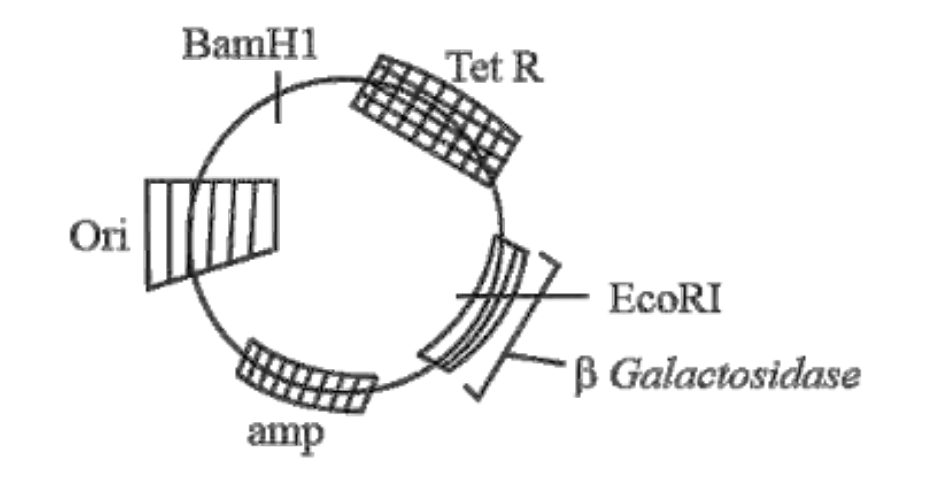
 In the represented plasmid, an alien piece of DNA is inserted at the EcoRI site within the $\beta$-Galactosidase gene. Which of the following strategies will be chosen to select the recombinant colonies?
Insertional inactivation of the $\beta$-galactosidase gene results in white recombinant colonies on chromogenic substrate (X-gal).
Insertion of recombinant foreign DNA into the coding region of $\beta$-galactosidase causes insertional inactivation. Non-recombinants retain active enzyme producing blue colonies with X-gal, while recombinants cannot produce active enzyme and appear white.
Gel Electrophoresis
-
Identify the incorrect statement related to gel electrophoresis.DNA fragments separated by gel electrophoresis cannot be seen directly; the gel must first be stained with a compound such as ethidium bromide, and the DNA bands are then visualised under UV radiation. Pure DNA fragments cannot be seen in visible light without staining, so the statement in option (a) is incorrect.
-
Given below are four statements pertaining to separation of DNA fragments using gel electrophoresis. Identify the incorrect statements. (a) DNA is negatively charged molecule and so it is loaded on gel towards the Anode terminal (b) DNA fragments travel along the surface of the gel whose concentration does not affect movement of DNA. (c) Smaller the size of DNA fragment larger is the distance it travels through it. (d) Pure DNA can be visualized directly by exposing UV radiation. Choose correct answer from the options given below
Tools of Recombinant DNA Technology
-
Match the organism with its use in biotechnology.
Pick the matching item from Column II for each row.
Column I
- A. Bacillus thuringiensis
- B. Thermus aquaticus
- C. Agrobacterium tumefaciens
- D. Salmonella typhimurium
Column II
- I. Cloning vector
- II. Construction of first rDNA molecule
- III. DNA polymerase
- IV. Cry proteins
Correct answer: A → IV, B → III, C → I, D → II
Somatic Hybridization Technique
-
Arrange the following steps of somatic hybridisation in a correct sequence. I. Digestion of cell walls. II. Isolation of naked protoplasts. III. Fusion of protoplasts to get hybrid protoplast. IV. Isolation of single cells from two different varieties of plants. V. Growing of hybrid protoplast to form a new plant. Choose the CORRECT answer from the options given below:
-
Which of the following are fused in somatic hybridization involving two varieties of plants?In somatic hybridisation, protoplasts (cells whose cell walls have been removed) from two different varieties of plants are fused to form hybrid protoplasts. These are then grown to form a new plant (somatic hybrid), e.g. pomato.
Bioreactors and Large-scale Production
-
Which of the following statements is incorrect?Bioreactors are used to produce large quantities (100–1000 litres) of bacterial cultures, not small-scale cultures – so this statement is incorrect. Bioreactors do have an agitator system, an oxygen delivery system and a foam control system, they provide optimal growth conditions (temperature, pH, substrate, salts, vitamins, oxygen), and the most commonly used ones are of the stirring type.
Tools of Recombinant DNA Technology – Gel Electrophoresis
-
Which one of the following statement is not true regarding gel electrophoresis technique?
Processes of Recombinant DNA Technology
-
Main steps in the formation of Recombinant DNA are given below. Arrange these steps in a correct sequence A. Insertion of recombinant DNA into the host cell. B. Cutting of DNA at specific location by restriction enzyme. C. Isolation of desired DNA fragment. D. Amplification of gene of interest using PCR. Choose the correct answer from the option given below:
The sequence is cutting with restriction enzyme, isolating the fragment, PCR amplification, then insertion into host.
Main steps in the formation of recombinant DNA in correct sequence are: B: Cutting of DNA at specific location by restriction enzyme. C: Isolation of desired DNA fragment by electrophoresis. D: Amplification of gene of interest using PCR. A: Insertion of recombinant DNA into the host cell.
PCR and Selectable Markers
-
Polymerase chain reaction is used in DNA amplificationReason: The ampicillin resistant gene is used as a selectable marker to check transformation
Restriction Enzymes
-
Given below are two statements: Statement I: Restriction endonucleases recognise specific sequence to cut DNA known as palindromic nucleotide sequence. Statement II: Restriction endonucleases cut the DNA strand a little away from the centre of the palindromic site In the light of the above statements, choose the most appropriate answer from the options given below.
-
Following statements describe the characteristics of the enzyme Restriction endonuclease. Identify the incorrect statement.
Cloning Vectors
-
Which of the following is not a desirable feature of a cloning vector?
Processes of Recombinant DNA Technology – PCR
-
Which of the following is not an application of PCR (Polymerase Chain Reaction)?
-
During the process of gene amplification using PCR, if very high temperature is not maintained in the beginning, then which of the following steps of PCR will be affected first?
Restriction endonucleases
-
Which of the following statements are NOT true regarding restriction endonucleases? I. They are called molecular scissors. II. These are the enzymes responsible for restricting the growth of bacteriophages in E. coli. III. They cut the DNA only at the centre of the palindromic sites. IV. They remove nucleotides only from the ends of DNA fragments. V. They recognise specific palindromic base-pair sequences. Choose the answer from the options given below:
Vectors and tools in biotechnology
-
Match List I with List II:
Pick the matching item from Column II for each row.
Column I
- i. Genetically modified organism
- ii. Thermostable DNA polymerase
- iii. Ti plasmid
- iv. pBR322
Column II
- a. $Agrobacterium\ tumefaciens$
- b. Bt cotton
- c. $Thermus\ aquaticus$
- d. $Escherichia\ coli$
Correct answer: i → b, ii → c, iii → a, iv → d
Gel electrophoresis and DNA visualization
-
Which of the following statements are correct with respect to DNA separation, isolation and visualization? I. The cutting of DNA is done by molecular scissors. II. The DNA fragments separate according to their size in an agarose gel, upon electrophoresis. III. The separated DNA fragments can be seen without staining when exposed to UV light. IV. The separated DNA fragments, when stained with ethidium bromide, can be seen in visible light. Choose the CORRECT answer from the options given below:
pBR322 vector - restriction sites and antibiotic resistance genes
-
Insertion of a foreign DNA at $Bam$HI site in an $E.\ coli$ cloning vector pBR322 results in the loss of antibiotic resistance towards:
Restriction enzymes and recombinant DNA technology
-
Recombinant DNA molecule can be created normally by cutting the vector DNA and source DNA respectively with:To create recombinant DNA, both the vector DNA and the source (foreign) DNA are typically cut using the same restriction enzyme so that the sticky/complementary ends generated can anneal together — hence Hind II (or the same enzyme) is used to cut both.
pBR322 cloning vector - restriction sites
-
Select the restriction endonuclease enzymes whose restriction sites are present for the tetracycline resistance ($tet^R$) gene in the pBR322 cloning vector.In the pBR322 vector, the tetracycline resistance ($tet^R$) gene contains unique restriction sites for Bam HI and Sal I, which are commonly used for inserting foreign DNA at this locus.
Restriction endonuclease EcoRI
-
Which of the following are correct about EcoRI? A. Cut the DNA with blunt end B. Cut the DNA with sticky end C. Recognise a specific palindromic sequence D. Cut the DNA between the base G and A when encounters the DNA sequence 'GAATTC' E. Exonuclease. Choose the correct answer from the options given below:EcoRI is a restriction endonuclease that recognises the specific palindromic sequence GAATTC (C) and cuts the DNA strand between the G and A bases (D), producing sticky/cohesive ends (B), not blunt ends (A is incorrect). It is an endonuclease, not an exonuclease (E is incorrect). So the correct statements are B, C and D only.
RNA interference (RNAi)
-
Given below are two statements: Statement I: RNA interference takes place in all Eukaryotic organisms as method of cellular defense. Statement II: RNAi involves the silencing of a specific mRNA due to a complementary single-stranded RNA molecule that binds and prevents translation of mRNA. In the light of the above statements, choose the correct answer from the options given below.RNA interference operates in all eukaryotic organisms as a defense mechanism against invading genetic elements (viruses, transposons), so Statement I is true. RNAi involves the binding of a complementary RNA molecule to a specific mRNA, silencing it and preventing its translation, so Statement II is also true.
Techniques and instruments in biotechnology
-
Match the following techniques or instruments with their usage:
Pick the matching item from Column II for each row.
Column I
- a. Bioreactor
- b. Electrophoresis
- c. PCR
- d. ELISA
Column II
- i. Separation of DNA fragments
- ii. Production of large quantities of products
- iii. Detection of pathogen, based on antigen-antibody reaction
- iv. Amplification of nucleic acids
Correct answer: a → ii, b → i, c → iv, d → iii
Bioreactor is used for production of large quantities of products (a-ii); Electrophoresis is used for separation of DNA fragments (b-i); PCR is used for amplification of nucleic acids (c-iv); ELISA is used for detection of pathogen based on antigen-antibody reaction (d-iii).
Gel electrophoresis - separation of DNA fragments
-
In a mixture, DNA fragments are separated byGel electrophoresis separates DNA fragments by size, using an electric field to move negatively charged DNA fragments through a gel matrix, with smaller fragments moving faster/farther than larger ones.
Role of antibiotic resistance genes
-
In Recombinant DNA technology antibiotics are usedIn this context, antibiotics are used to keep the culture medium free from unwanted/contaminating bacteria, while antibiotic resistance genes act as selectable markers to differentiate transformed from non-transformed cells.
Discovery of restriction endonucleases
-
First discovered restriction endonuclease that always cuts DNA molecule at a particular point by recognising a specific sequence of six base pairs isHind II was the first restriction endonuclease discovered, found to always cut DNA molecules at a particular point by recognising a specific sequence of six base pairs (a palindromic sequence).
Restriction enzyme digestion
-
Select the correct statement from the followingRestriction enzyme digestion involves incubating purified DNA molecules with the appropriate restriction enzymes under optimum reaction conditions (temperature, buffer, etc.) to cut the DNA at specific sites.
DNA isolation - spooling
-
Spooling isSpooling refers to the process of collecting precipitated/isolated DNA, which appears as fine threads, typically by winding it around a glass rod after precipitation with chilled ethanol.
Taq polymerase in PCR
-
Thermostable DNA polymerase used in PCR was isolated from:The thermostable DNA polymerase (Taq polymerase) used in PCR was isolated from the thermophilic bacterium Thermus aquaticus, which allows it to withstand the repeated high-temperature denaturation steps of the PCR cycle.
pBR322 vector - restriction sites within resistance genes
-
Ligation of foreign DNA at which of the following site will result in loss of tetracyclin resistance of pBR322:The $BamHI$ restriction site lies within the tetracycline resistance ($tet^R$) gene of pBR322, so ligating foreign DNA at this site disrupts (inactivates) the $tet^R$ gene, resulting in loss of tetracycline resistance.
Agrobacterium tumefaciens as a gene delivery vector
-
Which of the following statement is incorrect about Agrobacterium tumifaciens?Agrobacterium tumefaciens is used primarily as a vector for delivering genes of interest into plant (eukaryotic) host cells, not prokaryotic cells — so the statement that it is used for both prokaryotic and eukaryotic hosts is incorrect.
Tools and vectors in genetic engineering
-
Match List-I with List-II.
Pick the matching item from Column II for each row.
Column I
- A. Kanamycin
- B. ClaI
- C. Disarmed retroviruses
- D. Kanamycin R gene
Column II
- I. Delivers genes into animal cells
- II. Selectable marker
- III. Restriction site
- IV. Antibiotic resistance
Correct answer: A → IV, B → III, C → I, D → II
Kanamycin is an antibiotic used as a selection agent, related to antibiotic resistance (A-IV); ClaI is a restriction enzyme with a specific restriction site (B-III); Disarmed retroviruses are used to deliver genes into animal cells (C-I); the Kanamycin resistance gene ($Kan^R$) acts as a selectable marker (D-II).
Restriction enzymes as molecular scissors
-
Which of the following can act as molecular scissors?Restriction enzymes (restriction endonucleases) cut DNA at specific recognition sequences, acting as 'molecular scissors', while DNA ligase joins DNA fragments together.
Polymerase chain reaction
-
The figure below shows three steps (A, B, C) of Polymerase Chain Reaction (PCR). Select the option giving correct identification together with what it represents.
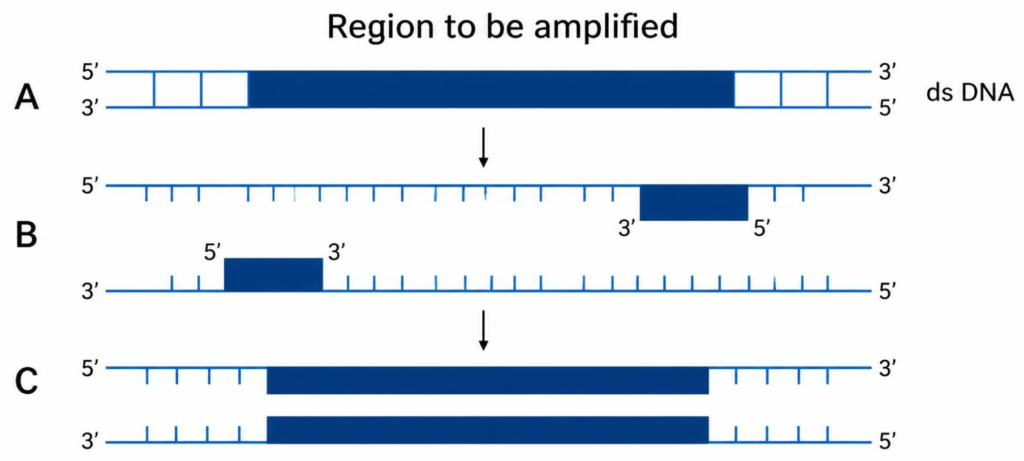 Each cycle of PCR has three steps in a fixed order: denaturation, annealing and extension.
Step A is denaturation: the double-stranded DNA is heated to a high temperature (about $94^\circ C$) so that the two strands separate. It is not annealing, and it does not occur at about $50^\circ C$.
Step B is annealing: two sets of primers bind to the complementary regions of the separated strands at a lower temperature. It is not denaturation.
Step C is extension: the thermostable DNA polymerase (Taq polymerase from $Thermus\ aquaticus$) extends the primers using the nucleotides provided, copying the template.
Hence the correct identification is C – extension in the presence of heat stable DNA polymerase.
Cloning vectors - plasmids
-
Plasmid has been used as vector because :A plasmid is a small circular DNA that replicates independently in bacteria.
It can be cut with a restriction enzyme and a piece of foreign (e.g. eukaryotic) DNA can be joined into it with DNA ligase, forming recombinant DNA. When put back into a bacterium, the plasmid replicates and copies the foreign gene too.
Antibiotic resistance genes are useful as selectable markers, but the basic reason a plasmid is used as a vector is its ability to carry joined foreign DNA and replicate.
So, as per the answer key, plasmid is used as a vector because it is a circular DNA that can be joined to eukaryotic DNA.
Restriction enzymes – blunt and sticky ends
-
Which of the following restriction enzymes produces blunt ends?
Selectable markers
-
The colonies of recombinant bacteria appear white in contrast to blue colonies of non-recombinant bacteria because of:Non-recombinant bacteria have an intact beta-galactosidase gene, so they act on the chromogenic substrate and give blue colonies.
In recombinants the insert inactivates this gene (insertional inactivation), so their colonies stay white.
Methods of gene transfer
-
Polyethylene glycol method is used forPolyethylene glycol (PEG) alters the cell membrane; it makes plant protoplasts take up DNA directly from the surrounding medium, and it also induces the fusion of protoplasts.
So PEG-mediated uptake is a chemical method of direct, vector-less gene transfer.
Other vector-less methods are micro-injection, electroporation and biolistics (gene gun).
It has no role in energy production from sewage, biodiesel production or seedless fruit production.
Hence the polyethylene glycol method is used for gene transfer without a vector.
Agrobacterium as a Natural Genetic Engineer
-
The most thoroughly studied of the known bacteria-plant interactions is the :-Agrobacterium tumefaciens infects wounds of many dicotyledonous plants and causes crown gall disease, a tumour-like growth.
It does this by transferring a piece of DNA called T-DNA from its tumour-inducing (Ti) plasmid into the plant genome. The T-DNA genes make the plant cells produce growth hormones (causing the gall) and opines, which the bacterium uses as food.
Because this natural gene transfer is the basis of plant genetic engineering (Agrobacterium is called a natural genetic engineer), the Agrobacterium–plant interaction has been studied in great molecular detail.
Stem nodulation of Sesbania, phosphate-solubilising bacteria and the Anabaena–Azolla symbiosis are important but have been studied much less thoroughly.
So the most thoroughly studied bacteria-plant interaction is gall formation on certain angiosperms by Agrobacterium.
That is every question in Biotechnology: Principles and Processes for this filter.
Show all 132 questions Next: Biotechnology and its Applications
Want a score?
Answers here are not saved. Practise as a test to be marked and see your progress.
Practise as a test