Looking for classes? Ksquare Career Institute, Bengaluru →

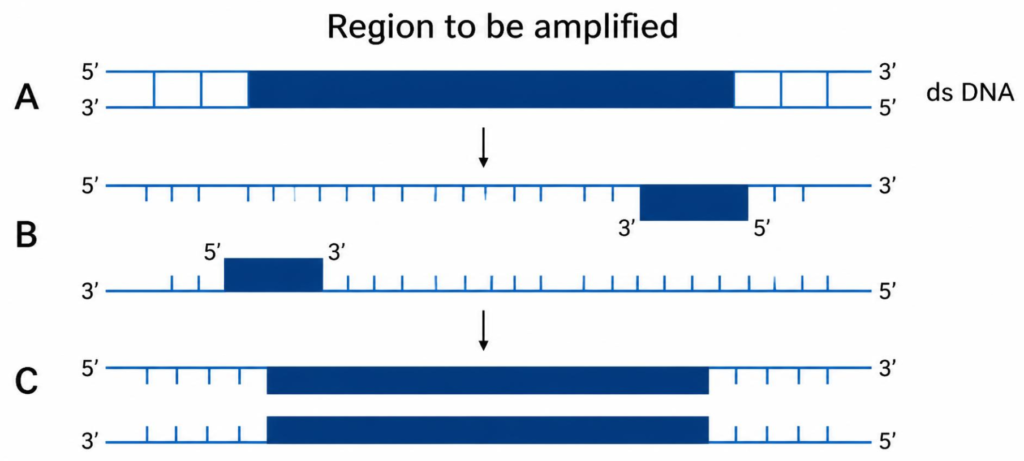
The figure below shows three steps (A, B, C) of Polymerase Chain Reaction (PCR). Select the option giving correct identification together with what it represents.
A
A – Annealing with two sets of primers
B
B – Denaturation at a temperature of about $98^\circ C$ separating the two DNA strands
C
A – Denaturation at a temperature of about $50^\circ C$
D
C – Extension in the presence of heat stable DNA polymerase
Detailed Solution
Each cycle of PCR has three steps in a fixed order: denaturation, annealing and extension.
Step A is denaturation: the double-stranded DNA is heated to a high temperature (about $94^\circ C$) so that the two strands separate. It is not annealing, and it does not occur at about $50^\circ C$.
Step B is annealing: two sets of primers bind to the complementary regions of the separated strands at a lower temperature. It is not denaturation.
Step C is extension: the thermostable DNA polymerase (Taq polymerase from $Thermus\ aquaticus$) extends the primers using the nucleotides provided, copying the template.
Hence the correct identification is C – extension in the presence of heat stable DNA polymerase.
Step A is denaturation: the double-stranded DNA is heated to a high temperature (about $94^\circ C$) so that the two strands separate. It is not annealing, and it does not occur at about $50^\circ C$.
Step B is annealing: two sets of primers bind to the complementary regions of the separated strands at a lower temperature. It is not denaturation.
Step C is extension: the thermostable DNA polymerase (Taq polymerase from $Thermus\ aquaticus$) extends the primers using the nucleotides provided, copying the template.
Hence the correct identification is C – extension in the presence of heat stable DNA polymerase.