Looking for classes? Ksquare Career Institute, Bengaluru →

Biotechnology: Principles and Processes
Polymerase chain reaction
3 questions from 3 papers, each with its answer.
- questions
- 3
- papers
- 3
- years asked, 2017–2026
- 1 of 10
- of Biotechnology: Principles and Processes
- 2.27%
Appears in
Concepts tested
- Polymerase chain reaction
- Steps of PCR
- Taq polymerase
All Questions
2026 Re-NEET 1 question
-
During PCR, primers bind to the DNA strands in the ______ step.Reference: NCERT Class XII, page 172.
2012 AIPMT-MAINS 1 question
-
The figure below shows three steps (A, B, C) of Polymerase Chain Reaction (PCR). Select the option giving correct identification together with what it represents.
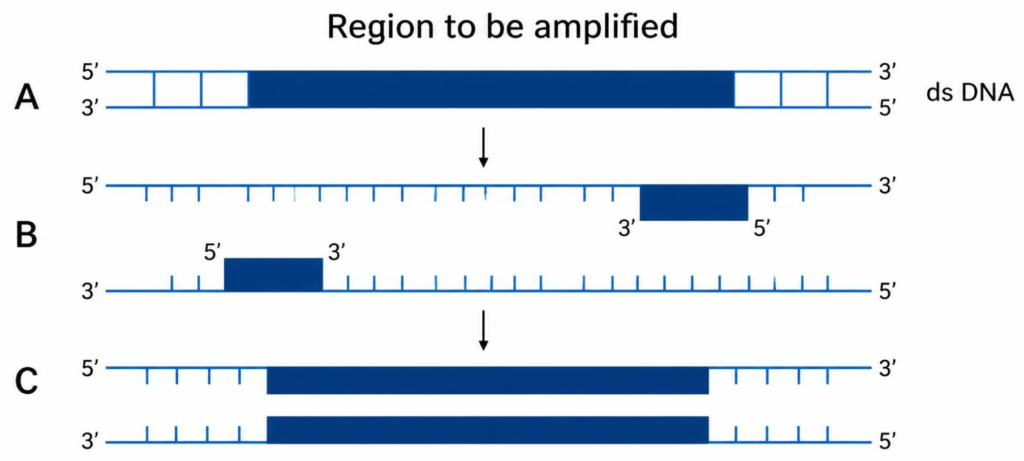 Each cycle of PCR has three steps in a fixed order: denaturation, annealing and extension.
Step A is denaturation: the double-stranded DNA is heated to a high temperature (about $94^\circ C$) so that the two strands separate. It is not annealing, and it does not occur at about $50^\circ C$.
Step B is annealing: two sets of primers bind to the complementary regions of the separated strands at a lower temperature. It is not denaturation.
Step C is extension: the thermostable DNA polymerase (Taq polymerase from $Thermus\ aquaticus$) extends the primers using the nucleotides provided, copying the template.
Hence the correct identification is C – extension in the presence of heat stable DNA polymerase.
2012 AIPMT-PRE 1 question
-
Which one is a true statement regarding DNA polymerase used in PCR?PCR uses a thermostable DNA polymerase (Taq polymerase) isolated from the bacterium Thermus aquaticus.
It remains active during the high-temperature denaturation step, so it need not be added again in each cycle.
Ligation is done by DNA ligase, and the enzyme is from a bacterium, not a virus.