Looking for classes? Ksquare Career Institute, Bengaluru →

Biotechnology: Principles and Processes
Cloning Vectors
9 questions from 8 papers, each with its answer.
- questions
- 9
- papers
- 8
- years asked, 2017–2026
- 1 of 10
- of Biotechnology: Principles and Processes
- 6.82%
Appears in
Concepts tested
- Components of pBR322
- features of a cloning vector
- Insert capacity of vectors
- Plasmids
- Selectable markers
- Ti plasmid
- Vector
- Vectors
- Vectors for animal cells
All Questions
2022 1 question
-
Which of the following is not a desirable feature of a cloning vector?
2015 AIPMT-II 1 question
-
The DNA molecules to which the gene of interest is integrated for cloning is called:
2014 AIPMT 1 question
-
Which vector can clone only a small fragment of DNA?A plasmid can carry only a small DNA insert (about 10 kb).
Cosmids carry about 45 kb, BACs 100–300 kb and YACs up to about 1000 kb.
2012 AIPMT-MAINS 1 question
-
In genetic engineering, the antibiotics are usedA cloning vector carries a selectable marker, which helps to identify and eliminate the non-transformants and selectively permit the growth of the transformants.
Genes coding for resistance to antibiotics such as ampicillin, tetracycline, chloramphenicol and kanamycin are the usual selectable markers (e.g., $amp^R$ and $tet^R$ in pBR322).
When the cells are plated on a medium containing the antibiotic, only the cells that have taken up the plasmid survive, so the transformants are selected.
The sequence from where replication starts is the origin of replication (ori), which is a different feature of the vector.
Hence, in genetic engineering, antibiotics are used as selectable markers.
Note: the coaching key in the source PDF marks 'To select healthy vectors'; the NCERT description (and the official answer) is that antibiotic resistance acts as a selectable marker, so that is taken as correct here.
2012 AIPMT-PRE 1 question
-
The figure below is the diagrammatic representation of the E. coli vector pBR322. Which one of the given options correctly identifies its certain component(s)?
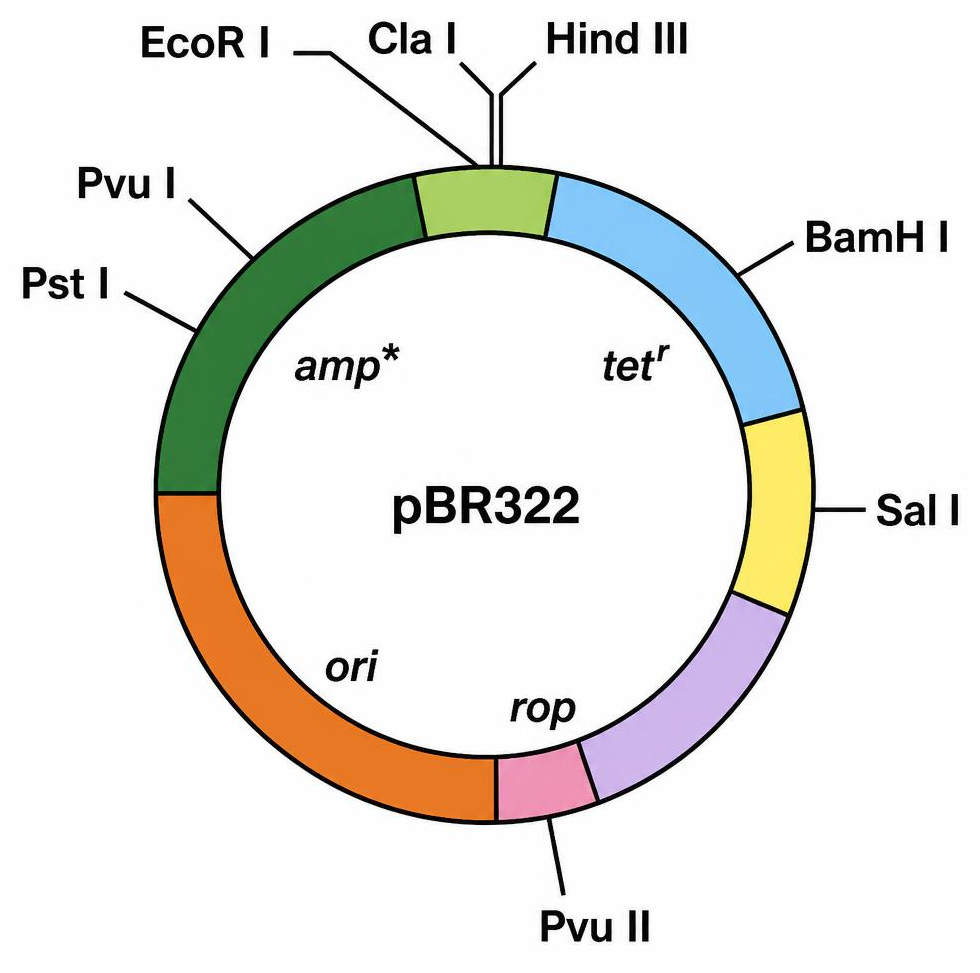 In pBR322, $amp^R$ and $tet^R$ are genes for resistance to ampicillin and tetracycline; they serve as selectable markers.
ori is the origin of replication, rop codes for proteins involved in the replication of the plasmid, and Hind III and EcoRI are restriction sites.
2010 AIPMT-MAINS 2 questions
-
Which of the following are used in gene cloning?Gene cloning needs a vector, a DNA molecule that can carry the foreign gene into a host cell and replicate there.
Plasmids are small, circular, extra-chromosomal DNA molecules of bacteria that replicate independently of the chromosomal DNA; they are the most commonly used cloning vectors (e.g., pBR322).
A nucleoid is the main genetic material of a bacterium, a mesosome is an infolding of the bacterial plasma membrane, and lomasomes are membranous structures found in fungal cells; none of them is used as a vector.
Hence plasmids are used in gene cloning. -
In genetic engineering, a DNA segment (gene) of interest is transferred to the host cell through a vector. Consider the following four agents (A–D) in this regard and select the correct option about which one or more of these can be used as a vector/vectors.
(A) A bacterium
(B) Plasmid
(C) $Plasmodium$
(D) BacteriophageA vector is a DNA molecule that can carry a foreign DNA segment into a host cell and replicate there independently of the control of the chromosomal DNA.
Plasmids are autonomously replicating circular extra-chromosomal DNA molecules of bacteria; they are used as vectors.
Bacteriophages are viruses that infect bacteria and have a high copy number of their genome inside the bacterial cell; they are also used as vectors.
A bacterium is the host into which the vector carries the gene, not the vector itself.
$Plasmodium$ is the malarial parasite, a protozoan, and has nothing to do with cloning.
Hence only (B) and (D) can be used as vectors.
2010 AIPMT-PRE 1 question
-
Which one of the following is used as vector for cloning genes into higher organisms?Retroviruses in animals have the natural ability to transform normal cells into cancerous cells by inserting their genetic material into the host genome.
This ability has been put to use: retroviruses have been disarmed (their disease-causing genes removed) and are now used to deliver desirable genes into animal cells.
In the same way, the Ti plasmid of $Agrobacterium\ tumefaciens$ is used for plants.
Baculovirus is an insect pathogen used as a biocontrol agent, $Salmonella\ typhimurium$ is a bacterium and $Rhizopus\ nigricans$ is a fungus; they are not used as cloning vectors for higher organisms.
Hence the vector is the retrovirus.
2009 AIPMT 1 question
-
Which one of the following is commonly used in transfer of foreign DNA into crop plants?$Agrobacterium\ tumefaciens$ is a pathogen of several dicot plants; it naturally delivers a piece of DNA, known as T-DNA, into the plant cell, transforming normal cells into a tumour (crown gall).
Its tumour-inducing (Ti) plasmid has been modified into a cloning vector that is no longer pathogenic but can still use this mechanism to deliver genes of interest into a variety of plants.
It is therefore described as a natural genetic engineer of plants.
$Penicillium$ and $Trichoderma$ are fungi, and $Meloidogyne\ incognita$ is a root-knot nematode; none of them is a gene-transfer agent.
Hence $Agrobacterium\ tumefaciens$ is commonly used.