Looking for classes? Ksquare Career Institute, Bengaluru →

Biology
Cell: The Unit of Life
137 questions from 38 papers, each with its answer.
- 137 questions
- 38 papers
- 3.89% of Biology
Ribosomes
-
Which of the following ribosomes are engaged in protein synthesis in animal cell :In an animal cell, protein synthesis takes place on ribosomes found free in the cytosol and bound to the rough endoplasmic reticulum and the outer nuclear membrane (which is continuous with the ER). Mitochondrial ribosomes also make a few proteins.
Ribosomes are assembled in the nucleolus but do not synthesise proteins there.
The option that correctly lists ribosomes engaged in protein synthesis, without wrongly restricting it, is the ribosomes on the nuclear membrane and ER.
So, as per the answer key, ribosomes that occur on the nuclear membrane and ER are engaged in protein synthesis.
Cell Organelles
-
Choose the correct statements regarding cell organelles and their inclusions. I. The endomembrane system includes Golgi complex, endoplasmic reticulum and mitochondria. II. Rough endoplasmic reticulum bears ribosomes on its surface. III. Both mitochondria and plastids have circular DNA. IV. A network of microtubules, microfilaments and intermediate filaments present in the cytoplasm is called cytoskeleton. V. Mitochondrion is a single membrane-bound structure. Choose the CORRECT answer from the options given below:
-
Match the columns and identify the correct option:
Pick the matching item from Column II for each row.
Column I
- a. Thylakoids
- b. Cristae
- c. Cisternae
- d. Chromatin
Column II
- i. Disc-shaped sacs in Golgi apparatus
- ii. Condensed structure of DNA
- iii. Flat membranous sacs in stroma
- iv. Infoldings in mitochondria
Correct answer: a → iii, b → iv, c → i, d → ii
-
Match the following and select the correct answer:
Pick the matching item from Column II for each row.
Column I
- a. Centriole
- b. Chlorophyll
- c. Cristae
- d. Ribozymes
Column II
- i. Infoldings in mitochondria
- ii. Thylakoids
- iii. Nucleic acids
- iv. Basal body of cilia or flagella
Correct answer: a → iv, b → ii, c → i, d → iii
Centriole forms the basal body of cilia or flagella (iv).
Chlorophyll is located in the thylakoids (ii).
Cristae are infoldings of the inner mitochondrial membrane (i).
Ribozymes are catalytic nucleic acids (RNA) (iii).
Correct match: a-iv, b-ii, c-i, d-iii.
Structure and Function of Cell Organelles
-
Match List-I with List-II regarding cell organelles and their functions/structural features.
Pick the matching item from Column II for each row.
Column I
- A. Nucleolus
- B. Centriole
- C. Leucoplasts
- D. Golgi apparatus
Column II
- I. Site of formation of glycolipid
- II. Organization like the cartwheel
- III. Site for active ribosomal RNA synthesis
- IV. For storing nutrients
Correct answer: A → III, B → II, C → IV, D → I
Nucleolus – site for active ribosomal RNA synthesis Centriole – organisation like a cartwheel (9 peripheral triplet microtubules) Leucoplasts – colourless plastids for storing nutrients (starch, oils, proteins) Golgi apparatus – important site of formation of glycoproteins and glycolipids Correct match: A-III, B-II, C-IV, D-I.
Ultrastructure of Centriole and Mitochondria
-
Match List-I with List-II regarding cell structures.
Pick the matching item from Column II for each row.
Column I
- A. Axoneme
- B. Cartwheel pattern
- C. Crista
- D. Satellite
Column II
- I. Centriole
- II. Cilia and flagella
- III. Chromosome
- IV. Mitochondria
Correct answer: A → II, B → I, C → IV, D → III
Axoneme – forms the core of cilia and flagella Cartwheel pattern – organisation of the centriole Crista – infoldings of the inner membrane of mitochondria Satellite – short segment (knob) of certain chromosomes Correct match: A-II, B-I, C-IV, D-III.
Membrane Structure of Mitochondria and Chloroplast
-
Given below are two statements: Statement I: Mitochondria and chloroplasts are both double membrane bound organelles. Statement II: Inner membrane of mitochondria is relatively less permeable, as compared to chloroplast. In the light of the above statements, choose the most appropriate answer from the options given below:Statement I is correct: both mitochondria and chloroplasts are double membrane bound organelles. Statement II is incorrect: the inner membranes of both mitochondria and chloroplasts are relatively impermeable, with specific transporters for selective transport. So Statement I is correct but Statement II is incorrect.
Cell Organelles – Endomembrane System
-
Which of the following are NOT considered as the part of endomembrane system? A. Mitochondria B. Endoplasmic Reticulum C. Chloroplasts D. Golgi complex E. Peroxisomes Choose the most appropriate answer from the options given below:
Mitochondria, chloroplasts and peroxisomes are not part of the endomembrane system.
The endomembrane system includes endoplasmic reticulum (ER), Golgi complex, lysosomes and vacuoles. Since the functions of the mitochondria, chloroplast and peroxisomes are not coordinated with the above components, these are not considered as part of the endomembrane system.
Chromosomes – Types Based on Centromere Position
-
Match List-I with List-II.
Pick the matching item from Column II for each row.
Column I
- A. Metacentric chromosome
- B. Acrocentric chromosome
- C. Sub-metacentric
- D. Telocentric chromosome
Column II
- I. Centromere situated close to the end forming one extremely short and one very long arms
- II. Centromere at the terminal end
- III. Centromere in the middle forming two equal arms of chromosomes
- IV. Centromere slightly away from the middle forming one shorter arm and one longer arm
Correct answer: A → III, B → I, C → IV, D → II
Prokaryotic Cells – Mycoplasma
-
Given below are two statements: Statement I: Mycoplasma can pass less than 1 micron filter size. Statement II: Mycoplasma are bacteria with cell wall In the light of the above statements, choose the most appropriate answer from the options given below.
Cell Organelles – Nucleus and Microbodies
-
Which of the following is an incorrect statement?
Chromosomes – Types and Structure
-
The shorter and longer arms of a submetacentric chromosome are referred to as:
Cell Organelles – DNA-containing Organelles
-
Which of the following pair of organelles does not contain DNA?
Cell Organelles – Endomembrane System (Lysosomes)
-
Which of the following statements is not correct?
Cell Organelles – Mitochondria
-
Which of the following statements regarding mitochondria is incorrect?
Nucleolus and rRNA synthesis
-
The biosynthesis of ribosomal RNA occurs in:The nucleolus is the site of synthesis of ribosomal RNA (rRNA) and assembly of ribosomal subunits.
Discoveries in cell biology
-
Match List-I with List-II (Scientist; Discovery/structure) and choose the correct answer from the options given below:
Pick the matching item from Column II for each row.
Column I
- A. Fleming
- B. Robert Brown
- C. George Palade
- D. Camillo Golgi
Column II
- I. Disc shaped sacs or cisternae near cell nucleus
- II. Chromatin
- III. Ribosomes
- IV. Nucleus
Correct answer: A → II, B → IV, C → III, D → I
Fleming (Flemming) discovered chromatin (A-II); Robert Brown discovered the nucleus (B-IV); George Palade discovered ribosomes (C-III); Camillo Golgi discovered the Golgi complex, described as disc-shaped sacs/cisternae near the nucleus (D-I).
Prokaryotic cell structures - mesosomes
-
Mesosome in a cell is a:Mesosomes are special structures formed by the extension of the plasma membrane into the cell (in the form of vesicles, tubules and lamellae) in prokaryotic cells, helping in cell wall formation, DNA replication and respiration.
Cell junctions
-
Which of the following statements is correct about the type of junction and their role in our body?Tight junctions prevent the leakage of substances across a tissue by sealing the space between adjacent cells. (Adhering junctions cement cells together; gap junctions facilitate communication between adjacent cells by connecting cytoplasm.)
Cell organelle components
-
Match List-I with List-II and choose the correct answer from the options given below:
Pick the matching item from Column II for each row.
Column I
- A. F1 Particles
- B. Histones
- C. Axoneme
- D. Cisternae
Column II
- I. Chromosomes
- II. Cilia
- III. Golgi apparatus
- IV. Mitochondria
Correct answer: A → IV, B → I, C → II, D → III
$F_1$ particles are associated with mitochondria (ATP synthase, A-IV); Histones are proteins associated with chromosomes (B-I); Axoneme is the internal structure of cilia (C-II); Cisternae are components of the Golgi apparatus (D-III).
Golgi apparatus structure and function
-
Given below are two statements: Statement I: Concentrically arranged cisternae of Golgi complex are arranged near the nucleus with distinct convex cis or maturing and concave trans or forming face. Statement II: A number of proteins are modified in the cisternae of Golgi complex before they are released from cis face. In the light of the above statements, choose the correct answer from the option below.The Golgi cisternae are actually arranged with a convex cis (forming) face and a concave trans (maturing) face — Statement I incorrectly swaps 'maturing' and 'forming' for the cis and trans faces, so it is false. Proteins modified in the Golgi cisternae are released from the trans face, not the cis face, so Statement II is also false.
Functions of cell organelles
-
Match the following columns and select the correct option:
Pick the matching item from Column II for each row.
Column I
- a. Smooth endoplasmic reticulum
- b. Rough endoplasmic reticulum
- c. Golgi complex
- d. Centriole
Column II
- i. Protein synthesis
- ii. Lipid synthesis
- iii. Glycosylation
- iv. Spindle formation
Correct answer: a → ii, b → i, c → iii, d → iv
Smooth endoplasmic reticulum is involved in lipid synthesis (a-ii); Rough endoplasmic reticulum is involved in protein synthesis (b-i); Golgi complex is involved in glycosylation (c-iii); Centriole is involved in spindle formation (d-iv).
Membrane transport - symport and antiport
-
During symport two different molecules move across the membrane:In symport, two different molecules move across the membrane simultaneously, in the same direction, using the same (single) carrier protein.
Mesosomes in bacteria
-
Given below are two statements:- Statement I: In bacteria, the mesosomes are formed by the extensions of plasma membrane. Statement II: The mesosomes, in bacteria, help in DNA replication and cell wall formation. In the light of the above statements, choose the most appropriate answer from the options given below:Mesosomes are indeed formed by extensions of the plasma membrane in bacteria (Statement I is true) and help in DNA replication, cell wall formation, and respiration (Statement II is true).
Functions of the Golgi apparatus
-
Which of the following statements are correct with respect of Golgi apparatus? (A) It is the important site of formation of glycoprotein and glycolipids. (B) It produces cellular energy in the form of ATP. (C) It modifies the protein synthesized by ribosomes on ER. (D) It facilitates the transport of ions. (E) It provides mechanical support. Choose the most appropriate answer from the options given below:The Golgi apparatus is the important site of formation of glycoproteins and glycolipids (A is correct), and it modifies proteins synthesised by ribosomes on the endoplasmic reticulum (C is correct). It does not produce cellular ATP (that's the mitochondrion's role; B is incorrect), does not facilitate ion transport (D is incorrect - that's more a function of specific membrane transporters/vacuoles), and does not provide mechanical support (E is incorrect). So A and C only.
Lysosomes
-
Hydrolytic enzymes which act on low pH are called as : -Lysosomes contain many hydrolytic enzymes, such as lipases, proteases, carbohydrases and nucleases.
These enzymes work best at an acidic pH (about 4.5–5) maintained inside the lysosome, so they are called acid hydrolases.
Protease and amylase are particular types of hydrolytic enzyme, not the general name; peroxidase is an oxidoreductase.
So hydrolytic enzymes acting at low pH are called hydrolases (acid hydrolases).
Prokaryotic cells - genetic material
-
Which of the following nucleic acids is present in an organism having 70S ribosomes only?
Endomembrane system
-
Identify the components labelled A, B, C and D in the diagram below from the list (i) to (viii) given along with.
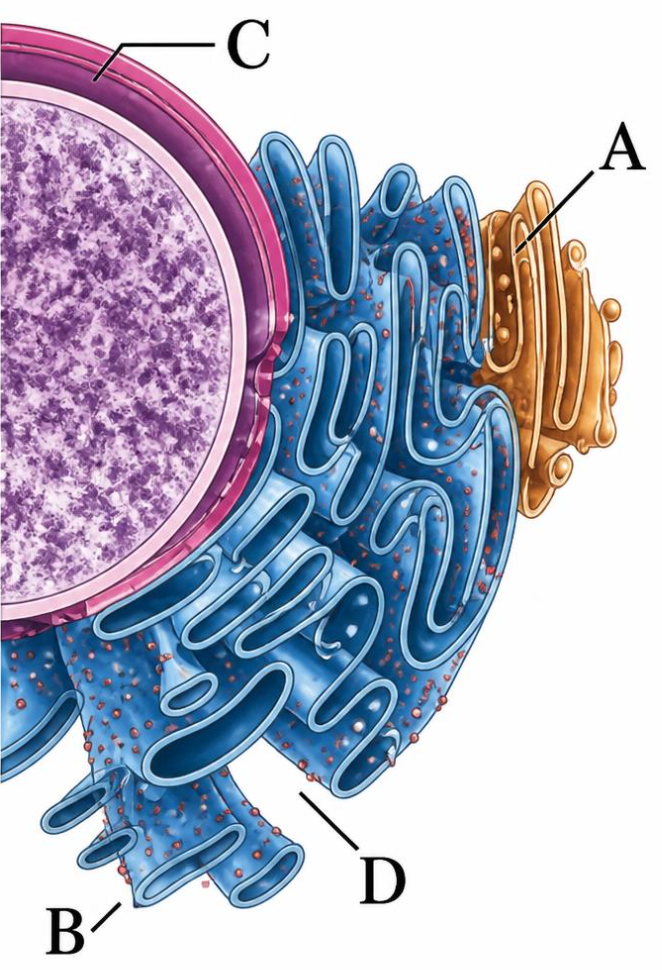
Components:
(i) Cristae of mitochondria
(ii) Inner membrane of mitochondria
(iii) Cytoplasm
(iv) Smooth endoplasmic reticulum
(v) Rough endoplasmic reticulum
(vi) Mitochondrial matrix
(vii) Cell vacuole
(viii) Nucleus
The correct components are:The diagram is the NCERT figure of the endoplasmic reticulum lying next to the nucleus.
A is the part of the reticulum whose flattened cisternae are studded with ribosomes on the outer surface: rough endoplasmic reticulum (v). It is continuous with the outer membrane of the nucleus and is the site of protein synthesis.
B is the tubular part of the reticulum without ribosomes: smooth endoplasmic reticulum (iv), the major site of lipid synthesis.
C is the large rounded body enclosed by the nuclear envelope with pores: the nucleus (viii).
D is the region lying outside these membranes: the cytoplasm (iii).
Hence A – (v), B – (iv), C – (viii), D – (iii). -
The main organelle involved in modification and routing of newly synthesized proteins to their destinations is -Proteins destined for secretion, for the plasma membrane or for lysosomes are synthesised on ribosomes attached to the rough endoplasmic reticulum.
As they enter the lumen of the ER they are folded, and their modification begins (for example the addition of oligosaccharides, i.e. glycosylation).
From the ER they are packed into vesicles and sent to the Golgi apparatus for further modification, sorting and dispatch to their destinations.
Among the given choices, the endoplasmic reticulum is the organelle involved in the modification and routing of newly synthesised proteins.
Lysosomes digest materials, and mitochondria and chloroplasts are concerned with energy conversion.
So the answer is the endoplasmic reticulum.
Chromosomes – types and special chromosomes
-
Select the incorrect match:
Polytene chromosomes occur in dipteran salivary glands.
Polytene chromosomes are found in the salivary glands of insects of order Diptera, not in oocytes of amphibians (which have lampbrush chromosomes).
Nucleus
-
Nuclear envelope is a derivative ofVesicles of rough ER gather during telophase to re-form the nuclear envelope that fragmented in prophase.
Polytene chromosomes
-
Balbiani rings are sites of:
Cytoskeleton
-
The solid linear cytoskeletal elements having a diameter of 6 nm and made up of a single type of monomer are known as:Microfilaments are solid, rod-like cytoskeletal elements about 6 nm in diameter made of a single protein, actin.
Microtubules are hollow (about 25 nm) and made of tubulin; intermediate filaments are about 10 nm.
Prokaryotic and eukaryotic cells
-
Which one of the following does not differ in E. coli and Chlamydomonas?E. coli is a prokaryote and Chlamydomonas is a eukaryote.
They differ in ribosomes (70S vs 80S), chromosomal organisation (naked circular DNA vs chromosomes with histones) and cell wall (peptidoglycan vs cellulose).
The cell membrane is structurally similar in both: a lipid bilayer with proteins.
Cell membrane
-
Keeping in view the 'fluid mosaic model' for the structure of cell membrane, which one of the following statements is correct with respect to the movement of lipids and proteins from one lipid monolayer to the other (described as flip-flop movement)?According to the fluid mosaic model of Singer and Nicolson (1972), the quasi-fluid nature of lipids enables the lateral movement of proteins within the overall bilayer.
Lipid molecules move freely sideways within their own monolayer (lateral diffusion) and also rotate.
Flip-flop is the transverse movement of a molecule from one monolayer to the other. For a lipid, the polar head would have to pass through the hydrophobic core of the bilayer, which is energetically unfavourable, so it occurs only rarely (it is helped by enzymes called flippases).
Proteins are much larger and have extensive hydrophilic regions; they cannot pass through the hydrophobic core, so they cannot flip-flop at all. This keeps the two faces of the membrane different (membrane asymmetry).
So the correct statement is: while lipids can rarely flip-flop, proteins cannot. -
According to the widely accepted 'fluid mosaic model', cell membranes are semi-fluid, where lipids and integral proteins can diffuse randomly. In recent years, this model has been modified in several respects. In this regard, which of the following statements is incorrect -In the fluid mosaic model, the quasi-fluid lipid bilayer allows the lateral movement of proteins within the membrane; so proteins can travel within the bilayer.
Integral proteins may remain partly or completely embedded within the lipid bilayer, and some proteins are confined to particular domains of the membrane by attachment to the cytoskeleton.
Flip-flop is the transverse movement of a molecule from one monolayer to the other. Proteins are large and have extensive hydrophilic regions, which cannot pass through the hydrophobic core of the bilayer.
So proteins cannot undergo flip-flop movement; even lipids do so only rarely.
This is why the two faces of a membrane remain different (membrane asymmetry).
So the incorrect statement is that proteins can also undergo flip-flop movements in the lipid bilayer.
Prokaryotic cell
-
In eubacteria, a cellular component that resembles eukaryotic cell isThe plasma membrane of bacteria is a selectively permeable lipid bilayer with proteins, structurally similar to that of eukaryotic cells (NCERT: 'this membrane is similar structurally to that of the eukaryotes').
Cell wall: the bacterial wall is made of peptidoglycan, unlike the cellulose wall of plants or the chitin wall of fungi.
Nucleus: bacteria have no membrane-bound nucleus; the genetic material lies naked as a nucleoid.
Ribosomes: bacteria have 70S ribosomes, whereas the cytoplasmic ribosomes of eukaryotes are 80S.
Hence the component that resembles the eukaryotic cell is the plasma membrane.
Chloroplast
-
Stroma in the chloroplast of higher plants containsThe chloroplast has a membrane system (grana thylakoids and stroma lamellae) and a fluid matrix, the stroma.
The membrane system traps light energy and synthesises ATP and NADPH; chlorophyll and the enzymes of the light-dependent reactions are located in the thylakoid membranes.
The stroma contains the enzymes required for the synthesis of carbohydrates, i.e., the enzymes of the light-independent (dark) reactions of the Calvin cycle, such as RuBisCO.
The stroma also contains small circular DNA and 70S ribosomes, but the feature most characteristic of the stroma, and the one asked for here, is the set of light-independent reaction enzymes.
Hence the stroma contains light-independent reaction enzymes.
Microbodies
-
In germinating seeds fatty acids are degraded exclusively in the:Glyoxysomes are single membrane-bound microbodies found in the fat-storing tissues (endosperm or cotyledons) of germinating oil seeds such as castor and groundnut.
They contain the enzymes for the $\beta$-oxidation of fatty acids and the enzymes of the glyoxylate cycle (isocitrate lyase and malate synthase).
In them the stored fatty acids are broken down to acetyl CoA, which is converted through the glyoxylate cycle into succinate and finally into sugars (gluconeogenesis) for the growing seedling.
So in germinating seeds the degradation of fatty acids takes place exclusively in the glyoxysomes.
Peroxisomes of leaves are concerned mainly with photorespiration, mitochondria carry out the Krebs cycle and oxidative phosphorylation, and proplastids are immature plastids.
Hence the answer is glyoxysomes.
Microscopy
-
A major breakthrough in the studies of cells came with the development of electron microscope. This is because -The resolving power of a microscope is its ability to show two close points as separate; it improves as the wavelength of the radiation used becomes shorter.
A light microscope uses visible light and can resolve points about 0.2 micrometre (200 nm) apart.
An electron microscope uses a beam of electrons, whose wavelength is much shorter than that of visible light, so it can resolve points only about 0.1 to 0.2 nm apart.
Its resolution is therefore much higher than that of the light microscope, which made it possible to see the fine structure (ultrastructure) of the cell and its organelles.
The statement giving 200-350 nm for the electron microscope has the two values interchanged.
Electrons have very poor penetrating power, so the electron microscope needs ultra-thin sections, and the wavelength of electrons is shorter, not longer, than that of light.
So the breakthrough came because the resolution power of the electron microscope is much higher than that of the light microscope. -
A student wishes to study the cell structure under a light microscope having 10X eyepiece and 45X objective. He should illuminate the object by which one of the following colours of light so as to get the best possible resolution -The resolving power of a microscope is its ability to show two closely placed points as separate.
The limit of resolution is $d = \dfrac{0.61\lambda}{n\sin\theta}$ (Abbe's formula), so it is directly proportional to the wavelength $\lambda$ of the light used.
The shorter the wavelength, the smaller the distance that can be resolved, i.e. the better the resolution.
Among the given colours, blue light has the shortest wavelength (about 450 nm), compared with green (about 530 nm), yellow (about 580 nm) and red (about 700 nm).
The magnification of the eyepiece and objective does not change this.
So the object should be illuminated with blue light for the best resolution.
Flagella of Prokaryotes and Eukaryotes
-
Flagella of prokaryotic and eukaryotic cells differ in :-Eukaryotic flagella are covered by the plasma membrane and have a core (axoneme) of microtubules in the 9 + 2 arrangement, i.e. nine doublets around two central singlets. They move by a whip-like or wave-like bending, driven by dynein arms (ATP dependent).
Bacterial (prokaryotic) flagella have no microtubules. Each is a thin hollow filament of the protein flagellin, attached through a hook to a basal body in the cell wall and membrane. It rotates like a propeller, driven by a flow of protons.
Both kinds of flagella have the same function (locomotion) and can be present on the cell surface in similar positions.
So they differ in microtubular organisation and type of movement.
That is every question in Cell: The Unit of Life for this filter.
Want a score?
Answers here are not saved. Practise as a test to be marked and see your progress.
Practise as a test