Looking for classes? Ksquare Career Institute, Bengaluru →

Biology
Biotechnology: Principles and Processes
132 questions from 36 papers, each with its answer.
- 132 questions
- 36 papers
- 3.74% of Biology
Polymerase Chain Reaction (PCR)
-
Polymerase chain reaction (PCR) amplifies DNA following the equation.
DNA amplifies exponentially as $2^n$ in PCR.
In PCR, each cycle doubles the amount of target DNA. Thus, after $n$ cycles, DNA molecules increase by a factor of $2^{n}$.
Selectable Markers - Blue-White Screening
-
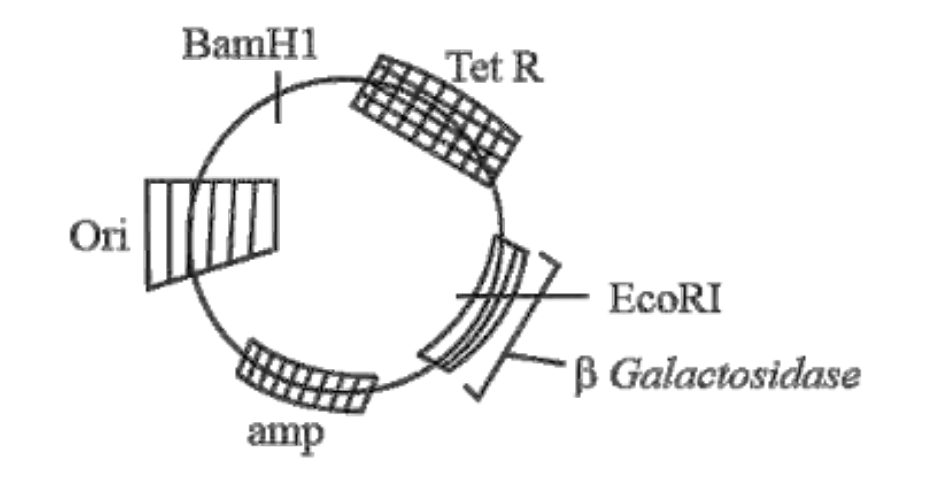
 In the represented plasmid, an alien piece of DNA is inserted at the EcoRI site within the $\beta$-Galactosidase gene. Which of the following strategies will be chosen to select the recombinant colonies?
Insertional inactivation of the $\beta$-galactosidase gene results in white recombinant colonies on chromogenic substrate (X-gal).
Insertion of recombinant foreign DNA into the coding region of $\beta$-galactosidase causes insertional inactivation. Non-recombinants retain active enzyme producing blue colonies with X-gal, while recombinants cannot produce active enzyme and appear white.
Bioreactors
-
Identify the part of a bio-reactor which is used as a foam braker from the given figure (A: flat bladed impeller, B: motor, C: foam breaker, D: sterile air inlet).
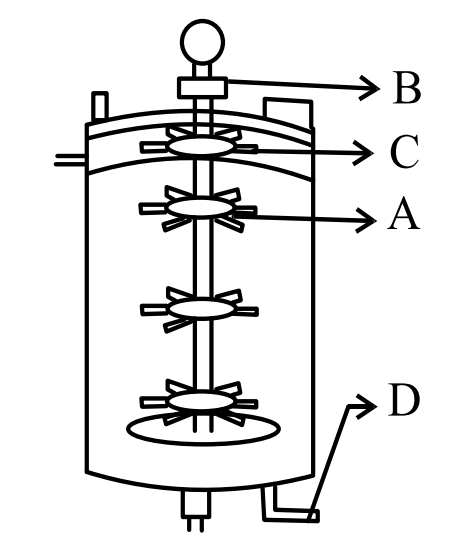
Label C indicates the foam breaker at the top of the stirrer shaft.
In a continuous stirred-tank bioreactor: B represents the drive motor, C represents the foam breaker blades near the top, A represents the flat-bladed impeller blades, and D represents the sparger/sterile air entry. Thus C is the foam breaker.
Gel Electrophoresis
-
Given below are two statements:
Statement I: The DNA fragments extracted from gel electrophoresis can be used in construction of recombinant DNA.
Statement II: Smaller size DNA fragments are observed near anode while larger fragments are found near the wells in an agarose gel.
In the light of the above statements, choose the most appropriate answer from the options given below:Both statements regarding agarose gel electrophoresis and elution are correct.
DNA fragments resolved on agarose gel are cut out and extracted (elution) to construct rDNA vectors (Statement I is correct). Negatively charged DNA migrates toward the positive anode; smaller fragments encounter lower sieving resistance and travel farthest toward the anode, while large fragments remain near the cathode wells (Statement II is correct).
Tools of Recombinant DNA Technology
-
Which of the following enzyme(s) are NOT essential for gene cloning?
A. Restriction enzymes
B. DNA ligase
C. DNA mutase
D. DNA recombinase
E. DNA polymerase
Choose the correct answer from the options given below:DNA mutase and DNA recombinase are not required tools in recombinant DNA cloning vectors.
Core recombinant cloning enzymes comprise restriction endonucleases (cutting), DNA ligase (joining), and DNA polymerases (synthesis/PCR). DNA mutase and recombinase are non-essential/irrelevant.
Blue-White Screening Method
-
The blue and white selectable markers have been developed which differentiate recombinant colonies from non-recombinant colonies on the basis of their ability to produce colour in the presence of a chromogenic substrate.
Given below are two statements about this method:
Statement I: The blue coloured colonies have DNA insert in the plasmid and they are identified as recombinant colonies.
Statement II: The colonies without blue colour have DNA insert in the plasmid and are identified as recombinant colonies.
In the light of the above statements, choose the most appropriate answer from the options given below:Statement I is false; Statement II is true because insertional inactivation prevents color formation, yielding white recombinant colonies.
When foreign DNA is inserted into $\beta$-galactosidase, insertional inactivation prevents enzyme formation, leaving recombinant colonies white (uncolored). Plasmids without insert express active $\beta$-galactosidase and turn blue with chromogenic X-gal. Thus Statement I is incorrect and Statement II is correct.
That is every question in Biotechnology: Principles and Processes for this filter.
Show all 132 questions Next: Biotechnology and its Applications
Want a score?
Answers here are not saved. Practise as a test to be marked and see your progress.
Practise as a test