2010 AIPMT-MAINS Reproduction in OrganismsReproductive structures of plants Medium Question 17 of 17 in Reproduction in Organisms

Examine the figures (A–D) given below and select the right option out of 1–4, in which all the four structures…

Examine the figures (A–D) given below and select the right option out of 1–4, in which all the four structures A, B, C and D are identified correctly.
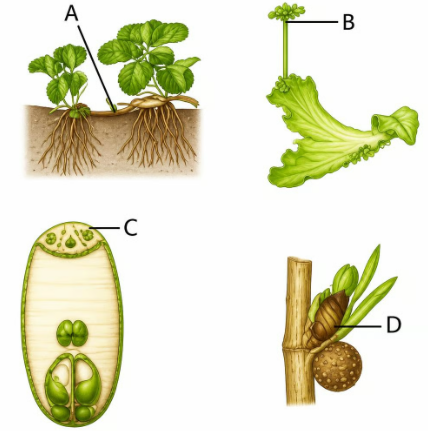
A A – Rhizome, B – Sporangiophore, C – Polar cell, D – Globule
B A – Runner, B – Archegoniophore, C – Synergid, D – Antheridium
C A – Offset, B – Antheridiophore, C – Antipodals, D – Oogonium
D A – Sucker, B – Seta, C – Megaspore mother cell, D – Gemma cup

The answer is C.

Solution

Figure A shows the vegetative propagule of water hyacinth ($Eichhornia$): a short, thick lateral branch bearing a tuft of leaves, i.e., an offset.
Figure B shows the male thallus of $Marchantia$ bearing a stalked, disc-like structure with antheridia: the antheridiophore. (The archegoniophore has drooping, finger-like rays.)
Figure C marks the three cells at the chalazal end of the embryo sac: the antipodals. (Synergids and the egg lie at the micropylar end; the polar nuclei lie in the central cell.)
Figure D shows the female sex organ of $Chara$, an oval structure covered by spirally twisted cells with a corona: the oogonium (nucule). (The globule is the round male organ.)
Hence A – offset, B – antheridiophore, C – antipodals, D – oogonium.

Concept Identification of structures

Reproduction in Organisms in past papers

17 questions from this chapter have appeared across 10 exam years.
