Looking for classes? Ksquare Career Institute, Bengaluru →

Reproduction in Organisms
Reproductive structures of plants
1 question from 1 paper, each with its answer.
- question
- 1
- paper
- 1
- of Reproduction in Organisms
- 5.88%
Concepts tested
- Identification of structures
All Questions
2010 AIPMT-MAINS 1 question
-
Examine the figures (A–D) given below and select the right option out of 1–4, in which all the four structures A, B, C and D are identified correctly.
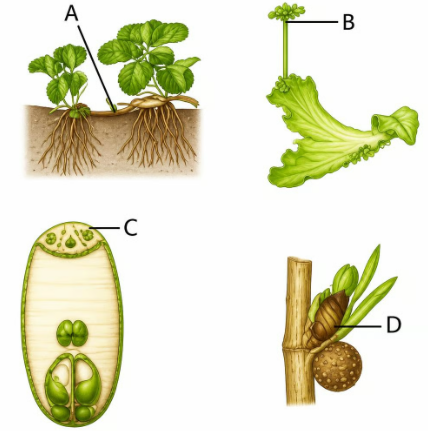 Figure A shows the vegetative propagule of water hyacinth ($Eichhornia$): a short, thick lateral branch bearing a tuft of leaves, i.e., an offset.
Figure B shows the male thallus of $Marchantia$ bearing a stalked, disc-like structure with antheridia: the antheridiophore. (The archegoniophore has drooping, finger-like rays.)
Figure C marks the three cells at the chalazal end of the embryo sac: the antipodals. (Synergids and the egg lie at the micropylar end; the polar nuclei lie in the central cell.)
Figure D shows the female sex organ of $Chara$, an oval structure covered by spirally twisted cells with a corona: the oogonium (nucule). (The globule is the round male organ.)
Hence A – offset, B – antheridiophore, C – antipodals, D – oogonium.