Looking for classes? Ksquare Career Institute, Bengaluru →

Which one of the following is most reactive towards electrophilic attack ?
A
- 
B
- 
C
- 
D
- 
Detailed Solution
Reactivity towards an electrophile depends on the electron density of the benzene ring: higher the electron density, faster the attack.
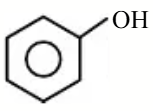
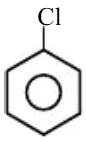
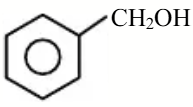
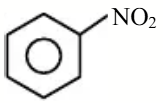
The electron density of the phenol ring is the highest among chlorobenzene, benzyl alcohol and nitrobenzene.
In phenol, the OH group shows both the $+M$ (resonance) effect and the $-I$ (inductive) effect, but the $+M$ effect of OH dominates over its $-I$ effect.
The lone pair on oxygen is delocalised into the ring, increasing the electron density, especially at the ortho and para positions. So OH is a strongly activating group.
In chlorobenzene the $-I$ effect of Cl dominates over its $+M$ effect, so the ring is weakly deactivated.
In benzyl alcohol the $CH_2OH$ group has no lone pair directly on the ring atom and is slightly electron withdrawing, so there is no strong activation.
In nitrobenzene the $NO_2$ group has strong $-M$ and $-I$ effects, so the ring is strongly deactivated.
Hence phenol is the most reactive towards electrophilic attack.
The electron density of the phenol ring is the highest among chlorobenzene, benzyl alcohol and nitrobenzene.
In phenol, the OH group shows both the $+M$ (resonance) effect and the $-I$ (inductive) effect, but the $+M$ effect of OH dominates over its $-I$ effect.
The lone pair on oxygen is delocalised into the ring, increasing the electron density, especially at the ortho and para positions. So OH is a strongly activating group.
In chlorobenzene the $-I$ effect of Cl dominates over its $+M$ effect, so the ring is weakly deactivated.
In benzyl alcohol the $CH_2OH$ group has no lone pair directly on the ring atom and is slightly electron withdrawing, so there is no strong activation.
In nitrobenzene the $NO_2$ group has strong $-M$ and $-I$ effects, so the ring is strongly deactivated.
Hence phenol is the most reactive towards electrophilic attack.