Looking for classes? Ksquare Career Institute, Bengaluru →

Alcohols, Phenols and Ethers
-
Which one of the following alcohols reacts instantaneously with Lucas reagent?A $CH_3-CH(CH_3)-CH_2OH$B $CH_3-C(CH_3)_2-OH$C $CH_3-CH_2-CH_2-CH_2OH$D $CH_3-CH_2-CH(CH_3)-OH$
-
Identify the correct reagents that would bring about the following transformation.
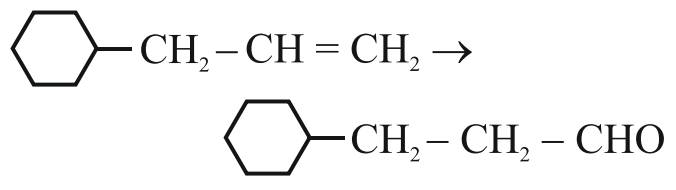 A (i) $BH_3$ (ii) $H_2O_2/OH^-$ (iii) alk. $KMnO_4$ (iv) $H_3O^+$B (i) $H_2O/H^+$ (ii) PCCC (i) $H_2O/H^+$ (ii) $CrO_3$D (i) $BH_3$ (ii) $H_2O_2/OH^-$ (iii) PCC
 -
The products A and B obtained in the following reactions, respectively, are $3ROH + PCl_3 \rightarrow 3RCl + A$ $ROH + PCl_5 \rightarrow RCl + HCl + B$A $H_3PO_4$ and $POCl_3$B $H_3PO_3$ and $POCl_3$C $POCl_3$ and $H_3PO_3$D $POCl_3$ and $H_3PO_4$
-
Consider the following reaction
 Identify products A and BA -
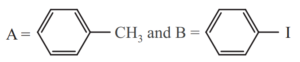 B -
B -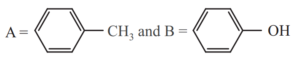 C -
C - D -
D -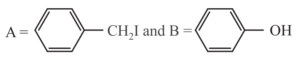
The ether cleaves by an SN1 path through a benzylic carbocation.
Reaction follows SN1 pathway involving Benzylic carbocation. [add image] -
Which amongst the following will be most readily dehydrated under acidic conditions ?A -
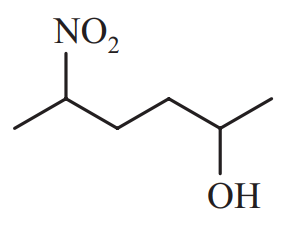 B -
B -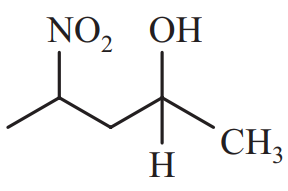 C -
C -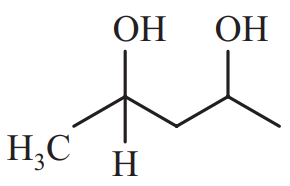 D -
D -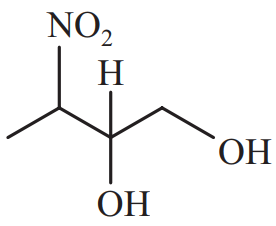
The alcohol whose dehydration gives a conjugated diene is dehydrated most readily.
Formation of conjugated diene in option (c) makes the given reactant most reactive towards dehydration in acidic conditions. [add image] -
Given below are two statements: Statement I: The acidic strength of monosubstituted nitrophenol is higher than phenol because of electron withdrawing nitro group. Statement II: o-nitrophenol, m-nitrophenol and p-nitrophenol will have same acidic strength as they have one nitro group attached to the phenolic ring. In the light of the above statements, choose the most appropriate answer from the options given below:A Statement I is incorrect but Statement II is correctB Both Statement I and Statement II are correctC Both Statement I and Statement II are incorrectD Statement I is correct but Statement II is incorrect
-
Given below are two statements: Statement I: In Lucas test, primary, secondary and tertiary alcohols are distinguished on the basis of their reactivity with conc. HCl + $ZnCl_2$, known as Lucas Reagent. Statement II: Primary alcohols are most reactive and immediately produce turbidity at room temperature on reaction with Lucas Reagent. In the light of the above statements, choose the most appropriate answer from the options given below:A Statement I is incorrect but Statement II is correctB Both Statement I and Statement II are correctC Both Statement I and Statement II are incorrectD Statement I is correct but Statement II is incorrect
-
What is the IUPAC name of the organic compound formed in the following chemical reaction? Acetone $\xrightarrow[(ii)\ H_2O,\ H^+]{(i)\ C_2H_5MgBr,\ dry\ ether}$ ProductA Pentan-2-olB Pentan-3-olC 2-methyl butan-2-olD 2-methyl propan-2-ol
-
The product formed in the following chemical reaction is: [add image]A [add image]B [add image]C [add image]D [add image]
-
Reaction between acetone and methylmagnesium chloride followed by hydrolysis will give:A Sec. butyl alcoholB Tert. butyl alcoholC Isobutyl alcoholD Isopropyl alcohol
-
Anisole on cleavage with HI gives:A [add image] + $CH_3OH$B [add image] + $C_2H_5I$C [add image] + $C_2H_5OH$D [add image] + $CH_3I$
-
The compound that is most difficult to protonate is: [add image]A $H-O-H$B $H_3C-O-H$C $H_3C-O-CH_3$D $Ph-O-H$
-
The structure of intermediate A in the following reaction is: [add image]A [add image]B [add image]C [add image]D [add image]