Looking for classes? Ksquare Career Institute, Bengaluru →

Chemistry
The p-Block Elements (Group 15 to 18)
11 questions, each with its answer.
-
Match List-I (Oxoacids of Sulphur) with List-II (Bonds of Sulphur):
Pick the matching item from Column II for each row.
Column I
- A. Peroxodisulphuric acid
- B. Sulphuric acid
- C. Pyrosulphuric acid
- D. Sulphurous acid
Column II
- I. Two S-OH, Four S=O, One S-O-S
- II. Two S-OH, One S=O
- III. Two S-OH, Four S=O, One S-O-O-S
- IV. Two S-OH, Two S=O
Correct answer: A → III, B → IV, C → I, D → II
Peroxodisulphuric acid has an S–O–O–S link; pyrosulphuric acid has an S–O–S link.
$H_2S_2O_8$, peroxodisulphuric acid: Two S-OH, Four S=O, One S-O-O-S $H_2SO_3$, sulphurous acid: Two S-OH, One S=O bond $H_2S_2O_7$, pyrosulphuric acid: Two S-OH, Four S=O, One S-O-S bond $H_2SO_4$, sulphuric acid: Two S-OH, Two S=O -
Assertion (A): ICl is more reactive than $I_2$.Reason (R): I-Cl bond is weaker than I-I bondICl is more reactive than $I_2$ because the I–Cl bond is polar and weaker than the I–I bond. In general, the X–X' bond in interhalogens is weaker than the X–X bond (except F–F). So both A and R are correct and R is the correct explanation of A.
-
Given below are two statements: Statement I: The boiling points of the following hydrides of group 16 elements increases in the order- $H_2O<H_2S<H_2Se<H_2Te$ Statement II: The boiling points of these hydrides increase with increase in molar mass. In the light of the above statements, choose the most appropriate answer from the options given below:From $H_2S$ to $H_2Te$, boiling point increases with molar mass (van der Waals forces), but $H_2O$ has the highest boiling point due to hydrogen bonding. Correct order: $H_2S < H_2Se < H_2Te < H_2O$ So Statement I ($H_2O$ lowest) is incorrect, and Statement II (boiling points of all these hydrides increase with molar mass) is also incorrect because of the anomaly of water. So both statements are incorrect.
-
Noble gases are named because of their inertness towards reactivity. Identify an incorrect statement about them.Noble gases have only weak dispersion forces between their atoms. So their melting and boiling points are very low, not very high – this statement is incorrect.
-
Statement-I: Acid strength increases in the order given as HF << HCl << HBr << HI. Statement-II: As the size of the elements F, Cl, Br, I increases down the group, the bond strength of HF, HCl, HBr and HI decreases and so the acid strength increases. In the light of the above statements, choose the correct answer from the options given below.H–F (1s–2p), H–Cl (1s–3p), H–Br (1s–4p), H–I (1s–5p) Down the group, the size of the halogen increases, orbital overlap decreases, bond strength decreases, and so the acidic strength increases: HF << HCl << HBr << HI. So both statements are true.
-
In which one of the following arrangements the given sequence is not strictly according to the properties indicated against it?Down group 16, acidic strength increases: $H_2O < H_2S < H_2Se < H_2Te$, so $pK_a$ decreases (not increases). So '$H_2O < H_2S < H_2Se < H_2Te$ : increasing $pK_a$' is not correct. The other sequences are correct.
-
Which of the following oxoacid of sulphur has $-O-O-$ linkage?Peroxodisulphuric acid ($H_2S_2O_8$) contains the peroxo –O–O– linkage:
$HO-SO_2-O-O-SO_2-OH$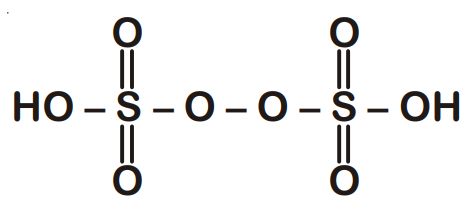
-
Match the Xenon compounds in Column-I with its structure in Column-II and assign the correct code:
Pick the matching item from Column II for each row.
Column I
- A. $XeF_4$
- B. $XeF_6$
- C. $XeOF_4$
- D. $XeO_3$
Column II
- I. pyramidal
- II. square planar
- III. distorted octahedral
- IV. square pyramidal
Correct answer: A → II, B → III, C → IV, D → I
-
Which is the correct thermal stability order for $H_2E$ (E = O, S, Se, Te and Po)?On going down the group, the H–E bond dissociation enthalpy decreases, so the thermal stability of $H_2E$ decreases. Order of stability: $H_2Po<H_2Te<H_2Se<H_2S<H_2O$
-
The correct structure of tribromooctaoxide is:Tribromooctaoxide is $Br_3O_8$. The three Br atoms are linked in a chain, Br–Br–Br.
Each terminal Br carries three double-bonded O atoms and the central Br carries two double-bonded O atoms, giving 8 O atoms and no formal charges.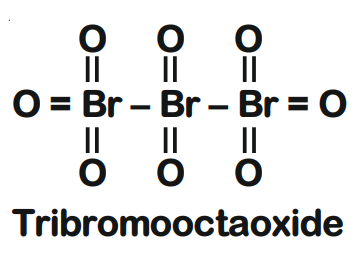
-
Match the following:
Pick the matching item from Column II for each row.
Column I
- A. Pure nitrogen
- B. Haber process
- C. Contact process
- D. Deacon's process
Column II
- I. Chlorine
- II. Sulphuric acid
- III. Ammonia
- IV. Sodium azide or Barium azide
Correct answer: A → IV, B → III, C → II, D → I
That is every question in The p-Block Elements (Group 15 to 18).
Want a score?
Answers here are not saved. Practise as a test to be marked and see your progress.
Practise as a test