Looking for classes? Ksquare Career Institute, Bengaluru →

Preparation of Aldehydes
-
Identify the suitable reagent for the selective reduction of an ester to an aldehyde:
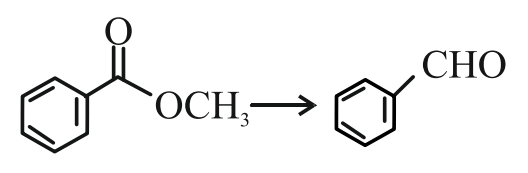 A (i) $\text{LiAlH}_4$, (ii) $\text{H}^+/\text{H}_2\text{O}$B (i) $\text{AlH}(i\text{Bu})_2$, (ii) $\text{H}_2\text{O}$C (i) $\text{NaBH}_4$, (ii) $\text{H}^+/\text{H}_2\text{O}$D (i) $\text{H}_2/\text{Pd}-\text{BaSO}_4$
Diisobutylaluminium hydride (DIBAL-H or $\text{AlH}(i\text{Bu})_2$) at low temperature selectively reduces esters and nitriles to aldehydes.
Diisobutylaluminium hydride (DIBAL-H, $[(i\text{Bu})_2\text{AlH}]$) is a bulky, selective reducing agent. At low temperatures (around $-78^\circ\text{C}$), it reduces esters cleanly to aldehydes upon subsequent aqueous workup without reducing them further to primary alcohols. In contrast, $\text{LiAlH}_4$ reduces esters completely to primary alcohols, $\text{NaBH}_4$ is generally unreactive toward esters, and Rosenmund catalyst ($\text{H}_2/\text{Pd}-\text{BaSO}_4$) selectively reduces acyl chlorides, not esters.