Looking for classes? Ksquare Career Institute, Bengaluru →

Chemistry
Amines
61 questions from 36 papers, each with its answer.
- 61 questions
- 36 papers
- 3.47% of Chemistry
Protection of Amino Group and Bromination
-
The final product C, obtained in this reaction, would be :
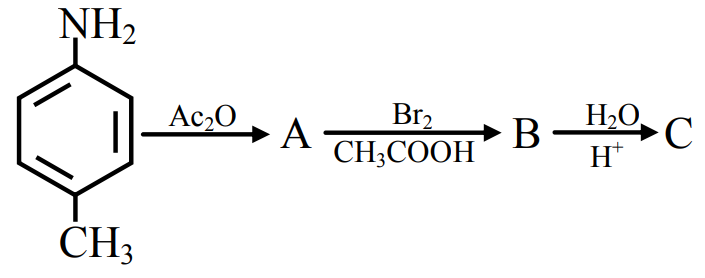 Step 1 (A): acetic anhydride acetylates the $-NH_2$ group of p-toluidine, giving p-methylacetanilide, $p-CH_3C_6H_4NHCOCH_3$. This protects the amino group and reduces its strong activating effect, so that only monobromination occurs.
Step 2 (B): bromine in acetic acid substitutes on the ring. The $-NHCOCH_3$ group is ortho/para directing; the para position is occupied by $CH_3$, so Br enters ortho to $-NHCOCH_3$, giving 2-bromo-4-methylacetanilide.
Step 3 (C): acid hydrolysis removes the acetyl group and frees the amino group:
$2-Br-4-CH_3C_6H_3NHCOCH_3 + H_2O \xrightarrow{H^+} 2-Br-4-CH_3C_6H_3NH_2 + CH_3COOH$
So C is 2-bromo-4-methylaniline: $NH_2$ on the ring, Br ortho to it and $CH_3$ para to it. (B, the acetamide, is the intermediate before hydrolysis.)
Electrophilic Substitution: Activating and Deactivating Groups
-
The correct order of reactivity towards the electrophilic substitution of the compounds aniline (I), benzene (II) and nitrobenzene (III) isThe $-NH_2$ group of aniline donates electrons to the ring by resonance (+R effect), increasing the electron density, especially at ortho and para positions. So aniline is much more reactive than benzene towards electrophiles.
The $-NO_2$ group of nitrobenzene withdraws electrons from the ring by both $-I$ and $-R$ effects, decreasing the electron density. So nitrobenzene is much less reactive than benzene.
Order of reactivity: aniline $\gt$ benzene $\gt$ nitrobenzene.
So I $\gt$ II $\gt$ III.
That is every question in Amines for this filter.
Want a score?
Answers here are not saved. Practise as a test to be marked and see your progress.
Practise as a test