Looking for classes? Ksquare Career Institute, Bengaluru →

Chemistry
Amines
61 questions from 36 papers, each with its answer.
- 61 questions
- 36 papers
- 3.47% of Chemistry
Basicity of Amines
-
The correct order of decreasing basic strength of the given amines is:
Aliphatic amines are stronger bases than aromatic amines. Secondary aliphatic amine > primary aliphatic amine > secondary aromatic amine > aniline.
Aliphatic amines have localized electron pairs on nitrogen and are far stronger bases than aryl amines where the nitrogen lone pair is delocalized into the benzene ring (+R effect). Among aliphatic amines in aqueous medium, diethylamine (N-ethylethanamine, $2^\circ$) is more basic than ethylamine (ethanamine, $1^\circ$) due to combined $+I$ and steric/solvation effects. Among aromatic amines, N-methylaniline has a $+I$ methyl group that enhances electron density on N relative to benzenamine (aniline). Thus: N-ethylethanamine > ethanamine > N-methylaniline > benzenamine.
Diazonium Salts - Preparation and Reactions
-
Given below are two statements:
Statement I: Benzenediazonium salt is prepared by the reaction of aniline with nitrous acid at 273-278 K. It decomposes easily in the dry state.
Statement II: Insertion of iodine into the benzene ring is difficult and hence iodobenzene is prepared through the reaction of benzenediazonium salt with KI.
In the light of the above statements, choose the most appropriate answer from the options given below:Both statements are correct: diazotization occurs at $0-5^\circ\text{C}$ and dry diazonium salt is explosive; direct iodination is reversible, so iodobenzene is prepared by treating diazonium salt with KI.
Statement I is correct: Aniline reacts with nitrous acid ($\text{NaNO}_2 + \text{HCl}$) at $273-278\text{ K}$ ($0-5^\circ\text{C}$) to form benzenediazonium chloride; in the dry solid state, diazonium salts are dangerously unstable and explode upon mild disturbance. Statement II is correct: Direct electrophilic iodination of benzene is reversible due to the generation of reducing agent HI and requires strong oxidizing agents ($\text{HNO}_3, \text{HIO}_3$); hence iodobenzene is conveniently prepared by treating benzenediazonium chloride solution with aqueous potassium iodide (KI).
Peroxide Effect and Nitrile Reduction
-
Predict the major product 'P' in the following sequence of reactions:
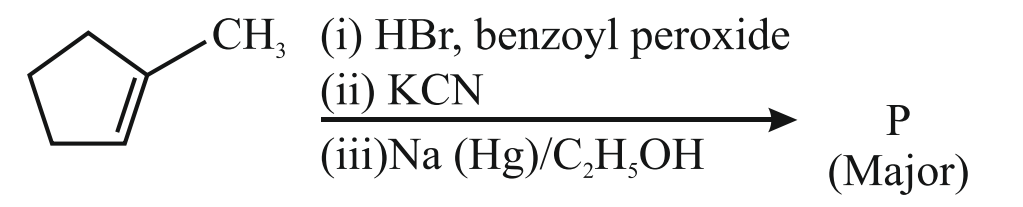
Peroxide effect adds Br at C-2 (anti-Markovnikov). Nucleophilic substitution with KCN yields 2-methylcyclopentanecarbonitrile. Reduction by Na(Hg)/EtOH (Mendius reduction) yields (2-methylcyclopentyl)methanamine.
Reaction step 1: Free radical anti-Markovnikov addition of HBr in the presence of benzoyl peroxide to 1-methylcyclopentene gives 1-bromo-2-methylcyclopentane (Br attaches to the less substituted carbon). Reaction step 2: Cyanide substitution ($S_N2$) with KCN replaces Br by CN, yielding 2-methylcyclopentanecarbonitrile. Reaction step 3: Reduction of nitrile group with $\text{Na(Hg)}/\text{C}_2\text{H}_5\text{OH}$ (Mendius reaction) reduces $-\text{CN}$ to $-\text{CH}_2\text{NH}_2$, producing (2-methylcyclopentyl)methanamine.
Preparation of Benzene and Reactions of Diazonium Salts
-
Which one of the following reactions does NOT give benzene as the product?
Hydrolysis of benzenediazonium chloride with warm water yields phenol ($\text{C}_6\text{H}_5\text{OH}$), not benzene.
Reaction (1) is decarboxylation of sodium benzoate giving benzene. Reaction (2) is aromatization of n-hexane over $\text{Mo}_2\text{O}_3$ catalyst giving benzene. Reaction (3) is cyclic polymerization of ethyne forming benzene. Reaction (4) is warming benzenediazonium chloride with water, which undergoes nucleophilic substitution to yield phenol: $\text{C}_6\text{H}_5\text{N}_2^+\text{Cl}^- + \text{H}_2\text{O} \xrightarrow{\Delta} \text{C}_6\text{H}_5\text{OH} + \text{N}_2 + \text{HCl}$. Thus, reaction (4) does not yield benzene.
Test for Unsaturation and Bromine Water Reaction
-
Which one of the following compounds does not decolourize bromine water?
Cyclohexane is a saturated cycloalkane that does not react with bromine water. Phenol, aniline, and styrene rapidly decolourize bromine water.
Bromine water is decolourized by unsaturated hydrocarbons via electrophilic addition (e.g. styrene adds $\text{Br}_2$ across its vinyl double bond) or by strongly activated aromatic rings via rapid electrophilic aromatic substitution (e.g. phenol forms 2,4,6-tribromophenol white precipitate, and aniline forms 2,4,6-tribromoaniline). Saturated alkanes like cyclohexane lack both unsaturation and activation, and thus do not decolourize bromine water in the absence of UV light.
That is every question in Amines for this filter.
Want a score?
Answers here are not saved. Practise as a test to be marked and see your progress.
Practise as a test