Looking for classes? Ksquare Career Institute, Bengaluru →

Chemistry
Organic Chemistry - Some Basic Principles and Techniques
88 questions from 35 papers, each with its answer.
- 88 questions
- 35 papers
- 5% of Chemistry
Geometrical Isomerism
-
Which one of the following compounds can exist as cis-trans isomers?
1,2-Dimethylcyclohexane possesses two stereocenters with restricted rotation, existing as cis- and trans-geometric isomers.
For geometrical isomerism, there must be restricted rotation and each carbon of the stereogenic unit must be attached to two different groups. In Pent-1-ene, terminal carbon has two identical H atoms; in 2-methylhex-2-ene, C-2 has two methyl groups; in 1,1-dimethylcyclopropane, C-1 has two methyl groups. In 1,2-dimethylcyclohexane, the ring provides restricted rotation and C-1 and C-2 both hold $-\text{H}$ and $-\text{CH}_3$, allowing cis- and trans-isomers.
Purification of Organic Compounds
-
Match List-I with List-II.
Pick the matching item from Column II for each row.
Column I
- A. $\text{CHCl}_3 + \text{C}_6\text{H}_5\text{NH}_2$
- B. Crude oil in petroleum industry
- C. Glycerol from spent-lye
- D. Aniline-water
Column II
- I. Distillation under reduced pressure
- II. Steam distillation
- III. Fractional distillation
- IV. Simple distillation
Correct answer: A → IV, B → III, C → I, D → II
Chloroform + aniline: Simple distillation; Crude oil: Fractional distillation; Glycerol from spent-lye: Vacuum distillation; Aniline-water: Steam distillation.
Purification techniques: 1. $\text{CHCl}_3$ (b.p. $61^\circ\text{C}$) and aniline (b.p. $184^\circ\text{C}$) have a large difference in boiling points ($>50^\circ\text{C}$), separated by Simple distillation (IV). 2. Crude oil contains hydrocarbon fractions with close boiling points, separated by Fractional distillation (III). 3. Glycerol decomposes at its normal boiling point ($290^\circ\text{C}$), hence purified by Distillation under reduced pressure / vacuum distillation (I). 4. Aniline is steam volatile and immiscible with water, purified by Steam distillation (II). Hence, A-IV, B-III, C-I, D-II.
Hybridization and Bond Dissociation Energy
-
Among the given compounds I-III, the correct order of bond dissociation energy of C–H bond marked with * is:
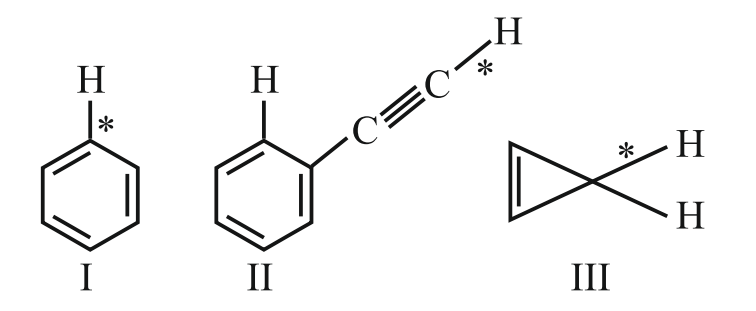
Bond dissociation energy increases with greater s-character: $sp$ ($50\%$ s, alkyne I) > $sp^2$ ($33.3\%$ s, aryl II) > $sp^3$ (cyclopropyl III). Thus $\text{I} > \text{II} > \text{III}$.
The strength and bond dissociation energy (BDE) of a $\text{C}-\text{H}$ bond depends on the hybridization of carbon. Higher s-character brings the bonded electron pair closer to the nucleus, increasing bond strength and BDE: 1. In ethyne (I), carbon is $sp$ hybridized ($50\%$ s-character), giving the highest BDE ($\,\approx 550\text{ kJ/mol}$). 2. In benzene (II), carbon is $sp^2$ hybridized ($33.3\%$ s-character), with intermediate BDE ($\,\approx 464\text{ kJ/mol}$). 3. In cyclopropane (III), the exocyclic C-H bond has predominant $sp^3$ character with lower BDE ($\,\approx 445\text{ kJ/mol}$). Therefore, the correct decreasing order of bond dissociation energy is I > II > III.
Isomerism in Cyclic Ethers
-
Total number of possible isomers (both structural as well as stereoisomers) of cyclic ethers of molecular formula $\text{C}_4\text{H}_8\text{O}$ is:
5-membered ring: tetrahydrofuran (1); 4-membered ring: 2-methyloxetane (2: R,S), 3-methyloxetane (1); 3-membered ring: 2-ethyloxirane (2: R,S), 2,3-dimethyloxirane (3: cis-meso, trans-pair), 2,2-dimethyloxirane (1). Total $= 1 + 2 + 1 + 2 + 3 + 1 = 10$.
For cyclic ethers with formula $\text{C}_4\text{H}_8\text{O}$ (Degree of unsaturation = 1): 1. Oxolane (5-membered): Tetrahydrofuran (THF) $\implies 1$ isomer. 2. Oxetanes (4-membered): (a) 2-methyloxetane has one chiral center at C-2 $\implies 2$ enantiomers (R and S); (b) 3-methyloxetane is achiral $\implies 1$ isomer. 3. Oxiranes (3-membered): (a) 2-ethyloxirane has one chiral center $\implies 2$ enantiomers (R and S); (b) 2,3-dimethyloxirane has two chiral centers, giving 1 meso-isomer (cis) and 1 pair of enantiomers (trans-R,R and trans-S,S) $\implies 3$ stereoisomers; (c) 2,2-dimethyloxirane is achiral $\implies 1$ isomer. Summing all structural and stereoisomers: $1 + 2 + 1 + 2 + 3 + 1 = 10$ isomers.
Qualitative Analysis of Organic Compounds - Lassaigne's Test
-
Which one of the following reactions does NOT belong to "Lassaigne's test"?
Lassaigne's test involves sodium fusion to convert covalent heteroatoms (N, S, X) into ionic sodium salts (NaCN, $\text{Na}_2\text{S}$, NaX). The reaction with CuO is used in copper oxide test for detection of carbon and hydrogen.
In Lassaigne's sodium fusion test, nitrogen, sulphur, and halogens present in an organic compound are converted from covalent to ionic form by fusing with metallic sodium: $\text{Na} + \text{C} + \text{N} \rightarrow \text{NaCN}$, $2\text{Na} + \text{S} \rightarrow \text{Na}_2\text{S}$, and $\text{Na} + \text{X} \rightarrow \text{NaX}$. The reduction of copper(II) oxide ($2\text{CuO} + \text{C} \rightarrow 2\text{Cu} + \text{CO}_2$) is used for the qualitative detection of carbon and hydrogen, not in Lassaigne's test.
That is every question in Organic Chemistry - Some Basic Principles and Techniques for this filter.
Want a score?
Answers here are not saved. Practise as a test to be marked and see your progress.
Practise as a test