Looking for classes? Ksquare Career Institute, Bengaluru →

Chemistry
Amines
61 questions from 36 papers, each with its answer.
- 61 questions
- 36 papers
- 3.47% of Chemistry
Preparation of Amines
-
Acetamide is treated with the following reagents separately. Which one of these would yield methyl amine?An amide treated with bromine and aqueous or ethanolic NaOH gives a primary amine with one carbon atom less (Hoffmann bromamide degradation).
$CH_3CONH_2 + Br_2 + 4NaOH \rightarrow CH_3NH_2 + Na_2CO_3 + 2NaBr + 2H_2O$
Acetamide has two carbons; the carbonyl carbon is lost as carbonate and the product is methyl amine.
$PCl_5$ dehydrates acetamide to acetonitrile ($CH_3CN$); soda lime and hot conc. $H_2SO_4$ do not give methyl amine (the latter hydrolyses it to acetic acid).
Hence the reagent is $NaOH-Br_2$.
Diazonium Salts
-
Aniline in a set of the following reactions yielded a coloured product Y.
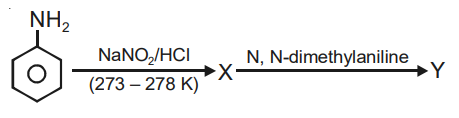
The structure of Y would beStep 1 (diazotisation): aniline reacts with $NaNO_2$/HCl at 273–278 K to give benzenediazonium chloride: $C_6H_5NH_2 + NaNO_2 + 2HCl \rightarrow C_6H_5N_2^+Cl^- + NaCl + 2H_2O$. So X = $C_6H_5N_2^+Cl^-$.
Step 2 (coupling): the diazonium ion is a weak electrophile; it attacks the electron-rich ring of N,N-dimethylaniline at the para position to the $-N(CH_3)_2$ group (electrophilic substitution).
$C_6H_5N_2^+Cl^- + C_6H_5N(CH_3)_2 \rightarrow C_6H_5-N=N-C_6H_4-N(CH_3)_2 + HCl$
The product, p-(N,N-dimethylamino)azobenzene, is a yellow azo dye; the extended conjugation through the –N=N– group makes it coloured.
Hence Y is $C_6H_5-N=N-C_6H_4-N(CH_3)_2$.
Reactions of amines
-
Which of the following statements about primary amines is 'False'?Alkyl groups release electrons (+I effect) and increase the electron density on nitrogen, so alkyl amines are stronger bases than ammonia (true).
In aryl amines the lone pair on nitrogen is delocalised into the benzene ring, so they are weaker bases than alkyl amines (true).
Primary aliphatic amines react with nitrous acid to give unstable aliphatic diazonium salts, which decompose to alcohols with evolution of nitrogen: $RNH_2 + HNO_2 \rightarrow ROH + N_2 + H_2O$ (true).
Primary aromatic amines react with nitrous acid at 273–278 K to form arenediazonium salts, which are stable at this temperature: $C_6H_5NH_2 + NaNO_2 + 2HCl \rightarrow C_6H_5N_2^+Cl^- + NaCl + 2H_2O$. Phenol is not the product of this reaction.
Hence the false statement is that aryl amines react with nitrous acid to produce phenols.
That is every question in Amines for this filter.
Want a score?
Answers here are not saved. Practise as a test to be marked and see your progress.
Practise as a test