Looking for classes? Ksquare Career Institute, Bengaluru →

An organic compound 'A' on treatment with $NH_3$ gives 'B' which on heating gives 'C'. 'C' when treated with $Br_2$ in the presence of KOH produces ethylamine. Compound 'A' is
A
$CH_3-CH(CH_3)-COOH$
B
$CH_3CH_2COOH$
C
$CH_3COOH$
D
$CH_3CH_2CH_2COOH$
Detailed Solution
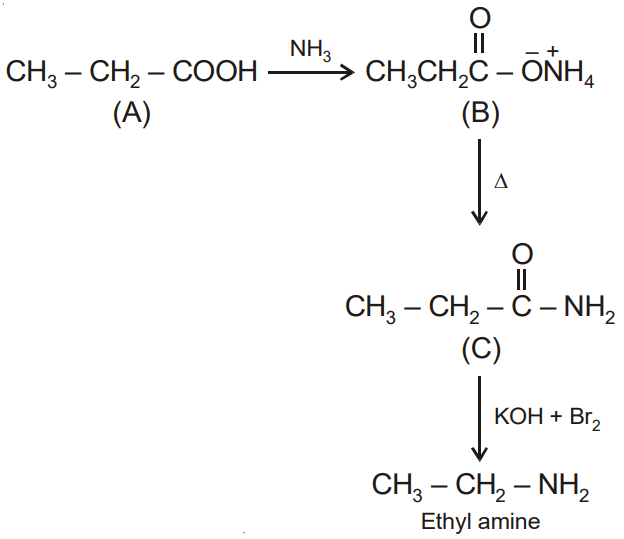
Work backwards from the product. $Br_2$/KOH converts an amide into a primary amine having one carbon less (Hoffmann bromamide degradation).
Ethylamine, $CH_3CH_2NH_2$, has two carbons, so the amide C has three carbons: C = $CH_3CH_2CONH_2$ (propanamide).
$CH_3CH_2CONH_2 + Br_2 + 4KOH \rightarrow CH_3CH_2NH_2 + K_2CO_3 + 2KBr + 2H_2O$
An amide is formed on heating the ammonium salt of the acid: B = $CH_3CH_2COO^-NH_4^+$ (ammonium propanoate), and $CH_3CH_2COONH_4 \xrightarrow{\Delta} CH_3CH_2CONH_2 + H_2O$
The ammonium salt is formed from the carboxylic acid and ammonia: $CH_3CH_2COOH + NH_3 \rightarrow CH_3CH_2COONH_4$
Hence A is propanoic acid, $CH_3CH_2COOH$.
Note: the question sentence is jumbled in the source PDF; it has been restored to its intended wording.