Looking for classes? Ksquare Career Institute, Bengaluru →

Amines
Preparation of Amines
6 questions from 6 papers, each with its answer.
- questions
- 6
- papers
- 6
- years asked, 2017–2026
- 1 of 10
- of Amines
- 9.84%
Appears in
Concepts tested
- Hoffmann bromamide degradation 3
- Gabriel synthesis limitation
- reduction of amide, nitrile and isocyanide
- Reduction of isocyanides
All Questions
2023 1 question
-
Which of the following reactions will NOT give primary amine as the product?
$CH_3NC$ on reduction gives the secondary amine $CH_3NHCH_3$.
$CH_3CONH_2\xrightarrow[(ii)\ H_3O^{\oplus}]{(i)\ LiAlH_4}CH_3CH_2NH_2$ $CH_3CONH_2\xrightarrow{Br_2/KOH}CH_3NH_2$ $CH_3CN\xrightarrow[(ii)\ H_3O^{\oplus}]{(i)\ LiAlH_4}CH_3CH_2NH_2$ $CH_3NC\xrightarrow[(ii)\ H_3O^{\oplus}]{(i)\ LiAlH_4}CH_3NHCH_3$ Methyl isocyanide gives a secondary amine, $CH_3NHCH_3$, upon reduction.
2015 AIPMT-II 1 question
-
Method by which Aniline cannot be prepared is:In chlorobenzene, resonance gives the C–Cl bond partial double bond character, so aryl halides do not undergo nucleophilic substitution with phthalimide anion.
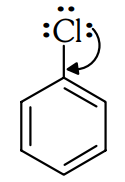
So Gabriel phthalimide synthesis cannot prepare aniline.
2011 AIPMT-MAINS 1 question
-
An organic compound 'A' on treatment with $NH_3$ gives 'B' which on heating gives 'C'. 'C' when treated with $Br_2$ in the presence of KOH produces ethylamine. Compound 'A' is
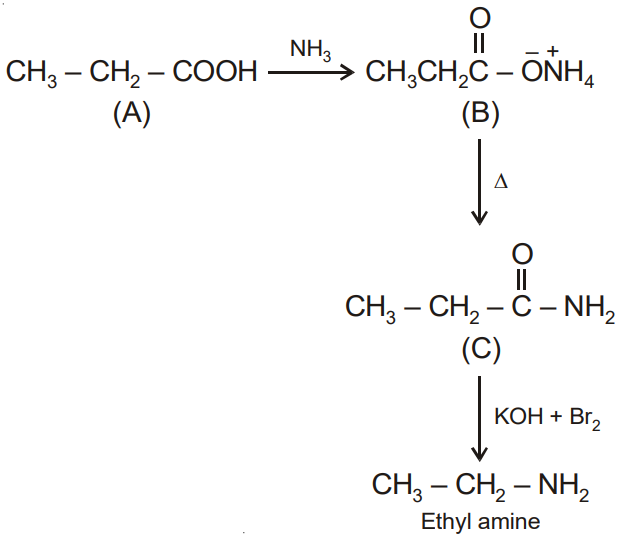
Work backwards from the product. $Br_2$/KOH converts an amide into a primary amine having one carbon less (Hoffmann bromamide degradation).
Ethylamine, $CH_3CH_2NH_2$, has two carbons, so the amide C has three carbons: C = $CH_3CH_2CONH_2$ (propanamide).
$CH_3CH_2CONH_2 + Br_2 + 4KOH \rightarrow CH_3CH_2NH_2 + K_2CO_3 + 2KBr + 2H_2O$
An amide is formed on heating the ammonium salt of the acid: B = $CH_3CH_2COO^-NH_4^+$ (ammonium propanoate), and $CH_3CH_2COONH_4 \xrightarrow{\Delta} CH_3CH_2CONH_2 + H_2O$
The ammonium salt is formed from the carboxylic acid and ammonia: $CH_3CH_2COOH + NH_3 \rightarrow CH_3CH_2COONH_4$
Hence A is propanoic acid, $CH_3CH_2COOH$.
Note: the question sentence is jumbled in the source PDF; it has been restored to its intended wording.
2011 AIPMT-PRE 1 question
-
In a set of reactions m-bromobenzoic acid gave a product D. Identify the product D.
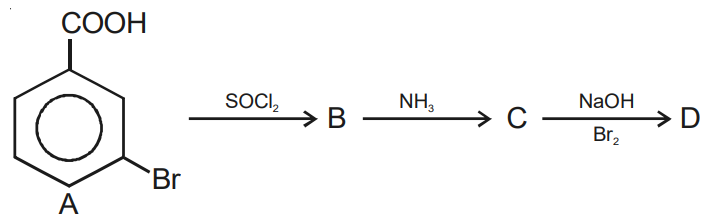
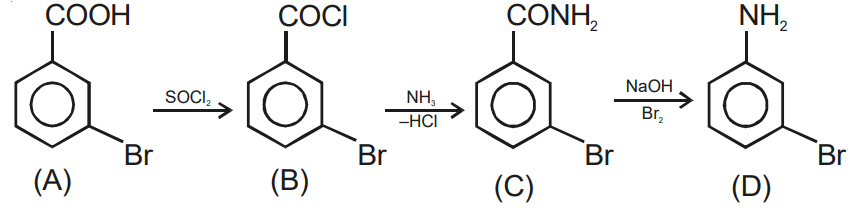
Step 1: thionyl chloride converts the carboxylic acid into the acid chloride: m-$BrC_6H_4COOH + SOCl_2 \rightarrow$ m-$BrC_6H_4COCl$ (B) $+ SO_2 + HCl$
Step 2: ammonia converts the acid chloride into the amide: m-$BrC_6H_4COCl + NH_3 \rightarrow$ m-$BrC_6H_4CONH_2$ (C) $+ HCl$
Step 3: with $Br_2$/NaOH the amide undergoes Hoffmann bromamide degradation, giving a primary amine with one carbon less: m-$BrC_6H_4CONH_2 + Br_2 + 4NaOH \rightarrow$ m-$BrC_6H_4NH_2$ (D) $+ Na_2CO_3 + 2NaBr + 2H_2O$
The ring bromine is not affected in any step.
Hence D is m-bromoaniline.
2010 AIPMT-PRE 1 question
-
Acetamide is treated with the following reagents separately. Which one of these would yield methyl amine?An amide treated with bromine and aqueous or ethanolic NaOH gives a primary amine with one carbon atom less (Hoffmann bromamide degradation).
$CH_3CONH_2 + Br_2 + 4NaOH \rightarrow CH_3NH_2 + Na_2CO_3 + 2NaBr + 2H_2O$
Acetamide has two carbons; the carbonyl carbon is lost as carbonate and the product is methyl amine.
$PCl_5$ dehydrates acetamide to acetonitrile ($CH_3CN$); soda lime and hot conc. $H_2SO_4$ do not give methyl amine (the latter hydrolyses it to acetic acid).
Hence the reagent is $NaOH-Br_2$.
2007 AIPMT-PRE 1 question
-
Which one of the following on reduction with lithium aluminium hydride yields a secondary amine?Reduction of alkyl isocyanides in the presence of $LiAlH_4$ yields secondary amines containing methyl as one of the alkyl groups.
$R-N\equiv C + 4[H] \xrightarrow{LiAlH_4} R-NH-CH_3$ ($2^\circ$ amine)
For methyl isocyanide: $CH_3-N\equiv C + 4[H] \xrightarrow{LiAlH_4} CH_3-NH-CH_3$ (dimethylamine)
The carbon of the isocyanide group is attached to nitrogen, so after reduction it becomes a methyl group on nitrogen, giving a secondary amine.
Alkyl cyanides give $1^\circ$ amines on reduction: $CH_3-C\equiv N + 4[H] \rightarrow CH_3CH_2NH_2$
Acetamide also gives a primary amine: $CH_3CONH_2 + 4[H] \rightarrow CH_3CH_2NH_2 + H_2O$
Nitroethane gives the primary amine $CH_3CH_2NH_2$.
So the compound that yields a secondary amine is methyl isocyanide.