Looking for classes? Ksquare Career Institute, Bengaluru →

Chemistry
Chemical Kinetics
80 questions from 37 papers, each with its answer.
- 80 questions
- 37 papers
- 4.55% of Chemistry
Arrhenius equation
-
For an elementary chemical reaction, the Arrhenius plot is given below.
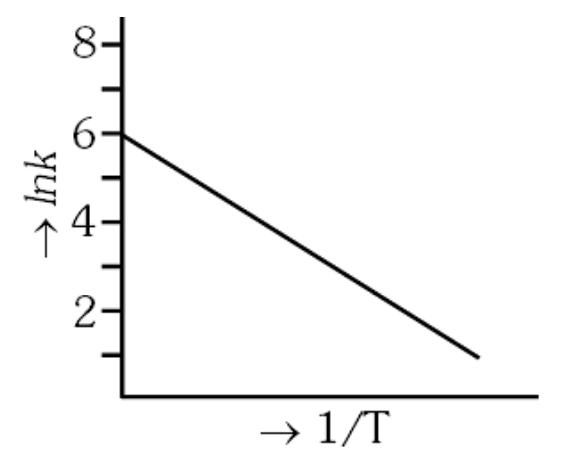 If the energy of activation is 6.64 kJ mol$^{-1}$ and R = 8.3 J K$^{-1}$ mol$^{-1}$, the temperature at which the rate constant becomes $e^2$ min$^{-1}$, is$\ln k=\ln A-\frac{E_a}{RT}$. From the graph, $\ln A=6$ (intercept). For $k=e^2$: $2=6-\frac{6.64\times1000}{8.3\times T} \Rightarrow \frac{6640}{8.3\times T}=4 \Rightarrow T=200$ K.
Zero order reactions
-
$2A\xrightarrow{k}B$ is a zero-order reaction, where k = 1.0 mol L$^{-1}$ min$^{-1}$. If the initial concentration of A is 2 M, then the time taken to complete 75% of the reaction will be$2A\xrightarrow{k}B$, zero order: rate $=\frac{1}{2}\left(-\frac{d[A]}{dt}\right)=k \Rightarrow -\frac{d[A]}{dt}=2k \Rightarrow [A]_0-[A]_t=2kt$. For 75% completion, $[A]_t=0.25\times2=0.5$ M: $2-0.5=2(1)t_{75\%} \Rightarrow t_{75\%}=0.75$ min.
That is every question in Chemical Kinetics for this filter.
Want a score?
Answers here are not saved. Practise as a test to be marked and see your progress.
Practise as a test