Looking for classes? Ksquare Career Institute, Bengaluru →

Chemistry
Coordination Compounds
104 questions from 38 papers, each with its answer.
- 104 questions
- 38 papers
- 5.91% of Chemistry
Isomerism in Coordination Compounds
-
The complex, $[Pt(Py)(NH_3)BrCl]$ will have how many geometrical isomers?
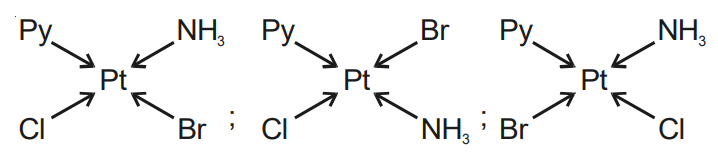
Pt(II) forms square planar complexes; this complex is of the type [Mabcd] with four different monodentate ligands (Py, $NH_3$, Br, Cl).
Fix one ligand, say Py, at one corner. The position trans to it can be occupied by any one of the other three ligands.
Isomer 1: Py trans to $NH_3$ (Br trans to Cl).
Isomer 2: Py trans to Br ($NH_3$ trans to Cl).
Isomer 3: Py trans to Cl ($NH_3$ trans to Br).
So a square planar complex [Mabcd] has 3 geometrical isomers. -
The complexes $[Co(NH_3)_6][Cr(CN)_6]$ and $[Cr(NH_3)_6][Co(CN)_6]$ are the examples of which type of isomerism?In both compounds the cation and the anion are complex ions.
In the first, $NH_3$ ligands are bound to Co and $CN^-$ ligands to Cr; in the second, $NH_3$ ligands are bound to Cr and $CN^-$ ligands to Co.
The ligands have been interchanged between the cationic and anionic coordination entities of the two different metal ions.
This type of isomerism is called coordination isomerism.
Linkage isomerism needs an ambidentate ligand bound through different atoms, and ionisation isomerism involves exchange of a ligand with the counter ion, which is not the case here.
Valence bond theory
-
Of the following complex ions, which is diamagnetic in nature?$[Ni(CN)_4]^{2-}$: $Ni^{2+}$ is $3d^8$. $CN^-$ is a strong field ligand and pairs up the 3d electrons, leaving one 3d orbital empty; the hybridisation is $dsp^2$ (square planar) and there are no unpaired electrons, so it is diamagnetic.
$[NiCl_4]^{2-}$: $Ni^{2+}$ is $3d^8$. $Cl^-$ is a weak field ligand, no pairing occurs; hybridisation is $sp^3$ (tetrahedral) with 2 unpaired electrons, so it is paramagnetic.
$[CoF_6]^{3-}$: $Co^{3+}$ is $3d^6$. $F^-$ is a weak field ligand; hybridisation is $sp^3d^2$ with 4 unpaired electrons, so it is paramagnetic.
$[CuCl_4]^{2-}$: $Cu^{2+}$ is $3d^9$ with 1 unpaired electron, so it is paramagnetic.
Hence the diamagnetic ion is $[Ni(CN)_4]^{2-}$.
Magnetic properties of complexes
-
The d-electron configurations of $Cr^{2+}$, $Mn^{2+}$, $Fe^{2+}$ and $Co^{2+}$ are $d^4$, $d^5$, $d^6$ and $d^7$ respectively. Which one of the following will exhibit minimum paramagnetic behaviour? (At. nos. Cr = 24, Mn = 25, Fe = 26, Co = 27)$H_2O$ is a weak field ligand, so all these octahedral complexes are high spin and the electrons are not forced to pair.
$Cr^{2+}$ ($d^4$): $t_{2g}^3e_g^1$, 4 unpaired electrons.
$Mn^{2+}$ ($d^5$): $t_{2g}^3e_g^2$, 5 unpaired electrons.
$Fe^{2+}$ ($d^6$): $t_{2g}^4e_g^2$, 4 unpaired electrons.
$Co^{2+}$ ($d^7$): $t_{2g}^5e_g^2$, 3 unpaired electrons.
Paramagnetism increases with the number of unpaired electrons ($\mu = \sqrt{n(n+2)}$ BM).
$[Co(H_2O)_6]^{2+}$ has the fewest unpaired electrons and shows minimum paramagnetic behaviour.
That is every question in Coordination Compounds for this filter.
Want a score?
Answers here are not saved. Practise as a test to be marked and see your progress.
Practise as a test