Looking for classes? Ksquare Career Institute, Bengaluru →

Chemistry
Haloalkanes and Haloarenes
55 questions from 33 papers, each with its answer.
- 55 questions
- 33 papers
- 3.13% of Chemistry
Reaction of alkyl halides with cyanide - nitrile vs isonitrile formation
-
Which amongst the following reactions of alkyl halides produces isonitrile as a major product? (A) R–X + HCN $\rightarrow$ (B) R–X + AgCN $\rightarrow$ (C) R–X + KCN $\rightarrow$ (D) R–X + NaCN $\xrightarrow{H_2O/C_2H_5OH}$$AgCN$ has a covalent character with the carbon of cyanide primarily bonding via nitrogen due to steric/electronic factors, so reaction of an alkyl halide with $AgCN$ produces the isonitrile (isocyanide) as the major product: $R-X+Ag-C\equiv N\rightarrow R-NC$. Reaction with $KCN$ or $NaCN$ (more ionic) predominantly gives the nitrile ($R-CN$) as the major product via the more nucleophilic carbon end.
Rate of dehydrohalogenation (E2 elimination) - substrate structure effect
-
The correct order for the rate of $\alpha,\beta$-dehydrohalogenation for the following compounds is ____.
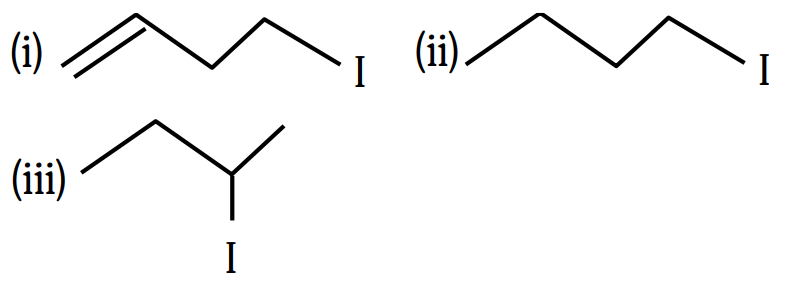 Based on the given reaction outcomes, the rate of dehydrohalogenation follows the order: (ii) < (iii) < (i).
Grignard reagent formation and reaction with D2O
-
Identify 'X' in the following reaction.
 With only 1.0 mol of Mg for 1.0 mol of the dihalide (Br and Cl on the ring), Mg preferentially inserts into the more reactive C–Br bond (aryl bromides are generally more reactive than aryl chlorides in this context) to form the Grignard reagent $BrMg-C_6H_4-Cl$. Reaction with $D_2O$ replaces the $-MgBr$ group with $-D$, giving $D-C_6H_4-Cl$ (chlorine remaining unreacted).
That is every question in Haloalkanes and Haloarenes for this filter.
Want a score?
Answers here are not saved. Practise as a test to be marked and see your progress.
Practise as a test