Looking for classes? Ksquare Career Institute, Bengaluru →

Chemistry
The p-Block Elements (Class XII)
12 questions from 4 papers, each with its answer.
- 12 questions
- 4 papers
- 0.68% of Chemistry
Group 17 – halogens: oxidation states and oxoacids
-
Which of the following statements is not true for halogens?
The key treats F as showing +1 in HOF, so the first statement is the untrue one.
Due to high electronegativity and small size, F forms only one oxoacid, HOF, known as fluoric (I) acid. Oxidation number of F is +1 in HOF. So the statement 'All but fluorine show positive oxidation states' is not true.
Oxoanions of sulphur – structures
-
In which pair of ions both the species contain S – S bond?
S–S bonds occur in thiosulphate and tetrathionate.
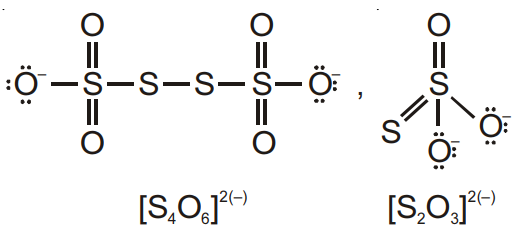
Tetrathionate $S_4O_6^{2-}$ has S–S–S–S linkage and thiosulphate $S_2O_3^{2-}$ has an S–S bond, whereas $S_2O_7^{2-}$ and $S_2O_8^{2-}$ have S–O–S and S–O–O–S linkages.
Xenon compounds – shapes
-
Match the compounds given in column I with the hybridisation and shape given in column II and mark the correct option.
Pick the matching item from Column II for each row.
Column I
- A. $XeF_6$
- B. $XeO_3$
- C. $XeOF_4$
- D. $XeF_4$
Column II
- 1. Distorted octahedral
- 2. Square planar
- 3. Pyramidal
- 4. Square pyramidal
Correct answer: A → 1, B → 3, C → 4, D → 2
$XeF_6$ distorted octahedral, $XeO_3$ pyramidal, $XeOF_4$ square pyramidal, $XeF_4$ square planar.
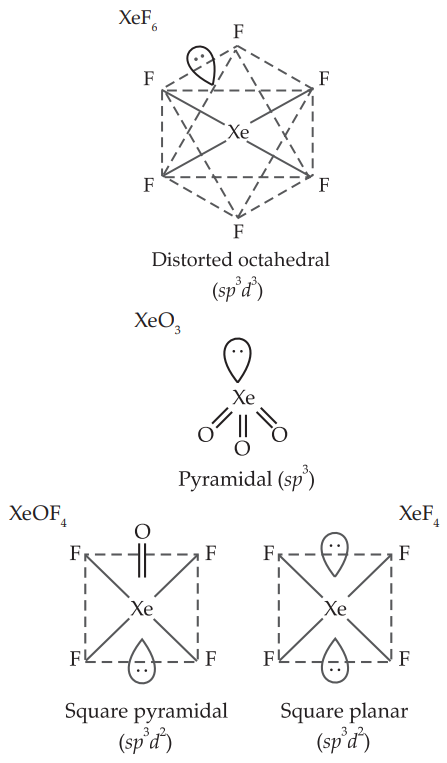
$XeF_6$: distorted octahedral ($sp^3d^3$)
$XeO_3$: pyramidal ($sp^3$)
$XeOF_4$: square pyramidal ($sp^3d^2$)
$XeF_4$: square planar ($sp^3d^2$)
Correct match: A-1, B-3, C-4, D-2.
Oxoacids of phosphorus – basicity
-
Which is the correct statement for the given acids?
Basicity equals the number of P–OH groups.
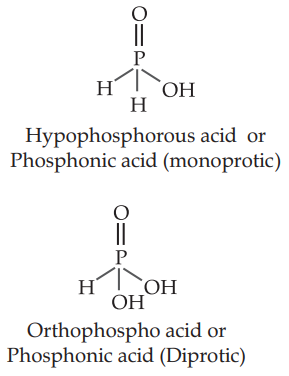
Hypophosphorous acid or phosphinic acid ($H_3PO_2$) has one P–OH group, so it is monoprotic.
Orthophosphorous acid or phosphonic acid ($H_3PO_3$) has two P–OH groups, so it is diprotic.
Halogens – bond dissociation enthalpy
-
Which one of the following orders is correct for the bond dissociation enthalpy of halogen molecules?
$F_2$ is anomalous due to lone pair repulsion.
Bond dissociation enthalpy decreases as the bond distance increases from $F_2$ to $I_2$, due to increase in atomic size down the group.
As the F atom is small, the lone pair–lone pair repulsion in $F_2$ is large, so the bond dissociation enthalpy of $F_2$ is smaller than $Cl_2$ and even $Br_2$.
Order: $Cl_2 > Br_2 > F_2 > I_2$
That is every question in The p-Block Elements (Class XII) for this filter.
Want a score?
Answers here are not saved. Practise as a test to be marked and see your progress.
Practise as a test