Looking for classes? Ksquare Career Institute, Bengaluru →

Chemistry
Aldehydes, Ketones and Carboxylic Acids
91 questions from 38 papers, each with its answer.
- 91 questions
- 38 papers
- 5.17% of Chemistry
Acidity of Carboxylic Acids
-
The correct order of decreasing acid strength of trichloroacetic acid (A), trifluoroacetic acid (B), acetic acid (C) and formic acid (D) is:Electron-withdrawing groups (–I effect) stabilise the carboxylate ion and increase acid strength; electron-releasing groups (+I) decrease it.
F is more electronegative than Cl, so $CF_3COOH > CCl_3COOH$.
The $CH_3$ group in acetic acid has a +I effect, so HCOOH > $CH_3COOH$.
Order: $CF_3COOH$ (B) > $CCl_3COOH$ (A) > HCOOH (D) > $CH_3COOH$ (C)
Reactions with Grignard Reagent
-
The major product of the following reaction is:
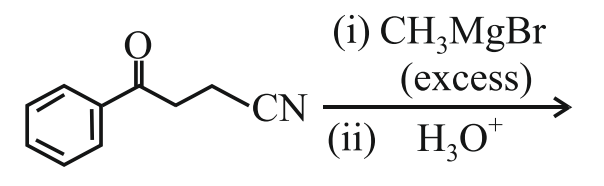
Excess $\text{CH}_3\text{MgBr}$ attacks both the ketone (forming a tertiary alcohol) and the nitrile (forming a methyl ketone after hydrolysis), yielding $\text{C}_6\text{H}_5-\text{C(OH)(CH}_3)-\text{CH}_2-\text{CH}_2-\text{COCH}_3$.
The starting compound contains two electrophilic functional groups: a ketone and a nitrile. Step 1: Grignard addition of $\text{CH}_3\text{MgBr}$ to the ketone gives a magnesium alkoxide: $\text{C}_6\text{H}_5-\text{C(O}^-\text{MgBr}^+)(\text{CH}_3)-\text{CH}_2-\text{CH}_2-\text{CN}$. Step 2: Another equivalent of $\text{CH}_3\text{MgBr}$ adds to the nitrile group to form an imine magnesium salt: $-\text{C}(=\text{N}^-\text{MgBr}^+)\text{CH}_3$. Step 3: Acidic aqueous workup ($\text{H}_3\text{O}^+$) protonates the alkoxide to a tertiary alcohol ($-\text{C(OH)(CH}_3)-$) and hydrolyzes the imine complex into a methyl ketone ($-\text{COCH}_3$). The major product is 5-hydroxy-5-phenylhexan-2-one (Option 2).
Preparation of Aldehydes
-
The incorrect method to synthesize benzaldehyde is:Benzonitrile with $CH_3MgBr$ followed by hydrolysis gives acetophenone ($C_6H_5COCH_3$), a ketone, not benzaldehyde. Benzoyl chloride with $H_2$/Pd-$BaSO_4$ (Rosenmund reduction), ethyl benzoate with DIBAL-H, and toluene with $CrO_2Cl_2$ (Etard reaction) all give benzaldehyde.
-
Reaction by which Benzaldehyde cannot be prepared:Zn–Hg and conc. HCl reduce aldehydes and ketones, but a carboxylic group remains unaffected, so benzoic acid does not give benzaldehyde.
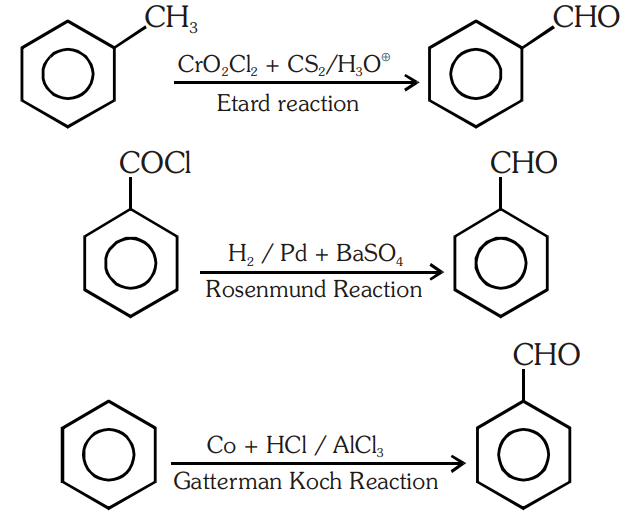
Reduction of Carbonyl Compounds – Clemmensen Reduction
-
Identify product (A) in the following reaction:
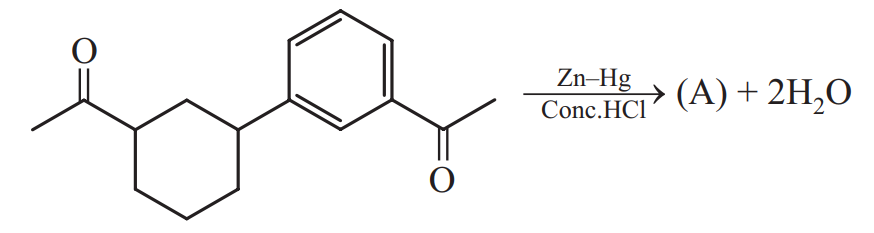
Zn–Hg/conc. HCl reduces a ketone carbonyl to a methylene group (Clemmensen reduction).
Ketones are reduced into hydrocarbons using Zn-Hg/HCl (Clemmenson reduction). $>C=O+Zn-Hg/HCl\rightarrow>CH_2$
Nucleophilic Addition – Cyanohydrin Formation
-
Complete the following reaction:
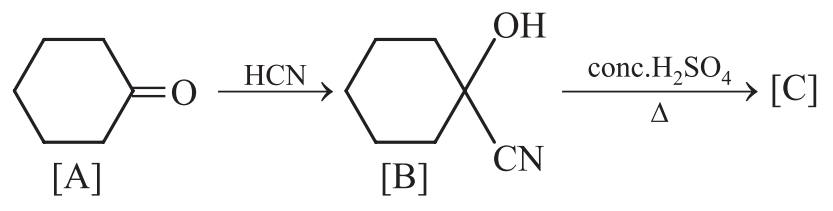 [C] is _______
The ketone forms a cyanohydrin [B] with HCN, which on treatment with conc. H2SO4 gives [C].
Reaction scheme: [A] $\xrightarrow{HCN}$ [B] $\xrightarrow[\Delta]{conc.\ H_2SO_4}$ [C]. [add image] -
A and B in the following reactions are :
$R-CO-R' \xrightarrow{HCN/KCN} A \xrightarrow{B} R-C(OH)(R')-CH_2NH_2$Step 1: HCN (with KCN as a source of $CN^-$) adds to the carbonyl group of the ketone to form a cyanohydrin (A):
$R-CO-R' + HCN \xrightarrow{KCN} RR'C(OH)CN$
Step 2: The product $R-C(OH)(R')-CH_2NH_2$ has a $-CH_2NH_2$ group in place of $-CN$. Reduction of a nitrile, $-C\equiv N \rightarrow -CH_2NH_2$, is done by $LiAlH_4$ (B):
$RR'C(OH)CN \xrightarrow{LiAlH_4} RR'C(OH)CH_2NH_2$
Hydrolysis with $H_3O^+$ would instead give the $\alpha$-hydroxy acid $RR'C(OH)COOH$.
So A = $RR'C(OH)CN$ and B = $LiAlH_4$.
Oxidation of Aldehydes – Tollens' Test
-
Identify the major product obtained in the following reaction:
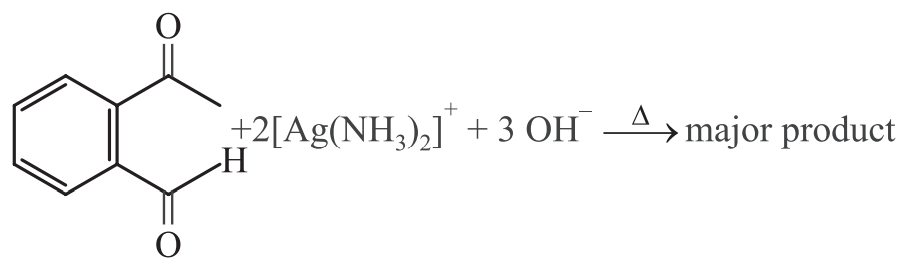
Tollens' reagent oxidises the aldehyde group to a carboxylate ion but does not oxidise a ketone.
Tollen's reagent oxidises aldehydes into carboxylate ion whereas ketone is not oxidised by Tollen's reagent. [add image]
Preparation of Carboxylic Acids – Grignard Reagent
-
$RMgX+CO_2\xrightarrow{dry\ ether}Y\xrightarrow{H_3O^+}RCOOH$. What is Y in the above reaction?The Grignard reagent adds to $CO_2$: $RMgX + O=C=O \rightarrow R-COO^-\,{}^+MgX$ (Y) $R-COOMgX \xrightarrow{H_3O^+} R-COOH$ So Y is $RCOO^-Mg^+X$.
Physical Properties of Aldehydes and Ketones
-
Given below are two statements: Statement I: The boiling points of aldehydes and ketones are higher than hydrocarbons of comparable molecular mass because of weak molecular association in aldehydes and ketones due to dipole-dipole interactions. Statement II: The boiling points of aldehydes and ketones are lower than the alcohols of similar molecular mass due to the absence of H-bonding. In the light of the above statements, choose the most appropriate answer from the options given below:Boiling point of compounds of comparable molecular mass: R–OH (H-bonding, strong association) > aldehydes/ketones (dipole-dipole interaction, weak association) > alkanes (non-polar) So both statements are correct.
Nucleophilic Addition and Addition-Elimination Reactions
-
Which of the following reactions is not an example for nucleophilic addition - elimination reaction?In nucleophilic addition-elimination reactions a water molecule is eliminated along with the product (imines, oximes, hydrazones). The reaction of $CH_3CHO$ with $NaHSO_3$ is only an addition reaction (bisulphite adduct).
Aldol Condensation
-
Of the following, which is the product formed when cyclohexanone undergoes aldol condensation followed by heating?
Aldol product dehydrates on heating to an $\alpha,\beta$-unsaturated ketone.
Two molecules of cyclohexanone undergo aldol addition in the presence of $OH^-$; on heating, dehydration gives the $\alpha,\beta$-unsaturated ketone.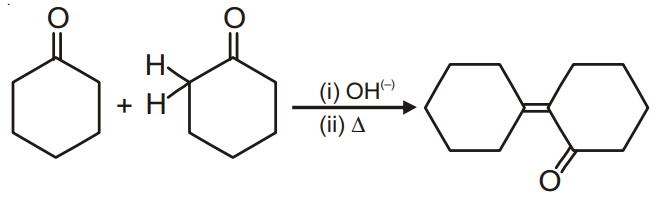
So the product is 2-cyclohexylidenecyclohexanone (two rings joined by a C=C double bond, with C=O on the ring carbon adjacent to it). -
Acetophenone when reacted with a base, $C_2H_5ONa$, yields a stable compound which has the structure :Acetophenone, $C_6H_5COCH_3$, has $\alpha$-hydrogen atoms, so with a base like $C_2H_5ONa$ it undergoes the aldol condensation reaction.
Step 1: the base removes an $\alpha$-hydrogen to give the carbanion (enolate) $C_6H_5CO\overset{\ominus}{C}H_2$.
Step 2: this carbanion attacks the carbonyl carbon of a second molecule of acetophenone.
$C_6H_5COCH_3 + CH_3COC_6H_5 \xrightarrow{C_2H_5ONa} C_6H_5-C(OH)(CH_3)-CH_2-CO-C_6H_5$ (a $\beta$-hydroxy ketone)
Step 3: the $\beta$-hydroxy ketone readily loses a molecule of $H_2O$ because the product is stabilised by conjugation with the carbonyl group and the benzene ring.
$C_6H_5-C(OH)(CH_3)-CH_2-CO-C_6H_5 \xrightarrow{-H_2O} C_6H_5-C(CH_3)=CH-CO-C_6H_5$
The stable product is the $\alpha,\beta$-unsaturated ketone $C_6H_5-C(CH_3)=CH-CO-C_6H_5$ (1,3-diphenylbut-2-en-1-one, also called dypnone).
Chemical Reactions of Carboxylic Acids – Decarboxylation
-
$CH_3CH_2COO^-Na^+\xrightarrow[Heat]{NaOH,\ +?}CH_3CH_3+Na_2CO_3$. Consider the above reaction and identify the missing reagent/chemical.$CH_3CH_2COO^-Na^+ \xrightarrow[Heat]{NaOH + CaO} CH_3CH_3 + Na_2CO_3$ Decarboxylation takes place with soda lime (NaOH + CaO), so the missing reagent is CaO.
Named Reactions of Aldehydes, Ketones and Carboxylic Acids
-
Match List-I with List-II.
Pick the matching item from Column II for each row.
Column I
- A. Benzene + CO, HCl (anhyd. $AlCl_3$/CuCl)
- B. $R-CO-CH_3+NaOX$
- C. $R-CH_2-OH+R'COOH$ (conc. $H_2SO_4$)
- D. $R-CH_2COOH$, (i) $X_2$/Red P, (ii) $H_2O$
Column II
- I. Hell-Volhard-Zelinsky reaction
- II. Gattermann-Koch reaction
- III. Haloform reaction
- IV. Esterification
Correct answer: A → II, B → III, C → IV, D → I
Benzene + CO, HCl (anhyd. $AlCl_3$/CuCl) – Gattermann-Koch reaction $R-CO-CH_3$ + NaOX – haloform reaction $R-CH_2-OH + R'COOH$ (conc. $H_2SO_4$) – esterification $R-CH_2COOH$ + (i) $X_2$/Red P, (ii) $H_2O$ – Hell-Volhard-Zelinsky reaction Correct match: A-II, B-III, C-IV, D-I.
Preparation of Aldehydes – From Benzal Chloride
-
Identify compound X in the following sequence of reactions:
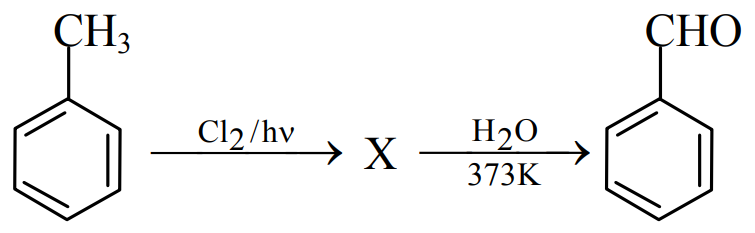 $C_6H_5CH_3 \xrightarrow{Cl_2/h\nu} C_6H_5CHCl_2$ (X, benzal chloride) $C_6H_5CHCl_2 \xrightarrow[373\ K]{H_2O} [C_6H_5CH(OH)_2] \xrightarrow{-H_2O} C_6H_5CHO$ So X is benzal chloride, $C_6H_5CHCl_2$.
Carboxylic Acids – Reaction with Ammonia (Formation of Imides)
-
The major product of the following reaction is-
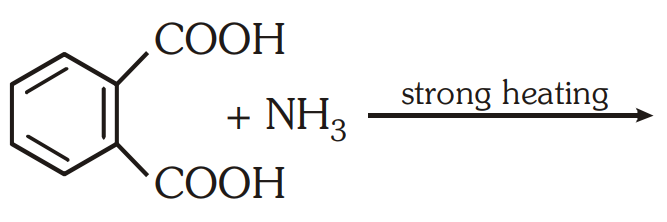 Phthalic acid + $NH_3$ → diammonium phthalate $C_6H_4(COO^-NH_4^+)_2$ On heating, it loses $2H_2O$ to give phthalamide $C_6H_4(CONH_2)_2$. On strong heating, phthalamide loses $NH_3$ to give phthalimide. So the major product is phthalimide.
Preparation and reactions of carboxylic acids and amides
-
Select the incorrect reaction among the following:
(a) $CH_3COCl\xrightarrow{H_2O,\Delta}CH_3COOH$; (b)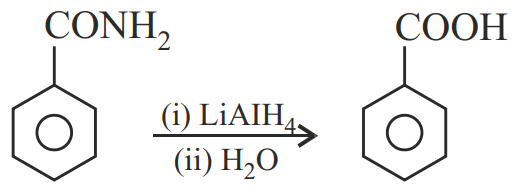
(c) $CH_3CH_2OH\xrightarrow{(i)\ KMnO_4/OH^-\ (ii)\ H_3O^+}CH_3COOH$; (d) $CH_3CH_2CH_2OH\xrightarrow{CrO_3-H_2SO_4}CH_3CH_2COOH$$LiAlH_4$ is a reducing agent that reduces an amide ($-CONH_2$) to a primary amine ($-CH_2NH_2$), not to a carboxylic acid. So reaction (b), which shows benzamide converting to benzoic acid on treatment with $LiAlH_4/H_2O$, is incorrect. Reactions (a), (c) and (d) correctly represent hydrolysis of an acid chloride, oxidation of ethanol to acetic acid, and Jones oxidation of a primary alcohol to a carboxylic acid, respectively.
Rosenmund reduction
-
The following conversion is known as:
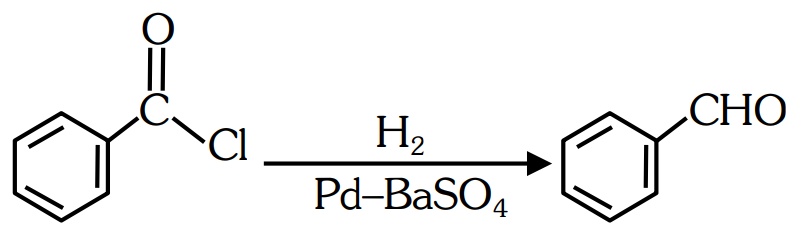 Selective reduction of an acid chloride to an aldehyde using $H_2$ over a Pd-$BaSO_4$ (poisoned palladium) catalyst is known as the Rosenmund reaction.
-
Identify compound (A) in the following reaction:
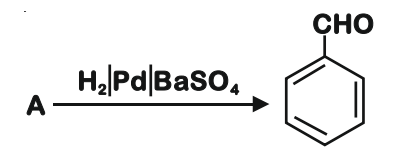 In the Rosenmund reduction, an acid chloride is selectively reduced to an aldehyde using $H_2$ over a poisoned Pd-$BaSO_4$ catalyst. So A must be benzoyl chloride ($C_6H_5COCl$), which is reduced to benzaldehyde.
Reactions of dicarboxylic acids - anhydride and imide formation
-
Which of the following acid will form an (a) Anhydride on heating and (b) Acid imide on strong heating with ammonia?A dicarboxylic acid capable of forming a stable 5- or 6-membered cyclic anhydride on heating (and a corresponding cyclic imide on strong heating with ammonia) is one whose two $-COOH$ groups are positioned close enough (e.g. succinic acid-type structure) to allow intramolecular cyclisation.
Aldol condensation of acetone
-
Consider the given reaction: $CH_3COCH_3\xrightarrow{dil\ Ba(OH)_2} "X"$. The functional groups present in compound "X" are:"Acetone undergoes a base-catalysed aldol reaction (with dilute $Ba(OH)_2$) to give diacetone alcohol: $CH_3-CO-CH_3\xrightarrow{Ba(OH)_2}CH_3-C(OH)(CH_3)-CH_2-CO-CH_3$. The functional groups present in this aldol product are alcohol and ketone.
Nitrile hydrolysis followed by Hell-Volhard-Zelinsky reaction
-
Identify the product in the following reaction below:
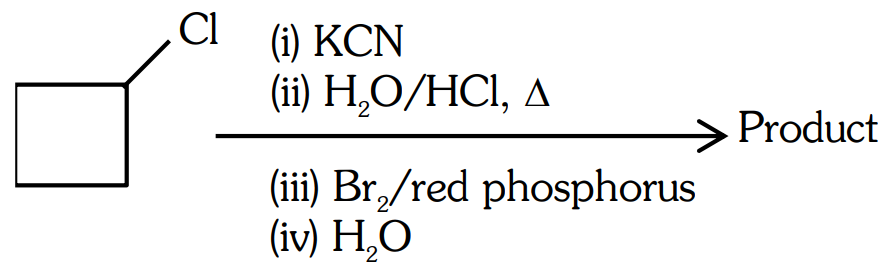 The cyclobutyl chloride reacts with KCN to form the nitrile (substituting Cl with CN), which is hydrolysed with $H_2O/HCl$ on heating to give the carboxylic acid. This acid then undergoes the Hell-Volhard-Zelinsky reaction ($Br_2$/red phosphorus, followed by $H_2O$) to introduce a bromine at the alpha-carbon, giving an alpha-bromo carboxylic acid as the final product.
Preparation of carboxylic acids
-
Consider the following reaction:
Phenol $\xrightarrow{Zn\ dust}$ X $\xrightarrow[Anhydrous\ AlCl_3]{CH_3Cl}$ Y $\xrightarrow{Alkaline\ KMnO_4}$ Z
The product Z isStep 1: phenol heated with zinc dust is reduced to benzene: $C_6H_5OH + Zn \rightarrow C_6H_6 + ZnO$. X is benzene.
Step 2: benzene undergoes Friedel–Crafts alkylation with $CH_3Cl$ and anhydrous $AlCl_3$: $C_6H_6 + CH_3Cl \rightarrow C_6H_5CH_3 + HCl$. Y is toluene.
Step 3: alkaline $KMnO_4$ oxidises the alkyl side chain of an alkylbenzene to a carboxyl group: $C_6H_5CH_3 \xrightarrow{alk.\ KMnO_4} C_6H_5COOK \xrightarrow{H_3O^+} C_6H_5COOH$
Hence Z is benzoic acid.
Friedel-Crafts acylation and haloform reaction
-
For the following reaction sequence, choose the correct option.
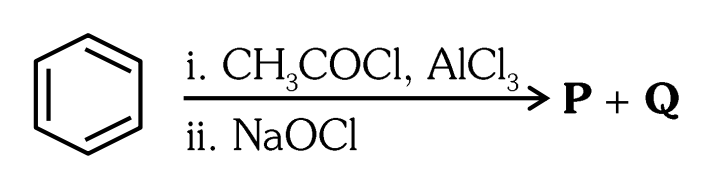
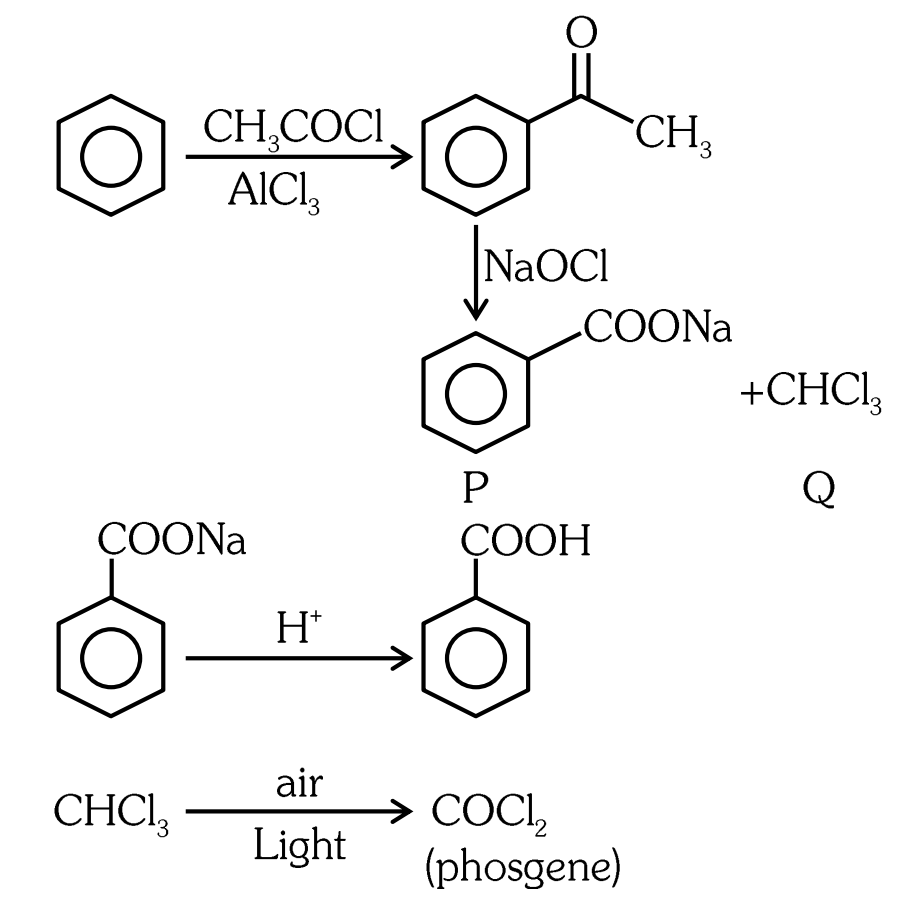 Friedel-Crafts acylation gives acetophenone: $C_6H_6\xrightarrow{CH_3COCl/AlCl_3}C_6H_5COCH_3$. The haloform reaction with NaOCl gives $C_6H_5COONa$ (P) + $CHCl_3$ (Q). On acidification P gives benzoic acid, $C_6H_5COOH$. Chloroform on exposure to air and light forms the poisonous gas phosgene: $CHCl_3\xrightarrow{air,\ light}COCl_2$.
Preparation of aldehydes - Rosenmund reduction
-
Consider the following reaction, and choose the correct option.
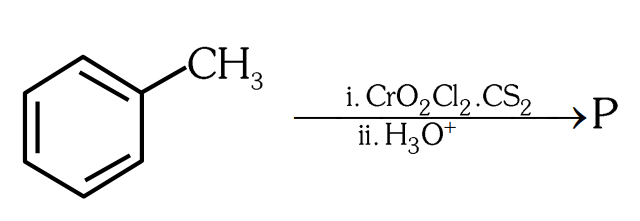 $C_6H_5CH_3\xrightarrow{(i)\ CrO_2Cl_2,\ CS_2;\ (ii)\ H_3O^+}C_6H_5CHO$ (Etard reaction), so P is benzaldehyde. Benzaldehyde is also obtained from benzoyl chloride by hydrogenation over Pd/$BaSO_4$ (Rosenmund reduction): $C_6H_5COCl\xrightarrow{H_2,\ Pd/BaSO_4}C_6H_5CHO$.
Haloform (iodoform) reaction
-
Compound A, $C_8H_{10}O$, is found to react with NaOI (produced by reacting Y with NaOH) and yields a yellow precipitate with characteristic smell. A and Y are respectively
Only the $CH_3CH(OH)-$ alcohol gives the iodoform test.
1-Phenylethanol is a secondary alcohol which on oxidation gives phenyl methyl ketone (acetophenone). This on reaction with $I_2$ and NaOH forms iodoform and sodium benzoate.
$2NaOH + I_2 \rightarrow NaOI + NaI + H_2O$
$C_6H_5CH(OH)CH_3\ (A) \xrightarrow{NaOI} C_6H_5COCH_3$ (acetophenone)
$C_6H_5COCH_3 \xrightarrow{I_2/NaOH} C_6H_5COONa + CHI_3$ (iodoform, yellow ppt)
So A is $C_6H_5CH(OH)CH_3$ and Y is $I_2$.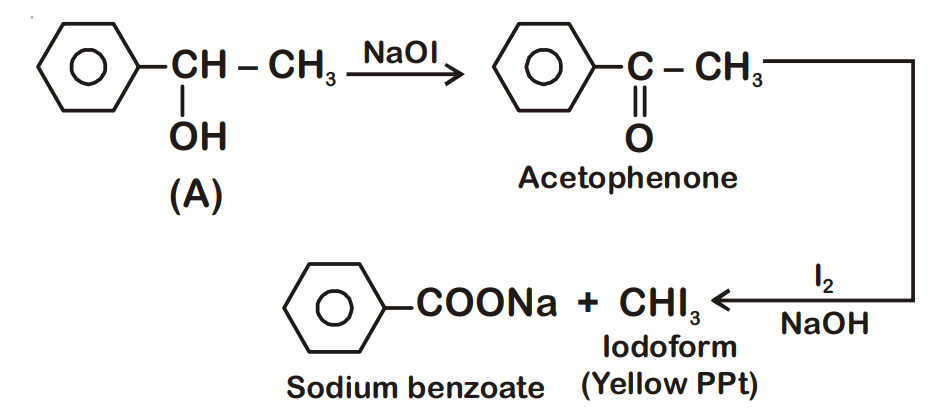
Preparation and reactions of aldehydes
-
Consider the reactions:
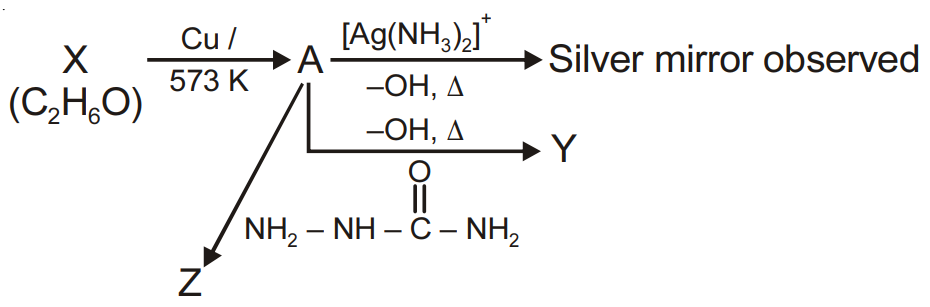
Identify A, X, Y and ZDehydrogenation of ethanol gives ethanal, which shows Tollens', aldol and semicarbazone reactions.
Since 'A' gives a positive silver mirror test, it must be an aldehyde or an $\alpha$-hydroxyketone.
Reaction with semicarbazide indicates that A can be an aldehyde or ketone.
Reaction with dilute $OH^-$ (aldol condensation) indicates that A is an aldehyde, as the aldol reaction of ketones is reversible and needs special apparatus.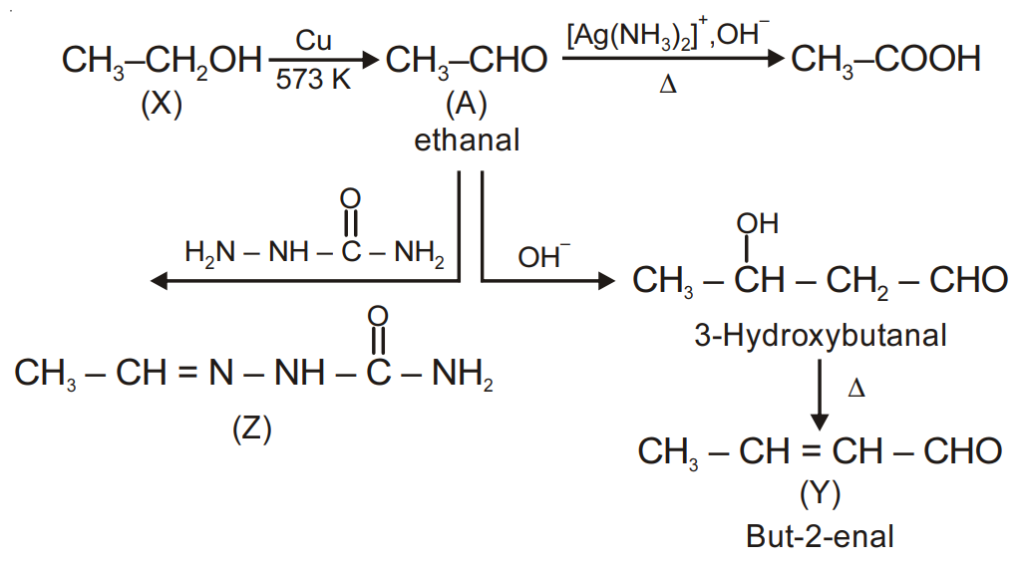
Selective catalytic hydrogenation
-
The correct structure of the product A formed in the reaction:
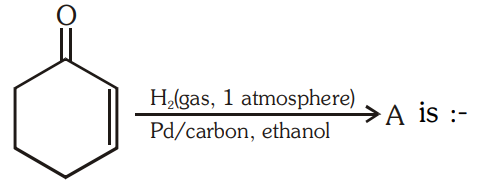
Pd/C with 1 atm H₂ reduces C=C, not C=O.
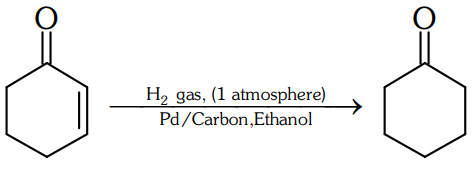
Cyclohex-2-en-1-one $\xrightarrow{H_2\ (1\ atm),\ Pd/C,\ ethanol}$ cyclohexanone
Only the C=C is reduced under these mild conditions; the C=O remains. So A is cyclohexanone.
Acidity of carboxylic acids – inductive effect
-
The correct order of strengths of the carboxylic acids I, II and III is:
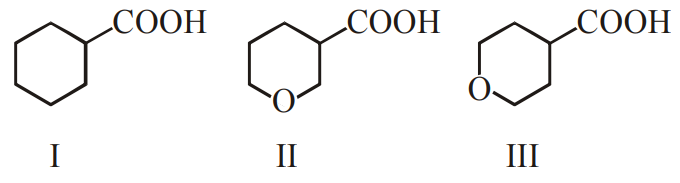
Closer electronegative O → stronger acid.
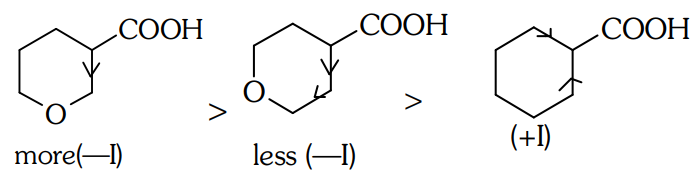
In II the ring oxygen is closer to –COOH, exerting more –I effect; in III it is farther (less –I); in I the ring has +I effect.
Acidic strength: II > III > I
Acidity of alpha-hydrogens
-
Treatment of cyclopentanone
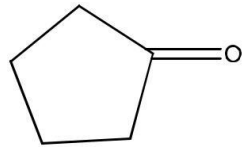 with methyl lithium gives which of the following species?$\overset{-}{C}H_3$ from $CH_3Li$ acts as a strong base and abstracts an $\alpha$-hydrogen of cyclopentanone.
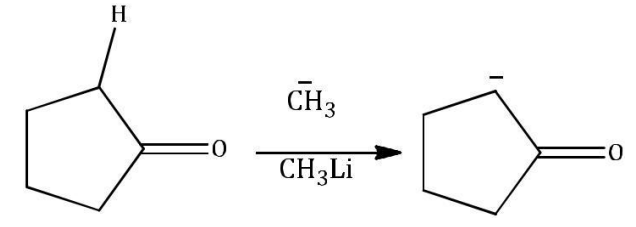
So the cyclopentanonyl anion is formed.
Tests for carbonyl compounds
-
An organic compound 'X' having molecular formula $C_5H_{10}O$ yields phenyl hydrazone and gives negative response to the Iodoform test and Tollens' test. It produces n-pentane on reduction. 'X' could be:Forms a phenylhydrazone, so X is a carbonyl compound.
Negative Tollens' test, so it is a ketone, not an aldehyde.
Negative iodoform test, so it has no $CH_3CO-$ group.
Reduction gives n-pentane, so the chain is unbranched: X is 3-pentanone, $CH_3CH_2COCH_2CH_3$.
$CH_3CH_2COCH_2CH_3 \xrightarrow{Zn-Hg/HCl} CH_3CH_2CH_2CH_2CH_3$
Nucleophilic addition reactions
-
Which one is most reactive towards Nucleophilic addition reaction?Reactivity towards nucleophilic addition depends on steric and electronic effects.
Order: p-nitrobenzaldehyde > benzaldehyde > p-tolualdehyde > acetophenone
The –M effect of $-NO_2$ increases the positive charge on the $sp^2$ carbonyl carbon. -
Acetone is treated with excess of ethanol in the presence of hydrochloric acid. The product obtained is:In the presence of dry HCl, one molecule of ethanol adds to the carbonyl group of acetone to give a hemiketal, $(CH_3)_2C(OH)(OC_2H_5)$.
With excess ethanol the hemiketal reacts with a second molecule of ethanol, losing water, to give the ketal.
$(CH_3)_2C=O + 2C_2H_5OH \xrightarrow{HCl} (CH_3)_2C(OC_2H_5)_2 + H_2O$
So the product is 2,2-diethoxypropane, $(CH_3)_2C(OC_2H_5)_2$.
Hydrolysis of esters
-
Which one of the following esters gets hydrolysed most easily under alkaline conditions?Electron-withdrawing groups increase reactivity towards nucleophilic attack by $OH^-$ (and stabilise the leaving phenoxide).
$-NO_2$ is a strong electron-withdrawing group, so p-nitrophenyl acetate is hydrolysed most easily.
Reactions of carboxylic acids
-
In the following sequence of reactions $CH_3-Br \xrightarrow{KCN} A \xrightarrow{H_3O^+} B \xrightarrow[ether]{LiAlH_4} C$, the end product (C) is$CH_3Br \xrightarrow{KCN} CH_3CN$ (A, methyl cyanide) by nucleophilic substitution
$CH_3CN \xrightarrow{H_3O^+} CH_3COOH$ (B, acetic acid) by hydrolysis
$CH_3COOH \xrightarrow[ether]{LiAlH_4} CH_3CH_2OH$ (C) by reduction
So C is ethyl alcohol. -
Propionic acid with $Br_2$/P yields a dibromo product. Its structure would beCarboxylic acids having α-hydrogen atoms are halogenated at the α-position by chlorine or bromine in the presence of a small amount of red phosphorus (Hell–Volhard–Zelinsky reaction).
Propionic acid, $CH_3-CH_2-COOH$, has two α-hydrogen atoms on the $-CH_2-$ group next to –COOH.
First: $CH_3CH_2COOH \xrightarrow{Br_2/P} CH_3CHBrCOOH$
With more bromine the second α-hydrogen is also replaced: $CH_3CHBrCOOH \xrightarrow{Br_2/P} CH_3CBr_2COOH$
The β-hydrogens are not substituted in this reaction.
Hence the dibromo product is $CH_3-CBr_2-COOH$ (2,2-dibromopropanoic acid).
Cannizzaro reaction
-
Predict the products in the given reaction:
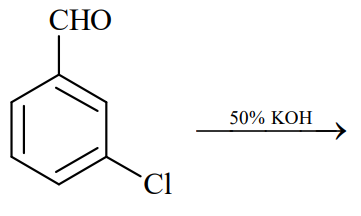
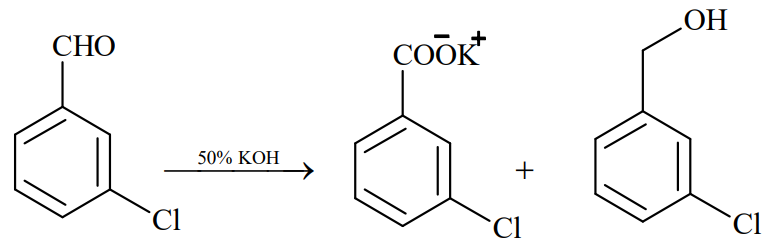
m-Chlorobenzaldehyde has no α-hydrogen, so with concentrated (50%) KOH it undergoes the Cannizzaro reaction.
One molecule is oxidised to the salt of the acid and another is reduced to the alcohol.
$2\,m\text{-}ClC_6H_4CHO \xrightarrow{50\%\ KOH} m\text{-}ClC_6H_4COO^-K^+ + m\text{-}ClC_6H_4CH_2OH$
The Cl on the ring is not replaced. The products are m-chlorobenzyl alcohol and the m-chlorobenzoate ion. -
When m-chlorobenzaldehyde is treated with 50% KOH solution, the product(s) obtained is (are)m-Chlorobenzaldehyde, $m-ClC_6H_4CHO$, has no $\alpha$-hydrogen. With concentrated (50%) alkali it undergoes the Cannizzaro reaction (self oxidation-reduction).
One molecule is oxidised to the carboxylate ion and another is reduced to the alcohol:
$2\,m-ClC_6H_4CHO + KOH \rightarrow m-ClC_6H_4COO^-K^+ + m-ClC_6H_4CH_2OH$
The aryl C–Cl bond is not affected by KOH under these conditions (aryl halides are very unreactive towards nucleophilic substitution), so Cl is not replaced by OH.
So the products are the m-chlorobenzoate ion and m-chlorobenzyl alcohol.
Named reactions of aromatic compounds
-
Match the compounds given in List-I with List-II and select the suitable option.
Pick the matching item from Column II for each row.
Column I
- a. Benzaldehyde
- b. Phthalic anhydride
- c. Phenyl benzoate
- d. Methyl salicylate
Column II
- i. Phenolphthalein
- ii. Benzoin condensation
- iii. Oil of wintergreen
- iv. Fries rearrangement
Correct answer: a → ii, b → i, c → iv, d → iii
Benzaldehyde: two molecules condense in the presence of alcoholic KCN to give benzoin, $C_6H_5CH(OH)COC_6H_5$; this is the benzoin condensation.
Phthalic anhydride: on heating with two molecules of phenol in the presence of conc. $H_2SO_4$ it gives phenolphthalein.
Phenyl benzoate: phenolic esters, on heating with anhydrous $AlCl_3$, rearrange to o- and p-hydroxy ketones; this is the Fries rearrangement.
Methyl salicylate: it is the chief constituent of oil of wintergreen.
Correct match: a-ii, b-i, c-iv, d-iii.
Nucleophilic addition to carbonyl compounds
-
The order of reactivity of phenyl magnesium bromide (PhMgBr) with the following compounds:
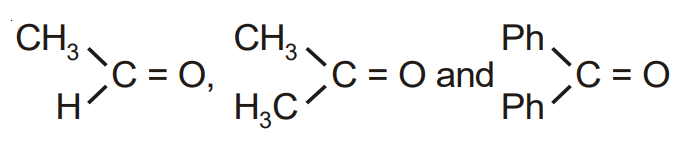 PhMgBr adds to the carbonyl group as a nucleophile (nucleophilic addition); reactivity depends on the electrophilicity of the carbonyl carbon and on steric hindrance around it.
(I) Acetaldehyde has only one alkyl group: least +I effect and least steric crowding, so it is the most reactive.
(II) Acetone has two methyl groups: their +I effect lowers the positive charge on the carbonyl carbon and they add steric hindrance, so it is less reactive than acetaldehyde.
(III) Benzophenone has two bulky phenyl groups: resonance of the rings with C=O (+R effect) reduces the electrophilicity of the carbonyl carbon greatly, and the steric hindrance is maximum, so it is the least reactive.
Order of reactivity: I > II > III
Haloform reaction
-
Following compounds are given
a. $CH_3CH_2OH$
b. $CH_3COCH_3$
c. $CH_3CH(OH)CH_3$
d. $CH_3OH$
Which of the above compound(s), on being warmed with iodine solution and NaOH, will give iodoform?The iodoform test (yellow precipitate of $CHI_3$ with $I_2$/NaOH) is given by compounds containing the $CH_3CO-$ group, and by alcohols containing the $CH_3CH(OH)-$ group, which are oxidised to $CH_3CO-$ by NaOI.
a. $CH_3CH_2OH$ has $CH_3CH(OH)-$ (with H); it is oxidised to $CH_3CHO$ and gives iodoform.
b. $CH_3COCH_3$ has the $CH_3CO-$ group; it gives iodoform.
c. $CH_3CH(OH)CH_3$ has the $CH_3CH(OH)-$ group; it is oxidised to acetone and gives iodoform.
d. $CH_3OH$ has neither group; it does not give iodoform.
Hence a, b and c give iodoform.
Carboxylic acids
-
In a set of reactions, ethyl benzene yielded a product D.

'D' would beStep 1: alkaline $KMnO_4$ oxidises the whole alkyl side chain of an alkylbenzene to –COOH, whatever its length: $C_6H_5CH_2CH_3 \rightarrow C_6H_5COOH$. So B is benzoic acid.
Step 2: $Br_2$/$FeCl_3$ brings about electrophilic substitution in the ring. The –COOH group is deactivating and meta directing, so bromine enters the meta position: C is m-bromobenzoic acid.
Step 3: with ethanol and acid the carboxylic acid is esterified (Fischer esterification): m-$BrC_6H_4COOH + C_2H_5OH \xrightarrow{H^+}$ m-$BrC_6H_4COOC_2H_5 + H_2O$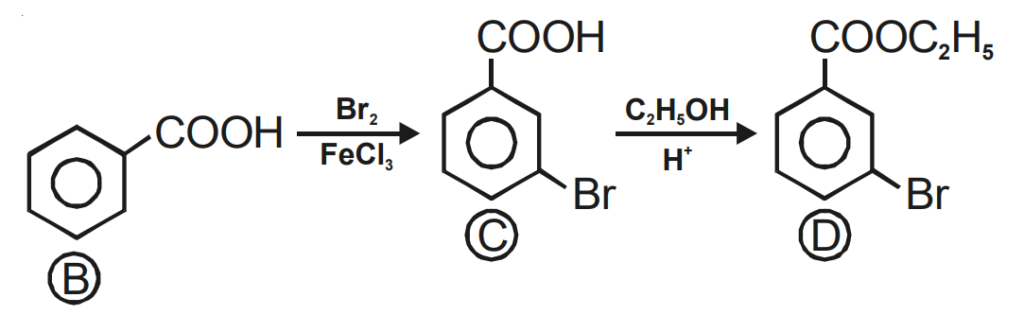
Hence D is ethyl m-bromobenzoate.
Named reactions
-
Which of the following reactions will not result in the formation of carbon-carbon bonds?Friedel–Crafts acylation: $C_6H_6 + RCOCl \xrightarrow{AlCl_3} C_6H_5COR$; a new ring carbon–acyl carbon bond is formed.
Reimer–Tiemann reaction: phenol + $CHCl_3$ + NaOH gives salicylaldehyde; a –CHO group is attached to the ring through a new C–C bond.
Wurtz reaction: $2RX + 2Na \rightarrow R-R + 2NaX$; two alkyl groups are joined by a new C–C bond.
Cannizzaro reaction: an aldehyde without α-hydrogen undergoes disproportionation in concentrated alkali; one molecule is oxidised to the acid salt and another is reduced to the alcohol by hydride transfer, e.g., $2HCHO + KOH \rightarrow HCOOK + CH_3OH$. Only C–H and C–O bonds change.
Hence the Cannizzaro reaction does not form a carbon–carbon bond.
Derivatives of carboxylic acids
-
Among the given compounds, the most susceptible to nucleophilic attack at the carbonyl group isReactivity of acid derivatives towards nucleophiles depends on how electron-deficient the carbonyl carbon is and on how good the leaving group is.
In $CH_3COCl$, chlorine withdraws electrons strongly by its −I effect and its 3p orbital overlaps poorly with the 2p of carbon, so there is little resonance donation; the carbonyl carbon is the most electrophilic.
$Cl^-$ is also the weakest base among the leaving groups ($Cl^-$, $CH_3COO^-$, $CH_3O^-$, $NH_2^-$), so it is the best leaving group.
In the anhydride, ester and amide the lone pair on O or N is donated to the carbonyl group by resonance, reducing its electrophilicity; the effect is greatest in the amide.
Order of reactivity: $CH_3COCl > CH_3COOCOCH_3 > CH_3COOCH_3 > CH_3CONH_2$
Hence $CH_3COCl$ is the most susceptible to nucleophilic attack.
Reactivity of Carboxylic Acid Derivatives
-
The relative reactivities of acyl compounds towards nucleophilic substitution are in the order of -The relative reactivity of acyl compounds ($RCO-L$) towards nucleophilic substitution depends upon the leaving group ability of $L$.
Weak bases are good leaving groups.
Basic strength increases in the order: $Cl^- \lt RCOO^- \lt RO^- \lt NH_2^-$
Therefore leaving group ability decreases in the order: $Cl^- \gt RCOO^- \gt RO^- \gt NH_2^-$
Also, the lone pair on the group attached to the carbonyl carbon is donated by resonance most strongly in amides and least in acyl chlorides, so the carbonyl carbon is most electrophilic in the acyl chloride.
Hence the reactivity order is: $RCOCl \gt (RCO)_2O \gt RCOOR \gt RCONH_2$
That is, acyl chloride > acid anhydride > ester > amide.
Reactivity of Acid Chlorides
-
Consider the following compounds.
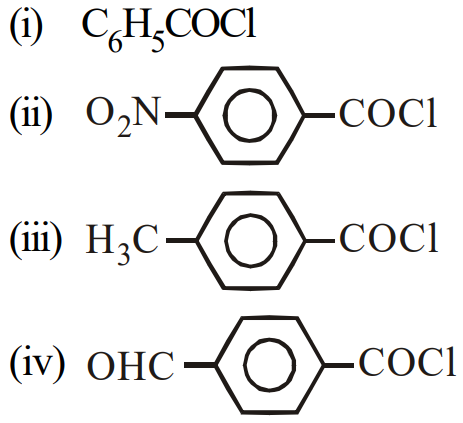
The correct decreasing order of their reactivity towards hydrolysis isHydrolysis of an acid chloride is a nucleophilic attack of water on the carbonyl carbon.
The ease of hydrolysis increases as the magnitude of the positive charge on the carbonyl carbon increases.
An electron withdrawing group on the ring increases this positive charge, while an electron releasing group decreases it.
Among the substituents, $-NO_2$ and $-CHO$ are electron withdrawing groups, and $-NO_2$ withdraws electrons more strongly than $-CHO$.
On the other hand, $-CH_3$ is an electron releasing group ($+I$ and hyperconjugation), so it lowers the reactivity below that of unsubstituted benzoyl chloride.
Therefore the order of reactivity towards hydrolysis is: $p\text{-}O_2N-C_6H_4COCl \gt p\text{-}OHC-C_6H_4COCl \gt C_6H_5COCl \gt p\text{-}H_3C-C_6H_4COCl$
That is, (ii) > (iv) > (i) > (iii).
Nucleophilic Addition of HCN
-
A carbonyl compound reacts with hydrogen cyanide to form cyanohydrin which on hydrolysis forms a racemic mixture of $\alpha$-hydroxy acid. The carbonyl compound is :A racemic mixture can form only if the $\alpha$-hydroxy acid has a chiral carbon, i.e. the carbon carrying OH must have four different groups.
Acetaldehyde: $CH_3CHO + HCN \rightarrow CH_3-CH(OH)-CN$
On hydrolysis: $CH_3-CH(OH)-CN \xrightarrow{H^+/H_2O} CH_3-\overset{*}{C}H(OH)-COOH$ (lactic acid)
The starred carbon has four different groups ($H$, $OH$, $CH_3$ and $COOH$), so it is chiral.
The carbonyl group is planar and $CN^-$ attacks it from both faces with equal ease, so both enantiomers are formed in equal amounts, giving a racemic mixture.
Formaldehyde gives $HOCH_2COOH$, acetone gives $(CH_3)_2C(OH)COOH$ and diethyl ketone gives $(C_2H_5)_2C(OH)COOH$; in each of these the carbon has two identical groups, so it is not chiral.
So the carbonyl compound is acetaldehyde.
Claisen Condensation
-
Self condensation of two moles of ethyl acetate in presence of sodium ethoxide yields :-Esters having $\alpha$-hydrogen atoms undergo self condensation in the presence of a strong base such as sodium ethoxide. This is the Claisen condensation.
The base removes an $\alpha$-hydrogen from one molecule of ethyl acetate to give a carbanion, $^-CH_2COOC_2H_5$.
The carbanion attacks the carbonyl carbon of a second molecule of ethyl acetate, and a molecule of ethanol is eliminated.
$CH_3-CO-OC_2H_5 + H-CH_2-CO-OC_2H_5 \xrightarrow{C_2H_5ONa} CH_3-CO-CH_2-CO-OC_2H_5 + C_2H_5OH$
The product is a $\beta$-keto ester, ethyl acetoacetate (ethyl 3-oxobutanoate), commonly called acetoacetic ester.
So the product is acetoacetic ester.
Friedel-Crafts Acylation and Cyanohydrins
-
In a set of reactions acetic acid yielded a product D
$CH_3COOH \xrightarrow{SOCl_2} A \xrightarrow[\text{Anhy. }AlCl_3]{\text{Benzene}} B \xrightarrow{HCN} C \xrightarrow{H_2O} D$
The structure of D would be -Step 1: $CH_3COOH \xrightarrow{SOCl_2} CH_3COCl$ (A, acetyl chloride) $+ SO_2 + HCl$
Step 2: Friedel-Crafts acylation: $C_6H_6 + CH_3COCl \xrightarrow{\text{anhy. }AlCl_3} C_6H_5COCH_3$ (B, acetophenone) $+ HCl$
Step 3: HCN adds to the carbonyl group of acetophenone to form a cyanohydrin: $C_6H_5COCH_3 + HCN \rightarrow C_6H_5-C(OH)(CN)-CH_3$ (C)
Step 4: hydrolysis of the cyano group gives a carboxylic acid: $C_6H_5-C(OH)(CN)-CH_3 \xrightarrow{H_2O/H^+} C_6H_5-C(OH)(CH_3)-COOH$ (D)
D is 2-hydroxy-2-phenylpropanoic acid (atrolactic acid).
So the structure of D is $C_6H_5-C(OH)(CH_3)-COOH$.
Nucleophilic Addition and Stereochemistry
-
In this reaction : $CH_3CHO + HCN \rightarrow CH_3CH(OH)CN \xrightarrow{H.OH} CH_3CH(OH)COOH$, an asymmetric centre is generated. The acid obtained would be :The carbonyl group of acetaldehyde is planar ($sp^2$ carbon). The cyanide ion can attack this carbon equally from either face of the plane.
Attack from one face gives one configuration of the new chiral carbon in $CH_3CH(OH)CN$, and attack from the other face gives the mirror image configuration.
Both attacks are equally probable, since there is no chiral influence (no chiral reagent, catalyst or solvent). So the two enantiomers are formed in equal amounts.
Hydrolysis of the cyanohydrin then gives lactic acid, $CH_3CH(OH)COOH$, also as a 1 : 1 mixture of the D and L forms, i.e. a racemic mixture which is optically inactive.
So the acid obtained is 50% D + 50% L-isomer.
Friedel-Crafts Acylation and Grignard Reaction
-
In a set of the given reactions, acetic acid yielded a product C.
$CH_3COOH + PCl_5 \rightarrow A \xrightarrow[Anh.\ AlCl_3]{C_6H_6} B \xrightarrow[ether]{C_2H_5MgBr} C$
Product C would beStep 1: $PCl_5$ converts acetic acid into acetyl chloride (A):
$CH_3COOH + PCl_5 \rightarrow CH_3COCl + POCl_3 + HCl$
Step 2: Friedel-Crafts acylation of benzene with acetyl chloride gives acetophenone (B):
$CH_3COCl + C_6H_6 \xrightarrow{anhyd.\ AlCl_3} CH_3COC_6H_5 + HCl$
Step 3: Ethylmagnesium bromide adds to the ketone; the ethyl group attacks the carbonyl carbon. Hydrolysis then gives a tertiary alcohol (C):
$CH_3COC_6H_5 + C_2H_5MgBr \rightarrow CH_3C(OMgBr)(C_2H_5)C_6H_5 \xrightarrow{H_2O} CH_3C(OH)(C_2H_5)C_6H_5$
So C is 2-phenylbutan-2-ol, $CH_3-C(OH)(C_2H_5)-C_6H_5$.
Preparation of Ketones from Nitriles
-
The reaction of m-methoxybenzonitrile ($m-CH_3OC_6H_4CN$) with $CH_3MgBr$ followed by $H_3O^+$ gives product P :
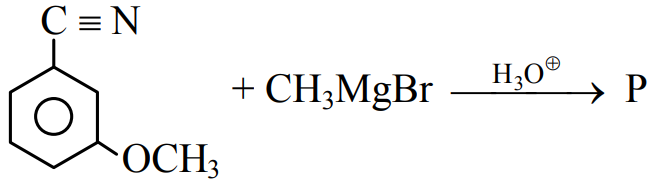 A Grignard reagent adds once to the C$\equiv$N group of a nitrile, forming an imine magnesium salt:
$ArC\equiv N + CH_3MgBr \rightarrow Ar-C(CH_3)=N-MgBr$
Acid hydrolysis converts this imine salt into a ketone:
$Ar-C(CH_3)=NMgBr \xrightarrow{H_3O^+} Ar-CO-CH_3 + NH_3 + Mg(OH)Br$
Here Ar is the m-methoxyphenyl group, so P is m-methoxyacetophenone, $m-CH_3OC_6H_4COCH_3$.
(The ketone is not attacked further because it is formed only during the hydrolysis, after the Grignard reagent has been destroyed.)
Hydrolysis of Esters and Reduction
-
Reduction by $LiAlH_4$ of hydrolysed product of an ester gives :Hydrolysis of an ester gives a carboxylic acid and an alcohol: $RCOOR' + H_2O \rightarrow RCOOH + R'OH$
$LiAlH_4$ reduces the carboxylic acid to a primary alcohol: $RCOOH \xrightarrow{LiAlH_4} RCH_2OH$; the alcohol $R'OH$ remains unchanged.
So the final products are two alcohols, $RCH_2OH$ and $R'OH$.
That is every question in Aldehydes, Ketones and Carboxylic Acids for this filter.
Want a score?
Answers here are not saved. Practise as a test to be marked and see your progress.
Practise as a test