Looking for classes? Ksquare Career Institute, Bengaluru →

Chemistry
Chemical Bonding and Molecular Structure
108 questions from 38 papers, each with its answer.
- 108 questions
- 38 papers
- 6.14% of Chemistry
Molecular Orbital Theory - Bond Order
-
Consider the following species: $CN^+$, $CN^-$, NO and CN. Which one of these will have the highest bond order?
$CN^-$ is isoelectronic with $N_2$ (14 electrons), bond order 3.
NO: $(\sigma1s)^2(\sigma^*1s)^2(\sigma2s)^2(\sigma^*2s)^2(\sigma2p_z)^2(\pi2p_x)^2 = (\pi2p_y)^2(\pi^*2p_x)^1$; BO $= \frac{10-5}{2} = 2.5$ $CN^-$: $(\sigma1s)^2(\sigma^*1s)^2(\sigma2s)^2(\sigma^*2s)^2(\pi2p_x)^2 = (\pi2p_y)^2(\sigma2p_z)^2$; BO $= \frac{10-4}{2} = 3$ CN: $(\sigma1s)^2(\sigma^*1s)^2(\sigma2s)^2(\sigma^*2s)^2(\pi2p_x)^2 = (\pi2p_y)^2(\sigma2p_z)^1$; BO $= \frac{9-4}{2} = 2.5$ $CN^+$: $(\sigma1s)^2(\sigma^*1s)^2(\sigma2s)^2(\sigma^*2s)^2(\pi2p_x)^2 = (\pi2p_y)^2$; BO $= \frac{8-4}{2} = 2$ So $CN^-$ has the highest bond order (3). -
Correct order of dissociation energy of $N_2$ and $N_2^+$ is :$N_2$ (14 electrons): $\sigma 1s^2\,\sigma^* 1s^2\,\sigma 2s^2\,\sigma^* 2s^2\,\pi 2p_x^2\,\pi 2p_y^2\,\sigma 2p_z^2$. Bond order $= \dfrac{10 - 4}{2} = 3$.
$N_2^+$ (13 electrons): one electron is removed from the bonding $\sigma 2p_z$ orbital. Bond order $= \dfrac{9 - 4}{2} = 2.5$.
Higher bond order means a stronger bond and greater dissociation energy.
So the dissociation energy of $N_2 \gt N_2^+$.
Dipole Moment and Bond Parameters
-
Identify the correct orders against the property mentioned:
A. $\text{H}_2\text{O} > \text{NH}_3 > \text{CHCl}_3$ - dipole moment
B. $\text{XeF}_4 > \text{XeO}_3 > \text{XeF}_2$ – number of lone pairs on central atom
C. $\text{O}-\text{H} > \text{C}-\text{H} > \text{N}-\text{O}$ – bond length
D. $\text{N}_2 > \text{O}_2 > \text{H}_2$ – bond enthalpy
Choose the correct answer from the options given below:Dipole moments: $\text{H}_2\text{O} (1.85\text{ D}) > \text{NH}_3 (1.47\text{ D}) > \text{CHCl}_3 (1.04\text{ D})$ (A is true). Bond enthalpies: $\text{N}_2 (946\text{ kJ/mol}) > \text{O}_2 (498\text{ kJ/mol}) > \text{H}_2 (436\text{ kJ/mol})$ (D is true).
Analyzing each statement: A. Dipole moment: $\text{H}_2\text{O} (1.85\text{ D}) > \text{NH}_3 (1.47\text{ D}) > \text{CHCl}_3 (1.04\text{ D})$. True. B. Lone pairs on xenon: $\text{XeF}_2$ has 3 lone pairs, $\text{XeF}_4$ has 2, $\text{XeO}_3$ has 1. Correct order is $\text{XeF}_2 > \text{XeF}_4 > \text{XeO}_3$, so B is false. C. Single bond lengths: $\text{N}-\text{O} (\approx 136\text{ pm}) > \text{C}-\text{H} (109\text{ pm}) > \text{O}-\text{H} (96\text{ pm})$, so C is false. D. Bond dissociation enthalpy: $\text{N}\equiv\text{N} (946\text{ kJ/mol}) > \text{O}=\text{O} (498\text{ kJ/mol}) > \text{H}-\text{H} (436\text{ kJ/mol})$. True. Thus, only A and D are correct.
Intramolecular vs Intermolecular Hydrogen Bonding
-
Intramolecular hydrogen bonding is present inIntramolecular hydrogen bonding takes place within the same molecule and occurs only when the two functional groups are close to each other in the molecule.
In HF, only intermolecular hydrogen bonding is possible.
In m-nitrophenol and p-nitrophenol, the $-NO_2$ and $-OH$ groups are far apart, so intramolecular hydrogen bonding is not possible.
In o-nitrophenol, the $-NO_2$ and $-OH$ groups are on adjacent carbon atoms, so they form intramolecular hydrogen bonding.
So intramolecular hydrogen bonding is present in o-nitrophenol (2-nitrophenol).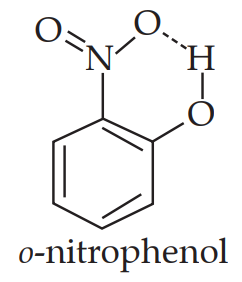
Resonance Structures and Dipole Moment
-
Identify the correct answer.Dipole moment of $NF_3$ is less than that of $NH_3$ (in $NF_3$ the lone-pair moment opposes the N–F bond moments) – incorrect. Three equivalent canonical forms can be drawn for $CO_3^{2-}$ – correct. Only two resonance structures can be drawn for ozone, not three – incorrect. $BF_3$ is trigonal planar and symmetrical, so its dipole moment is zero – incorrect. So the correct answer is: three canonical forms can be drawn for $CO_3^{2-}$ ion.
VSEPR Theory and Molecular Shapes
-
Match List-I with List-II regarding the shape/geometry of the given compounds.
Pick the matching item from Column II for each row.
Column I
- A. $NH_3$
- B. $BrF_5$
- C. $XeF_4$
- D. $SF_6$
Column II
- I. Trigonal Pyramidal
- II. Square Planar
- III. Octahedral
- IV. Square Pyramidal
Correct answer: A → I, B → IV, C → II, D → III
$NH_3$: 3 bond pairs + 1 lone pair ($sp^3$) – trigonal pyramidal $BrF_5$: 5 bond pairs + 1 lone pair ($sp^3d^2$) – square pyramidal $XeF_4$: 4 bond pairs + 2 lone pairs ($sp^3d^2$) – square planar $SF_6$: 6 bond pairs ($sp^3d^2$) – octahedral Correct match: A-I, B-IV, C-II, D-III.
Sigma and Pi Bonds in Hydrocarbons
-
Match List-I with List-II regarding the number and types of bonds between two carbon atoms in the given molecules.
Pick the matching item from Column II for each row.
Column I
- A. ethane
- B. ethene
- C. carbon molecule, $C_2$
- D. ethyne
Column II
- I. one $\sigma$-bond and two $\pi$-bonds
- II. two $\pi$-bonds
- III. one $\sigma$-bond
- IV. one $\sigma$-bond and one $\pi$-bond
Correct answer: A → III, B → IV, C → II, D → I
Ethane ($CH_3-CH_3$): one $\sigma$-bond Ethene ($CH_2=CH_2$): one $\sigma$-bond and one $\pi$-bond Carbon molecule $C_2$: two $\pi$-bonds Ethyne ($HC \equiv CH$): one $\sigma$-bond and two $\pi$-bonds Correct match: A-III, B-IV, C-II, D-I.
Octet Rule and Its Exceptions
-
Amongst the following, the total number of species NOT having eight electrons around central atom in its outer most shell, is: $NH_3$, $AlCl_3$, $BeCl_2$, $CCl_4$, $PCl_5$
$AlCl_3$, $BeCl_2$ and $PCl_5$ do not obey the octet rule.
$AlCl_3$, $BeCl_2$ and $PCl_5$ do not obey the octet rule. $AlCl_3$ and $BeCl_2$ are electron-deficient species (fewer than eight electrons in the valence shell of the central atom), whereas $PCl_5$ has ten electrons in the valence shell of phosphorus. The structures are: [add image]
Molecular Orbital Theory
-
The correct order of energies of molecular orbitals of $N_2$ molecule is:
For $N_2$ (fewer than 15 electrons) the $\pi2p$ orbitals lie below $\sigma2p_z$.
$\sigma1s<\sigma^*1s<\sigma2s<\sigma^*2s<(\pi2p_x=\pi2p_y)<\sigma2p_z<(\pi^*2p_x=\pi^*2p_y)<\sigma^*2p_z$ is the correct order of energy of MO for homo nuclear diatomic species $N_2$. -
Which one of the following statements is incorrect related to Molecular Orbital Theory?Molecular orbitals formed from $2P_x$ and $2P_y$ orbitals (perpendicular to the bond axis, typically taken as the z-axis) are actually unsymmetrical (not symmetrical) around the bond axis — they form $\pi$ molecular orbitals with electron density above and below the axis, not symmetric around it. So this statement is incorrect.
-
Which amongst the following is incorrect statement$O_2^+$ has 15 electrons, so it contains one unpaired electron. Hence it is paramagnetic, not diamagnetic – so this statement is incorrect. (Bond orders of $O_2^+$, $O_2$, $O_2^-$, $O_2^{2-}$ are 2.5, 2, 1.5, 1; $C_2$ has 4 electrons in two degenerate $\pi$ MOs; $H_2^+$ has one electron – all correct.)
-
Which of the following diatomic molecular species has only $\pi$ bonds according to Molecular Orbital Theory?MO configuration of $C_2$ (12 electrons): $\sigma1s^2\,\sigma^*1s^2\,\sigma2s^2\,\sigma^*2s^2\,\pi2p_x^2=\pi2p_y^2$ Bond order = 2, and both bonds are π bonds, so $C_2$ has only π bonds according to MOT.
-
The correct bond order in the following species is:Bond order $= \frac{N_b - N_a}{2}$, with 10 bonding electrons in each species.
$O_2^{2+}$ (14 e⁻): $\frac{10 - 4}{2} = 3$
$O_2^+$ (15 e⁻): $\frac{10 - 5}{2} = 2.5$
$O_2^-$ (17 e⁻): $\frac{10 - 7}{2} = 1.5$
So $O_2^- < O_2^+ < O_2^{2+}$. -
The pair of species with the same bond order is$N_2$ = 3, $O_2$ = 2
$O_2^{2-}$ (18 e⁻) = $\frac{1}{2}(10 - 8) = 1$; $B_2$ (10 e⁻) = $\frac{1}{2}(6 - 4) = 1$
$O_2^+$ = 2.5, $NO^+$ = 3
NO = 2.5, CO = 3
So $O_2^{2-}$ and $B_2$ have the same bond order, 1. -
Four diatomic species are listed below. Identify the correct order in which the bond order is increasing in them:Bond order $= \frac{1}{2}(N_b - N_a)$
$He_2^+$ (3 e⁻): $\frac{1}{2}(2 - 1) = 0.5$
$O_2^-$ (17 e⁻): $\frac{1}{2}(10 - 7) = 1.5$
NO (15 e⁻): $\frac{1}{2}(10 - 5) = 2.5$
$C_2^{2-}$ (14 e⁻): $\frac{1}{2}(10 - 4) = 3$
Increasing order: $He_2^+ < O_2^- < NO < C_2^{2-}$ -
The pairs of species of oxygen and their magnetic behaviours are noted below. Which of the following presents the correct description?$O_2$ (16 electrons): $\sigma1s^2\ \sigma^*1s^2\ \sigma2s^2\ \sigma^*2s^2\ \sigma2p_z^2\ \pi2p_x^2 = \pi2p_y^2\ \pi^*2p_x^1 = \pi^*2p_y^1$; 2 unpaired electrons, paramagnetic.
$O_2^+$ (15 electrons): ... $\pi^*2p_x^1\ \pi^*2p_y^0$; 1 unpaired electron, paramagnetic.
$O_2^-$ (17 electrons): ... $\pi^*2p_x^2\ \pi^*2p_y^1$; 1 unpaired electron, paramagnetic.
$O_2^{2-}$ (18 electrons): ... $\pi^*2p_x^2\ \pi^*2p_y^2$; no unpaired electron, diamagnetic.
O atom ($1s^22s^22p_x^22p_y^12p_z^1$) has 2 unpaired electrons and $O^+$ ($1s^22s^22p_x^12p_y^12p_z^1$) has 3 unpaired electrons; both are paramagnetic.
Every pair containing $O_2^{2-}$ described as paramagnetic is wrong, and $O_2^-$ is not diamagnetic.
The correct description is $O_2^+$, $O_2$ – both paramagnetic. -
Which of the following has the minimum bond length?MO configuration of $O_2$ (16 electrons): $\sigma1s^2\ \sigma^*1s^2\ \sigma2s^2\ \sigma^*2s^2\ \sigma2p_z^2\ \pi2p_x^2 = \pi2p_y^2\ \pi^*2p_x^1 = \pi^*2p_y^1$
Bond order = $\frac{N_b - N_a}{2}$. For $O_2$: $\frac{10 - 6}{2} = 2$
$O_2^+$ (one antibonding electron removed): $\frac{10 - 5}{2} = 2.5$
$O_2^-$ (one antibonding electron added): $\frac{10 - 7}{2} = 1.5$
$O_2^{2-}$ (two antibonding electrons added): $\frac{10 - 8}{2} = 1$
Bond length is inversely proportional to bond order.
$O_2^+$ has the highest bond order (2.5) and therefore the minimum bond length. -
Which one of the following species does not exist under normal conditions?A species exists only if its bond order, $\frac{N_b - N_a}{2}$, is greater than zero.
$Li_2$ (6 electrons): $\sigma1s^2\ \sigma^*1s^2\ \sigma2s^2$; bond order = $\frac{4 - 2}{2} = 1$
$Be_2$ (8 electrons): $\sigma1s^2\ \sigma^*1s^2\ \sigma2s^2\ \sigma^*2s^2$; bond order = $\frac{4 - 4}{2} = 0$
$Be_2^+$ (7 electrons): $\sigma1s^2\ \sigma^*1s^2\ \sigma2s^2\ \sigma^*2s^1$; bond order = $\frac{4 - 3}{2} = 0.5$
$B_2$ (10 electrons): $\sigma1s^2\ \sigma^*1s^2\ \sigma2s^2\ \sigma^*2s^2\ \pi2p_x^1 = \pi2p_y^1$; bond order = $\frac{6 - 4}{2} = 1$
$Be_2$ has zero bond order, so it does not exist under normal conditions. -
According to MO theory which of the following lists ranks the nitrogen species in terms of increasing bond order?$N_2$ (14 electrons): $\sigma1s^2\ \sigma^*1s^2\ \sigma2s^2\ \sigma^*2s^2\ \pi2p_x^2 = \pi2p_y^2\ \sigma2p_z^2$; bond order = $\frac{10 - 4}{2} = 3$
$N_2^-$ (15 electrons): the extra electron enters an antibonding $\pi^*2p$ orbital; bond order = $\frac{10 - 5}{2} = 2.5$
$N_2^{2-}$ (16 electrons): two extra electrons in antibonding $\pi^*2p$ orbitals; bond order = $\frac{10 - 6}{2} = 2$
Increasing bond order: $N_2^{2-}$ (2) < $N_2^-$ (2.5) < $N_2$ (3) -
Four diatomic species are listed below in different sequences. Which of these presents the correct order of their increasing bond order ?Bond order $= \dfrac{1}{2}(N_b - N_a)$, where $N_b$ and $N_a$ are the numbers of electrons in bonding and antibonding molecular orbitals.
$He_2^+$ (3 electrons): $\sigma 1s^2\,\sigma^* 1s^1$; bond order $= \dfrac{1}{2}(2 - 1) = 0.5$
$O_2^-$ (17 electrons): one more antibonding electron than $O_2$ (bond order 2); bond order $= \dfrac{1}{2}(10 - 7) = 1.5$
$NO$ (15 electrons): bond order $= \dfrac{1}{2}(10 - 5) = 2.5$
$C_2^{2-}$ (14 electrons, isoelectronic with $N_2$): bond order $= \dfrac{1}{2}(10 - 4) = 3.0$
Bond orders: 0.5, 1.5, 2.5 and 3.0 respectively.
Increasing order of bond order: $He_2^+ \lt O_2^- \lt NO \lt C_2^{2-}$ -
The number of unpaired electrons in a paramagnetic diatomic molecule of an element with atomic number 16 is :-The element with atomic number 16 is sulphur. Its diatomic molecule is $S_2$.
Sulphur belongs to the same group as oxygen, so the molecular orbital configuration of $S_2$ in its valence shell is like that of $O_2$.
In $O_2$ the last two electrons enter the two degenerate antibonding orbitals $\pi^*2p_x$ and $\pi^*2p_y$ singly (Hund's rule).
Similarly, in $S_2$ the last two electrons occupy the two degenerate $\pi^*3p$ orbitals singly: $\pi^*3p_x^1 = \pi^*3p_y^1$.
So $S_2$ has two unpaired electrons according to molecular orbital theory, which makes it paramagnetic like $O_2$.
The number of unpaired electrons is 2.
VSEPR Theory
-
Amongst the following which one will have maximum 'lone pair-lone pair' electron repulsions?$XeF_2$ has 2 bond pairs and 3 lone pairs on Xe ($sp^3d$, linear); the three lone pairs are in equatorial positions.
So $XeF_2$ has the maximum (3) lone pair–lone pair repulsions among the given molecules. -
Maximum bond angle at nitrogen is present in which of the following$NO_2^+$ is linear ($sp$), bond angle $180^\circ$.
Order: $NO_2^+$ ($180^\circ$) > $NO_2$ ($\approx 132^\circ$) > $NO_3^-$ ($120^\circ$) > $NO_2^-$ ($\approx 115^\circ$) -
In which of the following pairs, both the species are not isostructural?$NH_3$ and $PH_3$: $sp^3$ with one lone pair, both pyramidal.
$XeF_4$: $sp^3d^2$, square planar; $XeO_4$: $sp^3$, tetrahedral — not isostructural.
$SiCl_4$ and $PCl_4^+$: both $sp^3$, tetrahedral.
Diamond and SiC: both have tetrahedral arrangement with $sp^3$ central atoms. -
Which one of the following pairs is isostructural (i.e. having the same shape and hybridization)?$BF_4^-$: 4 bond pairs, no lone pair, $sp^3$, tetrahedral. $NH_4^+$: 4 bond pairs, no lone pair, $sp^3$, tetrahedral. Same shape and hybridisation.
$BCl_3$ is $sp^2$ trigonal planar, but $BrCl_3$ is $sp^3d$ T-shaped.
$NH_3$ is $sp^3$ pyramidal, but $NO_3^-$ is $sp^2$ trigonal planar.
$NF_3$ is $sp^3$ pyramidal, but $BF_3$ is $sp^2$ trigonal planar.
So $BF_4^-$ and $NH_4^+$ are isostructural. -
In $BrF_3$ molecule, the lone pairs occupy equatorial positions to minimize :-In $BrF_3$, Br has 7 valence electrons; 3 form bonds with F and 4 remain as 2 lone pairs. So there are 5 electron pairs (3 bp + 2 lp), and the electron geometry is trigonal bipyramidal ($sp^3d$).
Repulsions decrease in the order: lp–lp $\gt$ lp–bp $\gt$ bp–bp.
In a trigonal bipyramid, an equatorial position has only two neighbours at $90^\circ$, whereas an axial position has three neighbours at $90^\circ$. So lone pairs placed in equatorial positions have fewer strong $90^\circ$ interactions.
With both lone pairs equatorial, they are $120^\circ$ apart (reducing lp–lp repulsion), and each has fewer $90^\circ$ contacts with bond pairs (reducing lp–bp repulsion).
This gives $BrF_3$ its T-shaped (slightly bent T) molecular shape.
So the lone pairs occupy equatorial positions to minimise both lone pair–lone pair and lone pair–bond pair repulsions. -
Which of the following two species in the pair are isostructural : -$XeF_2$: Xe has 2 bond pairs and 3 lone pairs ($sp^3d$), so it is linear. $IF_2^-$: I has 2 bond pairs and 3 lone pairs, also linear. They are isostructural.
$NH_3$ is pyramidal (3 bp + 1 lp), while $BF_3$ is trigonal planar (3 bp, no lp).
$CO_3^{2-}$ is trigonal planar, while $SO_3^{2-}$ is pyramidal (S has a lone pair).
$PCl_5$ is trigonal bipyramidal, while $ICl_5$ is square pyramidal (5 bp + 1 lp).
So $XeF_2$ and $IF_2^-$ are isostructural.
VSEPR Theory – Shapes of Molecules
-
Match List-I with List-II.
Pick the matching item from Column II for each row.
Column I
- A. $PCl_5$
- B. $SF_6$
- C. $BrF_5$
- D. $BF_3$
Column II
- I. Square pyramidal
- II. Trigonal planar
- III. Octahedral
- IV. Trigonal bipyramidal
Correct answer: A → IV, B → III, C → I, D → II
$PCl_5$: $sp^3d$ – trigonal bipyramidal $SF_6$: $sp^3d^2$ – octahedral $BrF_5$: $sp^3d^2$ with one lone pair – square pyramidal $BF_3$: $sp^2$ – trigonal planar Correct match: A-IV, B-III, C-I, D-II.
Dipole Moment and Polarity of Molecules
-
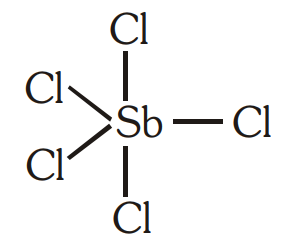
Which of the following molecules is non-polar in nature?$SbCl_5$: $sp^3d$, trigonal bipyramidal and symmetrical, so the bond dipoles cancel: dipole moment = 0 (non-polar).
Dipole Moment
-
Which of the following set of molecules will have zero dipole moment?$BF_3$ (trigonal planar), $BeF_2$ (linear), $CO_2$ (linear) and 1,4-dichlorobenzene (para, symmetrical) all have bond dipoles that cancel, so $\mu = 0$.
HF, $NF_3$, $H_2O$, $NH_3$ and 1,3-dichlorobenzene are polar. -
Which of the following is the correct order of dipole moment?$BF_3$ is symmetrical trigonal planar ($\mu=0$). In $NH_3$ the lone pair moment adds to the N-H bond moments, while in $NF_3$ it opposes the N-F bond moments, so $NH_3>NF_3$. $H_2O$ has the highest dipole moment. Order: $BF_3<NF_3<NH_3<H_2O$.
-
The electronegativity difference between N and F is greater than that between N and H, yet the dipole moment of $NH_3$ (1.5 D) is larger than that of $NF_3$ (0.2 D). This is because :-Both $NH_3$ and $NF_3$ are pyramidal, with a lone pair of electrons on nitrogen.
The net dipole moment is the vector sum of the bond dipoles and the orbital (atomic) dipole due to the lone pair, which points away from the nitrogen nucleus.
In $NH_3$, nitrogen is more electronegative than hydrogen, so each N-H bond dipole points towards nitrogen. The resultant of the three bond dipoles is in the same direction as the lone pair dipole, so they add up and give a large dipole moment.
In $NF_3$, fluorine is more electronegative than nitrogen, so each N-F bond dipole points towards fluorine, away from nitrogen. The resultant of the bond dipoles is opposite to the lone pair dipole, so they partly cancel and the dipole moment is small.
Hence in $NH_3$ the atomic dipole and bond dipole are in the same direction, whereas in $NF_3$ these are in opposite directions.
VSEPR theory - shapes of interhalogen compounds
-
Identify the correct statement about $ClF_3$, from the following options:In $ClF_3$, Cl has 3 bond pairs and 2 lone pairs, so hybridisation is $sp^3d$. The two lone pairs occupy equatorial positions, giving a T-shaped geometry. So $ClF_3$ is T-shaped with two lone pairs on the central Cl atom.
Sigma and pi bonds, hybridization
-
Match List I with List II
Pick the matching item from Column II for each row.
Column I
- i. $C_2H_4$
- ii. $C_2H_2$
- iii. $CH_4$
- iv. $NH_3$
Column II
- a. 3 $\sigma$ bonds, 2 $\pi$ bonds
- b. 3 $\sigma$ bonds, one lone pair
- c. 4 $\sigma$ bonds
- d. 5 $\sigma$ bonds, 1 $\pi$ bond
Correct answer: i → d, ii → a, iii → c, iv → b
$C_2H_4$ ($H_2C=CH_2$): 5 $\sigma$ bonds, 1 $\pi$ bond $C_2H_2$ ($H-C \equiv C-H$): 3 $\sigma$ bonds, 2 $\pi$ bonds $CH_4$: 4 $\sigma$ bonds $NH_3$: 3 $\sigma$ bonds, 1 lone pair Correct match: i-d, ii-a, iii-c, iv-b.
Formal charge calculation (ozone structure)
-
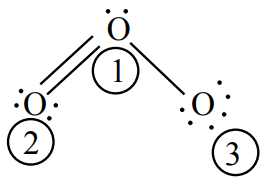 The correct formal charges on oxygen atoms numbered 2, 1 and 3 respectively are:F.C. = (valence electrons in free atom) $-$ (non-bonding electrons) $- \frac{1}{2}$(bonding electrons) O-2: $6 - 4 - \frac{1}{2}(4) = 0$ O-1: $6 - 2 - \frac{1}{2}(6) = +1$ O-3: $6 - 6 - \frac{1}{2}(2) = -1$ So formal charges on O-2, O-1 and O-3 are 0, +1, $-1$.
Dipole moment and molecular geometry
-
Which of the following molecules has "NON ZERO" dipole moment value?$CCl_4$, $CO_2$ and $BF_3$ are all symmetric molecules with zero net dipole moment due to cancellation of bond dipoles. HI is a polar diatomic molecule with a non-zero dipole moment ($\mu=0.38$ D) due to the electronegativity difference between H and I.
Structure and hybridisation of PCl5
-
Identify the incorrect statement about $PCl_5$.$PCl_5$ has trigonal bipyramidal geometry with $sp^3d$ hybridisation, five P–Cl sigma bonds, and two distinct bond angles ($90^\circ$ axial-equatorial and $120^\circ$ equatorial-equatorial). The three equatorial bonds are shorter than the two axial bonds, so all five P–Cl bonds are NOT identical in length — this statement is incorrect.
Potential energy curve for bond formation
-
The potential energy (y) curve for $H_2$ formation as a function of internuclear distance (x) of the H atoms is shown below, with asymptote at 'a', minimum at 'b', and reference level at 'c'.
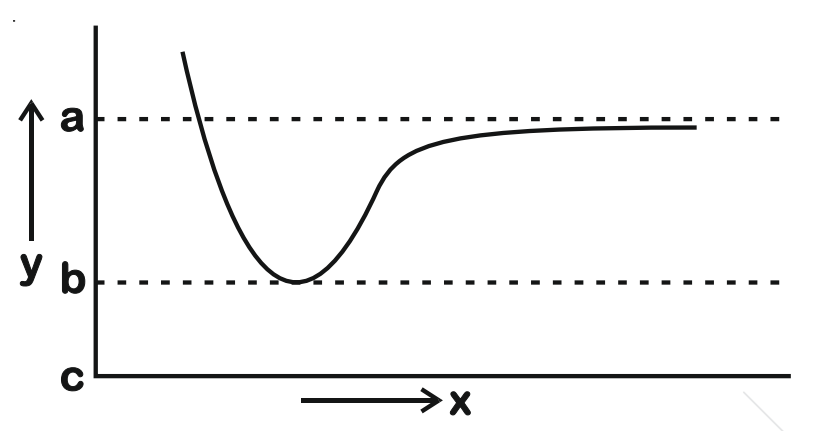 The bond energy of $H_2$ isThe bond energy corresponds to the depth of the potential energy well, i.e. the difference between the potential energy at infinite separation (level 'a') and the minimum potential energy at the equilibrium bond length (level 'b'): bond energy $=(b-a)$ in magnitude (the curve dips to a lower, i.e., more negative, energy at 'b').
Molecular shapes - VSEPR theory
-
Among the compounds shown below which one revealed a linear structure?$N_2O$ (nitrous oxide) has a linear structure (N=N=O). $NO_2$ is bent (angular), HOCl is bent, and $O_3$ is bent (angular) due to the presence of a lone pair on the central atom.
VSEPR theory - molecular geometry
-
Identify the wrongly match pair.$PCl_5$ actually has a trigonal bipyramidal geometry (not trigonal planar), so this pair is wrongly matched. $NH_3$ is trigonal pyramidal, $SF_6$ is octahedral, and $BeCl_2$ is linear — all correctly matched.
Comparison of dipole moments
-
The correct order of dipole moments for molecules $NH_3$, $H_2S$, $CH_4$ and HF, is:The correct order of dipole moments is $HF>NH_3>H_2S>CH_4$, where $CH_4$, being a perfectly symmetric (non-polar) tetrahedral molecule, has a dipole moment of zero.
VSEPR – geometry of XeF4
-
The correct geometry and hybridization for $XeF_4$ are:
4 bond pairs + 2 lone pairs → $sp^3d^2$, octahedral arrangement.
$XeF_4$ is of type $AB_4L_2$ → $sp^3d^2$ hybridisation
Geometry (electron-pair arrangement) → octahedral; shape → square planar
Note: the source key marks 'octahedral, $sp^3d^2$' (electron-pair geometry); the molecular shape of $XeF_4$ is square planar, which is also listed as an option.
VSEPR shapes and multiple bonding
-
Among the following which one is a wrong statement?
$SeF_4$ is see-saw; $CH_4$ is tetrahedral.
$SeF_4$: $sp^3d$, lp = 1, shape = see-saw; $CH_4$: $sp^3$, lp = 0, shape = tetrahedral. So they do not have the same shape.
$I_3^+$: $sp^3$, lp = 2, shape = bent/angular
$PH_5$ does not exist (d-orbital contraction absent); $BiCl_5$ does not exist due to inert pair effect ($Bi^{5+}$ acts as oxidising agent, $Cl^-$ as reducing agent)
$SO_2$ (O=S=O) has both $p\pi$–$d\pi$ and $p\pi$–$p\pi$ bonds
Hydrogen bonding – intra vs intermolecular
-
Which one of the following compounds shows the presence of intramolecular hydrogen bond?
Cellulose chains have intramolecular H-bonds.
In acetic acid, $H_2O_2$ and HCN intermolecular hydrogen bonding is present, but in cellulose intramolecular hydrogen bonding is present.
Isoelectronic and isostructural species
-
Which of the following pairs of ions is isoelectronic and isostructural?
Equal electron counts and the same VSEPR shape.
In $SO_3^{2-}$ and $ClO_3^-$: number of electrons = 42; shape: pyramidal
In $CO_3^{2-}$ and $NO_3^-$: number of electrons = 32; shape: trigonal planar
Note: the source key accepts both '$ClO_3^-$, $SO_3^{2-}$' and '$CO_3^{2-}$, $NO_3^-$'.
Sigma and pi bonds
-
Which of the following species contains equal number of $\sigma$- and $\pi$-bonds?
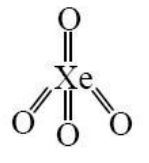
Each Xe=O bond has one $\sigma$ and one $\pi$ bond.
So $XeO_4$ has $4\sigma$ and $4\pi$ bonds — equal numbers.
VSEPR and isoelectronic species
-
Which of the following pairs of ions are isoelectronic and isostructural?$ClO_3^-$: 17 + 24 + 1 = 42 electrons; $SO_3^{2-}$: 16 + 24 + 2 = 42 electrons.
Both have $sp^3$ hybridisation with one lone pair (pyramidal).
So $ClO_3^-$ and $SO_3^{2-}$ are isoelectronic and isostructural.
Lewis structures and formal charge
-
Which of the following structures is the most preferred and hence of lowest energy for $SO_3$?The preferred Lewis structure is the one with the lowest formal charges on the atoms (ideally zero) and the maximum number of covalent bonds.
Formal charge = valence electrons − non-bonding electrons − $\frac{1}{2}$(bonding electrons).
In the structure with three S=O double bonds, sulphur has 6 bonds and no lone pair: formal charge on S = $6 - 0 - \frac{1}{2}(12) = 0$.
Each oxygen in that structure has two lone pairs and a double bond: formal charge = $6 - 4 - \frac{1}{2}(4) = 0$.
In the structures containing one or more S–O single bonds, the singly bonded oxygen carries a formal charge of −1 and sulphur carries a positive formal charge, so they have charge separation and are of higher energy.
Hence the structure in which sulphur is joined to all three oxygen atoms by double bonds is the most preferred.
Hybridisation
-
Which of the two ions from the list given below have the geometry that is explained by the same hybridization of orbitals: $NO_2^-$, $NO_3^-$, $NH_2^-$, $NH_4^+$, $SCN^-$?Find the steric number (σ bonds + lone pairs) of the central atom in each ion.
$NO_2^-$: N has 2 σ bonds + 1 lone pair = 3, so $sp^2$.
$NO_3^-$: N has 3 σ bonds + 0 lone pairs = 3, so $sp^2$.
$NH_2^-$: N has 2 σ bonds + 2 lone pairs = 4, so $sp^3$.
$NH_4^+$: N has 4 σ bonds + 0 lone pairs = 4, so $sp^3$.
$SCN^-$: C has 2 σ bonds + 0 lone pairs = 2, so sp.
Among the given pairs, only $NO_2^-$ and $NO_3^-$ have the same hybridisation ($sp^2$). -
In which one of the following species does the central atom have the type of hybridisation which is not the same as that present in the other three?Count σ bonds + lone pairs on the central atom.
$PCl_5$: 5 bond pairs + 0 lone pairs = 5, so $sp^3d$.
$SF_4$: 4 bond pairs + 1 lone pair = 5, so $sp^3d$.
$I_3^-$: the central I has 2 bond pairs + 3 lone pairs = 5, so $sp^3d$.
$SbCl_5^{2-}$: Sb has 5 valence electrons + 2 from the charge = 7; five are used in bonds, leaving one lone pair. 5 bond pairs + 1 lone pair = 6, so $sp^3d^2$.
Hence $SbCl_5^{2-}$ has a different hybridisation from the other three.
Hybridisation and shapes of molecules
-
In which of the following molecules all the bonds are not equal :-In $ClF_3$ the Cl atom is $sp^3d$ hybridised, with three bond pairs and two lone pairs, in a trigonal bipyramidal arrangement of electron pairs.
The two lone pairs occupy equatorial positions, so the molecule is T-shaped, with two axial Cl-F bonds and one equatorial Cl-F bond.
The axial bonds are longer than the equatorial bond, because the axial bond pairs suffer greater repulsion. So all the bonds in $ClF_3$ are not equal.
$BF_3$ is $sp^2$ hybridised and trigonal planar, with three equal B-F bonds.
$AlF_3$ has three equivalent Al-F bonds.
$NF_3$ is $sp^3$ hybridised and pyramidal, with three equal N-F bonds.
So the molecule in which all the bonds are not equal is $ClF_3$.
VSEPR Theory and Bond Angles
-
The correct order of increasing bond angles in the following triatomic species is :$NO_2^+$: the nitrogen has no lone pair and is $sp$ hybridised, so the ion is linear with a bond angle of $180^\circ$.
$NO_2$: the nitrogen is $sp^2$ hybridised and carries one odd (unpaired) electron. A single electron repels the bond pairs less than a lone pair does, so the bond angle is larger than $120^\circ$, about $132^\circ$ to $134^\circ$.
$NO_2^-$: the nitrogen is $sp^2$ hybridised and carries one lone pair. The lone pair-bond pair repulsion pushes the bonds closer, so the bond angle is less than $120^\circ$, about $115^\circ$.
Bond angles: $NO_2^+$ ($180^\circ$) > $NO_2$ (about $132^\circ$) > $NO_2^-$ ($115^\circ$)
Increasing order of bond angle: $NO_2^- \lt NO_2 \lt NO_2^+$
VSEPR Theory and Shapes of Molecules
-
In which of the following pairs, the two species are iso-structural?$BrO_3^-$: total valence electrons $= 7 + 3 \times 6 + 1 = 26$. The central Br has 3 bond pairs and 1 lone pair, so it is $sp^3$ hybridised and the ion is trigonal pyramidal.
$XeO_3$: total valence electrons $= 8 + 3 \times 6 = 26$. The central Xe has 3 bond pairs and 1 lone pair, so it is $sp^3$ hybridised and the molecule is trigonal pyramidal.
Both have 26 valence electrons and in both cases the structure is trigonal pyramidal, so they are isostructural.
$SO_3^{2-}$ is pyramidal (one lone pair on S), but $NO_3^-$ is trigonal planar (no lone pair on N).
$BF_3$ is trigonal planar ($sp^2$), but $NF_3$ is pyramidal ($sp^3$ with one lone pair).
$SF_4$ is see-saw shaped ($sp^3d$ with one lone pair), but $XeF_4$ is square planar ($sp^3d^2$ with two lone pairs).
So the isostructural pair is $BrO_3^-$ and $XeO_3$. -
Which of the following is not isostructural with $SiCl_4$ :-$SiCl_4$: silicon has four bond pairs and no lone pair. It is $sp^3$ hybridised and tetrahedral.
$SO_4^{2-}$: sulphur has four sigma bond pairs and no lone pair; $sp^3$, tetrahedral.
$PO_4^{3-}$: phosphorus has four sigma bond pairs and no lone pair; $sp^3$, tetrahedral.
$NH_4^+$: nitrogen has four bond pairs and no lone pair; $sp^3$, tetrahedral.
$SCl_4$: sulphur has six valence electrons; four are used in the four S-Cl bonds and two remain as one lone pair. With five electron pairs it is $sp^3d$ hybridised, and the shape is see-saw (distorted tetrahedral), like $SF_4$.
So $SCl_4$ is not isostructural with $SiCl_4$. -
Among the following, the pair in which the two species are not isostructural is :-Find the number of bond pairs (bp) and lone pairs (lp) on the central atom for each species.
$IO_3^-$: I has 3 bp and 1 lp, so it is pyramidal ($sp^3$). $XeO_3$: Xe has 3 bp and 1 lp, so it is also pyramidal. They are isostructural.
$BH_4^-$: B has 4 bp, 0 lp, tetrahedral. $NH_4^+$: N has 4 bp, 0 lp, tetrahedral. They are isostructural.
$PF_6^-$: P has 6 bp, 0 lp, octahedral ($sp^3d^2$). $SF_6$: S has 6 bp, 0 lp, octahedral. They are isostructural.
$SiF_4$: Si has 4 bp and 0 lp, so it is tetrahedral ($sp^3$).
$SF_4$: S has 6 valence electrons; 4 are used in bonds with F, leaving 1 lone pair. So there are 4 bp + 1 lp ($sp^3d$), and the shape is see-saw.
So $SiF_4$ (tetrahedral) and $SF_4$ (see-saw) are not isostructural.
Bond Order and Bond Length
-
The correct order of C-O bond length among CO, $CO_3^{2-}$, $CO_2$ isAll three species exhibit resonance, and the bond length depends on the bond order: more the single bond character, more will be the bond length.
(i) CO: $:C\equiv O:$ with a minor form $:C=O:$. The C-O bond is essentially a triple bond (bond order about 3).
(ii) $CO_3^{2-}$: three equivalent resonating structures, each with one $C=O$ and two $C-O^-$ bonds. Bond order $= \dfrac{4}{3} = 1.33$.
(iii) $CO_2$: $O=C=O$ with minor forms $^-O-C\equiv O^+$ and $^+O\equiv C-O^-$. Bond order is about 2.
Bond order: $CO$ (3) > $CO_2$ (2) > $CO_3^{2-}$ (1.33)
Bond length is inversely related to bond order (about 110 pm, 115 pm and 129 pm respectively).
Hence the correct order of C-O bond length is: $CO \lt CO_2 \lt CO_3^{2-}$ -
The correct order in which the O-O bond length increases in the following is :-Bond length decreases as the bond order increases.
$O_2$: O=O, a double bond (bond order 2); bond length about 121 pm.
$O_3$: resonance between two structures, each with one O=O and one O-O bond, so each O-O bond has bond order 1.5; bond length about 128 pm.
$H_2O_2$: H-O-O-H, a single O-O bond (bond order 1); bond length about 148 pm.
Increasing bond length: $O_2 \lt O_3 \lt H_2O_2$
Dipole Moment and Molecular Shape
-
Which of the following would have a permanent dipole moment -A molecule has a permanent dipole moment if its bond dipoles do not cancel, i.e. if the molecule is not symmetrical.
$BF_3$ is trigonal planar, $SiF_4$ is tetrahedral and $XeF_4$ is square planar; in all three the bond dipoles cancel by symmetry, so their dipole moment is zero.
$SF_4$: sulphur has four bond pairs and one lone pair ($sp^3d$). The lone pair occupies an equatorial position, so the molecule has a see-saw (distorted tetrahedral) shape.
In this unsymmetrical shape the bond dipoles do not cancel, and the lone pair also contributes, so $SF_4$ has a permanent dipole moment.
So the answer is $SF_4$.
Pi Bonding with d Orbitals
-
Which of the following has $p\pi - d\pi$ bondingA $p\pi - d\pi$ bond is formed by sideways overlap of a filled p orbital of one atom (here O) with an empty d orbital of the other atom.
N, B and C are second period elements with no d orbitals in their valence shell. In $NO_3^-$, $BO_3^{3-}$ and $CO_3^{2-}$, the $\pi$ bonding is of $p\pi - p\pi$ type.
S is a third period element with vacant 3d orbitals. In $SO_3^{2-}$, the S=O $\pi$ bond is formed by overlap of a 2p orbital of O with a 3d orbital of S ($p\pi - d\pi$ bonding).
So $SO_3^{2-}$ has $p\pi - d\pi$ bonding. -
$d\pi - p\pi$ bond is present in :A $d\pi - p\pi$ bond is formed by sideways overlap of a d orbital of one atom with a p orbital of another.
C and N are second period elements without d orbitals, so in $CO_3^{2-}$, $NO_3^-$ and $NO_2^-$ the $\pi$ bonds are $p\pi - p\pi$.
P is a third period element with vacant 3d orbitals. In $PO_4^{3-}$, the P=O $\pi$ bond is formed by overlap of a filled 2p orbital of oxygen with a vacant 3d orbital of phosphorus ($d\pi - p\pi$).
So the $d\pi - p\pi$ bond is present in $PO_4^{3-}$.
Lewis Structures
-
In $NO_3^-$ ion number of bond pairs and lone pairs of electrons on nitrogen atom are : -Lewis structure of $NO_3^-$: N is joined to one O by a double bond and to two O atoms by single bonds; the ion has 24 valence electrons.
Around nitrogen: one N=O double bond (2 bond pairs) + two N–O single bonds (2 bond pairs) = 4 bond pairs.
Nitrogen uses all 5 of its valence electrons plus the extra charge in bonding (one N–O bond is a coordinate bond), so it has no lone pair.
Hence N has 4 bond pairs and 0 lone pairs. (Its shape is trigonal planar, since only the 3 $\sigma$ bonds decide the shape.)
Hydrogen Bonding
-
In X–H ----- Y, X and Y both are electronegative elements : -In a hydrogen bond X–H$\cdots$Y, the hydrogen atom is covalently bonded to the strongly electronegative atom X.
X pulls the shared electron pair towards itself, so X gets a partial negative charge (electron density increases on X) and H gets a partial positive charge (electron density on H decreases): $X^{\delta-}-H^{\delta+}$.
This partially positive H is then attracted by the lone pair of the electronegative atom Y of another molecule, forming the hydrogen bond.
So electron density on X will increase and on H will decrease.
That is every question in Chemical Bonding and Molecular Structure for this filter.
Want a score?
Answers here are not saved. Practise as a test to be marked and see your progress.
Practise as a test