Looking for classes? Ksquare Career Institute, Bengaluru →

Chemistry
Thermodynamics
82 questions from 36 papers, each with its answer.
- 82 questions
- 36 papers
- 4.66% of Chemistry
Hess's Law and Thermochemical Calculations
-
The standard heat of formation, in $\text{kcal/mol}$ of $\text{Ba}^{2+}$ is:
[Given: standard heat of formation of $\text{SO}_4^{2-}$ ion $(aq) = -216\text{ kcal/mol}$, standard heat of crystallization of $\text{BaSO}_4(s) = -4.5\text{ kcal/mol}$, standard heat of formation of $\text{BaSO}_4(s) = -349\text{ kcal/mol}$]Using Hess's law: $\Delta H_f^\circ[\text{BaSO}_4(s)] = \Delta H_f^\circ[\text{Ba}^{2+}(aq)] + \Delta H_f^\circ[\text{SO}_4^{2-}(aq)] + \Delta H_{\text{crys}}^\circ$. Thus $-349 = \Delta H_f^\circ[\text{Ba}^{2+}] - 216 - 4.5 \implies \Delta H_f^\circ[\text{Ba}^{2+}] = -128.5\text{ kcal/mol}$.
For crystallization of barium sulfate from its aqueous ions: $\text{Ba}^{2+}(aq) + \text{SO}_4^{2-}(aq) \rightarrow \text{BaSO}_4(s)$ with $\Delta H_{\text{crys}}^\circ = -4.5\text{ kcal/mol}$. Applying Hess's Law of constant heat summation: $\Delta H_{\text{crys}}^\circ = \Delta H_f^\circ[\text{BaSO}_4(s)] - \left\{\Delta H_f^\circ[\text{Ba}^{2+}(aq)] + \Delta H_f^\circ[\text{SO}_4^{2-}(aq)]\right\}$. Substituting given values: $-4.5 = -349 - \Delta H_f^\circ[\text{Ba}^{2+}(aq)] - (-216) \implies -4.5 = -133 - \Delta H_f^\circ[\text{Ba}^{2+}(aq)] \implies \Delta H_f^\circ[\text{Ba}^{2+}(aq)] = -133 + 4.5 = -128.5\text{ kcal/mol}$.
Entropy Change in Physical and Chemical Processes
-
In which of the following processes entropy increases? A. A liquid evaporates to vapour. B. Temperature of a crystalline solid lowered from 130 K to 0 K. C. $2NaHCO_{3(s)} \rightarrow Na_2CO_{3(s)} + CO_{2(g)} + H_2O_{(g)}$ D. $Cl_{2(g)} \rightarrow 2Cl_{(g)}$ Choose the correct answer from the options given below:Entropy increases with increase in disorder (randomness) of the system. A. A liquid evaporates to vapour – randomness increases, entropy increases. B. Temperature of a crystalline solid lowered from 130 K to 0 K – randomness decreases, entropy decreases. C. $2NaHCO_3(s) \rightarrow Na_2CO_3(s) + CO_2(g) + H_2O(g)$ – solid gives gases, entropy increases. D. $Cl_2(g) \rightarrow 2Cl(g)$ – molecule converts into atoms, entropy increases. So entropy increases in A, C and D.
Work Done in Reversible Isothermal Expansion of Ideal Gas
-
The work done during reversible isothermal expansion of one mole of hydrogen gas at $25^\circ C$ from pressure of 20 atmosphere to 10 atmosphere is: (Given $R = 2.0$ cal $K^{-1}mol^{-1}$)For reversible isothermal expansion: $W = -2.303\,nRT\log\frac{P_1}{P_2}$ $W = -2.303 \times 1 \times 2 \times 298 \times \log\frac{20}{10}$ $= -2.303 \times 2 \times 298 \times 0.3010$ $= -413.14$ calories
Work Done in Isothermal and Adiabatic Processes
-
Which of the following p-V curve represents maximum work done?In a p-V graph, the area under the curve represents the magnitude of work done. The area is maximum for the isothermal curve extending over the largest volume change (curve (1) in the original paper).
Second Law – Entropy of Irreversible Processes
-
For irreversible expansion of an ideal gas under isothermal condition, the correct option is:For an ideal gas, internal energy depends only on temperature; in an isothermal process $\Delta U = 0$. An irreversible process is spontaneous, so $\Delta S_{total} > 0$, i.e. $\Delta S_{total} \neq 0$.
Enthalpy and Entropy Changes
-
For the reaction, $2Cl(g)\rightarrow Cl_2(g)$, the correct option is:$Cl_2(g) \rightarrow 2Cl(g)$ is endothermic (energy is needed to break the bond), so the reverse reaction $2Cl(g) \rightarrow Cl_2(g)$ is exothermic: $\Delta_rH < 0$. Two gaseous atoms combine to form one gaseous molecule, so randomness decreases: $\Delta_rS < 0$.
Thermodynamic Processes – Free Expansion
-
The correct option for free expansion of an ideal gas under adiabatic condition is:Free expansion: $P_{ext} = 0 \Rightarrow w = -P_{ext}\Delta V = 0$ Adiabatic process: q = 0 $\Delta U = q + w = 0$; since the internal energy of an ideal gas depends only on temperature, $\Delta T = 0$. So q = 0, $\Delta T$ = 0 and w = 0.
Work Done in Expansion against Constant Pressure
-
Under isothermal condition, a gas at 300 K expands from 0.1 L to 0.25 L against a constant external pressure of 2 bar. The work done by the gas is: [Given that $1\ L\ bar=100\ J$]For irreversible expansion against a constant external pressure: $W_{irr}=-P_{ext}\Delta V$ $W=-2\ bar\times(0.25-0.1)\ L=-2\times0.15\ L\,bar=-0.30\ L\,bar$ $W=-0.30\times100\ J=-30\ J$
Free expansion of an ideal gas into vacuum
-
Choose the correct statement for the work done in the expansion and heat absorbed or released when 5 litres of an ideal gas at 10 atmospheric pressure isothermally expands into vacuum until volume is 15 litres:Expansion into a vacuum occurs against zero external pressure ($P_{ext}=0$), so $W=-P_{ext}\Delta V=0$. Since the process is isothermal, $\Delta T=0$, so $\Delta U=nC_v\Delta T=0$. From the first law, $\Delta U=q+W\Rightarrow 0=q+0\Rightarrow q=0$. Both work done and heat are zero.
Sign conventions for endothermic and exothermic reactions
-
For an endothermic reaction: (A) $q_p$ is negative. (B) $\Delta_rH$ is positive. (C) $\Delta_rH$ is negative. (D) $q_p$ is positive. Choose the correct answer from the options given below:For an endothermic reaction, heat is absorbed by the system, so $q_p$ is positive (D) and $\Delta_rH=E_{a(forward)}-E_{a(backward)}$ is positive (B), since products are at higher energy than reactants.
Bond enthalpy values
-
Match List-I with List-II (Molecule; Bond enthalpy in kJ mol$^{-1}$) and choose the correct answer from the options given below:
Pick the matching item from Column II for each row.
Column I
- A. HCl
- B. N2
- C. H2
- D. O2
Column II
- I. 435.8
- II. 498
- III. 946.0
- IV. 431.0
Correct answer: A → IV, B → III, C → I, D → II
HCl has bond enthalpy 431.0 kJ/mol (A-IV); $N_2$ has bond enthalpy 946.0 kJ/mol (B-III); $H_2$ has bond enthalpy 435.8 kJ/mol (C-I); $O_2$ has bond enthalpy 498 kJ/mol (D-II).
Relation between enthalpy change and internal energy change
-
For the following reaction at 300 K: $A_2(g)+3B_2(g)\rightarrow2AB_3(g)$, the enthalpy change is +15 kJ, then the internal energy change is:$\Delta n_g=n_{products}-n_{reactants}=2-(1+3)=-2$. $\Delta H=\Delta U+\Delta n_gRT\Rightarrow15000=\Delta U-2\times8.314\times300\Rightarrow\Delta U=15000+4988.4=19988.4$ J.
Bond enthalpy calculations
-
At standard conditions, if the change in the enthalpy for the following reaction is $-109\ kJ\,mol^{-1}$: $H_2(g)+Br_2(g)\rightarrow2HBr(g)$. Given that bond energy of $H_2$ and $Br_2$ is $435\ kJ\,mol^{-1}$ and $192\ kJ\,mol^{-1}$, respectively, what is the bond energy (in kJ mol$^{-1}$) of HBr?$\Delta H=\text{(bonds broken)}-\text{(bonds formed)}=(435+192)-2\times BE(HBr)$. $-109=627-2\,BE(HBr)\Rightarrow2\,BE(HBr)=736\Rightarrow BE(HBr)=368\ kJ\,mol^{-1}$.
Gibbs free energy and spontaneity
-
If for a certain reaction $\Delta_rH$ is 30 kJ mol$^{-1}$ at 450 K, the value of $\Delta_rS$ (in $JK^{-1}mol^{-1}$) for which the same reaction will be spontaneous at the same temperature isFor spontaneity, $\Delta G=\Delta H-T\Delta S\dfrac{\Delta H}{T}=\dfrac{30000}{450}\approx66.7\ JK^{-1}mol^{-1}$. Among the given options, the value that satisfies this (making the reaction spontaneous) is $\Delta S=70\ JK^{-1}mol^{-1}$.
Enthalpy change for decomposition (reverse) reaction
-
Consider the following reaction:- $2H_2(g)+O_2(g)\rightarrow2H_2O(g)\ \Delta_rH^\circ=-483.64$ kJ. What is the enthalpy change for decomposition of one mole of water? (Choose the right option).Decomposition for 1 mole of water: $H_2O(g)\rightarrow H_2(g)+\dfrac{1}{2}O_2(g);\ \Delta H=+\dfrac{483.64}{2}=+241.82$ kJ.
Isothermal and adiabatic processes
-
Reversible expansion of an ideal gas under isothermal and adiabatic conditions are as shown in the figure.
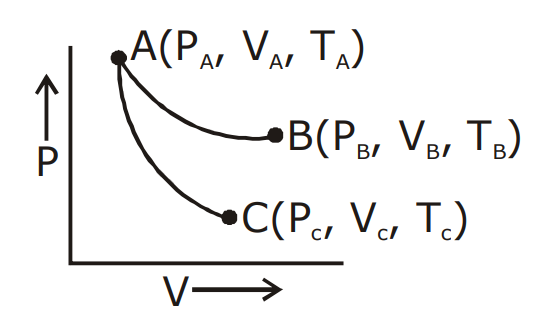
AB $\rightarrow$ Isothermal expansion
AC $\rightarrow$ Adiabatic expansion Which of the following options is not correct?In adiabatic expansion $q=0$, so $\Delta U=w<0$, i.e. $nC_v\Delta T<0 \Rightarrow T_CT_A$ is not correct.
Entropy change in free expansion
-
Two moles of an ideal gas undergo free expansion from 10 L to 100 L at 300 K. The values of $\Delta S_{system}$ and $\Delta S_{surroundings}$ are (R is universal gas constant)Isothermal free expansion of 2 mol: $\Delta S_{sys}=nR\ln\frac{V_2}{V_1}=2R\ln\frac{100}{10}=2R\times2.303=4.606R$. Since $dT=0$, $\Delta U=0$; $P_{ext}=0$, so $W=0$. By the first law, $Q=0$. As no heat is exchanged with the surroundings, $\Delta S_{surr}=-\frac{Q_{sys}}{T}=0$.
Gibbs energy and equilibrium
-
A protein undergoes reversible thermal denaturation from its initial state N to denatured state D according to $N\rightleftharpoons D$. At $60^\circ C$, the concentrations of both N and D are equal at equilibrium, and the standard enthalpy change of denaturation is 666 kJ mol$^{-1}$. The standard entropy change ($\Delta S^\circ$ in kJ K$^{-1}$ mol$^{-1}$) of the protein upon denaturation at $60^\circ C$ is closest to$N\rightleftharpoons D$, $K=\frac{[D]}{[N]}=1$ since [D] = [N] at equilibrium. $\Delta G^\circ=-2.303RT\log K=0$. $\Delta G^\circ=\Delta H^\circ-T\Delta S^\circ \Rightarrow 0=666-333\Delta S^\circ \Rightarrow \Delta S^\circ=\frac{666}{333}=2$ kJ K$^{-1}$ mol$^{-1}$.
-
Using the Gibbs energy change, $\Delta G^\circ = +63.3$ kJ, for the following reaction, $Ag_2CO_3(s) \rightleftharpoons 2Ag^+(aq) + CO_3^{2-}(aq)$ the $K_{sp}$ of $Ag_2CO_3(s)$ in water at $25^\circ C$ is: (R = 8.314 J $K^{-1}mol^{-1}$)$\Delta G^\circ = -2.303RT\log K_{sp}$
$63.3\times1000 = -2.303\times8.314\times298\log K_{sp}$
$\log K_{sp} = -11.09$
$K_{sp} = 10^{-11.09} = 8\times10^{-12}$
Bond enthalpy and enthalpy of formation
-
The bond dissociation energies of $X_2$, $Y_2$ and XY are in the ratio of 1 : 0.5 : 1. $\Delta H$ for the formation of XY is $-200\ kJ\ mol^{-1}$. The bond dissociation energy of $X_2$ will be
$\Delta H$ = bonds broken – bonds formed.
The reaction for $\Delta_fH^\circ(XY)$: $\frac{1}{2}X_2(g) + \frac{1}{2}Y_2(g) \rightarrow XY(g)$ Bond energies of $X_2$, $Y_2$ and XY are X, $\frac{X}{2}$ and X respectively. $\Delta H = \frac{X}{2} + \frac{X}{4} - X = -200$ On solving, $-\frac{X}{4} = -200$ X = 800 kJ/mol
First law – work in irreversible adiabatic expansion
-
A gas is allowed to expand in a well insulated container against a constant external pressure of 2.5 atm from an initial volume of 2.50 L to a final volume of 4.50 L. The change in internal energy $\Delta U$ of the gas in joules will be
Insulated means q = 0, so $\Delta U = -P_{ext}\Delta V$.
$\Delta U = q + w$ For an adiabatic process, q = 0, so $\Delta U = w$ $w = -P\Delta V = -2.5\ atm\times(4.5 - 2.5)$ L $= -2.5\times2$ L-atm $= -5\times101.3$ J $= -506.5$ J $\approx -505$ J
Gibbs energy and spontaneity
-
Match List-I (Equations) with List-II (Type of process) and select the correct option.
Pick the matching item from Column II for each row.
Column I
- a. $K_p > Q$
- b. $\Delta G^\circ < RT\ln Q$
- c. $K_p = Q$
- d. $T > \frac{\Delta H}{\Delta S}$
Column II
- i. Non-spontaneous
- ii. Equilibrium
- iii. Spontaneous and endothermic
- iv. Spontaneous
Correct answer: a → iv, b → i, c → ii, d → iii
a. $K_p > Q$: since $\Delta G = RT\ln\frac{Q}{K}$, Q < K makes $\Delta G$ negative, so the reaction proceeds in the forward direction: spontaneous.
b. $\Delta G^\circ < RT\ln Q$: as written in the source, this corresponds to a positive $\Delta G$, i.e., a non-spontaneous process.
c. $K_p = Q$: the reaction quotient equals the equilibrium constant, so $\Delta G = 0$ and the system is at equilibrium.
d. $T > \frac{\Delta H}{\Delta S}$: this gives $T\Delta S > \Delta H$ (with $\Delta H$ and $\Delta S$ both positive), so $\Delta G = \Delta H - T\Delta S < 0$; the process is spontaneous and endothermic.
Correct match: a-iv, b-i, c-ii, d-iii. -
Standard entropies of $X_2$, $Y_2$ and $XY_3$ are 60, 40 and 50 J $K^{-1}mol^{-1}$ respectively. For the reaction $\frac{1}{2}X_2 + \frac{3}{2}Y_2 \rightleftharpoons XY_3$, $\Delta H = -30$ kJ, to be at equilibrium, the temperature should be$\Delta S^\circ = \sum S^\circ_{products} - \sum S^\circ_{reactants}$
$\Delta S^\circ = S^\circ(XY_3) - \left[\frac{1}{2}S^\circ(X_2) + \frac{3}{2}S^\circ(Y_2)\right]$
$\Delta S^\circ = 50 - \left[\frac{1}{2}(60) + \frac{3}{2}(40)\right] = 50 - (30 + 60) = -40$ J $K^{-1}mol^{-1}$
At equilibrium $\Delta G = \Delta H - T\Delta S = 0$, so $T = \frac{\Delta H}{\Delta S}$
$T = \frac{-30\times10^3\ J\,mol^{-1}}{-40\ J\,K^{-1}mol^{-1}}$
T = 750 K
Clausius–Clapeyron equation
-
Consider the following liquid-vapour equilibrium: Liquid $\rightleftharpoons$ Vapour. Which of the following relations is correct?
Vapour pressure varies with T as ΔHv/RT².
The relation is the Clausius–Clapeyron equation: $\frac{d\ln P}{dT} = \frac{\Delta H_v}{RT^2}$
Entropy change in isothermal process
-
For a sample of perfect gas when its pressure is changed isothermally from $p_i$ to $p_f$, the entropy change is given by
$\Delta S = nR\ln(V_f/V_i) = nR\ln(p_i/p_f)$.
$\Delta S = nC_{p,m}\ln\frac{T_f}{T_i} + nR\ln\frac{P_i}{P_f}$
For isothermal change $T_i = T_f$, ln 1 = 0
$\Delta S = nR\ln\frac{P_i}{P_f}$
Gibbs energy
-
For the reaction: $X_2O_4(l) \rightarrow 2XO_2(g)$, $\Delta U$ = 2.1 kcal, $\Delta S$ = 20 cal $K^{-1}$ at 300 K. Hence $\Delta G$ is:$X_2O_4(l) \rightarrow 2XO_2(g)$; $\Delta n_g = 2 - 0 = 2$
$\Delta H = \Delta U + \Delta n_gRT = 2.1 + 2\times\frac{2}{1000}\times300 = 3.3$ kcal
$\Delta G = \Delta H - T\Delta S = 3.3 - 300\times\frac{20}{1000} = -2.7$ kcal
Enthalpy and internal energy
-
Standard enthalpy of vapourisation $\Delta_{vap}H^\ominus$ for water at $100^\circ C$ is 40.66 kJ $mol^{-1}$. The internal energy of vapourisation of water at $100^\circ C$ (in kJ $mol^{-1}$) is$H_2O(l) \rightarrow H_2O(g)$
$V_1$ of liquid water = 18 mL
$V_2$ of water vapour $= \frac{nRT}{P} = \frac{1\times0.0821\times373}{1} = 30.6233$ L
$\Delta V = 30623.3 - 18 = 30605.3$ mL = 30.605 L
$\Delta E = \Delta H - P\Delta V = 40.66\times10^3$ J $- 1\times30.605\times101.325$ J
$= 40660 - 3101 = 37559$ J ≈ 37.56 kJ $mol^{-1}$
(Equivalently, $\Delta U = \Delta H - \Delta n_gRT = 40.66 - 1\times8.314\times10^{-3}\times373 = 37.56$ kJ $mol^{-1}$.)
Hess's law
-
Consider the following processes:
$\frac{1}{2}A \rightarrow B$; $\Delta H = +150$ kJ/mol
$3B \rightarrow 2C + D$; $\Delta H = -125$ kJ/mol
$E + A \rightarrow 2D$; $\Delta H = +350$ kJ/mol
For $B + D \rightarrow E + 2C$, $\Delta H$ will be(i) $\frac{1}{2}A \rightarrow B$; $\Delta H = +150$
(ii) $3B \rightarrow 2C + D$; $\Delta H = -125$
(iii) $E + A \rightarrow 2D$; $\Delta H = +350$
Multiply (i) by 2: $A \rightarrow 2B$; $\Delta H = +300$
Reverse (iii): $2D \rightarrow E + A$; $\Delta H = -350$
Add 2 × (i), (ii) and reversed (iii): $A + 3B + 2D \rightarrow 2B + 2C + D + E + A$
Cancelling common species: $B + D \rightarrow E + 2C$
$\Delta H = 2(150) + (-125) - 350 = 300 - 125 - 350$
$\Delta H = -175$ kJ/mol -
The following two reactions are known:
$Fe_2O_3(s) + 3CO(g) \rightarrow 2Fe(s) + 3CO_2(g)$; $\Delta H = -26.8$ kJ
$FeO(s) + CO(g) \rightarrow Fe(s) + CO_2(g)$; $\Delta H = -16.5$ kJ
The value of $\Delta H$ for the following reaction $Fe_2O_3(s) + CO(g) \rightarrow 2FeO(s) + CO_2(g)$ is(1) $Fe_2O_3 + 3CO \rightarrow 2Fe + 3CO_2$; $\Delta H_1 = -26.8$ kJ
(2) $FeO + CO \rightarrow Fe + CO_2$; $\Delta H_2 = -16.5$ kJ
Reverse (2) and multiply by 2: $2Fe + 2CO_2 \rightarrow 2FeO + 2CO$; $\Delta H = +33.0$ kJ
Add this to (1): $Fe_2O_3 + 3CO + 2Fe + 2CO_2 \rightarrow 2Fe + 3CO_2 + 2FeO + 2CO$
Cancelling common species: $Fe_2O_3 + CO \rightarrow 2FeO + CO_2$
$\Delta H = \Delta H_1 - 2\Delta H_2 = -26.8 - 2(-16.5) = -26.8 + 33.0$
$\Delta H = +6.2$ kJ -
Heat of combustion $\Delta H^\circ$ for C(s), $H_2$(g) and $CH_4$(g) are –94, –68 and –213 kcal/mol. Then $\Delta H^\circ$ for $C(s) + 2H_2(g) \rightarrow CH_4(g)$ is : -Given:
(i) $C + O_2 \rightarrow CO_2$, $\Delta H = -94$ kcal
(ii) $H_2 + \dfrac{1}{2}O_2 \rightarrow H_2O$, $\Delta H = -68$ kcal
(iii) $CH_4 + 2O_2 \rightarrow CO_2 + 2H_2O$, $\Delta H = -213$ kcal
Required reaction = (i) + 2 $\times$ (ii) $-$ (iii):
$\Delta H = \sum\Delta H_c(\text{reactants}) - \sum\Delta H_c(\text{products}) = (-94) + 2(-68) - (-213)$
$= -94 - 136 + 213 = -17$ kcal -
Enthalpy of $CH_4 + \dfrac{1}{2}O_2 \rightarrow CH_3OH$ is negative. If enthalpies of combustion of $CH_4$ and $CH_3OH$ are x and y respectively, then which relation is correct : -Using combustion enthalpies: $\Delta H = \sum\Delta H_c(\text{reactants}) - \sum\Delta H_c(\text{products})$
For $CH_4 + \dfrac{1}{2}O_2 \rightarrow CH_3OH$: $\Delta H = x - y$ (combustion enthalpy of $O_2$ is zero)
Given $\Delta H$ is negative: $x - y \lt 0$
Hence $x \lt y$ (x is more negative than y; methane releases more heat on combustion than methanol).
Bond enthalpy
-
From the following bond energies:
H–H bond energy: 431.37 kJ $mol^{-1}$
C=C bond energy: 606.10 kJ $mol^{-1}$
C–C bond energy: 336.49 kJ $mol^{-1}$
C–H bond energy: 410.50 kJ $mol^{-1}$
Enthalpy for the reaction,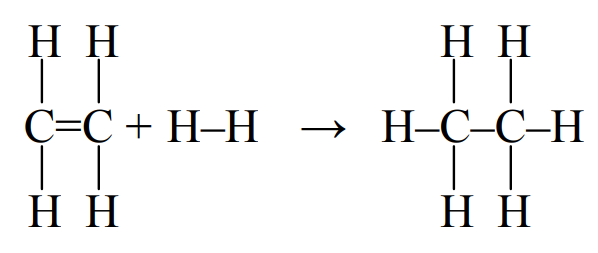 will be$\Delta H$ = (sum of bond energies of bonds broken) − (sum of bond energies of bonds formed)
Bonds broken (reactants): 1 C=C + 4 C–H + 1 H–H = $606.10 + 4(410.50) + 431.37 = 2679.47$ kJ
Bonds formed (product, ethane): 1 C–C + 6 C–H = $336.49 + 6(410.50) = 2799.49$ kJ
$\Delta H = 2679.47 - 2799.49$
$\Delta H = -120.02 \approx -120.0$ kJ $mol^{-1}$ -
Given that bond energies of H-H and Cl-Cl are 430 kJ mol$^{-1}$ and 240 kJ mol$^{-1}$ respectively and $\Delta H_f$ for HCl is $-90$ kJ mol$^{-1}$, bond enthalpy of HCl isFormation of one mole of HCl: $\dfrac{1}{2}H_2 + \dfrac{1}{2}Cl_2 \rightarrow HCl$
$\Delta H_{HCl} = \Sigma$ B.E. of reactants $- \Sigma$ B.E. of products
$-90 = \dfrac{1}{2} \times 430 + \dfrac{1}{2} \times 240 -$ B.E. of HCl
$-90 = 215 + 120 -$ B.E. of HCl
$\therefore$ B.E. of HCl $= 215 + 120 + 90$
$= 425$ kJ mol$^{-1}$
Bond Enthalpy and Enthalpy of Reaction
-
Bond dissociation enthalpy of $H_2$, $Cl_2$ and HCl are 434, 242 and 431 kJ mol$^{-1}$ respectively. Enthalpy of formation of HCl is -$H_2 + Cl_2 \rightarrow 2HCl$
$\Delta H_{reaction} = \Sigma(BE)_{reactants} - \Sigma(BE)_{products}$
$= [(BE)_{H-H} + (BE)_{Cl-Cl}] - [2(BE)_{H-Cl}]$
$= 434 + 242 - (431) \times 2$
$= 676 - 862$
$= -186$ kJ
This is the enthalpy change for the formation of 2 moles of HCl.
So the enthalpy of formation of HCl (per mole) $= \dfrac{-186}{2}$ kJ
$= -93$ kJ mol$^{-1}$
Resonance Energy
-
The enthalpy of hydrogenation of cyclohexene is $-119.5$ kJ mol$^{-1}$. If resonance energy of benzene is $-150.4$ kJ mol$^{-1}$, its enthalpy of hydrogenation would be :-Cyclohexene has one $C=C$ bond; its enthalpy of hydrogenation is $-119.5$ kJ mol$^{-1}$.
If benzene were cyclohexatriene with three isolated double bonds, its calculated enthalpy of hydrogenation would be $3 \times (-119.5) = -358.5$ kJ mol$^{-1}$
Benzene is more stable than this hypothetical structure by its resonance energy, 150.4 kJ mol$^{-1}$, so less heat is released on its hydrogenation.
Resonance energy = observed $\Delta H$ $-$ calculated $\Delta H$ (taken with the sign convention of the question)
$-150.4 = -358.5 - x$
$x = -358.5 + 150.4$
$x = -208.1$ kJ mol$^{-1}$
Enthalpy of Neutralisation
-
The absolute enthalpy of neutralisation of the reaction :
$MgO(s) + 2HCl(aq) \rightarrow MgCl_2(aq) + H_2O(l)$
will be : -The enthalpy of neutralisation of a strong acid by a strong base is constant, $-57.33$ kJ per mole of water formed, because the net reaction is always $H^+(aq) + OH^-(aq) \rightarrow H_2O(l)$.
Here the base is MgO, an insoluble solid, which is not present as free $OH^-$ ions in solution.
Part of the energy released is used up in breaking the lattice of MgO (dissociating it to give the base), i.e. in a process that absorbs energy.
So less heat is evolved than in the neutralisation of a strong acid by a strong base.
The enthalpy of neutralisation is therefore less negative than $-57.33$ kJ mol$^{-1}$, i.e. it is greater than $-57.33$ kJ mol$^{-1}$ (for example $-50$ kJ mol$^{-1}$ is greater than $-57.33$).
Standard Enthalpy of Formation
-
For which one of the following equations is $\Delta H^\circ_{react}$ equal to $\Delta H^\circ_f$ for the product :The standard enthalpy of formation is the enthalpy change when one mole of a compound is formed from its elements in their most stable (standard) states.
$N_2(g) + O_3(g) \rightarrow N_2O_3(g)$: ozone is not the standard state of oxygen ($O_2$ is).
$CH_4 + 2Cl_2 \rightarrow CH_2Cl_2 + 2HCl$: $CH_4$ is a compound, not an element, and there are two products.
$2CO + O_2 \rightarrow 2CO_2$: CO is a compound, and 2 moles of product are formed.
$Xe(g) + 2F_2(g) \rightarrow XeF_4(g)$: one mole of $XeF_4$ is formed from its elements in their standard states (Xe gas and $F_2$ gas).
So for $Xe(g) + 2F_2(g) \rightarrow XeF_4(g)$, $\Delta H^\circ_{react} = \Delta H^\circ_f(XeF_4)$.
Hess's Law for Gibbs Energy
-
$2Zn + O_2 \rightarrow 2ZnO$, $\Delta G^\circ = -616$ J
$2Zn + S_2 \rightarrow 2ZnS$, $\Delta G^\circ = -293$ J
$S_2 + 2O_2 \rightarrow 2SO_2$, $\Delta G^\circ = -408$ J
$\Delta G^\circ$ for the following reaction is : $2ZnS + 3O_2 \rightarrow 2ZnO + 2SO_2$The required reaction = (first) $-$ (second) + (third):
$2Zn + O_2 \rightarrow 2ZnO$ (–616)
$2ZnS \rightarrow 2Zn + S_2$ (+293, reversed)
$S_2 + 2O_2 \rightarrow 2SO_2$ (–408)
Adding: $2ZnS + 3O_2 \rightarrow 2ZnO + 2SO_2$
$\Delta G^\circ = -616 + 293 - 408 = -731$ J
That is every question in Thermodynamics for this filter.
Want a score?
Answers here are not saved. Practise as a test to be marked and see your progress.
Practise as a test