Looking for classes? Ksquare Career Institute, Bengaluru →

Chemistry
Alcohols, Phenols and Ethers
65 questions from 33 papers, each with its answer.
- 65 questions
- 33 papers
- 3.69% of Chemistry
Lucas Test for Classification of Alcohols
-
Which one of the following alcohols reacts instantaneously with Lucas reagent?Alcohols react with Lucas reagent (conc. HCl + anhyd. $ZnCl_2$) via a carbocation intermediate, forming an alkyl chloride (turbidity). A tertiary carbocation is more stable than secondary or primary, so tertiary alcohols react instantaneously. 2-methylpropan-2-ol (tert-butyl alcohol), $(CH_3)_3C-OH$, is tertiary, so it reacts instantaneously.
Reaction of Alcohols with Phosphorus Halides
-
The products A and B obtained in the following reactions, respectively, are $3ROH + PCl_3 \rightarrow 3RCl + A$ $ROH + PCl_5 \rightarrow RCl + HCl + B$$3ROH + PCl_3 \rightarrow 3RCl + H_3PO_3$ (A) $ROH + PCl_5 \rightarrow RCl + HCl + POCl_3$ (B) So A = $H_3PO_3$ and B = $POCl_3$.
Reactions of Ethers – Cleavage by HI
-
Anisole on cleavage with HI gives:$C_6H_5-O-CH_3 + HI \rightarrow C_6H_5OH + CH_3I$ The ether oxygen is protonated; $I^-$ attacks the methyl carbon ($S_N2$), because the aryl C–O bond has partial double bond character and phenyl cation formation is unfavourable. So the products are phenol and methyl iodide.
Dehydration of Alcohols
-
In preparation of alkene from alcohol using $Al_2O_3$ which is effective factor : -When alcohol vapour is passed over heated alumina, it is dehydrated. The product depends mainly on the temperature:
At about 523 K (250 °C), intermolecular dehydration gives an ether: $2C_2H_5OH \xrightarrow{Al_2O_3,\ 523\ K} C_2H_5OC_2H_5 + H_2O$
At about 633 K (360 °C), intramolecular dehydration gives an alkene: $C_2H_5OH \xrightarrow{Al_2O_3,\ 633\ K} CH_2=CH_2 + H_2O$
So temperature is the effective factor that decides whether an alkene is formed.
Acidity of Phenols – Effect of Substituents
-
Given below are two statements:
Statement I: The acidic strength of monosubstituted nitrophenol is higher than phenol because of electron withdrawing nitro group.
Statement II: o-nitrophenol, m-nitrophenol and p-nitrophenol will have same acidic strength as they have one nitro group attached to the phenolic ring. In the light of the above statements, choose the most appropriate answer from the options given below:The acidic strength of phenol increases due to electron-withdrawing groups, so nitrophenols are more acidic than phenol – Statement I is correct.
Order of acidic strength: p-nitrophenol > o-nitrophenol > m-nitrophenol > phenol, so they do not have the same acidic strength – Statement II is incorrect.
Preparation of Alcohols – Grignard Reagents
-
What is the IUPAC name of the organic compound formed in the following chemical reaction? Acetone $\xrightarrow[(ii)\ H_2O,\ H^+]{(i)\ C_2H_5MgBr,\ dry\ ether}$ Product$CH_3COCH_3 \xrightarrow{C_2H_5MgBr,\ dry\ ether} (CH_3)_2C(OMgBr)C_2H_5 \xrightarrow{H_2O,\ H^+} (CH_3)_2C(OH)CH_2CH_3$ IUPAC name: 2-methylbutan-2-ol
Preparation of Phenol – Cumene Process
-
The structure of intermediate A in the following reaction is:
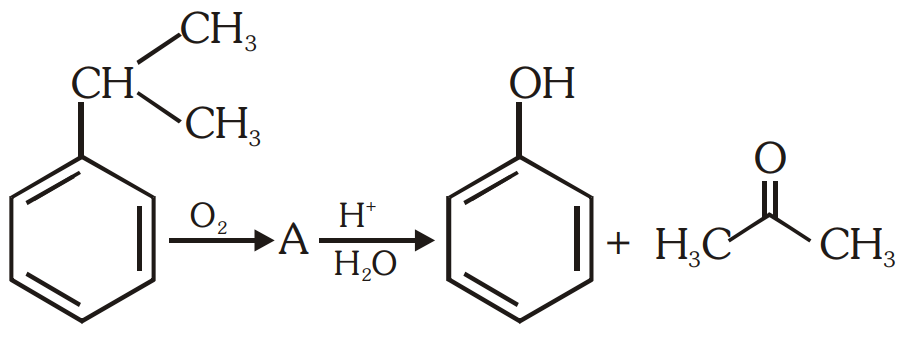 This is the cumene process for phenol. Cumene is oxidised by $O_2$ to cumene hydroperoxide (A), $C_6H_5-C(CH_3)_2-O-O-H$. On treatment with $H^+/H_2O$, cumene hydroperoxide gives phenol and acetone ($H_3C-CO-CH_3$). So intermediate A is cumene hydroperoxide.
Hydroboration-oxidation of alkenes
-
Given below are two statements: Statement I: Propene on treatment with diborane gives an addition product with the formula $((CH_3)_2CH)_3B$. Statement II: Oxidation of $((CH_3)_2CH)_3B$ with hydrogen peroxide in presence of NaOH gives propan-2-ol. In the light of the above statements, choose the most appropriate answer from the options given below:Hydroboration of propene is anti-Markovnikov, so boron attaches to the less hindered terminal carbon, giving $(CH_3CH_2CH_2)_3B$ (not $((CH_3)_2CH)_3B$) — so Statement I is incorrect. However, oxidation of a borane such as $((CH_3)_2CH)_3B$ with $H_2O_2/NaOH$ does proceed with retention of configuration to replace the C–B bond with a C–OH bond, giving propan-2-ol, so Statement II (as a statement of the oxidation step) is correct.
-
$CH_3CH_2CH=CH_2\xrightarrow[(ii)\ H_2O_2,\ OH^-]{(i)\ B_2H_6}Z$. What is Z?Hydroboration-oxidation follows anti-Markovnikov addition: boron attaches to the less substituted (terminal) carbon, and subsequent oxidation with $H_2O_2/OH^-$ replaces the C-B bond with a C-OH bond. So 1-butene gives the primary alcohol $CH_3CH_2CH_2CH_2OH$ (n-butanol).
Grignard reagent reactions
-
Identify D in the following sequence of reactions: $CH_3CH_2OH\xrightarrow{P+I_2}A\xrightarrow[dry\ ether]{Mg}B\xrightarrow{HCHO}C\xrightarrow{H_2O}D\ (major)$$CH_3CH_2OH\xrightarrow{P+I_2}CH_3CH_2I$ (A); $CH_3CH_2I\xrightarrow{Mg,\ dry\ ether}CH_3CH_2MgI$ (B, Grignard reagent); $CH_3CH_2MgI$ reacts with HCHO to give an addition product, which on hydrolysis with $H_2O$ gives $CH_3CH_2CH_2OH$ (D, n-propyl alcohol, major product).
Acidity of substituted phenols
-
Which of the following substituted phenols is the strongest acid?Electron-withdrawing groups (like $-NO_2$) stabilise the phenoxide ion by delocalising the negative charge (through resonance and inductive effect), increasing acidity. Electron-donating groups ($-CH_3$, $-OCH_3$, $-C_2H_5$) destabilise the phenoxide ion, decreasing acidity. So p-nitrophenol, with the strong EWG $-NO_2$, is the strongest acid among the given options.
Effect of substituents on electrophilic aromatic substitution
-
Which of the following compound is most reactive in electrophilic aromatic substitution?The $-OH$ group in phenol is a strong activating, ortho/para-directing group (due to resonance donation of the lone pair into the ring), making phenol far more reactive towards electrophilic aromatic substitution than benzene, chlorobenzene (weakly deactivating) or nitrobenzene (strongly deactivating).
Oxidation of primary alcohols to carboxylic acids
-
Reagents which can be used to convert alcohols to carboxylic acids, are
(A) $CrO_3-H_2SO_4$
(B) $K_2Cr_2O_7+H_2SO_4$
(C) $KMnO_4+KOH/H_3O^+$
(D) $Cu, 573 K$
(E) $CrO_3, (CH_3CO)_2O$. Choose the most appropriate answer from the options given below:Strong oxidising agents such as $CrO_3-H_2SO_4$ (A), $K_2Cr_2O_7-H_2SO_4$ (B), and $KMnO_4+KOH/H_3O^+$ (C) can oxidise a primary alcohol all the way to a carboxylic acid. (D) Cu at 573 K only dehydrogenates the alcohol to an aldehyde, and (E) $CrO_3$ with acetic anhydride (Collins-type reagent, Sarrett's reagent variant) typically stops oxidation at the aldehyde stage.
Selective reduction with NaBH4 followed by acid-catalysed dehydration
-
The major product formed in the following conversion is _____.
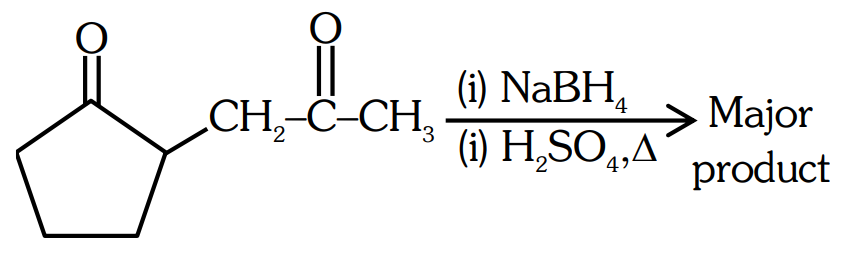 $NaBH_4$ selectively reduces the more reactive ketone in the side chain to a secondary alcohol without touching the ring, giving a diol-like intermediate with $-CH_2-CH(OH)-CH_3$ on the side chain and the ring ketone reduced too, giving $-OH$ on the ring as well. On treatment with $H_2SO_4/\Delta$, acid-catalysed dehydration (E1) occurs at both positions, ultimately giving the major product with a cyclopentene ring conjugated to a $-CH=CH-CH_3$ side chain (the more substituted, conjugated/stable alkene being favoured, per Zaitsev's rule).
Preparation of phenols
-
Which one of the following reaction sequence is incorrect method to prepare phenol?Chlorobenzene does not react with NaOH at STP; it needs 623 K and 300 atm. Benzene sulphonation (oleum) followed by NaOH fusion and acidification, diazotisation of aniline followed by warming with water, and the cumene process all give phenol.
Cleavage of ethers by HI
-
The major products C and D formed in the following reactions respectively are: $H_3C-CH_2-CH_2-O-C(CH_3)_3\xrightarrow[\Delta]{excess\ HI}C+D$The ether cleaves via the stable tertiary carbocation to give $CH_3CH_2CH_2OH+(CH_3)_3C-I$. With excess HI the propanol is further converted to $CH_3CH_2CH_2-I$. So C and D are $CH_3CH_2CH_2I$ and $(CH_3)_3CI$.
-
In the reaction:
$CH_3-CH(CH_3)-CH_2-O-CH_2-CH_3 + HI \xrightarrow{\text{Heated}}$
Which of the following compounds will be formed?In the cleavage of mixed ethers having two different alkyl groups, the alcohol and the alkyl iodide that form depend on the nature of the alkyl groups.
Step 1: the ether oxygen is protonated by HI to give an oxonium ion.
Step 2: the iodide ion attacks one of the alkyl carbons by the $S_N2$ mechanism.
When primary or secondary alkyl groups are present, the iodide ion attacks the smaller, less hindered alkyl group, so it is the lower alkyl group that forms the alkyl iodide.
Here the two groups are ethyl and isobutyl (2-methylpropyl). The ethyl carbon is less hindered than the isobutyl carbon, which has a branched $\beta$-carbon.
$CH_3-CH(CH_3)-CH_2-O-CH_2-CH_3 + HI \xrightarrow{\Delta} CH_3-CH(CH_3)-CH_2OH + CH_3CH_2I$
The products are 2-methylpropan-1-ol and ethyl iodide. -
The major organic product in the reaction,
$CH_3-O-CH(CH_3)_2 + HI \rightarrow$ Product is :Step 1: the ether oxygen is protonated by HI to give an oxonium ion: $CH_3-\overset{+}{O}(H)-CH(CH_3)_2$
Step 2: the iodide ion, a good nucleophile, attacks one of the alkyl carbons by the $S_N2$ mechanism.
In an $S_N2$ attack the nucleophile prefers the less sterically hindered carbon.
The methyl carbon is much less hindered than the isopropyl (secondary) carbon, so $I^-$ attacks the methyl group.
$CH_3-O-CH(CH_3)_2 + HI \xrightarrow{S_N2} CH_3I + (CH_3)_2CH-OH$
So the smaller alkyl group forms the alkyl iodide and the larger group forms the alcohol.
The products are methyl iodide and propan-2-ol: $CH_3I + (CH_3)_2CHOH$.
Preparation of phenol from cumene
-
Identify the major products P, Q and R in the following sequence of reactions:
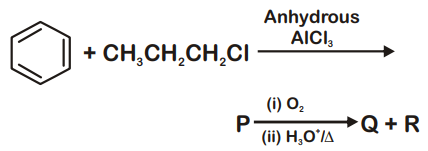
Friedel–Crafts alkylation with rearrangement gives cumene, which is converted to phenol and acetone.
$CH_3CH_2CH_2-Cl + AlCl_3 \rightarrow CH_3CH_2\overset{\delta+}{C}H_2\cdots Cl\cdots\overset{\delta-}{AlCl_3}$ (incipient carbocation)
1,2-H shift gives the more stable secondary carbocation $CH_3-\overset{+}{C}H-CH_3$.
Benzene $+ CH_3-\overset{+}{C}H-CH_3 \rightarrow C_6H_5CH(CH_3)_2$ (cumene, P)
$C_6H_5CH(CH_3)_2 \xrightarrow{O_2} C_6H_5C(CH_3)_2-O-O-H$ (cumene hydroperoxide)
$C_6H_5C(CH_3)_2OOH \xrightarrow[\text{rearrangement}]{H^+/H_2O} C_6H_5OH\ (Q) + CH_3COCH_3\ (R)$
So P = cumene, Q = phenol and R = acetone.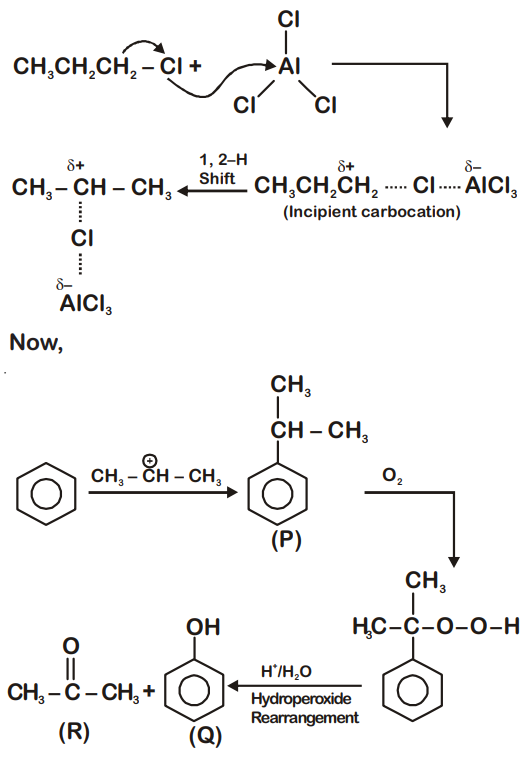
Reactions of diols – cyclic ketal formation
-
Which of the following reagents would distinguish cis-cyclopenta-1, 2-diol from the trans-isomer?
Only cis-1,2-diols can bridge to form a five-membered cyclic ketal.
With acetone, cis-cyclopenta-1,2-diol can form a cyclic ketal, but acetone cannot react with trans-cyclopenta-1,2-diol.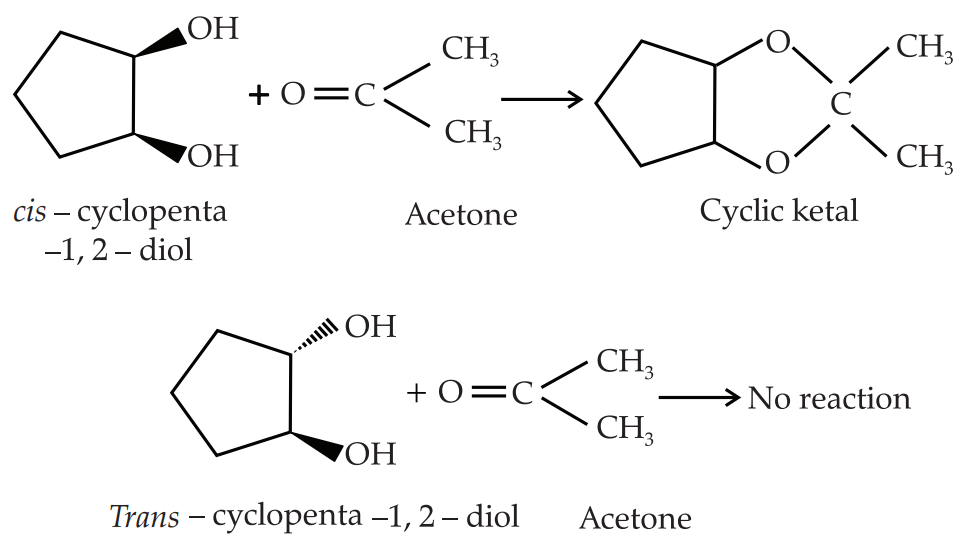
Acidity of phenols
-
Which of the following will not be soluble in sodium hydrogen carbonate?Acid + $NaHCO_3 \rightarrow$ salt + $H_2CO_3$; the reaction goes forward only if the acid is stronger than $H_2CO_3$.
o-Nitrophenol is less acidic than $H_2CO_3$, so it is not soluble in sodium hydrogen carbonate.
2,4,6-Trinitrophenol, benzoic acid and benzenesulphonic acid are soluble in $NaHCO_3$. -
Among the following four compounds
a. Phenol
b. Methyl phenol
c. Metanitrophenol
d. Paranitrophenol
the acidity order isThe acidity of a phenol depends on the stability of its phenoxide ion.
An electron-withdrawing group ($-NO_2$) disperses the negative charge of the phenoxide ion and increases acidity; an electron-donating group ($-CH_3$) intensifies the charge and decreases acidity.
p-Nitrophenol: the nitro group at the para position withdraws electrons by both −I and −R effects, so the charge is delocalised onto the nitro group; most acidic ($pK_a$ = 7.1).
m-Nitrophenol: at the meta position only the −I effect operates; less acidic than the para isomer ($pK_a$ = 8.3).
Phenol: no substituent ($pK_a$ = 10.0).
Methyl phenol (cresol): the +I and hyperconjugation effects of $-CH_3$ make it the least acidic ($pK_a \approx$ 10.2).
Acidity order: d > c > a > b
Cleavage of ethers
-
Among the following ethers, which one will produce methyl alcohol on treatment with hot concentrated HI?C–O bond cleavage of an ether can follow $S_N1$ or $S_N2$. If one group can form a stable carbocation, such as tert-butyl, the reaction follows the $S_N1$ mechanism.
$(CH_3)_3C-O-CH_3 \xrightarrow{\text{hot conc. HI}} (CH_3)_3C-\overset{+}{O}(H)-CH_3 \rightarrow (CH_3)_3C^+ + CH_3OH$
$(CH_3)_3C^+ + I^- \rightarrow (CH_3)_3C-I$
So methyl alcohol is produced.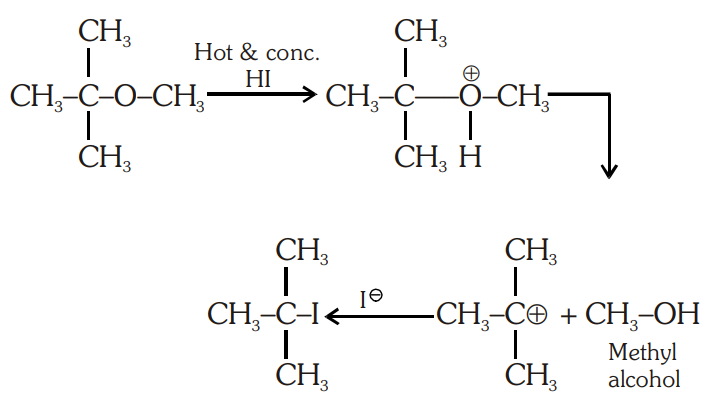
Electrophilic substitution in phenols
-
Which one of the following is most reactive towards electrophilic reagent?All four compounds have a methyl group on the ring; they differ only in the second substituent, so reactivity depends on how strongly that group donates electrons to the ring.
$-OH$ donates its lone pair to the ring by a strong +R (resonance) effect and is a very powerful activating group.
$-OCH_3$ also shows a +R effect, but it is weaker than that of $-OH$ (+R effect: $-OH > -OCH_3$).
In $-NHCOCH_3$ the lone pair on nitrogen is also delocalised onto the carbonyl group, so its +R effect on the ring is reduced.
$-CH_2OH$ has no lone pair attached directly to the ring and cannot activate it by resonance.
Hence o-cresol (the compound with $-OH$) is the most reactive towards electrophilic reagents. -
Which one is most reactive towards electrophilic reagent?All four compounds have a methyl group on the ring and differ only in the second substituent, so the reactivity depends on how strongly that group releases electrons into the ring.
$-OH$ releases its lone pair into the ring by a strong +R effect; it is one of the most powerful activating groups.
$-OCH_3$ also has a +R effect, but slightly weaker than that of $-OH$.
In $-NHCOCH_3$ the nitrogen lone pair is shared with the adjacent C=O group, which reduces its donation to the ring.
$-CH_2OH$ has no lone pair directly attached to the ring, so it cannot activate the ring by resonance.
Hence o-cresol is the most reactive towards an electrophilic reagent.
Acidity of alcohols, phenols and carboxylic acids
-
Given are cyclohexanol (I), acetic acid (II), 2,4,6-trinitrophenol (III) and phenol (IV). In these the order of decreasing acidic character will be2,4,6-Trinitrophenol (picric acid): three $-NO_2$ groups at the ortho and para positions withdraw electrons strongly by −I and −R effects and delocalise the negative charge of the phenoxide ion; $pK_a \approx 0.4$, a very strong acid.
Acetic acid: the carboxylate ion is stabilised by two equivalent resonance structures with the charge on two oxygen atoms; $pK_a = 4.76$.
Phenol: the phenoxide ion is resonance stabilised, but the charge is delocalised onto less electronegative carbon atoms; $pK_a \approx 10$.
Cyclohexanol: an ordinary alcohol with no resonance stabilisation of its alkoxide ion; $pK_a \approx 18$.
Decreasing order of acidic character: III > II > IV > I
Reactions of diols
-
$H_2COH\cdot CH_2OH$ on heating with periodic acid givesPeriodic acid ($HIO_4$) cleaves the C–C bond between two adjacent carbon atoms each bearing an –OH group (a vicinal diol).
Each carbon that carried an –OH group is converted into a carbonyl group: a $-CH_2OH$ end gives formaldehyde.
$HOCH_2-CH_2OH + HIO_4 \rightarrow 2HCHO + HIO_3 + H_2O$
Ethylene glycol has two $-CH_2OH$ carbons, so two molecules of formaldehyde are formed.
Hence the product is 2 HCHO.
Preparation of alcohols
-
Consider the following reaction:
Ethanol $\xrightarrow{PBr_3}$ X $\xrightarrow{alc.\ KOH}$ Y $\xrightarrow[(ii)\ H_2O,\ Heat]{(i)\ H_2SO_4,\ room\ temperature}$ Z
The product Z isStep 1: $PBr_3$ replaces –OH by –Br: $3CH_3CH_2OH + PBr_3 \rightarrow 3CH_3CH_2Br + H_3PO_3$. X is ethyl bromide.
Step 2: alcoholic KOH brings about dehydrohalogenation (elimination): $CH_3CH_2Br \xrightarrow{alc.\ KOH} CH_2=CH_2 + KBr + H_2O$. Y is ethene.
Step 3 (i): ethene adds cold concentrated $H_2SO_4$ to give ethyl hydrogen sulphate: $CH_2=CH_2 + H_2SO_4 \rightarrow CH_3CH_2OSO_3H$
Step 3 (ii): on heating with water this is hydrolysed: $CH_3CH_2OSO_3H + H_2O \rightarrow CH_3CH_2OH + H_2SO_4$
Hence Z is ethanol, $CH_3CH_2-OH$ (the starting compound is regenerated).
Preparation of Alcohols using Grignard Reagents
-
Ethylene oxide when treated with Grignard reagent yields :-Ethylene oxide (oxirane) is a strained three-membered ring with a polar C-O bond; its carbon atoms carry a partial positive charge.
In the Grignard reagent $R-MgX$, the alkyl group carries a partial negative charge and acts as a nucleophile.
The alkyl group attacks one of the ring carbons and the ring opens: $(CH_2)_2O + R-MgX \rightarrow R-CH_2-CH_2-OMgX$
Hydrolysis of this addition product gives the alcohol: $R-CH_2-CH_2-OMgX \xrightarrow{H_2O/H^+} R-CH_2-CH_2-OH + Mg(OH)X$
In the product the OH group is on a carbon attached to only one other carbon, so it is a primary alcohol with two more carbon atoms than the alkyl group of the Grignard reagent.
So ethylene oxide with a Grignard reagent yields a primary alcohol.
Acidity of Alcohols
-
Which of the following orders of acid strength is correct :Carboxylic acids are the strongest because the carboxylate ion is stabilised by resonance ($pK_a \approx 4.8$ for acetic acid).
Water ($pK_a \approx 15.7$) is a stronger acid than alcohols ($pK_a \approx 16$–18), because the alkyl group (+I effect) increases the electron density on the oxygen of $RO^-$ and destabilises it.
Ethyne ($pK_a \approx 25$) is a much weaker acid than water and alcohols, although it is acidic because of the $sp$ hybridised carbon.
This order is confirmed by reactions: water reacts with sodium acetylide to give ethyne, and alkoxides are formed from alcohols but are destroyed by water.
So the correct order is $RCOOH \gt HOH \gt ROH \gt HC \equiv CH$.
Hydroboration-Oxidation
-
Which reagent converts propene to 1-propanol :Acid-catalysed hydration and oxymercuration-demercuration follow Markovnikov's rule and give propan-2-ol.
Hydroboration-oxidation gives anti-Markovnikov addition of water: boron adds to the less substituted carbon, and is then replaced by –OH.
$3CH_3CH=CH_2 + \dfrac{1}{2}B_2H_6 \rightarrow (CH_3CH_2CH_2)_3B \xrightarrow{H_2O_2,\ OH^-} 3CH_3CH_2CH_2OH$
So propene is converted to 1-propanol by $B_2H_6$, $H_2O_2$ and $OH^-$.
That is every question in Alcohols, Phenols and Ethers for this filter.
Show all 65 questions Next: Aldehydes, Ketones and Carboxylic Acids
Want a score?
Answers here are not saved. Practise as a test to be marked and see your progress.
Practise as a test