Looking for classes? Ksquare Career Institute, Bengaluru →

Chemistry
Alcohols, Phenols and Ethers
65 questions from 33 papers, each with its answer.
- 65 questions
- 33 papers
- 3.69% of Chemistry
Acidity of Phenols – Effect of Substituents
-
Which one is the most acidic compound?
More electron-withdrawing $-NO_2$ groups at o/p positions increase acidity.
$-NO_2$ group has very strong –I and –R effects. 2,4,6-Trinitrophenol has three $-NO_2$ groups (ortho and para), which stabilise the phenoxide ion most, so it is the most acidic.
Identification of Primary, Secondary and Tertiary Alcohols
-
Given below are two statements: Statement I: In Lucas test, primary, secondary and tertiary alcohols are distinguished on the basis of their reactivity with conc. HCl + $ZnCl_2$, known as Lucas Reagent. Statement II: Primary alcohols are most reactive and immediately produce turbidity at room temperature on reaction with Lucas Reagent. In the light of the above statements, choose the most appropriate answer from the options given below:Statement I is correct: 1°, 2° and 3° alcohols are distinguished in the Lucas test by the time taken for turbidity to appear with conc. HCl + anhydrous $ZnCl_2$. Statement II is incorrect: tertiary alcohols are the most reactive and give turbidity immediately; secondary alcohols take about 5 minutes and primary alcohols do not give turbidity at room temperature. Reactivity towards Lucas reagent: 3° > 2° > 1°
Preparation of Alcohols – Grignard Reagents
-
Reaction between acetone and methylmagnesium chloride followed by hydrolysis will give:$CH_3COCH_3 \xrightarrow{CH_3MgCl} (CH_3)_3C-OMgCl \xrightarrow{hydrolysis} (CH_3)_3C-OH$ The product is tert-butyl alcohol (2-methylpropan-2-ol).
Detection of functional groups - phthalein dye test for phenols
-
The functional group that can be identified through phthalein dye test isPhthalein dye test is used for the identification of the phenolic group.
Reactions of phenol
-
Match the reagents (List - I) with the product (List - II) obtained from phenol. Choose the correct answer.
Pick the matching item from Column II for each row.
Column I
- A. (i) NaOH (ii) $CO_2$ (iii) $H^+$
- B. (i) Aqueous NaOH + $CHCl_3$ (ii) $H^+$
- C. Zn dust, $\Delta$
- D. $Na_2Cr_2O_7$, $H_2SO_4$
Column II
- I. Benzoquinone
- II. Benzene
- III. Salicylaldehyde
- IV. Salicylic acid
Correct answer: A → IV, B → III, C → II, D → I
(a) Kolbe's reaction: sodium phenoxide + $CO_2$, then $H^+$ gives salicylic acid. (b) Reimer-Tiemann reaction ($CHCl_3$/aq. NaOH, then $H^+$) gives salicylaldehyde. (c) Phenol with zinc dust on heating gives benzene. (d) Oxidation with $Na_2Cr_2O_7/H_2SO_4$ gives benzoquinone. -
Reaction of phenol with chloroform in presence of dilute sodium hydroxide finally introduces which one of the following functional group?This is the Reimer–Tiemann reaction: phenol + $CHCl_3$ + NaOH, followed by acidification, gives salicylaldehyde (o-hydroxybenzaldehyde).
So a –CHO group is introduced.
Named reactions - Gabriel, Kolbe, Williamson, Etard
-
Match List - I (Reaction) with List - II (Product formed). Choose the correct answer.
Pick the matching item from Column II for each row.
Column I
- A. Gabriel synthesis
- B. Kolbe synthesis
- C. Williamson synthesis
- D. Etard reaction
Column II
- I. Benzaldehyde
- II. Ethers
- III. Primary amines
- IV. Salicylic acid
Correct answer: A → III, B → IV, C → II, D → I
Gabriel phthalimide synthesis gives primary amines; Kolbe's reaction (sodium phenoxide + $CO_2$) gives salicylic acid; Williamson synthesis ($R-X+R'ONa\rightarrow R'OR+NaX$) gives ethers; Etard reaction (toluene + $CrO_2Cl_2$ in $CS_2$, then $H_3O^+$) gives benzaldehyde.
Dehydrogenation of alcohols
-
When vapours of a secondary alcohol is passed over heated copper at 573 K, the product formed is:$CH_3-CH(OH)-CH_3\xrightarrow{Cu/573\ K}CH_3-CO-CH_3$. Secondary alcohols are dehydrogenated to ketones.
Cleavage of ethers by HI
-
The heating of phenyl-methyl ethers with HI produces.
Alkyl aryl ethers give phenol and alkyl iodide with HI.
$C_6H_5-O-CH_3 + HI \rightarrow C_6H_5OH + CH_3I$ The O–aryl bond has partial double bond character, so $I^-$ attacks the methyl carbon, giving phenol and methyl iodide.
Williamson ether synthesis
-
The compound A on treatment with Na gives B, and with $PCl_5$ gives C. B and C react together to give diethyl ether. A, B and C are in the order
Sodium ethoxide + ethyl chloride gives diethyl ether by $S_N2$.
$C_2H_5OH\ (A) \xrightarrow{Na} C_2H_5O^-Na^+\ (B)$
$C_2H_5OH\ (A) \xrightarrow{PCl_5} C_2H_5Cl\ (C)$
$C_2H_5O^-Na^+\ (B) + C_2H_5Cl\ (C) \xrightarrow{S_N2} C_2H_5OC_2H_5$
So A, B and C are $C_2H_5OH$, $C_2H_5ONa$ and $C_2H_5Cl$. -
The reaction:
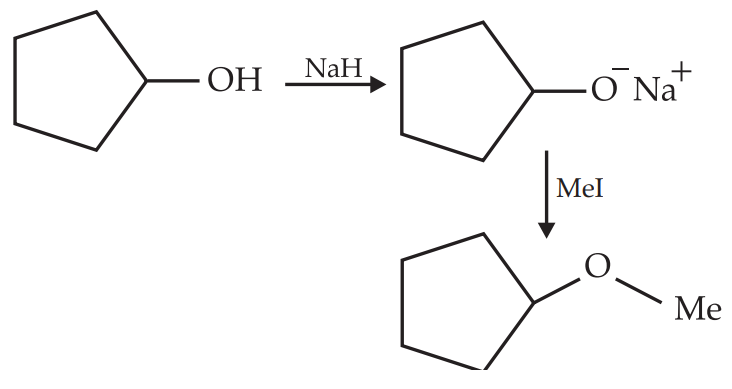 can be classified as
Alkoxide + alkyl halide → ether.
The final product is an ether. When sodium alkoxide is treated with methyl iodide, an ether is formed. This reaction is known as Williamson ether synthesis.
Cyclopentanol $\xrightarrow{NaH,\ -H_2}$ cyclopentyl $O^-Na^+$ $\xrightarrow{MeI\ (alkylation)}$ cyclopentyl–O–Me + NaI
Reimer–Tiemann reaction
-
In the reaction:
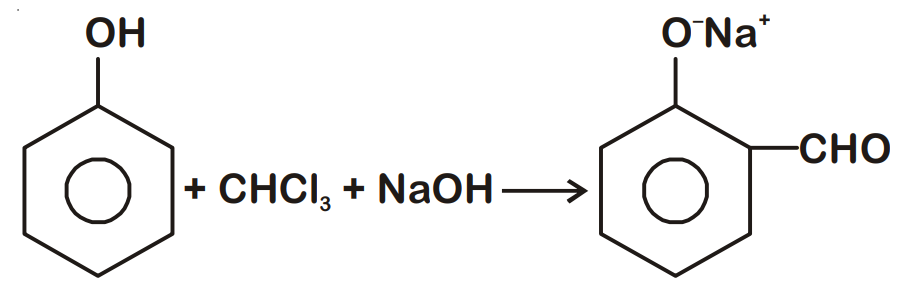
The electrophile involved isDichlorocarbene, from $\alpha$-elimination of chloroform, is the electrophile.
It is the Reimer–Tiemann reaction. The electrophile formed is $:CCl_2$ (dichlorocarbene) according to the following reactions: $CHCl_3 + OH^- \rightleftharpoons \overset{\ominus}{C}Cl_3 + H_2O$ $\overset{\ominus}{C}Cl_3 \rightarrow :CCl_2 + Cl^-$ (electrophile) -
When phenol is treated with $CHCl_3$ and NaOH, the product formed is :-This is the Reimer–Tiemann reaction. Chloroform and NaOH form dichlorocarbene ($:CCl_2$), an electrophile.
It attacks the phenoxide ion mainly at the ortho position. The $-CHCl_2$ group formed is hydrolysed by the alkali to $-CHO$.
$C_6H_5OH + CHCl_3 + 3NaOH \rightarrow o-HOC_6H_4CHO + 3NaCl + 2H_2O$ (after acidification)
The product is o-hydroxybenzaldehyde, i.e. salicylaldehyde.
(With $CCl_4$ instead of $CHCl_3$, salicylic acid is formed.)
Preparation of ethers
-
The reaction
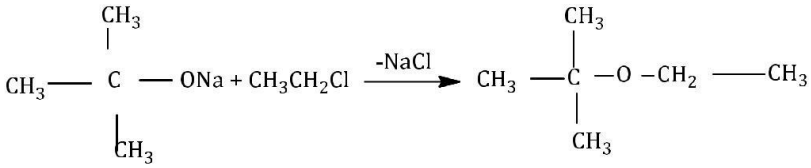 is calledSodium tert-butoxide reacts with ethyl chloride ($S_N2$) to give tert-butyl ethyl ether.
This is Williamson's synthesis, used for the preparation of ethers. -
Among the following sets of reactants which one produces anisole?$C_6H_5OH \xrightarrow[-H_2O]{NaOH} C_6H_5O^-Na^+ \xrightarrow[(S_N2)]{CH_3I} C_6H_5-O-CH_3$ (anisole)
Acidity of phenols
-
Which one of the following compounds is most acidic :-Phenols are more acidic than alcohols, because the phenoxide ion is stabilised by resonance with the benzene ring, while an alkoxide ion is not.
So $Cl-CH_2-CH_2-OH$, an alcohol (even with the $-I$ effect of Cl), is much less acidic than the phenols.
An electron withdrawing group on the ring increases the acidity of phenol by further stabilising the phenoxide ion.
The $-NO_2$ group at the ortho position withdraws electrons by both $-M$ and $-I$ effects, so o-nitrophenol ($pK_a$ about 7.2) is much more acidic than phenol ($pK_a$ 10).
The $-CH_3$ group is electron releasing ($+I$ and hyperconjugation); it destabilises the phenoxide ion, so o-cresol ($pK_a$ about 10.3) is less acidic than phenol.
So the most acidic compound is o-nitrophenol. -
The correct acidic order of the following is : -
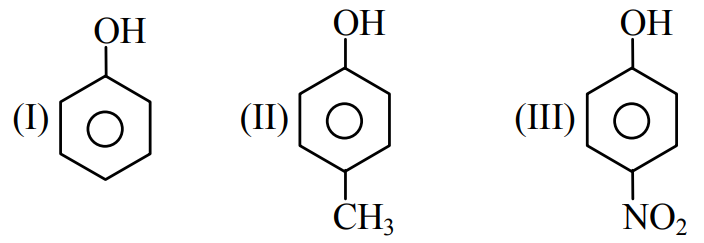 Phenol is acidic because the phenoxide ion formed after losing $H^+$ is stabilised by resonance.
An electron withdrawing group such as $-NO_2$ (by $-I$ and $-R$ effects) further stabilises the phenoxide ion by spreading its negative charge, so p-nitrophenol ($pK_a \approx 7.1$) is more acidic than phenol ($pK_a \approx 10$).
An electron donating group such as $-CH_3$ (+I effect and hyperconjugation) destabilises the phenoxide ion, so p-cresol ($pK_a \approx 10.2$) is less acidic than phenol.
So the order is III $\gt$ I $\gt$ II. -
Which of the following statements is correct for the stability of ions of ethyl alcohol and phenol :Phenol is more acidic than ethanol because the phenoxide ion is more stable than the ethoxide ion.
In the phenoxide ion, the negative charge on oxygen is delocalised into the benzene ring through resonance (it appears at the ortho and para positions), which stabilises the ion.
In the ethoxide ion, the negative charge stays localised on oxygen, and the ethyl group (+I effect) intensifies it, making the ion less stable.
So the stability is explained by delocalisation of $\pi$-electrons in the phenoxide ion.
Uses of alcohols
-
Which of the following compounds can be used as antifreeze in automobile radiators?Ethylene glycol ($HOCH_2CH_2OH$) is miscible with water and lowers its freezing point considerably (depression of freezing point).
It also has a high boiling point, so it does not evaporate from the radiator. So glycol is used as antifreeze.
Acidity of alcohols and phenols
-
Which one of the following compounds has the most acidic nature?Acidity depends on the stability of the anion formed after loss of $H^+$.
Phenol gives the phenoxide ion, in which the negative charge on oxygen is delocalised over the benzene ring by resonance; this stabilises the ion and makes phenol acidic ($pK_a \approx 10$).
In benzyl alcohol the –OH is on an $sp^3$ carbon, so the alkoxide ion formed cannot be stabilised by resonance with the ring.
Cyclohexanol and dicyclohexylmethanol are ordinary alcohols; their alkoxide ions are destabilised by the +I effect of the alkyl groups ($pK_a \approx 16$–18).
Hence phenol is the most acidic.
Electrophilic Substitution in Phenol
-
Which one of the following is most reactive towards electrophilic attack ?Reactivity towards an electrophile depends on the electron density of the benzene ring: higher the electron density, faster the attack.
The electron density of the phenol ring is the highest among chlorobenzene, benzyl alcohol and nitrobenzene.
In phenol, the OH group shows both the $+M$ (resonance) effect and the $-I$ (inductive) effect, but the $+M$ effect of OH dominates over its $-I$ effect.
The lone pair on oxygen is delocalised into the ring, increasing the electron density, especially at the ortho and para positions. So OH is a strongly activating group.
In chlorobenzene the $-I$ effect of Cl dominates over its $+M$ effect, so the ring is weakly deactivated.
In benzyl alcohol the $CH_2OH$ group has no lone pair directly on the ring atom and is slightly electron withdrawing, so there is no strong activation.
In nitrobenzene the $NO_2$ group has strong $-M$ and $-I$ effects, so the ring is strongly deactivated.
Hence phenol is the most reactive towards electrophilic attack.
Classification and Nomenclature of Alcohols
-
The general molecular formula, which represents the homologous series of alkanols is :-Alkanols are saturated monohydric alcohols, obtained by replacing one hydrogen atom of an alkane by an OH group.
General formula of an alkane: $C_nH_{2n+2}$
General formula of an alkanol: $C_nH_{2n+1}OH$
Written as a molecular formula this is $C_nH_{2n+2}O$.
Examples: methanol $CH_4O$ ($n = 1$), ethanol $C_2H_6O$ ($n = 2$).
$C_nH_{2n}O$ represents aldehydes and ketones, and $C_nH_{2n}O_2$ represents carboxylic acids and esters.
So the general molecular formula of alkanols is $C_nH_{2n+2}O$.
Oxidation of Alcohols
-
Which one of the following can be oxidised to the corresponding carbonyl compound :-An alcohol can be oxidised to a carbonyl compound only if the carbon bearing the –OH group has at least one hydrogen atom.
2-hydroxy propane is propan-2-ol, $CH_3CH(OH)CH_3$, a secondary alcohol. Its carbinol carbon has one H, so it is oxidised to the ketone acetone:
$CH_3CH(OH)CH_3 \xrightarrow{[O]} CH_3COCH_3 + H_2O$
2-methyl-2-hydroxy propane is tert-butyl alcohol, $(CH_3)_3C-OH$. It has no H on the carbinol carbon, so it is not oxidised to a carbonyl compound (under strong conditions it breaks down instead).
In phenol and o-nitrophenol, the –OH is attached to an aromatic ring carbon that has no H; they cannot form a corresponding carbonyl compound.
So 2-hydroxy propane can be oxidised to the corresponding carbonyl compound (acetone). -
n-propyl alcohol and isopropyl alcohol can be chemically distinguished by which reagent : -n-Propyl alcohol, $CH_3CH_2CH_2OH$, is a primary alcohol. On oxidation with acidified potassium dichromate it gives propanal and then propanoic acid (an acid with the same number of carbons).
Isopropyl alcohol, $(CH_3)_2CHOH$, is a secondary alcohol. On oxidation it gives acetone (a ketone), which is not oxidised further easily.
The products can be told apart: the aldehyde/acid gives positive Tollens' or Fehling's tests, while acetone does not (but gives the iodoform test).
$PCl_5$ reacts with both alcohols in the same way, giving HCl fumes, so it cannot distinguish them; reduction and ozonolysis are not relevant.
So they can be distinguished by oxidation with potassium dichromate.
Reactions Involving Cleavage of C–O Bond
-
The –OH group of an alcohol or the carboxylic acid can be replaced by –Cl, using :-Phosphorus pentachloride reacts with both alcohols and carboxylic acids, replacing the –OH group by –Cl:
$R-OH + PCl_5 \rightarrow R-Cl + POCl_3 + HCl$
$R-COOH + PCl_5 \rightarrow R-COCl + POCl_3 + HCl$ (acid chloride)
Hydrochloric acid converts alcohols to alkyl chlorides (with $ZnCl_2$, Lucas reagent) but it cannot convert a carboxylic acid into an acid chloride. Chlorine and hypochlorous acid do not replace –OH by –Cl.
So the reagent is phosphorus pentachloride, $PCl_5$ (also used to test for an –OH group, since HCl fumes are given off).
Iodoform Reaction
-
Which of following is correct : -Ethanol contains the $CH_3CH(OH)-$ group. With iodine and NaOH it is first oxidised to acetaldehyde and then gives a yellow precipitate of iodoform:
$C_2H_5OH + 4I_2 + 6NaOH \rightarrow CHI_3 + HCOONa + 5NaI + 5H_2O$; correct.
Reduction of aldehydes gives primary alcohols (ketones give secondary alcohols).
Glycerol is obtained by hydrolysis (saponification) of oils with alkali, not by reaction with $H_2SO_4$.
Invert sugar is obtained by hydrolysis of sucrose with dilute acid or the enzyme invertase, not with NaCl.
So the correct statement is that $C_2H_5OH$, iodine and NaOH give iodoform.
That is every question in Alcohols, Phenols and Ethers for this filter.
Show all 65 questions Next: Aldehydes, Ketones and Carboxylic Acids
Want a score?
Answers here are not saved. Practise as a test to be marked and see your progress.
Practise as a test