Looking for classes? Ksquare Career Institute, Bengaluru →

Chemistry
Structure of Atom
62 questions from 37 papers, each with its answer.
- 62 questions
- 37 papers
- 3.52% of Chemistry
Bohr Model and Hydrogen Spectrum
-
The ratio of the wavelengths of the light absorbed by a Hydrogen atom when it undergoes $n = 2 \rightarrow n = 3$ and $n = 4 \rightarrow n = 6$ transitions, respectively, is:
Energy absorbed is $\Delta E_1 = R_H \left(\frac{1}{4} - \frac{1}{9}\right) = \frac{5}{36} R_H$ and $\Delta E_2 = R_H \left(\frac{1}{16} - \frac{1}{36}\right) = \frac{5}{144} R_H$. Since $\lambda \propto 1/\Delta E$, $\lambda_1 / \lambda_2 = \Delta E_2 / \Delta E_1 = \frac{5/144}{5/36} = \frac{36}{144} = \frac{1}{4}$.
For hydrogen-like transitions, the energy difference between energy levels $n_1$ and $n_2$ is $\Delta E = R_H \left(\frac{1}{n_1^2} - \frac{1}{n_2^2}\right)$. For $n = 2 \rightarrow 3$: $\Delta E_1 = R_H \left(\frac{1}{4} - \frac{1}{9}\right) = \frac{5}{36} R_H$. For $n = 4 \rightarrow 6$: $\Delta E_2 = R_H \left(\frac{1}{16} - \frac{1}{36}\right) = \frac{5}{144} R_H$. Since wavelength $\lambda = \frac{hc}{\Delta E}$, the ratio of wavelengths is $\frac{\lambda_1}{\lambda_2} = \frac{\Delta E_2}{\Delta E_1} = \frac{5/144}{5/36} = \frac{36}{144} = \frac{1}{4}$.
Bohr Model for Hydrogen-like Species
-
Energy and radius of first Bohr orbit of $\text{He}^+$ and $\text{Li}^{2+}$ are [Given: $R_H = 2.18 \times 10^{-18}\text{ J}$, $a_0 = 52.9\text{ pm}$]:
$E_n = -R_H \frac{Z^2}{n^2}$ and $r_n = a_0 \frac{n^2}{Z}$. For $\text{He}^+$ ($Z=2$): $E_1 = -8.72 \times 10^{-18}\text{ J}$, $r_1 = 26.45\text{ pm}$. For $\text{Li}^{2+}$ ($Z=3$): $E_1 = -19.62 \times 10^{-18}\text{ J}$, $r_1 = 17.63\text{ pm}$.
For hydrogenic species: Energy is $E_n = -R_H \frac{Z^2}{n^2}$ and radius is $r_n = a_0 \frac{n^2}{Z}$. For $\text{He}^+$ ($Z = 2, n = 1$): $E_1 = -2.18 \times 10^{-18} \times (2^2) = -8.72 \times 10^{-18}\text{ J}$, $r_1 = \frac{52.9}{2} = 26.45\text{ pm} \approx 26.4\text{ pm}$. For $\text{Li}^{2+}$ ($Z = 3, n = 1$): $E_1 = -2.18 \times 10^{-18} \times (3^2) = -19.62 \times 10^{-18}\text{ J}$, $r_1 = \frac{52.9}{3} = 17.63\text{ pm} \approx 17.6\text{ pm}$.
Quantum Numbers and Their Significance
-
Match List-I with List-II regarding quantum numbers and the information they provide.
Pick the matching item from Column II for each row.
Column I
- A. $m_l$
- B. $m_s$
- C. $l$
- D. $n$
Column II
- I. shape of orbital
- II. size of orbital
- III. orientation of orbital
- IV. orientation of spin of electron
Correct answer: A → III, B → IV, C → I, D → II
$m_l$ (magnetic quantum number): orientation of orbital $m_s$ (spin quantum number): orientation of spin of electron $l$ (azimuthal quantum number): shape of orbital $n$ (principal quantum number): size of orbital Correct match: A-III, B-IV, C-I, D-II.
Quantum Numbers
-
The relation between $n_m$ ($n_m$ = the number of permissible values of magnetic quantum number $(m)$) for a given value of azimuthal quantum number $(l)$, is
$n_m=2l+1$, hence $l=\frac{n_m-1}{2}$.
$n_m=2l+1$ As there are $(2l+1)$ number of permissible values of magnetic quantum number. Hence, $l=\frac{n_m-1}{2}$ -
The angular momentum of electron in 'd' orbital is equal to:Orbital angular momentum $= \sqrt{l(l+1)}\,\hbar$
For a d orbital, l = 2: $\sqrt{2(2+1)}\,\hbar = \sqrt{6}\,\hbar$ -
What is the maximum number of orbitals that can be identified with the following quantum numbers? n = 3, l = 1, $m_l$ = 0n = 3, l = 1, $m_l$ = 0 specifies a single orbital, the $3p_z$ orbital.
-
What is the maximum number of electrons that can be associated with the following set of quantum numbers? n = 3, l = 1 and m = −1n = 3, l = 1 and m = −1 represent one 3p orbital, which can hold a maximum of 2 electrons.
-
Maximum number of electrons in a subshell with l = 3 and n = 4 is:n = 4, l = 3 is the 4f subshell.
Number of orbitals $= 2l + 1 = 7$
Each orbital holds 2 electrons, so maximum electrons $= 2(2l + 1) = 14$ -
The correct set of four quantum numbers for the valence electron of rubidium atom (Z = 37) isRb (Z = 37): $[Kr]5s^1$
The valence electron is in the 5s orbital: n = 5, l = 0 (s orbital), m = 0, s = $+\frac{1}{2}$ -
The orbital angular momentum of a p-electron is given as:Orbital angular momentum $= \sqrt{l(l+1)}\,\frac{h}{2\pi}$
For a p-electron l = 1: $\sqrt{1(1+1)}\,\frac{h}{2\pi} = \sqrt2\times\frac{h}{2\pi}$
$= \frac{h}{\sqrt2\pi}$ -
The total number of atomic orbitals in fourth energy level of an atom isThe number of orbitals in a shell with principal quantum number n is $n^2$.
For n = 4 the subshells are 4s (1 orbital), 4p (3 orbitals), 4d (5 orbitals) and 4f (7 orbitals).
Total orbitals = 1 + 3 + 5 + 7 = 16
Equivalently, $n^2 = 4^2 = 16$
So the fourth energy level has 16 atomic orbitals (which can hold 32 electrons). -
Maximum number of electrons in a subshell of an atom is determined by the followingA subshell with azimuthal quantum number l has $(2l + 1)$ orbitals, one for each value of $m_l$ from −l to +l.
Each orbital can hold a maximum of 2 electrons with opposite spins (Pauli exclusion principle).
Maximum number of electrons in a subshell = $2(2l + 1) = 4l + 2$
Check: s (l = 0) holds 2, p (l = 1) holds 6, d (l = 2) holds 10, f (l = 3) holds 14.
($2n^2$ is the maximum number of electrons in a shell, not a subshell.) -
Which of the following is not permissible arrangement of electrons in an atom?Rules: l can take values 0 to (n − 1); m can take values from −l to +l; s is $+\frac{1}{2}$ or $-\frac{1}{2}$.
n = 3, l = 2, m = –2: l = 2 is allowed for n = 3, and m = –2 lies within −2 to +2. Permissible.
n = 4, l = 0, m = 0: allowed (4s orbital). Permissible.
n = 5, l = 3, m = 0: l = 3 is allowed for n = 5, and m = 0 lies within −3 to +3. Permissible.
n = 3, l = 2, m = –3: for l = 2, m can only be −2, −1, 0, +1, +2; the value −3 is not possible.
Hence the arrangement n = 3, l = 2, m = –3, s = $-\frac{1}{2}$ is not permissible.
Note: the source prints the first and the fourth options identically; the first has been restored to m = –2, as in the original paper. -
Consider the following sets of quantum numbers:
(i) $n = 3$, $l = 0$, $m = 0$, $s = +\dfrac{1}{2}$
(ii) $n = 2$, $l = 2$, $m = 1$, $s = +\dfrac{1}{2}$
(iii) $n = 4$, $l = 3$, $m = -2$, $s = -\dfrac{1}{2}$
(iv) $n = 1$, $l = 0$, $m = -1$, $s = -\dfrac{1}{2}$
(v) $n = 3$, $l = 2$, $m = 3$, $s = +\dfrac{1}{2}$
Which of the following sets of quantum numbers is not possible?Rules: for a given $n$, $l$ varies from 0 to $(n - 1)$; for a given $l$, $m$ varies from $-l$ to $+l$; and $s = \pm\dfrac{1}{2}$.
(i) $n = 3$, $l = 0$, $m = 0$: allowed (3s orbital).
(ii) $n = 2$, $l = 2$: not possible, because for $n = 2$, $l$ can be only 0 or 1.
(iii) $n = 4$, $l = 3$, $m = -2$: allowed (4f orbital).
(iv) $n = 1$, $l = 0$, $m = -1$: not possible, because for $l = 0$, $m$ can be only 0.
(v) $n = 3$, $l = 2$, $m = 3$: not possible, because for $l = 2$, $m$ varies only from $-2$ to $+2$.
So the sets that are not possible are (ii), (iv) and (v). -
The orientation of an atomic orbital is governed by :-The principal quantum number ($n$) determines the size and, to a large extent, the energy of the orbital.
The azimuthal quantum number ($l$) determines the shape of the orbital (s, p, d, f).
The magnetic quantum number ($m_l$) determines the orientation of the orbital in space relative to the others; for a given $l$ it takes the $(2l + 1)$ values from $-l$ to $+l$.
For example, for $l = 1$, $m_l = -1, 0, +1$ correspond to the three orientations $p_x$, $p_y$ and $p_z$.
The spin quantum number ($m_s$) describes the spin of the electron, not the orbital.
So the orientation of an atomic orbital is governed by the magnetic quantum number. -
The following quantum numbers are possible for how many orbitals: n = 3, l = 2, m = +2The three quantum numbers n, l and $m_l$ together specify exactly one orbital.
n = 3, l = 2 is the 3d subshell, which has five orbitals with $m_l$ = –2, –1, 0, +1, +2.
Only one of these has $m_l = +2$.
So the given quantum numbers are possible for 1 orbital (which can hold 2 electrons with $m_s = \pm\dfrac{1}{2}$).
Electromagnetic Radiation – Frequency and Wavelength
-
A particular station of All India Radio, New Delhi, broadcasts on a frequency of 1,368 kHz (kilohertz). The wavelength of the electromagnetic radiation emitted by the transmitter is: [speed of light, $c=3.0\times10^8\ ms^{-1}$]$\lambda = \frac{c}{\nu} = \frac{3 \times 10^8}{1368 \times 10^3} = 219.298$ m $\approx 219.3$ m
Atomic Number, Mass Number and Isotopes
-
The number of protons, neutrons and electrons in $^{175}_{71}Lu$, respectively, are:$^{175}_{71}Lu$: number of protons = number of electrons = 71 Number of neutrons = mass number – protons = 175 – 71 = 104 So protons, neutrons and electrons are 71, 104 and 71.
Spectrum of the Hydrogen Atom
-
Which of the following series of transitions in the spectrum of hydrogen atom falls in visible region?In the hydrogen spectrum, the Balmer series transitions (to n = 2) fall in the visible region. The Lyman series lies in the UV region, and the Paschen and Brackett series lie in the IR region.
Isoelectronic species
-
Which of the following is iso-electronic : -Isoelectronic species have the same total number of electrons.
$CN^-$: C (6) + N (7) + 1 = 14 electrons; CO: C (6) + O (8) = 14 electrons. They are isoelectronic.
$CO_2$: 6 + 16 = 22; $NO_2$: 7 + 16 = 23; $NO_2^-$: 24; $SO_2$: 16 + 16 = 32. These pairs do not match.
So $CN^-$ and CO are isoelectronic (both also isoelectronic with $N_2$). -
Isoelectronic species are :Count the total electrons:
CO: 6 + 8 = 14; $CN^-$: 6 + 7 + 1 = 14; $NO^+$: 7 + 8 – 1 = 14; $C_2^{2-}$: 6 + 6 + 2 = 14.
All four have 14 electrons (like $N_2$), so they are isoelectronic.
In the other sets, the species have different numbers of electrons (e.g. CO 14, CN 13, NO 15, $C_2$ 12).
So CO, $CN^-$, $NO^+$ and $C_2^{2-}$ are isoelectronic.
Quantum numbers and orbitals
-
Match List - I (quantum number) with List - II (orbital). Choose the correct answer.
Pick the matching item from Column II for each row.
Column I
- A. $n=2$, $l=1$
- B. $n=3$, $l=2$
- C. $n=3$, $l=0$
- D. $n=2$, $l=0$
Column II
- I. 2s
- II. 3s
- III. 2p
- IV. 3d
Correct answer: A → III, B → IV, C → II, D → I
$l=0\Rightarrow s$, $l=1\Rightarrow p$, $l=2\Rightarrow d$. So $n=2, l=1\Rightarrow 2p$; $n=3, l=2\Rightarrow 3d$; $n=3, l=0\Rightarrow 3s$; $n=2, l=0\Rightarrow 2s$.
Radial and angular nodes
-
Orbital having 3 angular nodes and 3 total nodes is:Angular nodes $=l=3$ (f orbital). Total nodes $=n-1=3 \Rightarrow n=4$. The orbital is 4f.
Hund's rule and quantum numbers
-
Which one is a wrong statement?
Unpaired electrons in degenerate orbitals must have parallel spins.
According to Hund's rule of maximum multiplicity, the three 2p electrons of the N-atom must be in separate orbitals with parallel spins (all up or all down).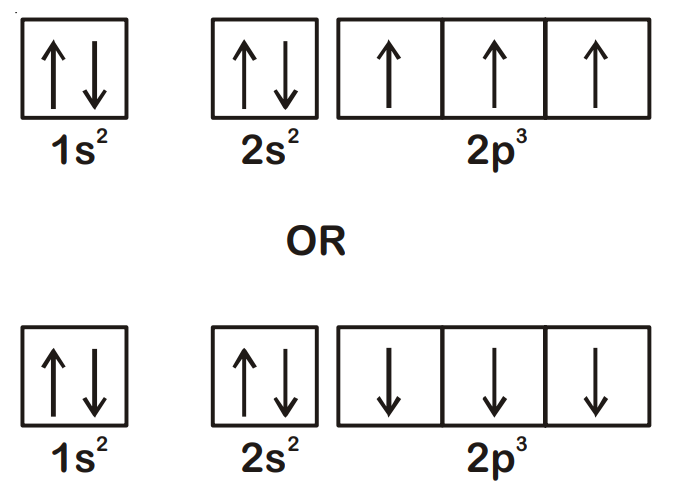
The configuration shown in the statement has one electron with opposite spin in $2p_z$, which violates Hund's rule. So that statement is wrong.
Quantum numbers – spin quantum number
-
Two electrons occupying the same orbital are distinguished by
Electrons in one orbital differ only in spin.
Two electrons in the same orbital have the same n, l and $m_l$, but differ in the fourth quantum number, the spin quantum number: $m_s = +\frac{1}{2}$ and $m_s = -\frac{1}{2}$.
Shapes of d-orbitals
-
Which of the following pairs of d-orbitals will have electron density along the axes?
Only $d_{z^2}$ and $d_{x^2-y^2}$ point along axes.
$d_{z^2}$ and $d_{x^2-y^2}$ have electron density concentrated on the axes; the others lie between the axes.
Quantum numbers and orbital capacity
-
How many electrons can fit in the orbital for which n = 3 and l = 1?
Any single orbital holds at most 2 electrons.
n = 3, l = 1 ⇒ 3p
An orbital (a single 3p orbital) can hold a total of 2 electrons.
Electronic configuration
-
The number of d-electrons in $Fe^{2+}$ (Z = 26) is not equal to the number of electrons in which one of the following?$Fe^{2+}$: $[Ar]3d^6$, so 6 d-electrons.
Mg: $1s^22s^22p^63s^2$ — 6 s-electrons.
Cl: $1s^22s^22p^63s^23p^5$ — 11 p-electrons.
Fe: $[Ar]3d^64s^2$ — 6 d-electrons.
Ne: $1s^22s^22p^6$ — 6 p-electrons.
So the p-electrons in Cl (11) are not equal to the d-electrons in $Fe^{2+}$.
Aufbau principle
-
Which is the correct order of increasing energy of the listed orbitals in the atom of titanium? (At. no. Z = 22)Ti (22): $1s^22s^22p^63s^23p^64s^23d^2$
Order of energy: 3s < 3p < 4s < 3d
Planck's quantum theory
-
Calculate the energy in joule corresponding to light of wavelength 45 nm: (Planck's constant h = $6.63\times10^{-34}$ Js; speed of light c = $3\times10^8$ $ms^{-1}$)$E = \frac{hc}{\lambda} = \frac{6.63\times10^{-34}\times3\times10^8}{45\times10^{-9}}$
$E = 4.42\times10^{-18}$ J -
The energies $E_1$ and $E_2$ of two radiations are 25 eV and 50 eV respectively. The relation between their wavelengths i.e. $\lambda_1$ and $\lambda_2$ will beEnergy of a photon: $E = \frac{hc}{\lambda}$, so $E \propto \frac{1}{\lambda}$
$\frac{E_1}{E_2} = \frac{\lambda_2}{\lambda_1}$
$\frac{25}{50} = \frac{\lambda_2}{\lambda_1}$
$\frac{\lambda_2}{\lambda_1} = \frac{1}{2}$
$\lambda_1 = 2\lambda_2$
Electromagnetic radiation
-
The value of Planck's constant is $6.63\times10^{-34}$ Js. The speed of light is $3\times10^{17}$ nm $s^{-1}$. Which value is closest to the wavelength in nanometer of a quantum of light with frequency of $6\times10^{15}$ $s^{-1}$?$\lambda = \frac{c}{\nu} = \frac{3\times10^{17}\ nm\,s^{-1}}{6\times10^{15}\ s^{-1}} = 50$ nm
Bohr's model
-
According to the Bohr theory, which of the following transitions in the hydrogen atom will give rise to the least energetic photon?Energy of the photon emitted: $\Delta E = 13.6\left(\frac{1}{n_1^2} - \frac{1}{n_2^2}\right)$ eV, where $n_2 > n_1$.
n = 6 to n = 5: $13.6\left(\frac{1}{25} - \frac{1}{36}\right) = 13.6\times0.0122 = 0.166$ eV
n = 5 to n = 4: $13.6\left(\frac{1}{16} - \frac{1}{25}\right) = 13.6\times0.0225 = 0.306$ eV
n = 5 to n = 3: $13.6\left(\frac{1}{9} - \frac{1}{25}\right) = 13.6\times0.0711 = 0.967$ eV
n = 6 to n = 1: $13.6\left(1 - \frac{1}{36}\right) = 13.6\times0.972 = 13.22$ eV
The energy levels come closer together as n increases, so the transition between the highest adjacent levels gives the smallest energy.
The least energetic photon is from n = 6 to n = 5.
de Broglie relation
-
A 0.66 kg ball is moving with a speed of 100 m/s. The associated wavelength will be ($h = 6.6\times10^{-34}$ J s)de Broglie relation: $\lambda = \frac{h}{mv}$
$\lambda = \frac{6.6\times10^{-34}}{0.66\times100}$
$\lambda = \frac{6.6\times10^{-34}}{66}$
$\lambda = 1.0\times10^{-35}$ m
Energy of radiation and bond dissociation
-
The energy absorbed by each molecule ($A_2$) of a substance is $4.4\times10^{-19}$ J and bond energy per molecule is $4.0\times10^{-19}$ J. The kinetic energy of the molecule per atom will beOf the energy absorbed by a molecule, a part equal to the bond energy is used to break the A–A bond; the rest appears as kinetic energy of the two atoms.
Kinetic energy per molecule = energy absorbed − bond energy = $4.4\times10^{-19} - 4.0\times10^{-19} = 0.4\times10^{-19}$ J
Each $A_2$ molecule gives two atoms, which share this energy equally.
Kinetic energy per atom = $\frac{0.4\times10^{-19}}{2} = 0.2\times10^{-19}$ J
$= 2.0\times10^{-20}$ J
Heisenberg's Uncertainty Principle
-
The measurement of the electron position is associated with an uncertainty in momentum, which is equal to $1 \times 10^{-18}$ g cm s$^{-1}$. The uncertainty in electron velocity is :
(Mass of an electron is $9 \times 10^{-28}$ g)Momentum $p = mv$, so uncertainty in momentum $\Delta p = m\,\Delta v$
Uncertainty in momentum $(m\,\Delta v) = 1 \times 10^{-18}$ g cm s$^{-1}$
Uncertainty in velocity: $\Delta v = \dfrac{\Delta p}{m}$
$\Delta v = \dfrac{1 \times 10^{-18}}{9 \times 10^{-28}}$
$\Delta v = 1.1 \times 10^{9}$ cm s$^{-1}$
$\approx 1 \times 10^{9}$ cm s$^{-1}$
Bohr's Model of Hydrogen Atom
-
The energy of second Bohr orbit of the hydrogen atom is $-328$ kJ mol$^{-1}$; hence the energy of fourth Bohr orbit would be :-Energy of the $n$th Bohr orbit: $E_n \propto -\dfrac{1}{n^2}$
$\dfrac{E_4}{E_2} = \dfrac{n_2^2}{n_4^2} = \dfrac{2^2}{4^2} = \dfrac{4}{16} = \dfrac{1}{4}$
$E_4 = \dfrac{E_2}{4} = \dfrac{-328}{4}$
$E_4 = -82$ kJ mol$^{-1}$
(Check: $E_1 = -1312$ kJ mol$^{-1}$, so $E_4 = \dfrac{-1312}{16} = -82$ kJ mol$^{-1}$.)
Wave Nature of Electromagnetic Radiation
-
The value of Planck's constant is $6.63 \times 10^{-34}$ J s. The velocity of light is $3.0 \times 10^8$ m s$^{-1}$. Which value is closest to the wavelength in nanometers of a quantum of light with frequency of $8 \times 10^{15}$ s$^{-1}$ :Wavelength and frequency are related by $c = \nu\lambda$ (Planck's constant is not needed).
$\lambda = \dfrac{c}{\nu} = \dfrac{3.0 \times 10^8}{8 \times 10^{15}} = 3.75 \times 10^{-8}$ m
1 nm $= 10^{-9}$ m, so $\lambda = 3.75 \times 10^{-8} \times 10^{9} = 37.5$ nm
The closest value is $4 \times 10^1$ nm.
Bohr's Model: Energy of Electron
-
In hydrogen atom, energy of first excited state is – 3.4 eV. Then find out KE of same orbit of hydrogen atom : -In the Bohr model, for an electron in an orbit: potential energy $U = -\dfrac{kZe^2}{r}$, kinetic energy $KE = \dfrac{kZe^2}{2r}$.
Total energy $E = KE + U = -\dfrac{kZe^2}{2r} = -KE$
So $KE = -E$ (and $U = 2E$).
For the first excited state, $E = -3.4$ eV, so $KE = +3.4$ eV.
(Its potential energy is $-6.8$ eV.)
Photon Energy and Wavelength
-
For given energy, $E = 3.03 \times 10^{-19}$ J, corresponding wavelength will be ($h = 6.6 \times 10^{-34}$ J s, $c = 3 \times 10^8$ m/s)$E = \dfrac{hc}{\lambda} \Rightarrow \lambda = \dfrac{hc}{E}$
$\lambda = \dfrac{6.6 \times 10^{-34} \times 3 \times 10^8}{3.03 \times 10^{-19}} = \dfrac{19.8 \times 10^{-26}}{3.03 \times 10^{-19}}$
$\lambda = 6.53 \times 10^{-7}$ m $= 653$ nm
(This is red light in the visible region.)
That is every question in Structure of Atom for this filter.
Show all 62 questions Next: Classification of Elements and Periodicity in Properties
Want a score?
Answers here are not saved. Practise as a test to be marked and see your progress.
Practise as a test