Looking for classes? Ksquare Career Institute, Bengaluru →

Chemistry
Organic Chemistry - Some Basic Principles and Techniques
88 questions from 35 papers, each with its answer.
- 88 questions
- 35 papers
- 5% of Chemistry
Geometrical Isomerism
-
Which one of the following compounds can exist as cis-trans isomers?
1,2-Dimethylcyclohexane possesses two stereocenters with restricted rotation, existing as cis- and trans-geometric isomers.
For geometrical isomerism, there must be restricted rotation and each carbon of the stereogenic unit must be attached to two different groups. In Pent-1-ene, terminal carbon has two identical H atoms; in 2-methylhex-2-ene, C-2 has two methyl groups; in 1,1-dimethylcyclopropane, C-1 has two methyl groups. In 1,2-dimethylcyclohexane, the ring provides restricted rotation and C-1 and C-2 both hold $-\text{H}$ and $-\text{CH}_3$, allowing cis- and trans-isomers. -
Which of the following compounds will exhibit cis-trans (geometrical) isomerism?Cis–trans isomerism needs restricted rotation (a C=C double bond or a ring) and two different groups on each of the doubly bonded carbon atoms.
2-Butene, $CH_3-CH=CH-CH_3$: each doubly bonded carbon has one H and one $CH_3$, so cis and trans forms exist.
1-Butanol and 2-butanol have only single bonds with free rotation (2-butanol shows optical, not geometrical, isomerism).
2-Butyne, $CH_3-C\equiv C-CH_3$, is linear about the triple bond, and each triply bonded carbon has only one substituent.
Hence 2-butene exhibits cis–trans isomerism. -
2-butene shows geometrical isomerism due to :Rotation about a C=C double bond is restricted, because it would break the sideways overlap of p orbitals that forms the $\pi$ bond.
In 2-butene, $CH_3CH=CHCH_3$, each doubly bonded carbon carries two different groups (H and $CH_3$). So the two methyl groups can be on the same side (cis) or on opposite sides (trans), and these forms cannot interconvert.
So 2-butene shows geometrical isomerism due to restricted rotation about the double bond.
Purification of Organic Compounds
-
Match List-I with List-II.
Pick the matching item from Column II for each row.
Column I
- A. $\text{CHCl}_3 + \text{C}_6\text{H}_5\text{NH}_2$
- B. Crude oil in petroleum industry
- C. Glycerol from spent-lye
- D. Aniline-water
Column II
- I. Distillation under reduced pressure
- II. Steam distillation
- III. Fractional distillation
- IV. Simple distillation
Correct answer: A → IV, B → III, C → I, D → II
Chloroform + aniline: Simple distillation; Crude oil: Fractional distillation; Glycerol from spent-lye: Vacuum distillation; Aniline-water: Steam distillation.
Purification techniques: 1. $\text{CHCl}_3$ (b.p. $61^\circ\text{C}$) and aniline (b.p. $184^\circ\text{C}$) have a large difference in boiling points ($>50^\circ\text{C}$), separated by Simple distillation (IV). 2. Crude oil contains hydrocarbon fractions with close boiling points, separated by Fractional distillation (III). 3. Glycerol decomposes at its normal boiling point ($290^\circ\text{C}$), hence purified by Distillation under reduced pressure / vacuum distillation (I). 4. Aniline is steam volatile and immiscible with water, purified by Steam distillation (II). Hence, A-IV, B-III, C-I, D-II.
Qualitative Analysis of Organic Compounds - Lassaigne's Test
-
Which one of the following reactions does NOT belong to "Lassaigne's test"?
Lassaigne's test involves sodium fusion to convert covalent heteroatoms (N, S, X) into ionic sodium salts (NaCN, $\text{Na}_2\text{S}$, NaX). The reaction with CuO is used in copper oxide test for detection of carbon and hydrogen.
In Lassaigne's sodium fusion test, nitrogen, sulphur, and halogens present in an organic compound are converted from covalent to ionic form by fusing with metallic sodium: $\text{Na} + \text{C} + \text{N} \rightarrow \text{NaCN}$, $2\text{Na} + \text{S} \rightarrow \text{Na}_2\text{S}$, and $\text{Na} + \text{X} \rightarrow \text{NaX}$. The reduction of copper(II) oxide ($2\text{CuO} + \text{C} \rightarrow 2\text{Cu} + \text{CO}_2$) is used for the qualitative detection of carbon and hydrogen, not in Lassaigne's test.
Isomerism – Structural Isomerism
-
The compound which shows metamerism is:Metamerism requires different alkyl groups on either side of a polyvalent functional group. $C_4H_{10}O$: $CH_3-CH_2-O-CH_2-CH_3$ and $CH_3-O-CH_2-CH_2-CH_3$ are metamers. $C_3H_6O$ (acetone) and $C_3H_8O$ ($CH_3-O-CH_2-CH_3$) allow only one arrangement, and $C_5H_{12}$ has no polyvalent functional group – so they cannot show metamerism.
Purification of Organic Compounds – Chromatography
-
Paper chromatography is an example of:Paper chromatography is a type of partition chromatography: the stationary phase is water trapped in the special chromatography paper, and the mobile phase is the solvent, between which the components are partitioned.
Electronic Displacements in a Covalent Bond – Hyperconjugation
-
A tertiary butyl carbocation is more stable than a secondary butyl carbocation because of which of the following?Tertiary butyl carbocation has 9 $\alpha$-H atoms, while secondary butyl carbocation has 5 $\alpha$-H atoms. The more the number of $\alpha$-H atoms, the greater the hyperconjugation, and hence the greater the stability of the carbocation.
Detection of elements - Lassaigne's test
-
During Lassaigne's test, the elements present in an organic compound are converted from:During Lassaigne's test, the organic compound is fused with sodium metal, so the elements present in the compound (N, S, halogens) are converted from covalent form to ionic form (NaCN, $Na_2S$, NaX).
Stability of carbocations
-
Which amongst the following is the most stable carbocation :-Alkyl groups are electron releasing. They stabilise a carbocation by the $+I$ effect and by hyperconjugation, which spread the positive charge.
The more alkyl groups attached to the positively charged carbon, the more stable the carbocation.
$(CH_3)_3C^+$ (tert-butyl cation) is a tertiary carbocation with three methyl groups and nine $\alpha$-hydrogens available for hyperconjugation.
$(CH_3)_2CH^+$ is secondary (6 $\alpha$-H), $CH_3CH_2^+$ is primary (3 $\alpha$-H) and $CH_3^+$ has no alkyl group.
Order of stability: $3^\circ \gt 2^\circ \gt 1^\circ \gt CH_3^+$
So the most stable carbocation is $(CH_3)_3C^+$.
Lassaigne's test for sulphur
-
The amino acid that gives a red-blood colour on treating its sodium fusion extract with sodium nitroprusside isMethionine, $CH_3-S-CH_2-CH_2-CH(NH_2)-COOH$, contains both sulphur and nitrogen, so its sodium fusion extract gives the red-blood colour test.
Hybridisation of carbon
-
Which of the following molecules represents the order of hybridisation $sp^2$, $sp^2$, sp, sp from left to right atoms?
Double-bonded carbons are $sp^2$ and triple-bonded carbons are sp.
$\overset{sp^2}{C}H_2=\overset{sp^2}{C}H-\overset{sp}{C}\equiv\overset{sp}{C}H$ Number of orbitals required in hybridisation = number of $\sigma$-bonds around each carbon atom. -
In the hydrocarbon,
$\overset{6}{C}H_3-\overset{5}{C}H=\overset{4}{C}H-\overset{3}{C}H_2-\overset{2}{C}\equiv\overset{1}{C}H$
The state of hybridization of carbons 1, 3 and 5 are in the following sequence :The hybridisation of a carbon atom is decided by the number of sigma bonds it forms: 4 sigma bonds means $sp^3$, 3 sigma bonds (one double bond) means $sp^2$, and 2 sigma bonds (a triple bond) means $sp$.
Hybridisation of the carbons from C6 to C1: $sp^3$, $sp^2$, $sp^2$, $sp^3$, $sp$, $sp$
C1 is part of the triple bond ($C\equiv CH$), so it is $sp$ hybridised.
C3 is a $CH_2$ group with four single bonds, so it is $sp^3$ hybridised.
C5 is part of the double bond ($CH=CH$), so it is $sp^2$ hybridised.
The state of hybridization of carbons 1, 3 and 5 is $sp$, $sp^3$ and $sp^2$ respectively. -
The correct order regarding the electronegativity of hybrid orbitals of carbon is :-The electronegativity of a hybrid orbital depends on its percentage of s-character.
An s orbital is closer to the nucleus than a p orbital, so electrons in an orbital with more s-character are held more strongly by the nucleus.
s-character: $sp$ = 50 percent, $sp^2$ = 33.3 percent, $sp^3$ = 25 percent.
Greater the s-character, greater is the electronegativity of the hybrid orbital.
So the order of electronegativity is $sp \gt sp^2 \gt sp^3$.
This explains why the hydrogen of ethyne (sp carbon) is more acidic than that of ethene or ethane.
Electrophiles and nucleophiles
-
The correct statement regarding electrophile is
Electrophiles are neutral or positive electron-pair acceptors.
Fact: an electrophile is an electron-deficient species, either neutral or positively charged, that forms a bond by accepting an electron pair from a nucleophile.
Methods of purification – steam distillation
-
The most suitable method of separation of 1 : 1 mixture of ortho and para-nitrophenols is
o-Nitrophenol is steam volatile due to intramolecular H-bonding.
Steam distillation is the most suitable method of separation of a 1 : 1 mixture of ortho and para nitrophenols, as there is intramolecular H-bonding in ortho-nitrophenol, making it steam volatile.
Hybridisation of carbanions
-
The pair of electron in the given carbanion, $CH_3C\equiv C^-$, is present in which orbitals?
The carbanion carbon is sp hybridised.
In $CH_3-C\equiv\ddot{C}^-$, both triple-bonded carbons are sp hybridised, so the lone pair is present in an sp orbital.
Carbocation stability
-
In which of the following compounds, the C–Cl bond ionization shall give most stable carbonium ion?$C_6H_5CH_2Cl \xrightarrow{\text{ionisation}} C_6H_5\overset{+}{C}H_2 + Cl^-$
The benzyl carbonium ion is the most stable because the positive charge is delocalised over the ring by resonance.
Bonding in organic molecules
-
The total number of $\pi$-bond electrons in the following structure is:
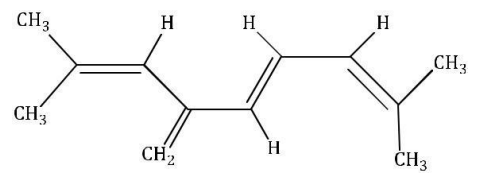 The structure has 4 C=C double bonds, i.e. 4 $\pi$ bonds.
Each $\pi$ bond has 2 electrons, so total $\pi$-bond electrons = 8.
Reaction intermediates and reagents
-
Which of the following statements is not correct for a nucleophile?Nucleophiles are electron-rich species that donate an electron pair, so they act as Lewis bases, not Lewis acids.
Stereoisomerism
-
Two possible stereo-structures of $CH_3CHOH.COOH$, which are optically active, are called:
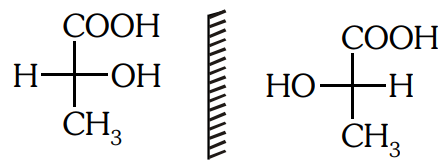
Lactic acid has one chiral carbon; its two forms are non-superimposable mirror images, i.e. enantiomers.
Hybridisation
-
Which of the following organic compounds has same hybridization as its combustion product ($CO_2$)?$C_2H_2 + \frac{5}{2}O_2 \rightarrow 2CO_2 + H_2O$
Carbon is sp hybridised in both $HC\equiv CH$ and $CO_2$.
Nomenclature
-
The structure of isobutyl group in an organic compound is:$(CH_3)_3C-$ is tert-butyl; $(CH_3)_2CH-CH_2-$ is isobutyl; $CH_3-CH(-)-CH_2-CH_3$ is sec-butyl; $CH_3CH_2CH_2CH_2-$ is n-butyl.
IUPAC nomenclature
-
The IUPAC name of the compound
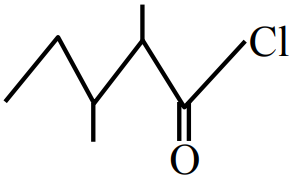 is:-The functional group is the acid chloride group, $-COCl$, so the suffix is '-oyl chloride'.
Select the longest carbon chain that includes the carbon of the $-COCl$ group. It has five carbon atoms, so the parent name is pentanoyl chloride.
Number the chain starting from the carbon of the $-COCl$ group, which is always C-1.
$\overset{5}{C}H_3-\overset{4}{C}H_2-\overset{3}{C}H(CH_3)-\overset{2}{C}H(CH_3)-\overset{1}{C}OCl$
There are methyl substituents on C-2 and C-3.
So the IUPAC name is 2,3-dimethylpentanoyl chloride.
Choosing a four-carbon chain (2-ethyl-3-methylbutanoyl chloride) is wrong because it is not the longest chain, and 3,4-dimethyl numbering starts from the wrong end.
Optical isomerism
-
Which of the following acids does not exhibit optical isomerism?Optical isomerism needs a chiral centre.
Tartaric acid, lactic acid and $\alpha$-amino acids (except glycine) have chiral carbon atoms.
Maleic acid, cis-$HOOC-CH=CH-COOH$, has no chiral carbon and has a plane of symmetry, so it does not show optical isomerism (it shows geometrical isomerism).
Qualitative analysis
-
The Lassaigne's extract is boiled with conc. $HNO_3$ while testing for halogens. By doing so itIf the organic compound also contains nitrogen or sulphur, the sodium fusion extract contains NaCN or $Na_2S$.
These would react with $AgNO_3$ to give a white precipitate of AgCN or a black precipitate of $Ag_2S$, which would interfere with the test for halogens.
Boiling with conc. $HNO_3$ decomposes them into volatile products: $NaCN + HNO_3 \rightarrow NaNO_3 + HCN\uparrow$
$Na_2S + 2HNO_3 \rightarrow 2NaNO_3 + H_2S\uparrow$
After this, $AgNO_3$ gives a precipitate only with the halide ions.
Hence boiling with conc. $HNO_3$ decomposes $Na_2S$ and NaCN, if formed.
Hybridisation in organic compounds
-
The state of hybridization of $C_2$, $C_3$, $C_5$ and $C_6$ of the hydrocarbon
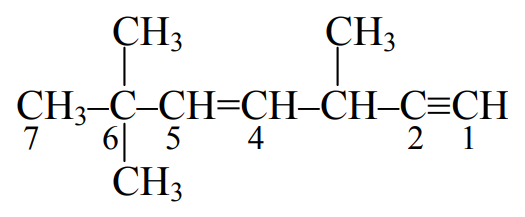
is in the following sequenceThe hybridisation of a carbon atom follows from the number of σ bonds it forms: 4 σ bonds means $sp^3$, 3 σ bonds means $sp^2$ and 2 σ bonds means sp.
$C_2$ is part of the triple bond: 2 σ bonds (and 2 π bonds), so sp.
$C_3$ is the CH carbon carrying a methyl group, with four single bonds: 4 σ bonds, so $sp^3$.
$C_5$ is part of the double bond: 3 σ bonds (and 1 π bond), so $sp^2$.
$C_6$ is the carbon bonded to three methyl groups and $C_5$, with four single bonds: 4 σ bonds, so $sp^3$.
Sequence: sp, $sp^3$, $sp^2$ and $sp^3$
Stereoisomerism: Geometrical Isomerism
-
Geometrical isomers differ in : -Geometrical (cis–trans) isomers have the same molecular formula and the same structure (sequence of bonded atoms), but differ in the spatial arrangement of groups around a double bond or ring, which cannot rotate freely.
Example: cis-but-2-ene and trans-but-2-ene, which have the two methyl groups on the same side and on opposite sides of the C=C bond.
Differences in the position of a functional group or the length of the chain give structural isomers.
So geometrical isomers differ in the spatial arrangement of atoms.
That is every question in Organic Chemistry - Some Basic Principles and Techniques for this filter.
Want a score?
Answers here are not saved. Practise as a test to be marked and see your progress.
Practise as a test