Looking for classes? Ksquare Career Institute, Bengaluru →

Chemistry
General Principles and Processes of Isolation of Elements
29 questions from 22 papers, each with its answer.
- 29 questions
- 22 papers
- 1.65% of Chemistry
Extraction of Iron – Blast Furnace
-
The maximum temperature that can be achieved in blast furnace is:The maximum temperature that can be achieved in a blast furnace is up to 2200 K (near the tuyeres, in the zone of combustion).
Occurrence of Metals – Ores and Composition
-
Match List-I (Ores) with List-II (Composition).
Pick the matching item from Column II for each row.
Column I
- A. Haematite
- B. Magnetite
- C. Calamine
- D. Kaolinite
Column II
- I. $Fe_3O_4$
- II. $ZnCO_3$
- III. $Fe_2O_3$
- IV. $[Al_2(OH)_4Si_2O_5]$
Correct answer: A → III, B → I, C → II, D → IV
Haematite – $Fe_2O_3$ Magnetite – $Fe_3O_4$ Calamine – $ZnCO_3$ Kaolinite – $[Al_2(OH)_4Si_2O_5]$ Correct match: A-III, B-I, C-II, D-IV.
Refining of Metals
-
Which one of the following methods can be used to obtain highly pure metal which is liquid at room temperature?Mercury is a metal that is liquid at room temperature. Low-boiling metals such as Hg (and Zn) are purified by distillation.
-
Which of the following pairs of metals is purified by van Arkel method?The van Arkel method is a vapour phase refining method used to obtain ultra-pure Zr and Ti by removing oxygen and nitrogen present as impurities.
The crude metal is heated with iodine in an evacuated vessel to form the volatile tetraiodide: $Zr + 2I_2 \rightarrow ZrI_4$ (and $Ti + 2I_2 \rightarrow TiI_4$)
The tetraiodide is decomposed on a tungsten filament heated electrically to about 1800 K: $ZrI_4 \rightarrow Zr + 2I_2$
The pure metal deposits on the filament.
Ni is refined by Mond's process, Ga and In by zone refining, and Ag and Au by electrolytic methods.
Hence Zr and Ti are purified by the van Arkel method.
Occurrence of Metals – Ores
-
Which one is malachite from the following?Malachite is $CuCO_3\cdot Cu(OH)_2$ (green colour). $CuFeS_2$ is copper pyrites and $Fe_3O_4$ is magnetite.
Calcination
-
Which one of the following is not a calcination reaction?Calcination is heating an ore in the absence (or limited supply) of air, whereby volatile matter escapes leaving the metal oxide. Reactions (2), (3) and (4) are calcination; reaction (1) is an acid-carbonate reaction, not calcination.
Minerals, ores and gangue
-
Identify the incorrect statement.The contaminated undesired material present in an ore is called gangue; gangue is not the ore itself.
Ellingham diagram
-
Considering Ellingham diagram, which of the following metals can be used to reduce alumina?
Only a metal with more negative $\Delta G^\circ$ of oxide formation than Al (Mg) can reduce $Al_2O_3$.
The metal which is more reactive than 'Al' (whose oxide line lies below that of $Al_2O_3$ in the Ellingham diagram) can reduce alumina. So Mg can be used to reduce alumina.
Leaching and recovery of silver and gold
-
Extraction of gold and silver involves leaching with $CN^-$ ion. Silver is later recovered by
Zn displaces Ag from the soluble cyanide complex.
Zn, being more reactive than Ag and Au, displaces them. From native ore: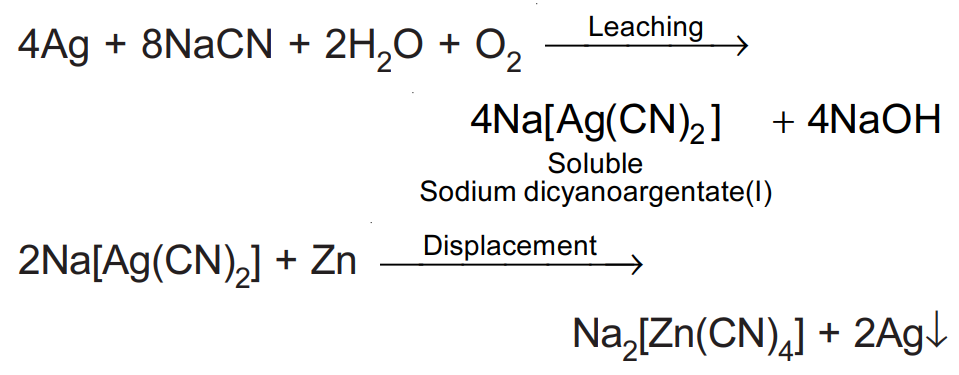
Occurrence of metals
-
''Metals are usually not found as nitrates in their ores''. Out of the following two (a and b) reasons which is/are true for the above observation? (a) Metal nitrates are highly unstable (b) Metal nitrates are highly soluble in waterMetal nitrates are highly soluble in water, so they get washed away and do not occur as minerals in the Earth's crust.
So (a) is false and (b) is true. -
Which one of the following is a mineral of iron?Magnetite is $Fe_3O_4$, an ore of iron.
Malachite is $CuCO_3\cdot Cu(OH)_2$ (copper), cassiterite is $SnO_2$ (tin) and pyrolusite is $MnO_2$ (manganese).
Extraction of copper
-
In the extraction of copper from its sulphide ore, the metal is finally obtained by the reduction of cuprous oxide with:Self-reduction: $Cu_2S + 2Cu_2O \rightarrow 6Cu + SO_2$
-
In the extraction of copper from its sulphide ore, the metal is finally obtained by the reduction of cuprous oxide with:In the Bessemer converter part of $Cu_2S$ is oxidised: $2Cu_2S + 3O_2 \rightarrow 2Cu_2O + 2SO_2$
The $Cu_2O$ formed is then reduced by the remaining $Cu_2S$: $2Cu_2O + Cu_2S \rightarrow 6Cu + SO_2$
This is self-reduction (auto-reduction), and the copper obtained is blister copper.
Alloys
-
Identify the alloy containing a non-metal as a constituent in it.Steel is an alloy of iron with carbon, a non-metal.
Bronze (Cu + Sn), invar (Fe + Ni) and bell metal (Cu + Sn) contain only metals.
Extraction of aluminium
-
Aluminium is extracted from alumina ($Al_2O_3$) by electrolysis of a molten mixture of:In the Hall–Heroult process purified alumina is mixed with cryolite ($Na_3AlF_6$) and fluorspar ($CaF_2$).
These lower the melting point of the mixture and increase its conductivity.
So the molten mixture is $Al_2O_3 + Na_3AlF_6 + CaF_2$.
Extraction of iron
-
The following reactions take place in the blast furnace in the preparation of impure iron. Identify the reaction pertaining to the formation of the slag.In the blast furnace, limestone is added as a flux; it first decomposes: $CaCO_3 \rightarrow CaO + CO_2$
The basic oxide CaO (flux) then combines with the acidic impurity silica (gangue) to form fusible calcium silicate, which is the slag: $CaO + SiO_2 \rightarrow CaSiO_3$
The slag is lighter than molten iron, floats on it and is removed separately.
$2C + O_2 \rightarrow 2CO$ is the combustion of coke that supplies heat and the reducing agent, and $Fe_2O_3 + 3CO \rightarrow 2Fe + 3CO_2$ is the reduction of the ore.
Hence the slag-forming reaction is $CaO(s) + SiO_2(s) \rightarrow CaSiO_3(s)$. -
Which of the following elements is present as the impurity to the maximum extent in the pig iron?The iron obtained from the blast furnace is called pig iron.
It contains about 4% carbon and smaller amounts of other impurities such as S, P, Si and Mn.
So carbon is by far the main impurity.
(Cast iron, made by melting pig iron with scrap iron and coke, has about 3% carbon.)
Hence the impurity present to the maximum extent in pig iron is carbon.
Industrial processes
-
Match List-I (substances) with List-II (processes) employed in the manufacture of the substances and select the correct option.
Pick the matching item from Column II for each row.
Column I
- a. Sulphuric acid
- b. Steel
- c. Sodium hydroxide
- d. Ammonia
Column II
- i. Haber's Process
- ii. Bessemer's Process
- iii. Leblanc Process
- iv. Contact Process
Correct answer: a → iv, b → ii, c → iii, d → i
Sulphuric acid is manufactured by the Contact process: $SO_2$ is oxidised to $SO_3$ over $V_2O_5$, which is absorbed in $H_2SO_4$ to give oleum.
Steel is made from pig iron by Bessemer's process, in which air is blown through the molten iron to oxidise the impurities.
Sodium hydroxide was obtained through the Leblanc process (sodium carbonate from the Leblanc process is causticised with lime to give NaOH).
Ammonia is manufactured by Haber's process: $N_2 + 3H_2 \rightleftharpoons 2NH_3$ over an iron catalyst.
Correct match: a-iv, b-ii, c-iii, d-i.
Concentration of Ores
-
Sulphide ores of metals are usually concentrated by froth flotation process. Which one of the following sulphide ores offers an exception and is concentrated by chemical leaching?Leaching is the selective dissolution of the desired mineral in a suitable reagent, leaving behind the impurities.
Argentite or silver glance, $Ag_2S$, is an ore of silver.
Silver is extracted from argentite by the MacArthur-Forrest cyanide process, which is a leaching process: the ore is treated with a dilute solution of NaCN in the presence of air.
$Ag_2S + 4NaCN \rightarrow 2Na[Ag(CN)_2] + Na_2S$
Silver dissolves as the soluble complex and is later recovered by displacement with zinc. Gold is leached in the same way: $4Au + 8KCN + 2H_2O + O_2 \rightarrow 4K[Au(CN)_2] + 4KOH$
Galena (PbS), copper pyrite ($CuFeS_2$) and sphalerite (ZnS) are concentrated by froth flotation.
So the exception is argentite.
Refining: Zone Refining
-
The method of zone refining of metals is based on the principle of :In zone refining, a circular heater moves slowly along a rod of impure metal. A narrow molten zone forms and moves with the heater.
Impurities are more soluble in the molten metal than in the solid. So as the molten zone moves on, pure metal crystallises out behind it, while the impurities stay in the melt and are swept along to one end.
The process is repeated several times, and the impure end is cut off.
It is used to obtain very pure semiconductors such as Si, Ge, B, Ga and In.
So zone refining is based on the greater solubility of the impurity in the molten state than in the solid.
That is every question in General Principles and Processes of Isolation of Elements for this filter.
Show all 29 questions Next: The p-Block Elements (Group 15 to 18)
Want a score?
Answers here are not saved. Practise as a test to be marked and see your progress.
Practise as a test