Looking for classes? Ksquare Career Institute, Bengaluru →

Chemistry
Aldehydes, Ketones and Carboxylic Acids
91 questions from 38 papers, each with its answer.
- 91 questions
- 38 papers
- 5.17% of Chemistry
Acidity of Carboxylic Acids
-
The correct order of decreasing acidity of the following aliphatic acids is:
Alkyl groups are electron-donating ($+I$) which destabilize the carboxylate anion, decreasing acid strength: $\text{HCOOH} > \text{CH}_3\text{COOH} > (\text{CH}_3)_2\text{CHCOOH} > (\text{CH}_3)_3\text{CCOOH}$.
Acidity of carboxylic acids depends on the stability of the conjugate carboxylate anion ($\text{RCOO}^-$). Electron-donating inductive groups ($+I$) intensify the negative charge on the carboxylate group and destabilize it, thereby reducing acid strength. Formic acid (HCOOH) has no alkyl group and is the strongest acid. Acetic acid has one $+I$ methyl group, isobutyric acid has an isopropyl group (two methyls), and pivalic acid has a tert-butyl group (three methyls), making it the weakest acid. The decreasing order of acidity is $\text{HCOOH} > \text{CH}_3\text{COOH} > (\text{CH}_3)_2\text{CHCOOH} > (\text{CH}_3)_3\text{CCOOH}$. -
Which of the following represents the correct order of the acidity in the given compounds?An electron withdrawing substituent increases the acidity of a carboxylic acid: by its $-I$ (inductive) effect it increases the polarity of the O-H bond and stabilises the carboxylate anion formed.
The halogen atoms are electron withdrawing, so all three haloacetic acids are stronger than acetic acid, in which $CH_3$ is an electron releasing group.
Electronegativity decreases in the order: F > Cl > Br
Hence the $-I$ effect also decreases in the same order.
Therefore the correct order of acidity is: $FCH_2COOH \gt ClCH_2COOH \gt BrCH_2COOH \gt CH_3COOH$
(The $pK_a$ values are about 2.6, 2.9, 2.9 and 4.8 respectively.)
Preparation of Aldehydes
-
Identify the suitable reagent for the selective reduction of an ester to an aldehyde:
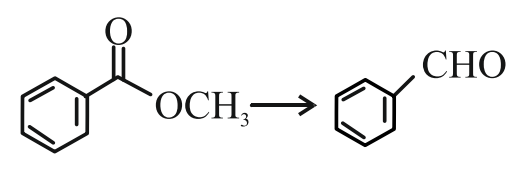
Diisobutylaluminium hydride (DIBAL-H or $\text{AlH}(i\text{Bu})_2$) at low temperature selectively reduces esters and nitriles to aldehydes.
Diisobutylaluminium hydride (DIBAL-H, $[(i\text{Bu})_2\text{AlH}]$) is a bulky, selective reducing agent. At low temperatures (around $-78^\circ\text{C}$), it reduces esters cleanly to aldehydes upon subsequent aqueous workup without reducing them further to primary alcohols. In contrast, $\text{LiAlH}_4$ reduces esters completely to primary alcohols, $\text{NaBH}_4$ is generally unreactive toward esters, and Rosenmund catalyst ($\text{H}_2/\text{Pd}-\text{BaSO}_4$) selectively reduces acyl chlorides, not esters. -
Consider the following reaction:
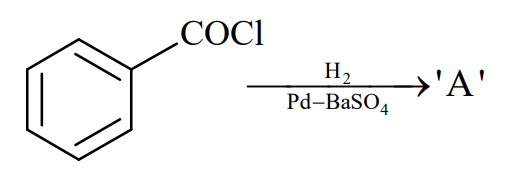
'A'. The product 'A' isAn acid chloride is reduced by $H_2$ over palladium supported on $BaSO_4$ to an aldehyde. This is the Rosenmund reduction.
$BaSO_4$ poisons the catalyst so that the aldehyde is not reduced further to the alcohol.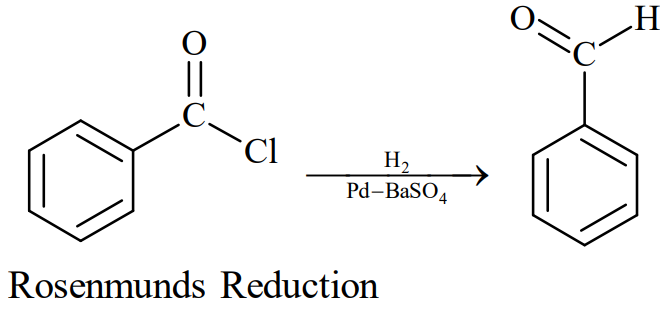
So A is benzaldehyde, $C_6H_5CHO$.
Fehling's Test for Aldehydes
-
Fehling's solution 'A' isFehling's solution 'A' is aqueous copper sulphate. It is prepared by dissolving pentahydrated copper sulphate in distilled water and adding a few drops of dilute sulphuric acid. (Fehling's solution 'B' is an alkaline solution of sodium potassium tartrate – Rochelle's salt.)
Nucleophilic Addition and Addition-Elimination Reactions
-
Match List-I (Products formed) with List-II (Reaction of carbonyl compound with):
Pick the matching item from Column II for each row.
Column I
- A. Cyanohydrin
- B. Acetal
- C. Schiff's base
- D. Oxime
Column II
- I. $NH_2OH$
- II. $RNH_2$
- III. alcohol
- IV. HCN
Correct answer: A → IV, B → III, C → II, D → I
$>C=O + HCN \xrightarrow{OH^-}$ cyanohydrin $>C=O + 2ROH \xrightarrow{H^+}$ acetal (alcohol) $>C=O + R-NH_2 \xrightarrow{H^+} >C=N-R$ Schiff's base $>C=O + NH_2OH \xrightarrow{H^+} >C=N-OH$ oxime Correct match: A-IV, B-III, C-II, D-I.
Aldol Condensation
-
Reaction between benzaldehyde and acetophenone in presence of dilute NaOH is known as:$C_6H_5CHO + CH_3COC_6H_5 \xrightarrow{dil.\ OH^-} C_6H_5CH(OH)CH_2COC_6H_5 \xrightarrow{-H_2O} C_6H_5CH=CHCOC_6H_5$ Benzaldehyde (no $\alpha$-H) and acetophenone (with $\alpha$-H) react in the presence of dilute alkali to undergo cross aldol condensation (Claisen–Schmidt reaction).
-
The product formed in Aldol condensation isAldehydes and ketones having at least one $\alpha$-hydrogen atom, in the presence of dilute alkali, give a $\beta$-hydroxy aldehyde (aldol) or a $\beta$-hydroxy ketone (ketol).
The base removes an $\alpha$-hydrogen to form a carbanion (enolate), which attacks the carbonyl carbon of a second molecule.
$CH_3-CHO + H-CH_2-CHO \xrightarrow{dil.\ NaOH} CH_3-CH(OH)-CH_2-CHO$ (aldol, 3-hydroxybutanal)
The OH group is on the $\beta$-carbon with respect to the carbonyl group.
On heating, the aldol loses water to give an $\alpha,\beta$-unsaturated aldehyde: $CH_3-CH(OH)-CH_2-CHO \xrightarrow{\Delta,\ -H_2O} CH_3-CH=CH-CHO$ (crotonaldehyde)
So the product formed in aldol condensation is a beta-hydroxy aldehyde or a beta-hydroxy ketone.
Rosenmund reduction
-
In the following reaction product 'P' is : - $R-CO-Cl \xrightarrow[Pd-BaSO_4]{H_2} P$Hydrogenation of an acid chloride over palladium on barium sulphate (poisoned with sulphur or quinoline) is called Rosenmund reduction.
$R-COCl + H_2 \xrightarrow{Pd-BaSO_4} R-CHO + HCl$
$BaSO_4$ poisons the catalyst so that the aldehyde formed is not reduced further to the alcohol.
So P is the aldehyde RCHO.
Preparation of carboxylic acids
-
The reaction that does not give benzoic acid as the major product is:$K_2Cr_2O_7$ and $KMnO_4/H^+$ oxidise benzyl alcohol to benzoic acid, and acetophenone undergoes the haloform reaction with NaOCl to give benzoic acid (+ $CHCl_3$). PCC is a mild oxidising agent and stops at benzaldehyde ($C_6H_5CHO$).
Physical properties of carboxylic acids
-
Carboxylic acids have higher boiling points than aldehydes, ketones and even alcohols of comparable molecular mass. It is due to their
Carboxylic acids form strongly H-bonded dimers.
Due to formation of intermolecular H-bonding in carboxylic acids, association occurs. Hence the boiling point increases and becomes more than that of aldehydes, ketones and alcohols of comparable molecular masses.
Keto–enol tautomerism
-
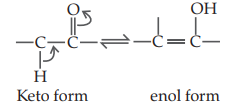
The correct statement regarding a carbonyl compound with a hydrogen atom on its alpha-carbon, is
$\alpha$-H allows equilibrium with the enol form.
Keto-enol tautomerism: the keto form $-CH-C(=O)-$ equilibrates with the enol form $-C=C(OH)-$ by shift of the $\alpha$-hydrogen.
Reactions with ammonia derivatives – Schiff base
-
The product formed by the reaction of an aldehyde with a primary amine is
Aldehyde + primary amine → imine (Schiff base).
$R-CH=O + H_2N-R \xrightarrow{-H_2O} R-CH=N-R$ (Schiff's base)
Tests for carbonyl compounds
-
$CH_3CHO$ and $C_6H_5CH_2CHO$ can be distinguished chemically byBoth compounds are aldehydes, so both respond to Fehling's, Benedict's and Tollens' tests. These tests cannot tell them apart.
The iodoform test is given only by aldehydes and ketones that have the $CH_3-CO-$ group.
$CH_3CHO$ has this group: $CH_3CHO + 3I_2 + 4NaOH \rightarrow CHI_3 + HCOONa + 3NaI + 3H_2O$, giving a yellow precipitate of iodoform.
$C_6H_5CH_2CHO$ has no $CH_3-CO-$ group, so it gives no precipitate.
So the two are distinguished by the iodoform test. -
Which of the following compounds will give a yellow precipitate with iodine and alkali?A yellow precipitate of iodoform ($CHI_3$) is given by compounds having the $CH_3-CO-$ group attached to C or H.
Acetophenone has this group: $C_6H_5COCH_3 \xrightarrow{I_2/NaOH} C_6H_5COONa + CHI_3\downarrow$
In methyl acetate and acetamide the $CH_3CO-$ group is attached to O or N, so they do not give the test.
As per the key the answer is acetophenone.
Nucleophilic addition reactions
-
Reaction of carbonyl compound with one of the following reagents involves nucleophilic addition followed by elimination of water. The reagent is:Carbonyl compounds react with ammonia derivatives such as hydrazine (in feebly acidic medium) by nucleophilic addition followed by elimination of water, giving hydrazones.
-
Consider the reaction: $RCHO + NH_2NH_2 \rightarrow RCH=N-NH_2$. What sort of reaction is it?Hydrazine has a lone pair on nitrogen and acts as a nucleophile.
Step 1 (nucleophilic addition): $NH_2NH_2$ attacks the carbonyl carbon of RCHO to give $RCH(OH)-NH-NH_2$.
Step 2 (elimination): a molecule of water is lost to give the hydrazone $RCH=N-NH_2$.
So it is a nucleophilic addition–elimination reaction.
Cannizzaro reaction
-
Which one of the following on treatment with 50% aqueous sodium hydroxide yields the corresponding alcohol and acid?Aldehydes containing no $\alpha$-hydrogen atom, on warming with 50% NaOH or KOH, undergo disproportionation, i.e. self oxidation-reduction, known as Cannizzaro's reaction.
One molecule of the aldehyde is reduced to the alcohol and another is oxidised to the salt of the carboxylic acid.
Benzaldehyde, $C_6H_5CHO$, has no $\alpha$-hydrogen (the CHO group is attached directly to the ring).
$2C_6H_5CHO + NaOH \xrightarrow{conc.\ NaOH} C_6H_5COONa + C_6H_5CH_2OH$
It gives sodium benzoate (the acid salt) and benzyl alcohol.
$CH_3CH_2CH_2CHO$, $CH_3COCH_3$ and $C_6H_5CH_2CHO$ all have $\alpha$-hydrogen atoms, so they undergo aldol condensation with a base instead.
So the compound is $C_6H_5CHO$.
Reduction of aldehydes and ketones
-
Clemmensen reduction of a ketone is carried out in the presence of which of the following?In the Clemmensen reduction, the carbonyl group of an aldehyde or ketone is reduced to a methylene ($-CH_2-$) group.
The reagent is zinc amalgam and concentrated hydrochloric acid: $>C=O \xrightarrow{Zn-Hg/HCl} >CH_2 + H_2O$
Hydrazine followed by KOH in ethylene glycol is the Wolff–Kishner reduction.
$H_2$/Pt and $LiAlH_4$ reduce a ketone only to a secondary alcohol.
Hence Clemmensen reduction is carried out with Zn-Hg and HCl.
Acidity of Alpha Hydrogen
-
A strong base can abstract an $\alpha$-hydrogen from:The hydrogen atoms on the carbon next to a carbonyl group ($\alpha$-hydrogens) are acidic.
The carbonyl group is strongly electron withdrawing, and the carbanion formed after the loss of the $\alpha$-hydrogen is stabilised by resonance with the $C=O$ group (enolate ion).
$R-CO-CH_3 + B^- \rightarrow R-CO-\overset{\ominus}{C}H_2 \leftrightarrow R-C(O^-)=CH_2 + BH$
So a strong base can abstract an $\alpha$-hydrogen from aldehydes and ketones to form a carbanion or the enolate ion. This is the first step of reactions like the aldol condensation.
In alkanes, alkenes and amines there is no such resonance stabilisation of the resulting carbanion, so their C-H hydrogens are not acidic enough to be removed in this way.
Hence the answer is ketone.
Reduction of Carbonyl Compounds
-
Reduction of aldehydes and ketones into hydrocarbons using zinc amalgam and conc. HCl is calledIn the Clemmensen reduction, the carbonyl group of an aldehyde or ketone is reduced to a $CH_2$ group on treatment with zinc amalgam and concentrated hydrochloric acid.
$\gt C=O \xrightarrow{Zn\text{-}Hg,\ conc.\ HCl} \gt CH_2 + H_2O$
For example: $CH_3-CO-CH_3 \xrightarrow{Zn\text{-}Hg,\ conc.\ HCl} CH_3-CH_2-CH_3 + H_2O$
In the Wolff-Kishner reduction the same conversion is done with hydrazine followed by heating with KOH in ethylene glycol, i.e. in a basic medium.
The Dow process is used for the manufacture of phenol from chlorobenzene, and the Cope reaction is an elimination (or rearrangement), not this reduction.
So the reduction with zinc amalgam and conc. HCl is the Clemmensen reduction.
Reactivity towards Nucleophilic Addition
-
Nucleophilic addition reaction will be most favoured in :-In nucleophilic addition the nucleophile attacks the electron-deficient carbonyl carbon.
Reactivity $\propto \dfrac{1}{\text{steric hindrance}}$: bulky groups around the carbonyl carbon hinder the approach of the nucleophile.
Alkyl groups are also electron releasing ($+I$ effect); they reduce the positive charge on the carbonyl carbon and lower its reactivity.
So aldehydes (one alkyl group) are more reactive than ketones (two alkyl groups), and among aldehydes the smaller alkyl group gives the higher reactivity.
$CH_3CHO$ has the smallest alkyl group among the given compounds; $CH_3CH_2CHO$ has a larger ethyl group, and the two ketones are still less reactive.
Order: $CH_3CHO \gt CH_3CH_2CHO \gt (CH_3)_2CO \gt CH_3CH_2CH_2COCH_3$
So nucleophilic addition is most favoured in $CH_3CHO$.
Iodoform Test
-
Which of the following will not form a yellow precipitate on heating with an alkaline solution of iodine :-Heating with iodine and alkali gives a yellow precipitate of iodoform, $CHI_3$, only if the compound contains the $CH_3CO-$ group or the $CH_3CH(OH)-$ group (which is first oxidised to $CH_3CO-$).
$CH_3CH_2CH(OH)CH_3$ (butan-2-ol) has the $CH_3CH(OH)-$ group; it gives iodoform.
$CH_3CH_2OH$ (ethanol) has $CH_3CH(OH)-$ with H as the other group; it is oxidised to $CH_3CHO$ and gives iodoform.
$CH_3CH(OH)CH_3$ (propan-2-ol) has the $CH_3CH(OH)-$ group; it gives iodoform.
$CH_3OH$ (methanol) has only one carbon. It cannot give a $CH_3CO-$ group (it is oxidised to HCHO), so it does not give the iodoform test.
So methanol, $CH_3OH$, will not form a yellow precipitate.
Preparation of Carboxylic Acids from Grignard Reagents
-
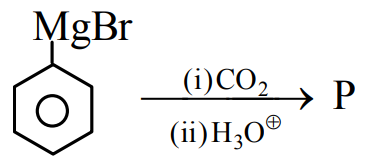
In the above reaction product 'P' is : -A Grignard reagent adds to carbon dioxide (dry ice); the carbanion-like carbon attacks the carbon of $CO_2$:
$C_6H_5MgBr + CO_2 \rightarrow C_6H_5COOMgBr$
Acid hydrolysis gives the carboxylic acid:
$C_6H_5COOMgBr + H_3O^+ \rightarrow C_6H_5COOH + Mg(OH)Br$
The acid formed has one carbon more than the Grignard reagent.
So P is benzoic acid, $C_6H_5COOH$.
Tests for Functional Groups
-
Which of the following is incorrect : -Neutral $FeCl_3$ gives a violet colour with phenols; correct.
Fehling's solution is reduced by glucose (a reducing sugar) to a red precipitate of $Cu_2O$; correct.
Sodium bisulphite forms crystalline addition products with aldehydes and many ketones; correct.
Tollens' reagent (ammoniacal silver nitrate) is used to detect aldehydes (silver mirror test), not unsaturation. Unsaturation (C=C) is detected with bromine water or Baeyer's reagent (cold dilute alkaline $KMnO_4$).
So the incorrect statement is that Tollens' reagent is used in detection of unsaturation.
Esterification
-
Ethyl benzoate can be prepared from benzoic acid by using :Carboxylic acids react with alcohols in the presence of an acid catalyst (dry HCl gas or conc. $H_2SO_4$) to form esters (Fischer esterification):
$C_6H_5COOH + C_2H_5OH \xrightarrow{dry\ HCl} C_6H_5COOC_2H_5 + H_2O$
Without a catalyst the reaction is extremely slow; the acid protonates the carbonyl oxygen and makes the carbonyl carbon more electrophilic.
So ethyl benzoate is prepared from benzoic acid using ethyl alcohol and dry HCl.
Nucleophilic Addition-Elimination with Ammonia Derivatives
-
First product of the reaction between RCHO and $NH_2NH_2$ : -Hydrazine is a derivative of ammonia ($H_2N-Z$ with Z = $NH_2$). It adds to the carbonyl group and then loses water (addition-elimination):
$RCHO + H_2N-NH_2 \rightarrow RCH=N-NH_2 + H_2O$
The product is a hydrazone. (In the Wolff–Kishner reduction, the hydrazone is then heated with KOH to give $RCH_3$.)
So the first product is $RCH=NNH_2$.
That is every question in Aldehydes, Ketones and Carboxylic Acids for this filter.
Want a score?
Answers here are not saved. Practise as a test to be marked and see your progress.
Practise as a test