Looking for classes? Ksquare Career Institute, Bengaluru →

Chemistry
Chemical Kinetics
80 questions from 37 papers, each with its answer.
- 80 questions
- 37 papers
- 4.55% of Chemistry
First Order Reaction Kinetics
-
If the half-life ($t_{1/2}$) for a first order reaction is $1\text{ minute}$, then the time required for 99.9% completion of the reaction is closest to:
For a first order reaction, $t_{99.9\%} \approx 10 \times t_{1/2} = 10 \times 1\text{ min} = 10\text{ minutes}$.
For a first order reaction: $k = \frac{0.693}{t_{1/2}} = \frac{0.693}{1\text{ min}} = 0.693\text{ min}^{-1}$. Time for 99.9% completion: $t = \frac{2.303}{k} \log\left(\frac{100}{100 - 99.9}\right) = \frac{2.303}{0.693} \log\left(\frac{100}{0.1}\right) = \frac{2.303}{0.693} \log(10^3) = \frac{2.303 \times 3}{0.693} = \frac{6.909}{0.693} \approx 10\text{ minutes}$.
Integrated Rate Equations
-
If the rate constant of a reaction is $0.03\text{ s}^{-1}$, how much time does it take for $7.2\text{ mol L}^{-1}$ concentration of the reactant to get reduced to $0.9\text{ mol L}^{-1}$? (Given: $\log 2 = 0.301$)
Since $[R]_0 / [R] = 7.2 / 0.9 = 8 = 2^3$, this represents 3 half-lives: $t = 3 \times t_{1/2} = 3 \times \frac{0.693}{0.03} = 3 \times 23.1 = 69.3\text{ s}$.
The unit of rate constant $k = 0.03\text{ s}^{-1}$ signifies a first order reaction. The first order integrated rate law is: $t = \frac{2.303}{k} \log\left(\frac{[R]_0}{[R]}\right)$. Given $[R]_0 = 7.2\text{ mol L}^{-1}$ and $[R] = 0.9\text{ mol L}^{-1}$: $\frac{[R]_0}{[R]} = \frac{7.2}{0.9} = 8 = 2^3$. Then $\log 8 = 3 \log 2 = 3(0.301) = 0.903$. Substituting: $t = \frac{2.303}{0.03} \times 0.903 = \frac{2.0796}{0.03} = 69.32\text{ s} \approx 69.3\text{ s}$.
Rate Law and Order of Reaction
-
For a certain reaction, the rate $=k[A]^2[B]$. When the initial concentration of A is tripled keeping concentration of B constant, the initial rate would
Rate $\propto[A]^2$, so tripling $[A]$ multiplies the rate by 9.
Let the new rate be $R'$. $[A]'=[3A]$, $[B]'=[B]$ $R'=k[A']^2[B']=k[3A]^2[B]=9k[A]^2[B]=9\times R$ Hence, rate would become nine times.
Integrated Rate Equation for a First Order Reaction
-
If the rate constant for a first order reaction is $k$, the time ($t$) required for the completion of 99% of the reaction is given by:For a first order reaction: $k=\frac{2.303}{t}\log\frac{[A]_0}{[A]_t}$ For 99% completion, $\frac{[A]_0}{[A]_t}=\frac{100}{1}$ $k=\frac{2.303}{t}\log10^2=\frac{2.303\times2}{t}$ $t=\frac{4.606}{k}$
Collision Theory of Chemical Reactions
-
An increase in the concentration of the reactants of a reaction leads to change in:The number of collisions per second per unit volume of the reaction mixture is the collision frequency. Increasing the concentration of reactants increases the number of molecules per unit volume, so the collision frequency changes (increases). Heat of reaction, threshold energy and activation energy do not depend on concentration.
Rate of a Chemical Reaction
-
For the reaction $N_2O_5(g) \rightarrow 2NO_2(g) + \frac{1}{2}O_2(g)$ the value of rate of disappearance of $N_2O_5$ is given as $6.25\times10^{-3}$ mol $L^{-1}s^{-1}$. The rate of formation of $NO_2$ and $O_2$ is given respectively asFor $N_2O_5 \rightarrow 2NO_2 + \frac{1}{2}O_2$: $-\frac{d[N_2O_5]}{dt} = \frac{1}{2}\frac{d[NO_2]}{dt} = 2\frac{d[O_2]}{dt}$
$\frac{d[NO_2]}{dt} = 2\times\left(-\frac{d[N_2O_5]}{dt}\right) = 2\times6.25\times10^{-3}$
$\frac{d[NO_2]}{dt} = 1.25\times10^{-2}$ mol $L^{-1}s^{-1}$
$\frac{d[O_2]}{dt} = \frac{1}{2}\times\left(-\frac{d[N_2O_5]}{dt}\right) = \frac{1}{2}\times6.25\times10^{-3}$
$\frac{d[O_2]}{dt} = 3.125\times10^{-3}$ mol $L^{-1}s^{-1}$ -
For the reaction, $N_2 + 3H_2 \rightarrow 2NH_3$, if $\frac{d[NH_3]}{dt} = 2\times10^{-4}$ mol $L^{-1}s^{-1}$, the value of $\frac{-d[H_2]}{dt}$ would beFor $N_2 + 3H_2 \rightarrow 2NH_3$: Rate $= -\frac{d[N_2]}{dt} = -\frac{1}{3}\frac{d[H_2]}{dt} = \frac{1}{2}\frac{d[NH_3]}{dt}$
$-\frac{1}{3}\frac{d[H_2]}{dt} = \frac{1}{2}\frac{d[NH_3]}{dt}$
$-\frac{d[H_2]}{dt} = \frac{3}{2}\frac{d[NH_3]}{dt} = \frac{3}{2}\times2\times10^{-4}$
$-\frac{d[H_2]}{dt} = 3\times10^{-4}$ mol $L^{-1}s^{-1}$ -
In the reaction $BrO_3^-(aq) + 5Br^-(aq) + 6H^+ \rightarrow 3Br_2(l) + 3H_2O(l)$, the rate of appearance of bromine ($Br_2$) is related to rate of disappearance of bromide ions as followingFor the given reaction: Rate $= -\frac{1}{5}\frac{d[Br^-]}{dt} = \frac{1}{3}\frac{d[Br_2]}{dt}$
The negative sign appears with $Br^-$ because its concentration decreases with time.
$\frac{1}{3}\frac{d[Br_2]}{dt} = -\frac{1}{5}\frac{d[Br^-]}{dt}$
$\frac{d[Br_2]}{dt} = -\frac{3}{5}\frac{d[Br^-]}{dt}$ -
For the reaction :
$2A + B \rightarrow 3C + D$
Which of the following does not express the reaction rate :-For the reaction $2A + B \rightarrow 3C + D$, the rate is expressed as:
Rate $= -\dfrac{1}{2}\dfrac{d[A]}{dt} = -\dfrac{d[B]}{dt} = +\dfrac{1}{3}\dfrac{d[C]}{dt} = +\dfrac{d[D]}{dt}$
The concentration of a reactant decreases with time, so a negative sign is used to make the rate positive.
The concentration of a product increases with time, so a positive sign is used.
C is a product, so the correct expression for it is $+\dfrac{d[C]}{3\,dt}$.
$-\dfrac{d[C]}{3\,dt}$ would be a negative quantity, so it does not express the reaction rate. -
Consider the reaction
$N_2(g) + 3H_2(g) \rightarrow 2NH_3(g)$
The equality relationship between $\dfrac{d[NH_3]}{dt}$ and $-\dfrac{d[H_2]}{dt}$ is :-For the reaction $N_2(g) + 3H_2(g) \rightarrow 2NH_3(g)$, the rate is:
Rate $= -\dfrac{d[N_2]}{dt} = -\dfrac{1}{3}\dfrac{d[H_2]}{dt} = +\dfrac{1}{2}\dfrac{d[NH_3]}{dt}$
Taking the last two terms: $\dfrac{1}{2}\dfrac{d[NH_3]}{dt} = -\dfrac{1}{3}\dfrac{d[H_2]}{dt}$
Multiplying both sides by 2:
$\dfrac{d[NH_3]}{dt} = -\dfrac{2}{3}\dfrac{d[H_2]}{dt}$
This agrees with the stoichiometry: 3 moles of $H_2$ consumed give 2 moles of $NH_3$.
Half-life of first order reaction
-
The half life of a first order reaction is 2000 years. If the concentration after 8000 years is 0.02 M, then the initial concentration was:Number of half lives $n=\frac{8000}{2000}=4$. $\frac{[A_0]}{[A_t]}=2^n \Rightarrow [A_0]=0.02\times2^4=0.32$ M.
First order reaction - half-life
-
A first order reaction has a rate constant of $2.303\times10^{-3}$ s$^{-1}$. The time required for 40 g of this reactant to reduce to 10 g will be [Given that $\log_{10}2=0.3010$]$t_{1/2}=\frac{0.693}{k}=\frac{0.693}{2.303\times10^{-3}}=301$ s. 40 g to 10 g is two half-lives (75% completion): $t=2\times301=602$ s.
Arrhenius equation
-
For a reaction, activation energy $E_a=0$ and the rate constant at 200 K is $1.6\times10^6$ s$^{-1}$. The rate constant at 400 K will be [Given that gas constant R = 8.314 J K$^{-1}$ mol$^{-1}$]$\log\frac{K_2}{K_1}=\frac{E_a}{2.303R}\left(\frac{1}{T_1}-\frac{1}{T_2}\right)=0$ since $E_a=0$. So $K_2=K_1=1.6\times10^6$ s$^{-1}$.
-
The activation energy of a reaction can be determined from the slope of which of the following graphs?Arrhenius equation: $\ln k = \ln A - \frac{E_a}{RT}$
A plot of $\ln k$ vs $\frac{1}{T}$ is a straight line of slope $-\frac{E_a}{R}$, from which $E_a$ is found. -
Activation energy ($E_a$) and rate constants ($k_1$ and $k_2$) of a chemical reaction at two different temperatures ($T_1$ and $T_2$) are related by:Arrhenius equation: $\ln k = \ln A - \frac{E_a}{RT}$
At $T_1$: $\ln k_1 = \ln A - \frac{E_a}{RT_1}$; at $T_2$: $\ln k_2 = \ln A - \frac{E_a}{RT_2}$
Subtracting: $\ln\frac{k_2}{k_1} = \frac{E_a}{R}\left(\frac{1}{T_1} - \frac{1}{T_2}\right)$
This is the same as $-\frac{E_a}{R}\left(\frac{1}{T_2} - \frac{1}{T_1}\right)$, which is just another way of writing it. -
The temperature dependence of rate constant (k) of a chemical reaction is written in terms of Arrhenius equation, $k = A\,e^{-E^*/RT}$. Activation energy ($E^*$) of the reaction can be calculated by plottingTaking logarithms of the Arrhenius equation: $\ln k = \ln A - \dfrac{E^*}{RT}$
or $\log k = \log A - \dfrac{E^*}{2.303R}\cdot\dfrac{1}{T}$
This is a straight line (y = c + mx) when log k is plotted against $\dfrac{1}{T}$.
Slope $= -\dfrac{E^*}{2.303R}$, so $E^* = -2.303R \times$ slope.
So the activation energy is calculated by plotting log k vs $\dfrac{1}{T}$.
Zero order reactions
-
The rate constant of the reaction $A \rightarrow B$ is $0.6\times10^{-3}$ mole per second. If the concentration of A is 5 M, then concentration of B after 20 minutes is:The units of k (mol per second) show a zero order reaction: $x = kt$
$x = 0.6\times10^{-3}\times 20\times 60 = 0.72$ M -
$2A \rightarrow B + C$. It would be a zero order reaction when : -For a zero order reaction: rate $= k[A]^0 = k$.
So the rate does not depend on the concentration of the reactant A; it remains the same at any concentration of A.
Rate proportional to $[A]^2$ would be second order. The concentrations of the products B and C do not decide the order.
So it is zero order when the rate remains the same at any concentration of A.
Half-life of first and second order reactions
-
The correct difference between first and second order reactions is that
First-order $t_{1/2}$ is concentration-independent; second-order $t_{1/2} \propto 1/[A]_0$.
For a first order reaction, $t_{1/2} = \frac{0.693}{k}$, which is independent of the initial concentration of reactant. For a second order reaction, $t_{1/2} = \frac{1}{k[A]_0}$, which depends on the initial concentration of reactant.
Zero order reactions – half-life
-
When initial concentration of the reactant is doubled, the half-life period of a zero order reaction
For zero order, $t_{1/2} \propto [A]_0$.
Half-life of a zero order reaction: $t_{1/2} = \frac{[A]_0}{2k}$ $t_{1/2}$ will be doubled on doubling the initial concentration.
First order reactions – half-life
-
A first order reaction has a specific reaction rate of $10^{-2}\ s^{-1}$. How much time will it take for 20 g of the reactant to reduce to 5 g?
20 g → 5 g is two half-lives.
$t_{1/2} = \frac{0.693}{10^{-2}}$ second For reduction of 20 g of reactant to 5 g, two $t_{1/2}$ are required. $t = 2\times\frac{0.693}{10^{-2}}$ second = 138.6 second
Effect of catalyst on activation energy
-
The addition of a catalyst during a chemical reaction alters which of the following quantities?
A catalyst lowers only the activation energy.
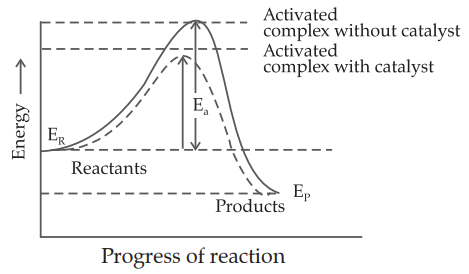
A catalyst provides an alternate path to the reaction which has lower activation energy.
Surface-catalysed reactions – order
-
The decomposition of phosphine ($PH_3$) on tungsten at low pressure is a first-order reaction. It is because the
At low pressure coverage ∝ pressure, so rate is first order.
The decomposition of $PH_3$ on tungsten at low pressure is first order because the rate is proportional to the surface coverage.
Half-life
-
When initial concentration of a reactant is doubled in a reaction, its half-life period is not affected. The order of the reaction is:For a first order reaction, $t_{1/2} = \frac{0.693}{k}$, which is independent of the initial concentration of the reactant.
So the reaction is first order.
Activation energy
-
A reaction having equal energies of activation for forward and reverse reactions has:$\Delta H = (E_a)_f - (E_a)_b$
Given $(E_a)_f = (E_a)_b$, so $\Delta H = 0$ -
For an endothermic reaction, energy of activation is $E_a$ and enthalpy of reaction is $\Delta H$ (both of these in kJ/mol). Minimum value of $E_a$ will beIn an endothermic reaction the products lie at a higher energy than the reactants by $\Delta H$.
The reactants must climb to the top of the energy barrier (the activated complex), which lies above the products.
From the energy profile: $E_a(\text{forward}) = \Delta H + E_a(\text{backward})$
$E_a(\text{backward})$ is always a positive quantity.
Therefore $E_a(\text{forward}) > \Delta H$; the activation energy must be more than $\Delta H$. -
The activation energy for a simple chemical reaction $A \rightarrow B$ is $E_a$ in forward direction. The activation energy for reverse reaction :For any reaction: $\Delta H = E_{a(forward)} - E_{a(backward)}$, so $E_{a(backward)} = E_a - \Delta H$.
[add image: potential energy diagram showing $E_a$ (forward), $E_a$ (backward) and $\Delta H$]
If the forward reaction is exothermic ($\Delta H \lt 0$), $E_{a(backward)} \gt E_a$.
If the forward reaction is endothermic ($\Delta H \gt 0$), $E_{a(backward)} \lt E_a$.
Activation energy is never negative.
So the activation energy for the reverse reaction can be less than or more than $E_a$.
Temperature dependence of rate
-
In a zero-order reaction for every $10^\circ$ rise of temperature, the rate is doubled. If the temperature is increased from $10^\circ C$ to $100^\circ C$, the rate of the reaction will become:$\frac{r_2}{r_1} = 2$ for every $10^\circ$ rise
Rise in temperature = 100 − 10 = $90^\circ$, i.e. nine intervals of $10^\circ$
$\frac{r_n}{r_1} = 2^{\Delta T/10} = 2^9 = 512$
So the rate becomes 512 times.
Rate law and rate constant
-
The unit of rate constant for a zero order reaction isFor a zero order reaction: Rate = $k[\text{Reactant}]^0 = k$
So the rate constant has the same unit as the rate of reaction.
Rate = change in concentration / time = $\frac{mol\ L^{-1}}{s}$
Unit of k = $mol\ L^{-1}\ s^{-1}$
(General formula: unit of k = $(mol\ L^{-1})^{1-n}\ s^{-1}$; with n = 0 this gives $mol\ L^{-1}\ s^{-1}$.) -
For the reaction $2N_2O_5 \rightarrow 4NO_2 + O_2$, rate and rate constant are $1.02 \times 10^{-4}$ and $3.4 \times 10^{-5}$ s$^{-1}$ respectively. Then conc. of $N_2O_5$ at that time will be : -The unit of the rate constant (s$^{-1}$) shows that this is a first order reaction.
$\therefore$ rate $= k[N_2O_5]$
$[N_2O_5] = \dfrac{\text{rate}}{k} = \dfrac{1.02 \times 10^{-4}}{3.4 \times 10^{-5}}$
$[N_2O_5] = 3$ mol L$^{-1}$
Half-life of a reaction
-
The half life of a substance in a certain enzyme-catalysed reaction is 138 s. The time required for the concentration of the substance to fall from 1.28 mg $L^{-1}$ to 0.04 mg $L^{-1}$ isThe reaction is treated as first order, for which the half-life is constant.
$\frac{\text{final concentration}}{\text{initial concentration}} = \frac{0.04}{1.28} = \frac{1}{32} = \left(\frac{1}{2}\right)^5$
Step by step: 1.28 → 0.64 → 0.32 → 0.16 → 0.08 → 0.04, which is five half-lives.
Time required = $5\times t_{1/2} = 5\times138$
= 690 s -
Half-life period of a first-order reaction is 1386 seconds. The specific rate constant of the reaction isFor a first order reaction: $t_{1/2} = \frac{0.693}{k}$
$k = \frac{0.693}{t_{1/2}} = \frac{0.693}{1386}$
$k = 5.0\times10^{-4}\ s^{-1}$
$k = 0.5\times10^{-3}\ s^{-1}$
Order of a reaction
-
Which one of the following statements for the order of a reaction is incorrect?Order of a reaction is the sum of the powers of the concentration terms of the reactants in the experimentally determined rate law (true).
It is an experimental quantity and cannot be predicted from the balanced equation, so it does not depend on the stoichiometric coefficients (both true).
Order can be zero, a whole number or a fraction; for example, the decomposition of acetaldehyde has order 1.5.
It is molecularity, not order, that is always a whole number.
Hence the incorrect statement is that the order of a reaction is always a whole number. -
The rate of reaction between two reactants A and B decreases by a factor of 4 if the concentration of reactant B is doubled. The order of this reaction with respect to reactant B is :-Let rate $= k[A]^x[B]^y$.
When [B] is doubled, the rate becomes $\dfrac{1}{4}$ of its original value.
$\dfrac{r_2}{r_1} = \dfrac{k[A]^x(2[B])^y}{k[A]^x[B]^y} = 2^y$
$2^y = \dfrac{1}{4} = 2^{-2}$
$\Rightarrow y = -2$
So the order with respect to B is $-2$ (B inhibits the reaction). -
If the rate of the reaction is equal to the rate constant, the order of the reaction is -Rate law: rate $= k[A]^n$, where n is the order.
If rate $= k$, then $[A]^n = 1$ for any concentration, which is possible only if $n = 0$.
For a zero order reaction, rate $= k[A]^0 = k$; the rate is independent of concentration.
So the order of the reaction is 0.
Factors affecting rate of reaction
-
The rate of the reaction $2NO + Cl_2 \rightarrow 2NOCl$ is given by the rate equation rate = $k[NO]^2[Cl_2]$. The value of the rate constant can be increased byThe rate constant k is characteristic of a reaction at a given temperature; it does not depend on the concentrations of the reactants.
Increasing [NO] or [$Cl_2$] increases the rate of the reaction, but the value of k stays the same.
The dependence of k on temperature is given by the Arrhenius equation: $k = Ae^{-E_a/RT}$
As T increases, $e^{-E_a/RT}$ increases, so k increases (roughly doubling for every 10 K rise).
Hence the rate constant can be increased by increasing the temperature.
Rate law and order
-
For the reaction A + B → products, it is observed that:
(1) On doubling the initial concentration of A only, the rate of reaction is also doubled and
(2) On doubling the initial concentration of both A and B, there is a change by a factor of 8 in the rate of the reaction.
The rate of this reaction is given byLet rate = $k[A]^x[B]^y$.
Observation (1): doubling [A] alone doubles the rate: $2^x = 2$, so x = 1.
Observation (2): doubling both [A] and [B] increases the rate 8 times: $2^x\times2^y = 8$
With x = 1: $2\times2^y = 8$, so $2^y = 4$ and y = 2.
Rate law: rate = $k[A][B]^2$
Half-Life of a First Order Reaction
-
In a first-order reaction $A \rightarrow B$, if $k$ is rate constant and initial concentration of the reactant A is 0.5 M, then the half-life isFor a first order reaction: $k = \dfrac{2.303}{t}\log_{10}\dfrac{a}{a - x}$
When $t = t_{1/2}$, $x = \dfrac{a}{2}$
$k = \dfrac{2.303}{t_{1/2}}\log_{10}\dfrac{a}{a - a/2}$
$k = \dfrac{2.303}{t_{1/2}}\log_{10}2$
$t_{1/2} = \dfrac{2.303}{k}\log_{10}2 = \dfrac{\ln 2}{k} = \dfrac{0.693}{k}$
The initial concentration cancels out, so the half-life of a first order reaction does not depend on the initial concentration (0.5 M here).
So the half-life is $\dfrac{\ln 2}{k}$. -
For a first order reaction A $\rightarrow$ B the reaction rate at reactant concentration of 0.01 M is found to be $2.0 \times 10^{-5}$ mole L$^{-1}$ s$^{-1}$. The half life period of the reaction is :-For a first order reaction, rate $= k[A]$
$k = \dfrac{\text{rate}}{[A]} = \dfrac{2.0 \times 10^{-5}}{0.01}$
$k = 2.0 \times 10^{-3}$ s$^{-1}$
Half-life: $t_{1/2} = \dfrac{0.693}{k}$
$t_{1/2} = \dfrac{0.693}{2 \times 10^{-3}}$
$t_{1/2} = 346.5 \approx 347$ s -
The rate of a first order reaction is $1.5 \times 10^{-2}$ mol L$^{-1}$ min$^{-1}$ at 0.5 M concentration of the reactant. The half life of the reaction is :-For a first order reaction, rate $= k[A]$.
$k = \dfrac{\text{rate}}{[A]} = \dfrac{1.5 \times 10^{-2}}{0.5} = 3 \times 10^{-2}$ min$^{-1}$
Half life of a first order reaction: $t_{1/2} = \dfrac{0.693}{k}$
$t_{1/2} = \dfrac{0.693}{3 \times 10^{-2}} = 23.1$ min
So the half life of the reaction is 23.1 min.
Radioactive Decay as First Order Process
-
The radioisotope, tritium ($^{3}_{1}H$) has a half-life of 12.3 years. If the initial amount of tritium is 32 mg, how many milligrams of it would remain after 49.2 years :Number of half lives: $n = \dfrac{49.2}{12.3} = 4$
Amount remaining $= N_0\left(\dfrac{1}{2}\right)^n = 32 \times \left(\dfrac{1}{2}\right)^4 = \dfrac{32}{16}$
$= 2$ mg
(32 mg $\rightarrow$ 16 $\rightarrow$ 8 $\rightarrow$ 4 $\rightarrow$ 2 mg.) -
A human body requires 0.01 Curie activity of radioactive substance after 24 hours. Half life of radioactive substance is 6 hours. Then max. activity of radioactive substance that can be injected will be : -The activity at the end of 24 hours must be 0.01 Ci.
Number of half lives in 24 hours: $n = \dfrac{24}{6} = 4$
Activity after n half lives $= \dfrac{A_0}{2^n}$
$\dfrac{A_0}{2^4} = 0.01 \Rightarrow A_0 = 0.01 \times 16 = 0.16$ Ci
So 0.16 Ci must be injected. -
A 300 gram radioactive sample has half life of 3 hours. After 18 hours remaining quantity will be :Number of half lives: $n = \dfrac{18}{3} = 6$
Remaining amount $= \dfrac{N_0}{2^n} = \dfrac{300}{2^6} = \dfrac{300}{64}$
$= 4.6875 \approx 4.68$ g
Rate of a Reaction
-
$3A \rightarrow 2B$, rate of reaction $+\dfrac{d[B]}{dt}$ is equal to : -For $3A \rightarrow 2B$, the rate of reaction $= -\dfrac{1}{3}\dfrac{d[A]}{dt} = +\dfrac{1}{2}\dfrac{d[B]}{dt}$
$\Rightarrow \dfrac{d[B]}{dt} = -\dfrac{2}{3}\dfrac{d[A]}{dt}$
For every 3 mol of A used, 2 mol of B are formed, so B is formed at $\dfrac{2}{3}$ the rate at which A disappears.
That is every question in Chemical Kinetics for this filter.
Want a score?
Answers here are not saved. Practise as a test to be marked and see your progress.
Practise as a test