Looking for classes? Ksquare Career Institute, Bengaluru →

Chemistry
Hydrocarbons
75 questions from 35 papers, each with its answer.
- 75 questions
- 35 papers
- 4.26% of Chemistry
Effect of Branching on Boiling Point of Alkanes
-
Given below are two statements:
Statement I: The boiling point of three isomeric pentanes follows the order n-pentane > isopentane > neopentane. Statement II: When branching increases, the molecule attains a shape of sphere. This results in smaller surface area for contact, due to which the intermolecular forces between the spherical molecules are weak, thereby lowering the boiling point. In the light of the above statements, choose the most appropriate answer from the options given below:n-pentane: $CH_3-CH_2-CH_2-CH_2-CH_3$; isopentane: $(CH_3)_2CH-CH_2-CH_3$; neopentane: $C(CH_3)_4$ When branching increases, the molecule attains a shape of a sphere. This results in a smaller surface area for contact, so the intermolecular forces between the spherical molecules are weak, lowering the boiling point. So n-pentane > isopentane > neopentane, and both statements are correct.
Conformations of Alkanes
-
Dihedral angle of least stable conformer of ethane is:The least stable conformer of ethane is the eclipsed conformation.
Dihedral angle of the eclipsed conformation = $0^\circ$ (staggered = $60^\circ$).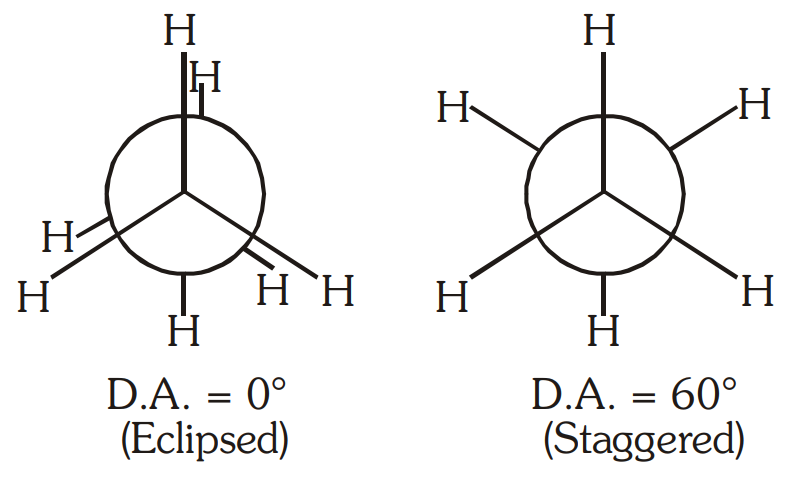
-
In the following the most stable conformation of n-butane isThe conformations of n-butane arise by rotation about the C2–C3 bond and are compared using Newman projections.
Eclipsed conformations have torsional strain; the fully eclipsed form, with the two methyl groups one behind the other, is the least stable.
Staggered conformations are more stable. In the gauche form the two methyl groups are $60^\circ$ apart and repel each other (steric strain).
In the anti (anti-staggered) form the two methyl groups are $180^\circ$ apart, as far from each other as possible, so both torsional and steric strain are minimum.
Order of stability: anti > gauche > eclipsed > fully eclipsed.
Hence the most stable conformation is the staggered Newman projection in which one $CH_3$ points straight up on the front carbon and the other $CH_3$ points straight down on the back carbon.
Boiling points of alkanes
-
The decreasing order of boiling points of the following alkanes is: (a) heptane (b) butane (c) 2-methylbutane (d) 2-methylpropane (e) hexane Choose the correct answer from the options given below:Boiling point of alkanes increases with molar mass, and straight chain alkanes boil higher than branched isomers. Heptane ($C_7$) > hexane ($C_6$) > 2-methylbutane ($C_5$) > butane ($C_4$) > 2-methylpropane ($C_4$, branched).
Preparation of alkenes
-
The incorrect method for the synthesis of alkenes is:Alkyl halides with aqueous KOH undergo substitution to give alcohols ($R-Cl\xrightarrow{aq.\ KOH}R-OH$), not alkenes. Alcoholic KOH (dehydrohalogenation), Zn with vicinal dihalides, and Na/liq. $NH_3$ reduction of alkynes (trans-alkenes) all give alkenes.
Halogenation of alkanes
-
The alkane that gives only one mono-chloro product on chlorination with $Cl_2$ in presence of diffused sunlight is:
Conjugated dienes
-
Among the following, the compound having conjugated double bonds is$\overset{1}{C}H_2=\overset{2}{C}H-\overset{3}{C}H=\overset{4}{C}H-\overset{5}{C}H_2-\overset{6}{C}H_2-\overset{7}{C}H_3$: in hepta-1,3-diene the double bonds alternate with a single bond, i.e. they are conjugated.
Alkanes – halogenation and Wurtz reaction
-
Hydrocarbon (A) reacts with bromine by substitution to form an alkyl bromide which by Wurtz reaction is converted to gaseous hydrocarbon containing less than four carbon atoms. (A) is
Wurtz coupling doubles the carbons, so the product has < 4 C only if A has 1 C.
$CH_4\ (A) \xrightarrow{Br_2/h\nu} CH_3Br \xrightarrow[\text{Wurtz reaction}]{Na/\text{dry ether}} CH_3-CH_3$ Ethane has fewer than four carbon atoms, so A is methane ($CH_4$).
Conformations of ethane
-
With respect to the conformers of ethane, which of the following statements is true?
Conformers differ only in dihedral angle.
There is no change in bond angles and bond lengths in the conformations of ethane. There is only a change in the dihedral angle.
Alkynes – hydration (Markovnikov) and keto–enol tautomerism
-
Predict the correct intermediate and product in the following reaction:

Hg²⁺-catalysed hydration gives an enol that tautomerises to a ketone.
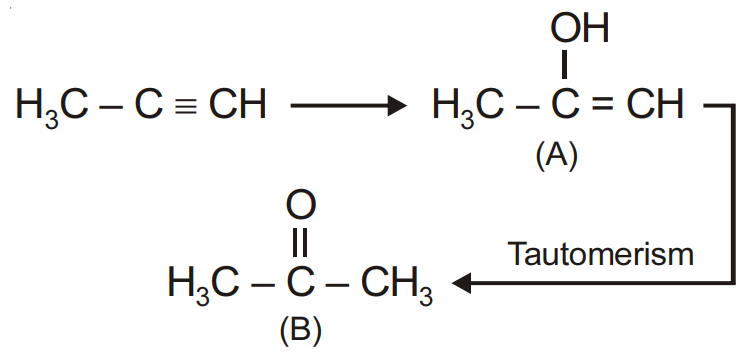
$H_3C-C\equiv CH \xrightarrow{H_2O,\ H_2SO_4,\ HgSO_4} H_3C-C(OH)=CH_2$ (A, enol)
$H_3C-C(OH)=CH_2 \xrightarrow{\text{tautomerism}} H_3C-CO-CH_3$ (B, acetone)
Acidic character of alkynes
-
Which one is the correct order of acidity?
Acidity follows s-character: sp > sp² > sp³.
Correct order is $H-C\equiv C-H > H_3C-C\equiv C-H > H_2C=CH_2 > CH_3-CH_3$ Ethyne has two acidic hydrogens and propyne one; sp carbon (more s-character) makes C–H more acidic than $sp^2$, which is more acidic than $sp^3$. -
Which of the following reagents will be able to distinguish between 1-butyne and 2-butyne?1-Butyne is a terminal alkyne with an acidic hydrogen on the sp carbon:
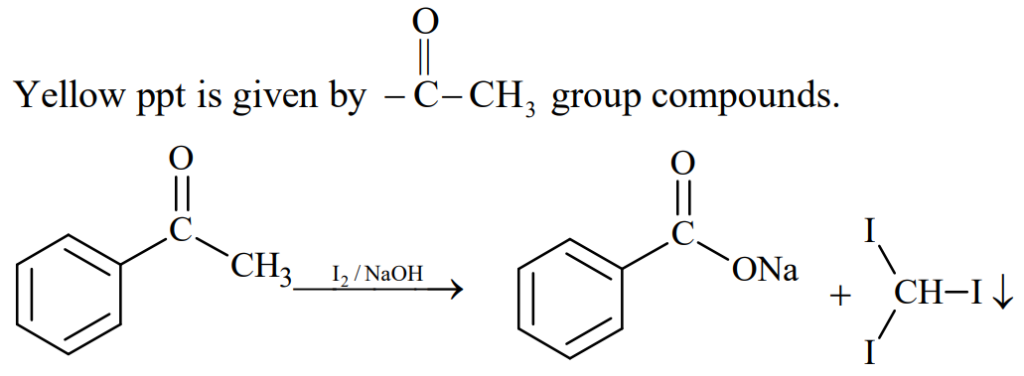
2-Butyne, $CH_3-C\equiv C-CH_3$, has no acidic hydrogen and does not react with $NaNH_2$.
$Br_2$, HCl and $O_2$ react with both alkynes, so only $NaNH_2$ distinguishes them.
Conformations of ethane – torsional strain
-
The correct statement regarding the comparison of staggered and eclipsed conformations of ethane, is
Staggered ethane has minimum torsional strain.
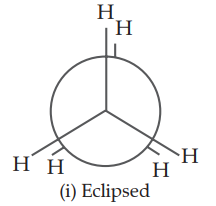
The magnitude of torsional strain depends on the angle of rotation about the C–C bond axis.
The staggered conformation of ethane is more stable than the eclipsed conformation because the staggered conformation has no torsional strain.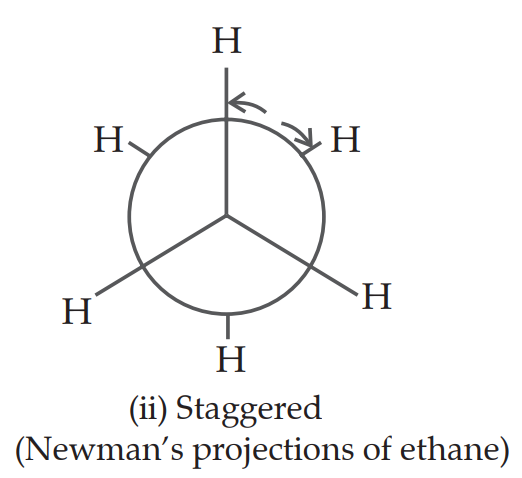
Friedel–Crafts alkylation
-
Which of the following can be used as the halide component for Friedel-Crafts reaction?
Aryl and vinyl halides cannot form carbocations easily.
Benzene $+ CH_3-CH(Cl)-CH_3 \xrightarrow{Anhy.\ AlCl_3}$ cumene
In chlorobenzene, bromobenzene and chloroethene, the lone pair of the halogen is delocalised with $\pi$ bonds, so the C–X bond attains double bond character and they do not form carbocations. -
In Friedel-Crafts reaction toluene can be prepared by :Friedel-Crafts alkylation: benzene reacts with an alkyl halide in the presence of anhydrous $AlCl_3$ to give an alkylbenzene.
$C_6H_6 + CH_3Cl \xrightarrow{anhyd.\ AlCl_3} C_6H_5CH_3 + HCl$
$AlCl_3$ generates the electrophile $CH_3^+$ (as a complex), which attacks the benzene ring.
With $CH_3COCl$, acylation gives acetophenone instead.
So toluene is prepared from $C_6H_6 + CH_3Cl$.
Reactions of benzene
-
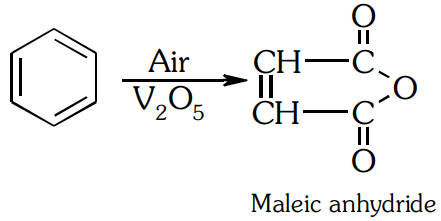
The oxidation of benzene by $V_2O_5$ in the presence of air produces:Benzene $\xrightarrow[V_2O_5]{Air}$ maleic anhydride
-
Benzene reacts with $CH_3Cl$ in the presence of anhydrous $AlCl_3$ to formThis is the Friedel–Crafts alkylation, an electrophilic substitution reaction.
Anhydrous $AlCl_3$, a Lewis acid, generates the electrophile from the alkyl halide: $CH_3Cl + AlCl_3 \rightarrow CH_3^+ + AlCl_4^-$
The methyl carbocation attacks the benzene ring and replaces a hydrogen atom: $C_6H_6 + CH_3Cl \xrightarrow{anhyd.\ AlCl_3} C_6H_5CH_3 + HCl$
The product, methylbenzene, is toluene.
Hence benzene forms toluene.
Electrophilic substitution
-
Nitrobenzene on reaction with conc. $HNO_3/H_2SO_4$ at 80–100$^\circ C$ forms which one of the following products?
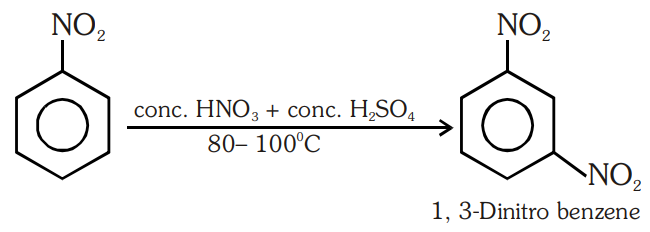
The mixture of conc. $HNO_3$ and conc. $H_2SO_4$ gives $NO_2^+$, which acts as the electrophile.
In nitrobenzene the $-NO_2$ group is meta-directing, so $NO_2^+$ attacks the meta position, giving 1,3-dinitrobenzene. -
Among the following compounds the one that is most reactive towards electrophilic nitration is:Electrophilic nitration is faster when the ring is electron rich.
In toluene the $-CH_3$ group releases electrons (+I effect and hyperconjugation); it is ortho-para directing and activates the ring.
$-COOH$ and $-NO_2$ are electron-withdrawing and deactivate the ring.
Reactivity: toluene > benzene > benzoic acid > nitrobenzene
Friedel-Crafts reaction
-
Which of the following compounds will not undergo Friedel-Crafts reaction easily:The Friedel-Crafts reaction fails when a strongly deactivating group is attached to the benzene ring.
Structure of alkynes
-
Considering the state of hybridization of carbon atoms, find out the molecule among the following which is linear?An sp hybridised carbon forms two σ bonds at $180^\circ$ to each other.
In but-2-yne, $CH_3-C\equiv C-CH_3$, both triple-bonded carbons are sp hybridised, so the four carbon atoms C–C≡C–C lie in one straight line.
In butane all carbons are $sp^3$ (bond angle $109.5^\circ$), giving a zig-zag chain.
In but-2-ene the double-bonded carbons are $sp^2$ (bond angle $120^\circ$), so the chain is bent.
Pent-1-en-4-yne contains $sp^2$ and $sp^3$ carbons as well, so the molecule is not linear.
Hence the linear molecule is $CH_3-C\equiv C-CH_3$.
Reactions of alkanes
-
Liquid hydrocarbons can be converted to a mixture of gaseous hydrocarbons byWhen higher alkanes are heated to a high temperature in the absence of air (often with a catalyst), the large molecules break down into smaller alkanes and alkenes.
This thermal decomposition is called pyrolysis or cracking, e.g., $C_6H_{14} \xrightarrow{773\ K} C_6H_{12} + H_2$, $C_4H_8 + C_2H_6$, $C_3H_6 + C_2H_4 + CH_4$
Smaller hydrocarbons are gases, so liquid hydrocarbons are converted into a mixture of gaseous hydrocarbons (as in the manufacture of oil gas from kerosene).
Hydrolysis does not affect hydrocarbons, oxidation gives $CO_2$ and water, and distillation only separates the components without breaking them.
Hence the process is cracking.
Ozonolysis of Alkenes
-
Which of the compounds with molecular formula $C_5H_{10}$ yields acetone on ozonolysis?In ozonolysis, the $C=C$ bond is cleaved and each doubly bonded carbon is converted into a carbonyl group.
Acetone, $(CH_3)_2C=O$, is formed only if one of the doubly bonded carbons carries two methyl groups, i.e. the alkene contains the unit $(CH_3)_2C=$.
2-methyl-2-butene: $(CH_3)_2C=CH-CH_3 \xrightarrow{O_3}$ ozonide $\xrightarrow{H_2O,\ -H_2O_2} CH_3-CO-CH_3 + CH_3-CHO$
It gives acetone and acetaldehyde.
3-methyl-1-butene, $(CH_3)_2CH-CH=CH_2$, gives 2-methylpropanal and formaldehyde.
2-methyl-1-butene, $CH_2=C(CH_3)-CH_2CH_3$, gives butanone and formaldehyde.
Cyclopentane has no double bond and does not undergo ozonolysis.
So the compound is 2-methyl-2-butene. -
Which alkene on ozonolysis gives $CH_3CH_2CHO$ and $CH_3COCH_3$ : -In ozonolysis, the C=C double bond is cleaved and each carbon of the double bond becomes a C=O group.
To find the alkene, remove the oxygen atoms from the two carbonyl compounds and join the two carbonyl carbons by a double bond.
$CH_3CH_2CH=O$ + $O=C(CH_3)_2$ $\Rightarrow$ $CH_3CH_2CH=C(CH_3)_2$ (2-methylpent-2-ene)
Check: $CH_3CH_2CH=C(CH_3)_2 \xrightarrow{(i)\ O_3\ (ii)\ Zn/H_2O} CH_3CH_2CHO + CH_3COCH_3$
So the alkene is $CH_3CH_2CH=C(CH_3)_2$.
Electrophilic Substitution in Benzene Derivatives
-
The order of decreasing reactivity towards an electrophilic reagent, for the following would be
(i) benzene
(ii) toluene
(iii) chlorobenzene
(iv) phenolElectrophiles have a high affinity for electrons; they attack the site where the electron density is highest.
Electron releasing substituents increase the electron density of the benzene ring and so increase the reactivity, while electron withdrawing substituents decrease it.
$-OH$ is a strongly activating group ($+M$ effect of the lone pair on oxygen).
$-CH_3$ is a weakly activating group ($+I$ effect and hyperconjugation).
$-Cl$ is a deactivating group, because its $-I$ effect is stronger than its $+M$ effect.
The electron releasing tendency decreases in the order: $-OH \gt -CH_3 \gt -H \gt -Cl$
Therefore the order of reactivity towards an electrophile is: $C_6H_5OH \gt C_6H_5CH_3 \gt C_6H_6 \gt C_6H_5Cl$
That is, (iv) > (ii) > (i) > (iii).
Ozonolysis of Alkynes
-
Products of the following reaction :
$CH_3C\equiv CCH_2CH_3 \xrightarrow[(ii)\ \text{Hydrolysis}]{(i)\ O_3}$
are -Ozonolysis of an alkyne cleaves the carbon-carbon triple bond, and on hydrolysis each carbon of the triple bond becomes the carbon of a carboxylic acid group (via a 1,2-diketone that is cleaved by the $H_2O_2$ formed).
The given alkyne is pent-2-yne, $CH_3-C\equiv C-CH_2CH_3$.
Cleavage between C2 and C3 gives a two-carbon fragment and a three-carbon fragment.
$CH_3-C\equiv C-CH_2CH_3 \xrightarrow{(i)\ O_3,\ (ii)\ H_2O} CH_3COOH + CH_3CH_2COOH$
The products are ethanoic (acetic) acid and propanoic acid, $HOOC-CH_2CH_3$.
So the products are $CH_3COOH + HOOC-CH_2CH_3$.
Anti-Markovnikov Addition (Peroxide Effect)
-
Reaction of HBr with propene in the presence of peroxide gives :-In the presence of a peroxide, HBr adds to an unsymmetrical alkene against Markovnikov's rule (Kharasch effect or peroxide effect). The reaction goes by a free radical mechanism.
The peroxide gives a bromine radical, which adds to the terminal carbon of propene so that the more stable secondary radical forms:
$CH_3-CH=CH_2 + \dot{B}r \rightarrow CH_3-\dot{C}H-CH_2Br$
$CH_3-\dot{C}H-CH_2Br + HBr \rightarrow CH_3CH_2CH_2Br + \dot{B}r$
Overall: $CH_3CH=CH_2 + HBr \xrightarrow{peroxide} CH_3CH_2CH_2Br$
The product is 1-bromopropane, i.e. n-propyl bromide. (Without peroxide, Markovnikov addition would give isopropyl bromide.)
Preparation of Alkynes
-
When $CH_3CH_2CHCl_2$ is treated with $NaNH_2$, the product formed is : -$CH_3CH_2CHCl_2$ (1,1-dichloropropane) is a geminal dihalide.
Sodamide, $NaNH_2$, is a very strong base. It removes two molecules of HCl (two successive eliminations) to form a triple bond:
$CH_3CH_2CHCl_2 \xrightarrow{NaNH_2} CH_3CH=CHCl \xrightarrow{NaNH_2} CH_3C\equiv CH$
So the product is propyne, $CH_3-C\equiv CH$.
That is every question in Hydrocarbons for this filter.
Want a score?
Answers here are not saved. Practise as a test to be marked and see your progress.
Practise as a test