Looking for classes? Ksquare Career Institute, Bengaluru →

Chemistry
Polymers
34 questions from 30 papers, each with its answer.
- 34 questions
- 30 papers
- 1.93% of Chemistry
Synthetic Rubbers
-
Which amongst the following molecules on polymerization produces neoprene?
Chloroprene is the monomer of neoprene.
Chloroprene is the monomer of neoprene. 2-chlorobuta-1,3-diene (chloroprene) polymerises to polychloroprene ('neoprene'). -
Which is the monomer of Neoprene in the following?$n\,CH_2=C(Cl)-CH=CH_2$ (chloroprene) $\xrightarrow{\text{polymerisation}} \left[-CH_2-C(Cl)=CH-CH_2-\right]_n$ (neoprene, artificial rubber)
-
Which of the following structures represents Neoprene polymer?Neoprene (polychloroprene) is a synthetic rubber formed by free radical addition polymerisation of chloroprene, 2-chloro-1,3-butadiene.
$n\ CH_2=C(Cl)-CH=CH_2 \rightarrow -[CH_2-C(Cl)=CH-CH_2]_n-$
Polymerisation occurs by 1,4-addition, leaving one double bond in each repeating unit.
$-[CH(C_6H_5)-CH_2]_n-$ is polystyrene, $-[CH_2-CH(CN)]_n-$ is polyacrylonitrile (orlon) and $-[CH_2-CH(Cl)]_n-$ is polyvinyl chloride (PVC).
Hence neoprene is $-[CH_2-C(Cl)=CH-CH_2]_n-$.
Classification of Polymers
-
Which statement regarding polymers is not correct?Thermosetting polymers undergo extensive cross-linking on heating and cannot be softened again, so they are not reusable. So 'Thermosetting polymers are reusable' is not correct.
-
Which one of the following is an example of a thermosetting polymer?Thermosetting polymers are cross-linked or heavily branched molecules, which on heating undergo extensive cross-linking in moulds and become infusible.
The most common example is bakelite (phenol–formaldehyde polymer). -
Which one of the following is not a condensation polymer?Neoprene is formed by addition (chain-growth) polymerisation of chloroprene,
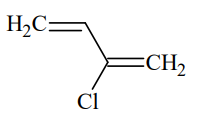
$CH_2=C(Cl)-CH=CH_2$. No small molecule is lost.
Melamine (melamine–formaldehyde), glyptal (ethylene glycol + phthalic acid) and dacron (ethylene glycol + terephthalic acid) are condensation polymers, formed with loss of water.
So neoprene is not a condensation polymer. -
Which of the following statements is false?Starch (α-glucose) and cellulose (β-glucose) are both polymers of glucose; artificial silk (rayon) is made from cellulose; natural rubber is cis-polyisoprene.
Nylon-6,6 has strong intermolecular hydrogen bonding, so it is a fibre, not an elastomer.
So the statement about nylon-66 is false. -
$[NH(CH_2)_6NHCO(CH_2)_4CO]_n$ is a :-The given polymer is Nylon-6,6.
It is formed from two different monomers: hexamethylenediamine, $H_2N(CH_2)_6NH_2$, and adipic acid, $HOOC(CH_2)_4COOH$.
$n\,H_2N(CH_2)_6NH_2 + n\,HOOC(CH_2)_4COOH \rightarrow [NH(CH_2)_6NHCO(CH_2)_4CO]_n + 2n\,H_2O$
A polymer made from two or more different monomers is called a copolymer; a homopolymer is made from only one kind of monomer.
It is formed with the loss of water molecules, so it is a condensation polymer, not an addition polymer.
It is a linear polyamide that softens on heating, i.e. a thermoplastic fibre, not a thermosetting polymer.
So the polymer is a copolymer.
Classification of Polymers – Addition and Condensation
-
Which one of the following polymers is prepared by addition polymerisation?Teflon is prepared by addition polymerisation of tetrafluoroethene: $nCF_2=CF_2 \xrightarrow[high\ pressure]{catalyst} -(CF_2-CF_2)_n-$ Nylon-66, Novolac and Dacron are prepared by condensation polymerisation.
Classification of Polymers – Natural Rubber
-
Which of the following is a natural polymer?Natural rubber is a naturally occurring polymer: cis-1,4-polyisoprene. Polybutadiene, Buna-S and Buna-N are synthetic polymers.
Biodegradable Polymers
-
The biodegradable polymer is:Nylon 2-nylon 6 is a biodegradable polymer (an alternating polyamide copolymer of glycine and amino caproic acid). Nylon-6,6, nylon-6 and Buna-S are non-biodegradable.
-
Biodegradable polymer which can be produced from glycine and aminocaproic acid is$H_2N-CH_2-COOH$ (glycine) + $H_2N-(CH_2)_5-COOH$ (aminocaproic acid) $\xrightarrow{-H_2O}$ $\left[-NH-CH_2-CO-NH-(CH_2)_5-CO-\right]_n$
This alternating polyamide is nylon-2-nylon-6, a biodegradable polymer. -
Which one of the following sets forms the biodegradable polymer?Glycine ($H_2N-CH_2-COOH$) and aminocaproic acid ($H_2N-(CH_2)_5-COOH$) form nylon-2-nylon-6, an alternating polyamide copolymer that is biodegradable.
Styrene + butadiene gives Buna-S, acrylonitrile + butadiene gives Buna-N and ethylene glycol + terephthalic acid gives dacron; these are not biodegradable.
Classification of polymers - thermoplastics
-
Which among the following is a thermoplastic polymer?Polythene, polystyrene, polyvinyls etc. are thermoplastic polymers. Bakelite, melamine and urea-formaldehyde resins are thermosetting polymers.
Addition polymers - polyacrylonitrile
-
The polymer that is used as a substitute for wool in making commercial fibres is:Polyacrylonitrile is used as a substitute for wool in making commercial fibres such as Orlon or Acrilan.
-
Acrilan is a hard, horny and a high melting point material. Which of the following represents its structure :Acrilan (also called orlon) is polyacrylonitrile (PAN), an addition polymer of acrylonitrile (vinyl cyanide), $CH_2=CH-CN$.
$n\,CH_2=CH-CN \xrightarrow{peroxide\ catalyst} [-CH_2-CH(CN)-]_n$
The strongly polar CN groups give strong intermolecular forces, which make the polymer hard, horny and high melting. It is used as a substitute for wool.
$[-CH_2-C(CH_3)(COOC_2H_5)-]_n$ is an ester polymer of the methacrylate type, $[-CH_2-CH(COOC_2H_5)-]_n$ is poly(ethyl acrylate), and $[-CH_2-CH(Cl)-]_n$ is PVC.
So the structure of acrilan is $[-CH_2-CH(CN)-]_n$.
Classification of polymers – cross-linked polymers
-
Regarding cross-linked or network polymers, which of the following statements is incorrect?
Cross-linked polymers are defined by covalent bonds between chains, not within chains.
Cross-linked or network polymers are formed from bi-functional and tri-functional monomers and contain strong covalent bonds between various linear polymer chains, e.g. bakelite, melamine etc. The statement 'They contain strong covalent bonds in their polymer chains' is not related to cross-linking, so it is the incorrect statement.
Natural rubber
-
Natural rubber has
Natural rubber is all-cis polyisoprene.
Chemically, natural rubber is cis-polyisoprene.
$nCH_2=C(CH_3)-CH=CH_2 \xrightarrow{Polymerisation} [-CH_2-C(CH_3)=CH-CH_2-]_n$ (cis-polyisoprene)
Condensation polymers – nylon 6,6
-
Which one of the following structures represents nylon 6,6 polymer?
Nylon 6,6: –CO(CH₂)₄CO–NH(CH₂)₆NH– repeat unit.
$HOOC-(CH_2)_4-COOH$ (adipic acid) $+ H_2N-(CH_2)_6-NH_2$ (hexamethylene diamine) $\xrightarrow{Polymerisation}$ $[-CO-(CH_2)_4-CO-NH-(CH_2)_6-NH-]_n$
So nylon 6,6 is the polyamide of adipic acid and hexamethylenediamine.
Polyamides
-
Caprolactam is used for the manufacture of:Caprolactam on heating with a trace of water opens up to 6-aminocaproic acid, $H_2N-(CH_2)_5-COOH$, which polymerises.
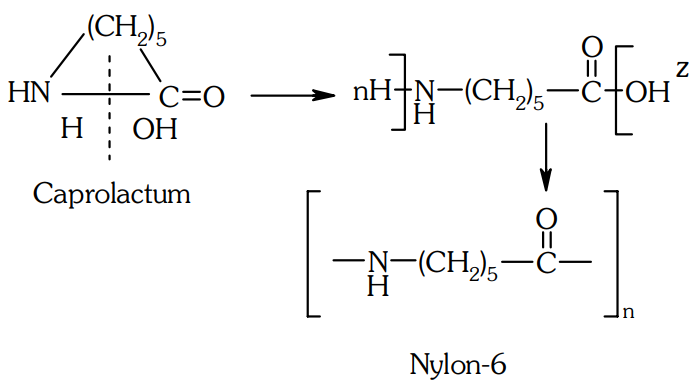
$n\,H_2N(CH_2)_5COOH \rightarrow \left[-NH-(CH_2)_5-CO-\right]_n$ — nylon-6. -
Nylon is an example of:Nylon has polyamide linkages. It is formed by condensation of amine and carboxylic acid groups.
Polyesters
-
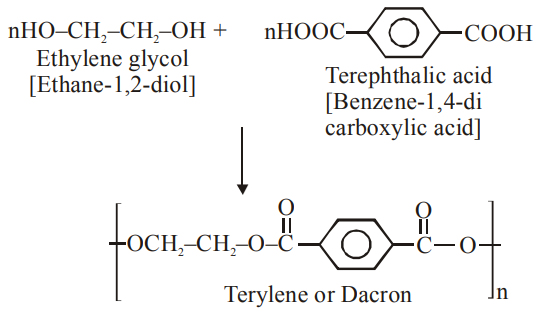
Which of the following organic compounds polymerizes to form the polyester Dacron?Dacron or terylene is the best known polyester. It is made by heating ethylene glycol and terephthalic acid at 420–460 K in the presence of zinc acetate–antimony trioxide catalyst.
Condensation polymers
-
Of the following which one is classified as polyester polymer?A polyester is a condensation polymer in which the monomer units are joined by ester (–COO–) linkages.
Terylene (dacron) is made by condensation of ethylene glycol ($HOCH_2CH_2OH$) with terephthalic acid ($HOOC-C_6H_4-COOH$) at 420–460 K, so it contains ester linkages and is a polyester.
Nylon-6,6 is a polyamide (from hexamethylenediamine and adipic acid).
Bakelite is a phenol–formaldehyde resin and melamine polymer is a melamine–formaldehyde resin.
Hence the polyester is terylene. -
Which one of the following polymers is prepared by condensation polymerisation?In condensation polymerisation, bifunctional monomers join with the elimination of small molecules such as water.
Nylon-66 is a copolymer of adipic acid (6 carbon atoms) and hexamethylenediamine (6 carbon atoms), formed with the loss of water molecules.
$n\,HOOC(CH_2)_4COOH + n\,H_2N(CH_2)_6NH_2 \rightarrow [-CO-(CH_2)_4-CO-NH-(CH_2)_6-NH-]_n + 2n\,H_2O$
It is a polyamide with high tenacity and elasticity. It is resistant to abrasion and is used for the reinforcement of rubber tyres and in the manufacture of parachutes, safety belts, carpets and fabrics.
Teflon is an addition polymer of tetrafluoroethene, and natural rubber is an addition polymer of isoprene.
Styrene is a monomer; its polymer, polystyrene, is also an addition polymer.
So the polymer prepared by condensation polymerisation is Nylon-66.
Natural and Synthetic Rubber
-
Which one of the following statements is not true ?Natural rubber is a linear 1,4-addition polymer of isoprene (2-methylbuta-1,3-diene).
It is cis-1,4-polyisoprene and has only the cis-configuration at every double bond.
Because of the cis arrangement the chains cannot pack closely; they are held by weak van der Waals forces and take up a coiled structure, which gives rubber its elasticity.
The all-trans polymer of isoprene is gutta-percha, which is hard and non-elastic.
So the statement that natural rubber has the trans-configuration at every double bond is not true.
The other statements are true: Buna-S is a copolymer of buta-1,3-diene and styrene; natural rubber is a 1,4-polymer of isoprene; and in vulcanization the sulphur cross-links (bridges) formed between different chains make the rubber harder and stronger.
Addition Polymerisation
-
The monomer of the polymer :
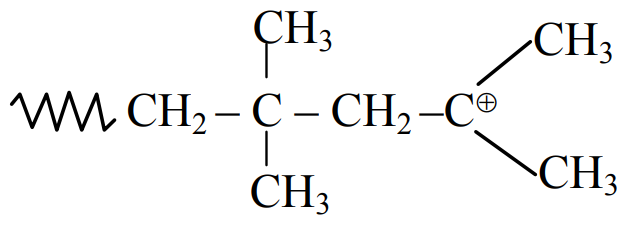 is :-The chain is built of the repeating unit $-CH_2-C(CH_3)_2-$.
The growing end is a carbocation, which shows that the polymer is formed by cationic addition polymerisation.
Adding back a double bond between the two carbons of the repeating unit gives the monomer $CH_2=C(CH_3)_2$.
This monomer is 2-methylpropene (isobutylene), and the polymer is polyisobutylene.
In cationic polymerisation the carbocation $\sim CH_2-\overset{+}{C}(CH_3)_2$ adds to the $CH_2$ end of a new monomer, regenerating a tertiary carbocation each time.
So the monomer is $H_2C=C(CH_3)_2$.
Addition (Chain Growth) Polymerisation
-
Which one of the following is a chain growth polymer :-Chain growth (addition) polymers are formed by repeated addition of monomer molecules having a double bond, through free radical, cationic or anionic chain reactions, without loss of any small molecule.
Polystyrene is made by free radical polymerisation of styrene: $n\,C_6H_5CH=CH_2 \rightarrow [-CH(C_6H_5)-CH_2-]_n$. It is a chain growth polymer.
Nucleic acids, proteins and starch are natural condensation (step growth) polymers. They are formed by joining monomers (nucleotides, amino acids and glucose) with loss of water molecules, through phosphodiester, peptide and glycosidic linkages.
So the chain growth polymer is polystyrene.
Synthetic Rubbers: Neoprene
-
Which one of the following monomers gives the polymer neoprene on polymerization : -Neoprene is a synthetic rubber formed by free radical polymerisation of chloroprene (2-chlorobuta-1,3-diene), $CH_2=C(Cl)-CH=CH_2$:
$n\,CH_2=C(Cl)-CH=CH_2 \rightarrow [-CH_2-C(Cl)=CH-CH_2-]_n$
Neoprene is resistant to oils and is used to make conveyor belts, gaskets and hoses.
$CH_2=CHCl$ gives PVC and $CF_2=CF_2$ gives Teflon.
So the monomer of neoprene is $CH_2=C(Cl)-CH=CH_2$.
Addition Polymers
-
Monomer of
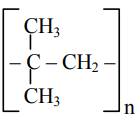 is : -The repeating unit $-C(CH_3)_2-CH_2-$ has a carbon with two methyl groups next to a $CH_2$.
Opening the double bond of $CH_2=C(CH_3)_2$ gives exactly this unit: $n\,CH_2=C(CH_3)_2 \rightarrow [-CH_2-C(CH_3)_2-]_n$
$CH_2=C(CH_3)_2$ is 2-methylpropene (isobutylene). The polymer is polyisobutylene, used in butyl rubber.
Propylene would give $[-CH_2-CH(CH_3)-]_n$ with only one methyl per unit.
So the monomer is 2-methyl propene. -
$CF_2=CF_2$ is monomer of :Tetrafluoroethylene, $CF_2=CF_2$, polymerises (free radical, under pressure) to polytetrafluoroethylene (PTFE), known as Teflon:
$n\,CF_2=CF_2 \rightarrow [-CF_2-CF_2-]_n$
Teflon is chemically inert and heat resistant, and is used for non-stick cookware.
Orlon is from acrylonitrile, polythene from ethene, and nylon-6 from caprolactam.
That is every question in Polymers for this filter.
Want a score?
Answers here are not saved. Practise as a test to be marked and see your progress.
Practise as a test