Looking for classes? Ksquare Career Institute, Bengaluru →

Chemistry
Biomolecules
67 questions from 34 papers, each with its answer.
- 67 questions
- 34 papers
- 3.81% of Chemistry
Vitamins and Deficiency Diseases
-
Match List-I with List-II.
Pick the matching item from Column II for each row.
Column I
- A. Vitamin $\text{B}_{12}$
- B. Vitamin D
- C. Vitamin $\text{B}_2$
- D. Vitamin $\text{B}_6$
Column II
- I. Cheilosis
- II. Convulsions
- III. Rickets
- IV. Pernicious anaemia
Correct answer: A → IV, B → III, C → I, D → II
Vitamin $\text{B}_{12}$: Pernicious anaemia; Vitamin D: Rickets; Vitamin $\text{B}_2$: Cheilosis; Vitamin $\text{B}_6$: Convulsions.
Vitamins and deficiency disorders: 1. Vitamin $\text{B}_{12}$ (Cobalamin) deficiency causes Pernicious anaemia (IV). 2. Vitamin D (Calciferol) deficiency causes Rickets (III). 3. Vitamin $\text{B}_2$ (Riboflavin) deficiency causes Cheilosis (fissuring at corners of mouth) (I). 4. Vitamin $\text{B}_6$ (Pyridoxine) deficiency leads to Convulsions (II). Hence, A-IV, B-III, C-I, D-II.
Carbohydrates - Fructose
-
Sugar 'X':
A. is found in honey.
B. is a keto sugar.
C. exists in $\alpha$ and $\beta$ – anomeric forms.
D. is laevorotatory.
'X' is:D-Fructose is a ketohexose found abundantly in honey, exists as $\alpha$ and $\beta$ anomers, and is strongly laevorotatory ($-92.4^\circ$, hence called levulose).
Fructose is a ketohexose ($\,\text{C}_6\text{H}_{12}\text{O}_6$) present along with glucose in honey and sweet fruits. It undergoes cyclization to form $\alpha$- and $\beta$-D-fructofuranose and fructopyranose anomers. It has a specific optical rotation of $[lpha]_D = -92.4^\circ$, making it strongly laevorotatory (also known as levulose). Thus, sugar 'X' is D-Fructose.
Enzymes
-
The incorrect statement regarding enzymes isEnzymes are biocatalysts, are very specific for a particular reaction and substrate, and (like chemical catalysts) reduce the activation energy of the process. Enzymes are proteins in nature, not polysaccharides – so this statement is incorrect.
-
During the process of digestion, the proteins present in food materials are hydrolysed to amino acids. The two enzymes involved in the process:
Proteins $\xrightarrow{\text{Enzyme (A)}}$ Polypeptides $\xrightarrow{\text{Enzyme (B)}}$ Amino acids,
are respectively -Proteins are polymers of amino acids joined by peptide bonds; enzymes that hydrolyse peptide bonds are called proteolytic enzymes.
Pepsin, present in the gastric juice of the stomach, hydrolyses proteins into smaller polypeptides (proteoses and peptones).
Trypsin, present in the pancreatic juice, acts in the small intestine and breaks the polypeptides down further, finally giving amino acids.
Amylase and diastase act on starch, and maltase acts on maltose.
Lipase acts on fats.
Invertase hydrolyses sucrose, and zymase converts glucose into ethanol.
So enzyme (A) is pepsin and enzyme (B) is trypsin. -
The enzyme which hydrolyses triglycerides to fatty acids and glycerol is called :-Triglycerides (fats and oils) are esters of glycerol with three fatty acid molecules.
Lipase catalyses their hydrolysis: triglyceride $+ 3H_2O \xrightarrow{lipase}$ glycerol $+ 3$ fatty acids.
Zymase converts glucose into ethanol and $CO_2$; pepsin hydrolyses proteins into peptides; maltase hydrolyses maltose into glucose.
So the enzyme is lipase. -
Enzymes are made up of : -Almost all enzymes are globular proteins.
Each enzyme has a specific three-dimensional structure, which forms an active site that fits only particular substrates. This specific structure is responsible for the high specificity of enzyme action.
If the structure is destroyed (denaturation by heat or pH change), the enzyme loses its activity.
So enzymes are made up of proteins with specific structure. -
Which of the following is correct : -Diastase (amylase) is an enzyme that hydrolyses starch into maltose; it is found in germinating barley (malt). Correct.
Cycloheptane is a saturated cyclic alkane, not aromatic (aromatic compounds are planar, cyclic and conjugated with $(4n + 2)\pi$ electrons).
Acetophenone, $C_6H_5COCH_3$, is a ketone, not an ether.
So the correct statement is that diastase is an enzyme.
Vitamins
-
The RBC deficiency is deficiency disease of:Deficiency of vitamin $B_{12}$ causes pernicious anaemia (RBC deficient in haemoglobin).
-
Deficiency of vitamin $B_1$ causes the diseaseVitamin $B_1$ is thiamine; its deficiency causes beri-beri (loss of appetite, retarded growth).
Sterility is linked to vitamin E, convulsions to vitamin $B_6$ and cheilosis to vitamin $B_2$ deficiency. -
Which of the following is not a fat soluble vitamin?Vitamins are classified by their solubility in water or fat.
Fat soluble vitamins: A, D, E and K; they are soluble in fats and oils, insoluble in water, and are stored in the liver and adipose tissue.
Water soluble vitamins: the B group vitamins and vitamin C; they are readily excreted in urine and cannot be stored (except vitamin $B_{12}$).
Hence vitamin B complex is not a fat soluble vitamin. -
Which of the following is water-soluble?Vitamins are classified into two groups on the basis of their solubility.
Fat soluble vitamins: vitamins A, D, E and K. They are soluble in fats and oils but insoluble in water, and are stored in the liver and adipose tissue.
Water soluble vitamins: the B group vitamins and vitamin C. They must be supplied regularly in the diet because they are readily excreted in urine and cannot be stored in the body (except vitamin $B_{12}$).
So vitamin B is water soluble, whereas vitamins A, E and K are water insoluble. -
The human body does not produce :-Vitamins are organic compounds required in small amounts for normal growth and health.
Most vitamins cannot be synthesised by the human body, so they must be supplied in the diet; that is why they are called essential dietary factors.
(Only a few are made in limited amounts, for example vitamin D in the skin in sunlight.)
DNA is synthesised in every dividing cell by replication.
Hormones are produced by the endocrine glands.
Enzymes are proteins synthesised in the cells of the body.
So the human body does not produce vitamins.
Proteins – Amino Acids
-
Which of the following is a basic amino acid?Lysine, $H_2N-(CH_2)_4-CH(NH_2)-COOH$, has an extra amino group in its side chain, so it is a basic amino acid. Alanine, tyrosine and serine are neutral amino acids.
-
The non-essential amino acid among the following is:Alanine is a non-essential amino acid (it can be synthesised in the body). Valine, leucine and lysine are essential amino acids.
Carbohydrates – Disaccharides
-
Sucrose on hydrolysis gives:Sucrose $\xrightarrow{hydrolysis}$ $\alpha$-D-glucose + $\beta$-D-fructose
Nucleic acids - structure of DNA and RNA
-
The correct statement with regard to the secondary structure of DNA/RNA is:DNA possesses a double strand helix structure and contains thymine as one of the four bases (RNA is single stranded and contains uracil instead of thymine).
Denaturation of proteins
-
The incorrect statement about denaturation of proteins is:Protein formation from amino acids through peptide bonds is not related to denaturation. Denaturation involves uncoiling of the helix and loss of biological activity due to changes in temperature or pH.
-
Which structure(s) of proteins remain(s) intact during denaturation process?During denaturation the $2^\circ$ and $3^\circ$ structures are destroyed but the $1^\circ$ structure remains intact.
Structure of proteins
-
The correct statement about peptides and proteins isIn $\beta$-pleated sheet structures, peptide chains are held together by intermolecular hydrogen bonds (NCERT, Biomolecules). The $\alpha$-helix is a right-handed helix, quaternary structure involves two or more subunits, and proteins need not have a quaternary structure to be biologically active.
-
Which functional group participates in disulphide bond formation in proteins :-A disulphide bond (-S-S-) is formed by the oxidation of two thiol (-SH) groups.
In proteins the thiol groups belong to the side chains of cysteine residues.
$R-SH + HS-R' \xrightarrow{[O]} R-S-S-R' + 2[H]$
Two cysteine residues joined in this way form cystine; such disulphide bridges hold different parts of a polypeptide chain (or different chains) together and stabilise the tertiary and quaternary structure, for example in insulin and keratin.
Methionine contains a thioether group, which does not form disulphide bonds.
So the functional group is the thiol group. -
The helical structure of protein is stabilized by:-The $\alpha$-helix is the secondary structure of a protein. The polypeptide chain coils into a right-handed spiral.
The helix is held in shape by intramolecular hydrogen bonds between the $C=O$ group of one amino acid residue and the $-NH$ group of the residue four places further along the chain ($C=O \cdots H-N$).
Peptide bonds join the amino acids in the primary structure; they make the chain but do not hold the helix in shape. Ether bonds are not present in proteins.
So the helical structure of a protein is stabilised by hydrogen bonds.
Vitamins - sources
-
Match the vitamins in List I with their sources in List II.
Pick the matching item from Column II for each row.
Column I
- A. vitamin A
- B. vitamin $B_{12}$
- C. vitamin E
- D. vitamin K
Column II
- I. meat
- II. sunflower oil
- III. green leafy vegetables
- IV. carrots
Correct answer: A → IV, B → I, C → II, D → III
Vitamin A - carrots; vitamin $B_{12}$ - meat; vitamin E - sunflower oil; vitamin K - green leafy vegetables.
Amino acids – zwitterion
-
Which of the following compounds can form a zwitterion?
An amino acid has both $-NH_2$ and $-COOH$ groups, giving a dipolar ion.
$H_3\overset{+}{N}-CH_2-COOH \rightleftharpoons H_3\overset{+}{N}-CH_2-COO^-$ (zwitterion form) $\rightleftharpoons H_2N-CH_2-COO^-$ $pK_a$ values: $-\overset{+}{N}H_3$ = 9.60, $-COOH$ = 2.34 Glycine contains both an acidic and a basic group, so it forms a zwitterion.
Carbohydrates – starch (amylose and amylopectin)
-
The difference between amylose and amylopectin is
Amylopectin is branched with $\alpha(1\rightarrow6)$ links in addition to $\alpha(1\rightarrow4)$.
Amylose and amylopectin are polymers of $\alpha$-D-glucose, so a $\beta$-link is not possible. Amylose is linear with $1\rightarrow4\ \alpha$-linkage whereas amylopectin is branched and has both $1\rightarrow4$ and $1\rightarrow6\ \alpha$-linkages.
Proteins – denaturation
-
Which of the following statements is not correct?
Denaturation destroys biological activity.
Due to denaturation of proteins, globules unfold and helices get uncoiled, and the protein loses its biological activity.
Proteins – peptide bond
-
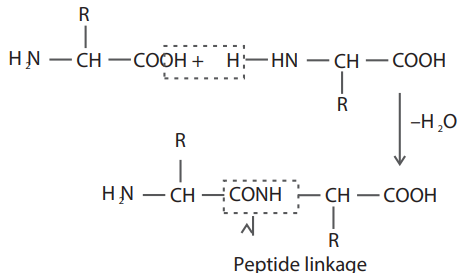
In a protein molecule various amino acids are linked together by
Amino acids join via –CONH– peptide bonds.
Amino acids are the structural units of proteins. Two or more amino acids are linked through the peptide linkage (–CONH–), known as the peptide bond.
Nucleic acids – sugar component
-
The correct statement regarding RNA and DNA, respectively is
RNA has ribose; DNA has 2'-deoxyribose.
The sugar unit of DNA is deoxyribose and that of RNA is ribose. C-atoms of the pentose sugar are numbered 1', 2', 3', ... to distinguish them from the C-atoms of the nitrogenous base.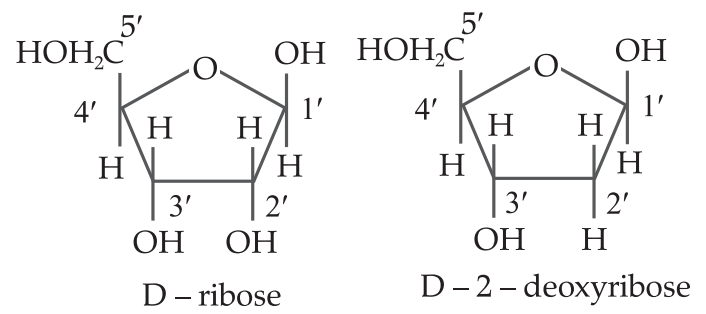
Carbohydrates – reducing and non-reducing sugars
-
Which one given below is a non-reducing sugar?
Sucrose has no free hemiacetal/hemiketal group.
When two monosaccharide units are linked through their respective carbonyl groups (reducing centres), the disaccharide is non-reducing, e.g. sucrose.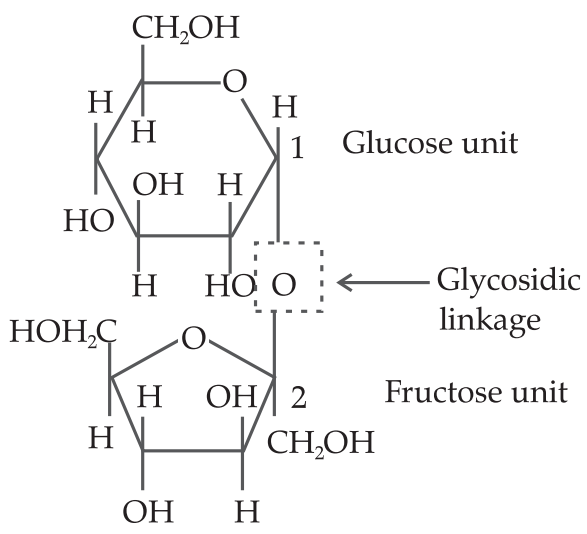
Nucleic acids – central dogma
-
The central dogma of molecular genetics states that the genetic information flows from:
DNA → RNA → protein.
DNA $\xrightarrow{Transcription}$ RNA $\xrightarrow{Translation}$ Protein
Hormones
-
Which of the following hormones is produced under the condition of stress which stimulates glycogenolysis in the liver of human beings?Adrenaline, commonly known as the fight or flight hormone, is produced by the adrenal glands after receiving a message from the brain that a stressful situation has presented itself.
-
Which of the following hormones contains iodine?Thyroxine, the hormone of the thyroid gland, is an iodinated derivative of the amino acid tyrosine; each molecule contains four iodine atoms (tetraiodothyronine, $T_4$).
This is why iodine is essential in the diet; its deficiency causes hypothyroidism and goitre, and iodised salt is used to prevent it.
Insulin is a polypeptide hormone, testosterone is a steroid hormone and adrenaline is an amine derived from tyrosine; none of them contains iodine.
Hence the hormone that contains iodine is thyroxine. -
Which one of the following is an amine hormone ?On the basis of chemical nature, hormones are classified as steroid hormones, peptide (protein) hormones and amine hormones.
Thyroxine and adrenaline are amine hormones. Thyroxine is an iodine containing derivative of the amino acid tyrosine and is secreted by the thyroid gland.
Amine hormones are water soluble hormones having amino groups.
Insulin is a peptide (protein) hormone made of 51 amino acids.
Progesterone is a steroid hormone.
Oxypurin (oxypurine) is a purine derivative, not an amine hormone.
So the amine hormone among these is thyroxine. -
Which one of the following is a peptide hormone :-Hormones are classified chemically into steroid hormones, peptide (polypeptide or protein) hormones and amine hormones.
Glucagon is a peptide hormone made of 29 amino acids; it is secreted by the $\alpha$-cells of the pancreas and raises the blood glucose level.
Other peptide hormones are insulin and oxytocin.
Testosterone is a steroid hormone.
Thyroxine and adrenaline are amine hormones, derived from the amino acid tyrosine.
So the peptide hormone is glucagon. -
The hormone that helps in the conversion of glucose to glycogen is :-After a meal, the blood glucose level rises. The pancreas then releases insulin.
Insulin promotes the uptake of glucose by liver and muscle cells and stimulates glycogenesis, i.e. the conversion of glucose into glycogen for storage. This lowers the blood glucose level.
Adrenaline and glucagon have the opposite effect (glycogenolysis, breaking glycogen into glucose). Cortisone, a glucocorticoid, raises blood sugar by gluconeogenesis. Bile acids are not hormones; they help in fat digestion.
So the hormone that helps in the conversion of glucose to glycogen is insulin. -
Which one is responsible for producing energy in bio reactions :Thyroxine, secreted by the thyroid gland, regulates the basal metabolic rate (BMR). It increases oxygen consumption and the oxidation of food in cells, so it increases the production of energy (heat) in the body.
Its deficiency lowers BMR and causes lethargy (myxoedema), while excess raises BMR (Graves' disease).
So thyroxine is responsible for producing energy in bioreactions.
Disaccharides
-
Which one of the following sets of monosaccharides forms sucrose?Sucrose is a disaccharide of glucose and fructose.
C-1 of $\alpha$-D-glucose (six-membered pyranose ring) is joined to C-2 of $\beta$-D-fructose (five-membered furanose ring) by a glycosidic linkage.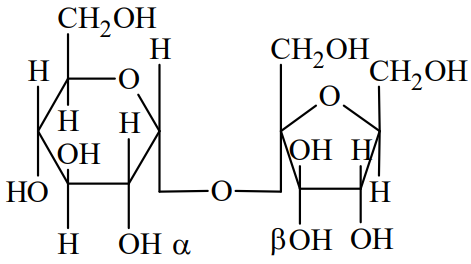
So sucrose is formed from $\alpha$-D-glucopyranose and $\beta$-D-fructofuranose.
Proteins and nucleic acids
-
Which of the statements about Denaturation given below are correct?
Statements:
(a) Denaturation of proteins causes loss of secondary and tertiary structures of the protein
(b) Denaturation leads to the conversion of double strand of DNA into single strand
(c) Denaturation affects primary structure which gets distorted"When a protein is subjected to a change in temperature or pH, the hydrogen bonds are disturbed; the globules unfold and the helices uncoil, and the protein loses its biological activity. This is denaturation.
During denaturation the secondary and tertiary structures are destroyed, so (a) is correct.
The primary structure, i.e., the sequence of amino acids held by peptide bonds, remains intact, so (c) is wrong.
On heating DNA, the hydrogen bonds between the complementary base pairs break and the double strand separates into two single strands; this is denaturation (melting) of DNA, so (b) is correct.
Hence the correct statements are (a) and (b).
Carbohydrates
-
Which one of the following does not exhibit the phenomenon of mutarotation?Mutarotation is the change in specific rotation of a sugar solution with time; it needs a free hemiacetal or hemiketal (anomeric –OH) group so that the ring can open and re-close to interconvert the α and β forms.
Fructose (a monosaccharide), maltose and lactose (reducing disaccharides) all have a free anomeric –OH group, so they show mutarotation.
In sucrose, C-1 of α-D-glucose is linked to C-2 of β-D-fructose; both anomeric carbons are used up in the glycosidic bond.
So sucrose has no free hemiacetal or hemiketal group; it is a non-reducing sugar and cannot show mutarotation.
Hence (+) sucrose does not exhibit mutarotation.
Nucleic acids
-
The segment of DNA which acts as the instruction manual for the synthesis of the protein isDNA carries the hereditary information of the cell in the sequence of its bases.
A gene is a segment of DNA whose base sequence codes for the amino acid sequence of one polypeptide (protein); it is transcribed into mRNA, which is then translated.
So the gene works as the instruction manual for the synthesis of a protein.
A nucleoside (base + sugar) and a nucleotide (base + sugar + phosphate) are only building units of nucleic acids, and ribose is the sugar of RNA.
Hence the segment is the gene. -
In DNA, the complementary bases are -DNA contains two types of nitrogenous bases.
Purines: Adenine (A) and Guanine (G).
Pyrimidines: Cytosine (C) and Thymine (T).
In the double helix a purine always pairs with a specific pyrimidine on the opposite strand.
Adenine pairs with thymine (A : T) by two hydrogen bonds.
Guanine pairs with cytosine (G : C) by three hydrogen bonds.
Uracil is present in RNA in place of thymine; it is not a base of DNA.
So the complementary bases in DNA are adenine and thymine, guanine and cytosine. -
RNA and DNA are chiral molecules, their chirality is due toEach nucleic acid consists of a pentose sugar, a heterocyclic base and phosphoric acid.
The sugar present in DNA is 2-deoxy-D(-)-ribose and the sugar present in RNA is D(-)-ribose.
These pentose sugars contain asymmetric (chiral) carbon atoms and belong to the D-series.
The heterocyclic bases (purines and pyrimidines) are planar aromatic rings and are not chiral.
The phosphate ester units are also not chiral.
So the chirality of DNA and RNA molecules is due to the presence of the D-sugar component.
Lipids
-
The cell membranes are mainly composed of :-According to the fluid mosaic model, the cell membrane is a lipid bilayer in which proteins are embedded.
The main lipids of the membrane are phospholipids. Each phospholipid has a polar (hydrophilic) phosphate head and two non-polar (hydrophobic) fatty acid tails.
In water they arrange themselves in a bilayer, with the heads facing the aqueous media on both sides and the tails inside.
This phospholipid bilayer forms the basic structure of every cell membrane; proteins and a small amount of carbohydrate (glycolipids and glycoproteins) are associated with it.
Simple fats (triglycerides) are storage lipids, not membrane components.
So the cell membranes are mainly composed of phospholipids, as given in the answer key.
Proteins and their Functions
-
The correct statement in respect of protein haemoglobin is that it :-Haemoglobin is a globular protein present in red blood cells. It contains four polypeptide chains, each with an iron-containing haem group.
The $Fe^{2+}$ of haem binds oxygen reversibly to form oxyhaemoglobin in the lungs, and releases it in the tissues.
So haemoglobin acts as an oxygen carrier in the blood.
Blood sugar level is maintained by the hormone insulin (and glucagon); antibodies are formed by immunoglobulins; biological reactions are catalysed by enzymes.
Nucleic Acids and the Genetic Code
-
A sequence of how many nucleotides in messenger RNA makes a codon for an amino acid :-The genetic code is a triplet code: a sequence of three consecutive nucleotides (bases) on mRNA codes for one amino acid. This group of three is called a codon.
There are 4 bases (A, U, G, C). Codons of one base would give only $4^1 = 4$ combinations and codons of two bases only $4^2 = 16$, which are fewer than the 20 amino acids.
Codons of three bases give $4^3 = 64$ combinations, which is enough to code all 20 amino acids along with start and stop signals.
So a sequence of three nucleotides makes a codon.
Carbohydrates: Cyclic Structure of Glucose
-
$\alpha$-D-glucose and $\beta$-D-glucose are :In the cyclic (pyranose) form of glucose, C-1 becomes a new chiral centre (the anomeric carbon).
$\alpha$-D-glucose and $\beta$-D-glucose differ only in the configuration of the –OH group at C-1 (below or above the ring).
Such isomers, differing only at the anomeric carbon, are called anomers.
(Epimers differ at a carbon other than the anomeric one, e.g. glucose and mannose at C-2.)
Metabolism of Carbohydrates
-
Glycolysis is : -Glycolysis (EMP pathway) is the first stage of respiration, taking place in the cytoplasm.
In it, one molecule of glucose (6C) is partially oxidised to two molecules of pyruvic acid (3C), with a net gain of 2 ATP and 2 NADH.
$C_6H_{12}O_6 \rightarrow 2CH_3COCOOH$ (+ 2 ATP + 2 NADH)
Conversion of pyruvate to acetyl CoA and then into citrate occurs in the mitochondria (Krebs cycle).
So glycolysis is the oxidation of glucose to pyruvate.
Lipids: Phospholipids
-
Phospholipids are esters of glycerol with :-Glycerol has three –OH groups.
In a triglyceride (fat), all three –OH groups are esterified with fatty acids (carboxylic acids).
In a phospholipid, two –OH groups are esterified with fatty acids and the third with phosphoric acid (a phosphate group), which is often further linked to a nitrogenous base such as choline (e.g. lecithin).
This gives the molecule a hydrophobic tail (two fatty acid chains) and a hydrophilic head (phosphate), which is why phospholipids form cell membranes.
So phospholipids are esters of glycerol with two carboxylic acid residues and one phosphate group.
Nucleic Acids: Structure of DNA
-
Chargaff's rule states that in an organism : -Erwin Chargaff found that in double stranded DNA, the amount of adenine is always equal to that of thymine (A = T), and the amount of guanine is always equal to that of cytosine (G = C).
So purines = pyrimidines: A + G = T + C.
These rules are explained by the Watson–Crick model, in which A always pairs with T (two hydrogen bonds) and G always pairs with C (three hydrogen bonds).
The amounts of all four bases are not equal; the ratio (A + T)/(G + C) differs from species to species.
So Chargaff's rule states that A = T and G = C.
Polysaccharides
-
Cellulose is polymer of : -Cellulose is a straight-chain polysaccharide made of $\beta$-D-glucose units joined by $\beta(1\rightarrow4)$ glycosidic linkages.
It is the main constituent of plant cell walls.
(Starch and glycogen are polymers of $\alpha$-D-glucose; fructose polymers are called fructans, e.g. inulin.)
So cellulose is a polymer of glucose. -
Which is correct statement : -Starch is a polymer of $\alpha$-D-glucose. It has two components: amylose (unbranched, $\alpha$-1,4 links) and amylopectin (branched, with $\alpha$-1,6 links as well). Correct.
Amylose is a component of starch, not cellulose (cellulose is made of $\beta$-glucose).
Proteins are made of many different amino acids (about 20 types).
In the furanose (cyclic) form of fructose, the five-membered ring has four carbons and one oxygen. (This statement is also true for the ring itself, but the key takes the starch statement as the correct one; fructose has six carbons in total.)
So, as per the answer key, the correct statement is that starch is a polymer of $\alpha$-glucose.
Carbohydrates: Reducing Sugars
-
Which of the following gives positive Fehling solution testFehling's solution (alkaline $Cu^{2+}$ complex) is reduced by compounds having a free aldehyde group, giving a red precipitate of $Cu_2O$.
Glucose is an aldose with a free (potential) aldehyde group, so it is a reducing sugar and gives a positive test.
In sucrose, the carbonyl groups of glucose and fructose are linked to each other in the glycosidic bond, so it is non-reducing. Fats and proteins do not have free aldehyde groups.
So glucose gives a positive Fehling's test.
Nucleic Acids: Base Pairing
-
Which of the following is correct about H-bonding in nucleotides : -In DNA, the two strands are held together by hydrogen bonds between complementary bases.
Adenine pairs with thymine through two hydrogen bonds (A=T), and guanine pairs with cytosine through three hydrogen bonds (G$\equiv$C).
A purine always pairs with a pyrimidine, which keeps the width of the double helix constant.
So hydrogen bonding is A–T and G–C.
Metals in Biomolecules
-
Mg is present in :Chlorophyll has a porphyrin ring with a magnesium atom at its centre.
Haemoglobin contains iron, and vitamin $B_{12}$ contains cobalt.
So Mg is present in chlorophyll.
That is every question in Biomolecules for this filter.
Show all 67 questions Next: Practical Chemistry / Qualitative Analysis
Want a score?
Answers here are not saved. Practise as a test to be marked and see your progress.
Practise as a test