Looking for classes? Ksquare Career Institute, Bengaluru →

Chemistry
Biomolecules
67 questions from 34 papers, each with its answer.
- 67 questions
- 34 papers
- 3.81% of Chemistry
Vitamins and Deficiency Diseases
-
Deficiency of which vitamin causes osteomalacia?Deficiency of Vitamin D causes osteomalacia in adults (softening of bones due to impaired calcium absorption) and rickets in children.
Chemical Reactions of Glucose (Aldehyde Group Tests)
-
The reagents with which glucose does not react to give the corresponding tests/products are A. Tollen's reagent B. Schiff's reagent C. $HCN$ D. $NH_2OH$ E. $NaHSO_3$ Choose the correct options from the given below:Glucose exists mainly in the cyclic (hemiacetal) form, so it lacks a free aldehyde group in the ring structure. Hence glucose does not give Schiff's test and does not form the hydrogensulphite addition product with $NaHSO_3$. So the reagents are B (Schiff's reagent) and E ($NaHSO_3$).
Nucleic Acids – Nucleoside and Nucleotide
-
Given below are two statements: Statement I: A unit formed by the attachment of a base to 1' position of sugar is known as nucleoside Statement II: When nucleoside is linked to phosphorous acid at 5'-position of sugar moiety, we get nucleotide. In the light of the above statements, choose the correct answer from the options given below:
A nucleotide forms when a nucleoside is linked to phosphoric acid (not phosphorous acid) at the 5' position.
When nucleoside is linked to phosphoric acid at 5'-position of sugar moiety, we get nucleotide.
Structure of polysaccharides - glycogen
-
Given below are two statements: Statement I: Glycogen is similar to amylose in its structure. Statement II: Glycogen is found in yeast and fungi also. In the light of the above statements, choose the correct answer from the options given below:Glycogen is structurally similar to amylopectin (highly branched), not amylose (which is a linear/unbranched polysaccharide), so Statement I is false. Glycogen (animal starch) is also found in yeast and fungi, so Statement II is true.
Structure and properties of glucose
-
Which of the following statement is not true about glucose?Glucose is an aldohexose (a six-carbon sugar with an aldehyde group), not an aldopentose (a five-carbon sugar) — so the statement that it is an aldopentose is not true.
Vitamin deficiency diseases
-
Cheilosis occurs due to deficiency of________.Cheilosis (fissuring at the corners of the mouth and lips) occurs due to deficiency of vitamin $B_2$ (Riboflavin).
Proteins – peptide bond
-
Which one of the following structures represents the peptide chain :-Proteins are polymers of $\alpha$-amino acids, $H_2N-CHR-COOH$. In an $\alpha$-amino acid, the amino group and the carboxyl group are attached to the same ($\alpha$) carbon.
When amino acids join, the $-COOH$ of one combines with the $-NH_2$ of the next, eliminating water and forming a peptide bond $-CO-NH-$.
So a peptide chain has the repeating unit $-NH-CHR-CO-$: nitrogen, then one $\alpha$ carbon, then a carbonyl carbon, then nitrogen again.
The chain $-NH-C-CO-NH-C-CO-NH-C-CO-$ has exactly this repeating pattern, so it represents a peptide chain.
The other chains have two or three carbons between the N and the C=O, or have $-NH-CO-NH-$ (urea-type) linkages, so they do not correspond to $\alpha$-amino acid units.
So the peptide chain is $-NH-C-CO-NH-C-CO-NH-C-CO-$. -
$-CO-NH-$ (peptide bond): which statement is incorrect about peptide bond : -In the peptide group, the lone pair on nitrogen is delocalised into the carbonyl group (resonance): $-C(=O)-NH- \leftrightarrow -C(-O^-)=NH^+-$.
So the C–N bond has partial double bond character. Its length (about 1.32 Å) is shorter than a normal C–N single bond (about 1.47 Å).
Because of this partial double bond, rotation about C–N is restricted and the $-CO-NH-$ group is planar, as shown by spectroscopy and X-ray studies.
So the statement that the C–N bond length in proteins is longer than the usual C–N bond length is incorrect.
Carbohydrates – D/L configuration of aldoses
-
The correct corresponding order names of four aldoses with configuration given below respectively, is:
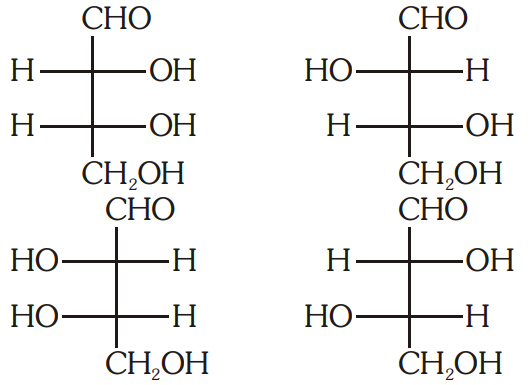
Bottom chiral –OH decides D/L; relative –OH positions distinguish erythrose/threose.
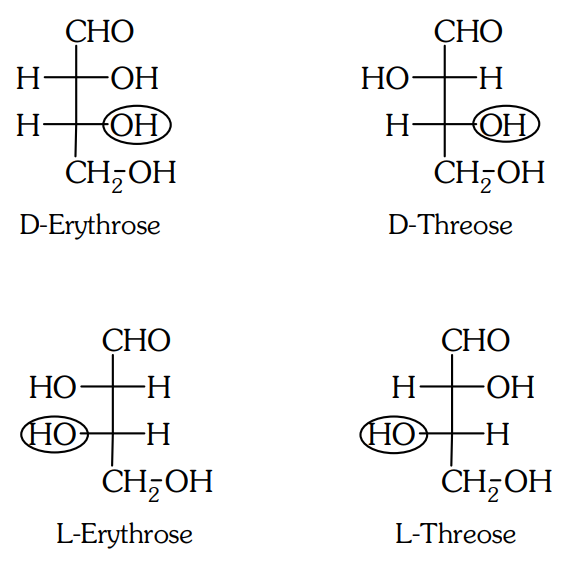
D/L is decided by the –OH on the chiral carbon farthest from CHO (right = D, left = L); erythrose has both –OH on the same side, threose on opposite sides.
So the order is D-erythrose, D-threose, L-erythrose, L-threose.
Reactions of glucose
-
D(+) glucose reacts with hydroxylamine and yields an oxime. The structure of the oxime would be:Glucose reacts with hydroxylamine to form an oxime: only the –CHO group changes to –CH=N–OH.
The configuration at C-2 to C-5 stays that of D(+)-glucose (OH on the right at C-2, left at C-3, right at C-4 and C-5).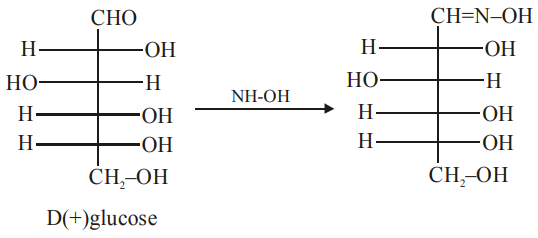
Disaccharides
-
Which one of the following statements is not true regarding (+) Lactose?Lactose is a disaccharide in which C-1 of $\beta$-D-galactose is linked to C-4 of $\beta$-D-glucose by a $\beta$-1,4-glycosidic linkage, so it is a $\beta$-glycoside (true).
On hydrolysis it gives one molecule each of D(+)-glucose and D(+)-galactose, i.e., equal amounts (true).
It has 8 –OH groups, four on each monosaccharide unit (true).
The C-1 of the glucose unit is not involved in the glycosidic bond, so lactose has a free hemiacetal group.
Because of this free hemiacetal group lactose is a reducing sugar and it also shows mutarotation.
Hence the statement that lactose does not exhibit mutarotation is not true.
Monosaccharides
-
Fructose reduces Tollen's reagent due toFructose is a ketohexose; a keto group by itself is not oxidised by mild oxidising agents such as Tollens' reagent.
Tollens' reagent, however, is alkaline. In the presence of a base, fructose undergoes enolisation to form an enediol.
The enediol rearranges to give the aldoses glucose and mannose (Lobry de Bruyn–van Ekenstein rearrangement), so an equilibrium mixture containing a free –CHO group is formed.
The aldehyde group so produced reduces Tollens' reagent to metallic silver.
Hence fructose reduces Tollens' reagent because of enolisation followed by conversion to aldehyde by the base.
Carbohydrates: Cyclic Structure of Glucose
-
Number of chiral carbons in $\beta$–D–(+)–glucose is: -$\beta$-D-(+)-glucose is the cyclic (pyranose) form of glucose, in which the C-5 –OH has added to the C-1 aldehyde group to form a six-membered ring containing oxygen.
Check each carbon:
C-1 (anomeric carbon): attached to H, OH, ring O and C-2, i.e. four different groups, so it is chiral.
C-2, C-3 and C-4: each carries H, OH and two different ring carbons, so each is chiral.
C-5: attached to H, ring O, C-4 and $CH_2OH$, so it is chiral.
C-6 ($CH_2OH$): it has two H atoms, so it is not chiral.
So $\beta$-D-glucose has five chiral carbons (C-1 to C-5). The open-chain form has only four (C-2 to C-5); ring formation makes C-1 a new chiral centre.
Amino Acids and Proteins
-
Which is not true statement : -In all $\alpha$-amino acids except glycine, the $\alpha$-carbon carries four different groups ($-H$, $-NH_2$, $-COOH$, $-R$), so it is asymmetric (chiral). This statement is generally true.
At pH 7, amino acids exist as zwitterions, $H_3N^+-CHR-COO^-$, with both groups ionised; true.
Human body can make all the proteins it needs, provided the essential amino acids are supplied in the diet; this is accepted as true in the key.
Proteins are made of L-amino acids, but the amino acid glycine is not optically active, and D-amino acids do occur in some natural peptides (e.g. in bacterial cell walls and some antibiotics). So the sweeping statement that all proteins are found in the L-form is taken as not true.
So, as per the answer key, the statement that is not true is: all proteins are found in L-form.
That is every question in Biomolecules for this filter.
Show all 67 questions Next: Practical Chemistry / Qualitative Analysis
Want a score?
Answers here are not saved. Practise as a test to be marked and see your progress.
Practise as a test