Looking for classes? Ksquare Career Institute, Bengaluru →

Chemistry
Amines
61 questions from 36 papers, each with its answer.
- 61 questions
- 36 papers
- 3.47% of Chemistry
Basicity of Amines
-
The correct order of decreasing basic strength of the given amines is:
Aliphatic amines are stronger bases than aromatic amines. Secondary aliphatic amine > primary aliphatic amine > secondary aromatic amine > aniline.
Aliphatic amines have localized electron pairs on nitrogen and are far stronger bases than aryl amines where the nitrogen lone pair is delocalized into the benzene ring (+R effect). Among aliphatic amines in aqueous medium, diethylamine (N-ethylethanamine, $2^\circ$) is more basic than ethylamine (ethanamine, $1^\circ$) due to combined $+I$ and steric/solvation effects. Among aromatic amines, N-methylaniline has a $+I$ methyl group that enhances electron density on N relative to benzenamine (aniline). Thus: N-ethylethanamine > ethanamine > N-methylaniline > benzenamine.
Reactivity and Preparation of Aniline
-
Given below are two statements: Statement I: Aniline does not undergo Friedel-Crafts alkylation reaction. Statement II: Aniline cannot be prepared through Gabriel synthesis. In the light of the above statements, choose the correct answer from the options given below:Statement I: Aniline forms a salt with $AlCl_3$ (Lewis acid); the positive charge on nitrogen is strongly electron-withdrawing and deactivates the ring, so aniline does not undergo Friedel-Crafts alkylation. True. Statement II: Aryl halides do not undergo nucleophilic substitution with the anion of phthalimide, so aniline cannot be prepared by Gabriel phthalimide synthesis. True. So both statements are true.
Preparation of Amines
-
Which of the following reactions will NOT give primary amine as the product?
$CH_3NC$ on reduction gives the secondary amine $CH_3NHCH_3$.
$CH_3CONH_2\xrightarrow[(ii)\ H_3O^{\oplus}]{(i)\ LiAlH_4}CH_3CH_2NH_2$ $CH_3CONH_2\xrightarrow{Br_2/KOH}CH_3NH_2$ $CH_3CN\xrightarrow[(ii)\ H_3O^{\oplus}]{(i)\ LiAlH_4}CH_3CH_2NH_2$ $CH_3NC\xrightarrow[(ii)\ H_3O^{\oplus}]{(i)\ LiAlH_4}CH_3NHCH_3$ Methyl isocyanide gives a secondary amine, $CH_3NHCH_3$, upon reduction. -
Method by which Aniline cannot be prepared is:In chlorobenzene, resonance gives the C–Cl bond partial double bond character, so aryl halides do not undergo nucleophilic substitution with phthalimide anion.
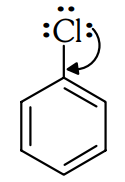
So Gabriel phthalimide synthesis cannot prepare aniline. -
An organic compound 'A' on treatment with $NH_3$ gives 'B' which on heating gives 'C'. 'C' when treated with $Br_2$ in the presence of KOH produces ethylamine. Compound 'A' is
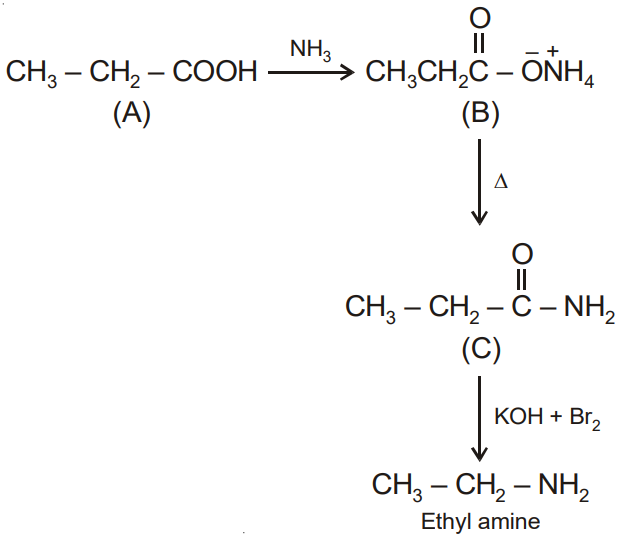
Work backwards from the product. $Br_2$/KOH converts an amide into a primary amine having one carbon less (Hoffmann bromamide degradation).
Ethylamine, $CH_3CH_2NH_2$, has two carbons, so the amide C has three carbons: C = $CH_3CH_2CONH_2$ (propanamide).
$CH_3CH_2CONH_2 + Br_2 + 4KOH \rightarrow CH_3CH_2NH_2 + K_2CO_3 + 2KBr + 2H_2O$
An amide is formed on heating the ammonium salt of the acid: B = $CH_3CH_2COO^-NH_4^+$ (ammonium propanoate), and $CH_3CH_2COONH_4 \xrightarrow{\Delta} CH_3CH_2CONH_2 + H_2O$
The ammonium salt is formed from the carboxylic acid and ammonia: $CH_3CH_2COOH + NH_3 \rightarrow CH_3CH_2COONH_4$
Hence A is propanoic acid, $CH_3CH_2COOH$.
Note: the question sentence is jumbled in the source PDF; it has been restored to its intended wording. -
In a set of reactions m-bromobenzoic acid gave a product D. Identify the product D.
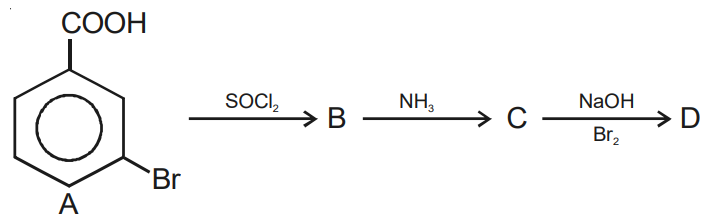
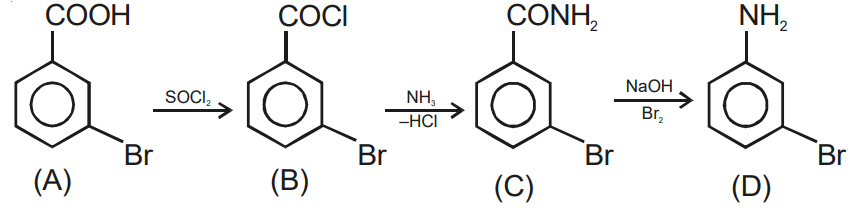
Step 1: thionyl chloride converts the carboxylic acid into the acid chloride: m-$BrC_6H_4COOH + SOCl_2 \rightarrow$ m-$BrC_6H_4COCl$ (B) $+ SO_2 + HCl$
Step 2: ammonia converts the acid chloride into the amide: m-$BrC_6H_4COCl + NH_3 \rightarrow$ m-$BrC_6H_4CONH_2$ (C) $+ HCl$
Step 3: with $Br_2$/NaOH the amide undergoes Hoffmann bromamide degradation, giving a primary amine with one carbon less: m-$BrC_6H_4CONH_2 + Br_2 + 4NaOH \rightarrow$ m-$BrC_6H_4NH_2$ (D) $+ Na_2CO_3 + 2NaBr + 2H_2O$
The ring bromine is not affected in any step.
Hence D is m-bromoaniline.
Diazonium Salts – Sandmeyer Reaction and Grignard Reagent
-
Identify the product in the following reaction:
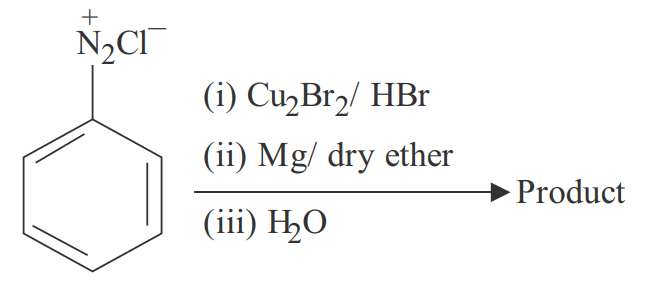
Sandmeyer bromination gives bromobenzene, then the Grignard reagent, which is hydrolysed to benzene.
Bromobenzene is formed in first step (Sandmeyer reaction), which further gives phenyl magnesium bromide. Phenyl magnesium bromide further gives benzene with water. $C_6H_5N_2^+Cl^-\xrightarrow{Cu_2Br_2/HBr}C_6H_5Br\xrightarrow{Mg/dry\ ether}C_6H_5MgBr\xrightarrow{H_2O}C_6H_6+Mg(Br)OH$
Diazonium Salts
-
Given below are two statements: Statement I: Primary aliphatic amines react with $HNO_2$ to give unstable diazonium salts. Statement II: Primary aromatic amines react with $HNO_2$ to form diazonium salts which are stable even above 300 K. In the light of the above statements, choose the most appropriate answer from the options given below:Primary aliphatic amines react with $HNO_2$ to give highly unstable alkyl diazonium salts – Statement I is correct. Aromatic diazonium salts are stable only at low temperature (273–278 K, i.e. 0–5 °C), not above 300 K – Statement II is incorrect. So Statement I is correct but Statement II is incorrect.
-
In the following reaction, the product (A)
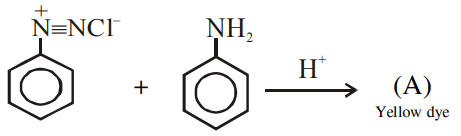 is:This is an electrophilic substitution (coupling) reaction.
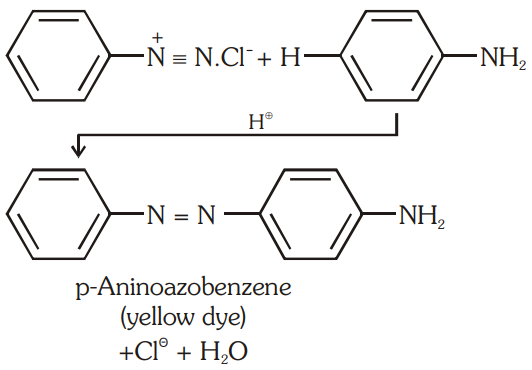
-
In the reaction
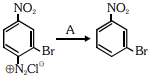 A is
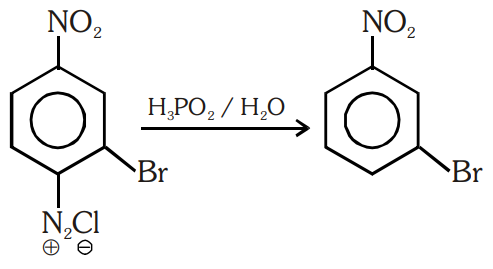
$H_3PO_2/H_2O$ reduces the diazonium group, replacing $-N_2^+Cl^-$ by H. -
Aniline in a set of the following reactions yielded a coloured product Y.
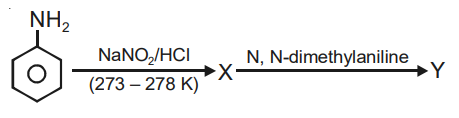
The structure of Y would beStep 1 (diazotisation): aniline reacts with $NaNO_2$/HCl at 273–278 K to give benzenediazonium chloride: $C_6H_5NH_2 + NaNO_2 + 2HCl \rightarrow C_6H_5N_2^+Cl^- + NaCl + 2H_2O$. So X = $C_6H_5N_2^+Cl^-$.
Step 2 (coupling): the diazonium ion is a weak electrophile; it attacks the electron-rich ring of N,N-dimethylaniline at the para position to the $-N(CH_3)_2$ group (electrophilic substitution).
$C_6H_5N_2^+Cl^- + C_6H_5N(CH_3)_2 \rightarrow C_6H_5-N=N-C_6H_4-N(CH_3)_2 + HCl$
The product, p-(N,N-dimethylamino)azobenzene, is a yellow azo dye; the extended conjugation through the –N=N– group makes it coloured.
Hence Y is $C_6H_5-N=N-C_6H_4-N(CH_3)_2$.
Chemical Reactions of Amines – Hinsberg's Test
-
Identify the compound that will react with Hinsberg's reagent to give a solid which dissolves in alkali.Primary amines react with Hinsberg's reagent (benzenesulphonyl chloride) to give an N-alkylbenzenesulphonamide, which is a solid soluble in alkali (it has an acidic N–H).
$CH_3CH_2NH_2 + C_6H_5SO_2Cl \rightarrow C_6H_5SO_2NHCH_2CH_3 + HCl$
So the compound is the primary amine, ethylamine ($CH_3CH_2NH_2$).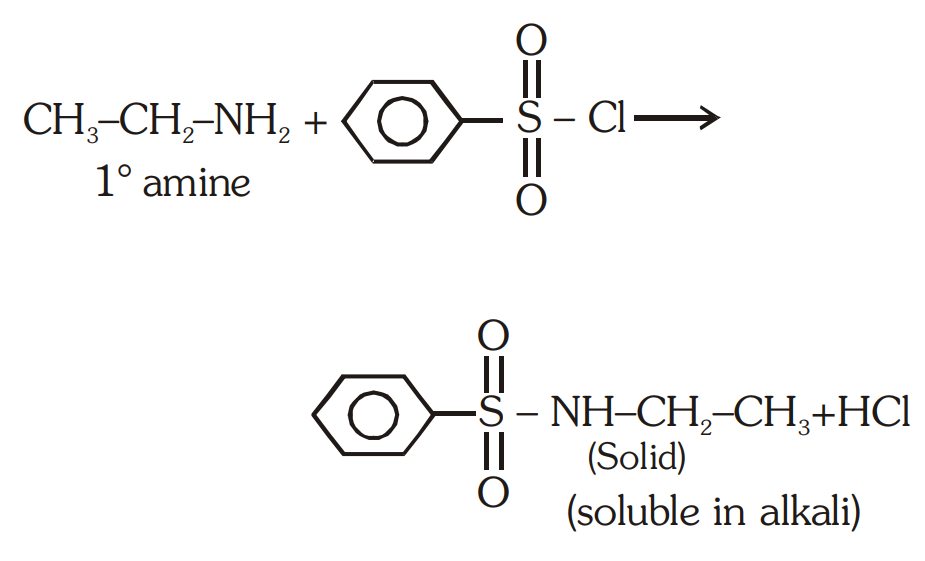
Diazonium Salts – Replacement of the Diazo Group
-
The reagent 'R' in the given sequence of chemical reaction is:
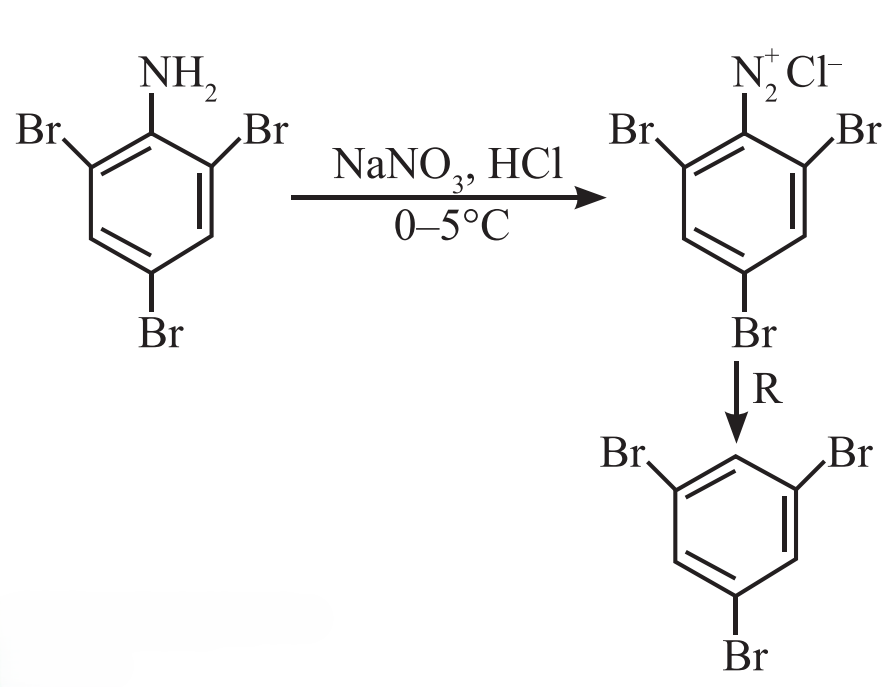
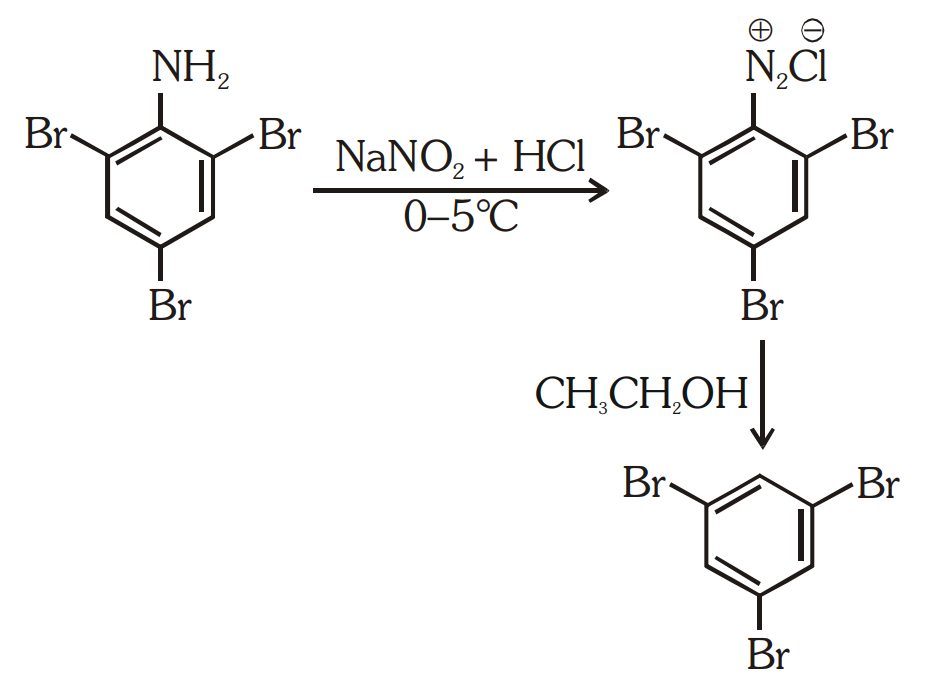
2,4,6-Tribromoaniline $\xrightarrow{NaNO_2 + HCl,\ 0-5^\circ C}$ diazonium chloride $\xrightarrow{CH_3CH_2OH}$ 1,3,5-tribromobenzene
Mild reducing agents like hypophosphorous acid or ethanol reduce diazonium salts to arenes (they themselves are oxidised to phosphorous acid and ethanal).
So R is $CH_3CH_2OH$.
Chemical Reactions of Amines – Carbylamine Reaction
-
Which of the following amine will give the carbylamine test?The carbylamine test is given only by primary amines (aliphatic and aromatic). Aniline ($C_6H_5NH_2$) is a primary amine: $C_6H_5NH_2 + CHCl_3 + 3KOH \xrightarrow{\Delta} C_6H_5NC + 3KCl + 3H_2O$ (foul-smelling isocyanide) N-methylaniline, N,N-dimethylaniline and N-ethylaniline are secondary/tertiary amines and do not give this test.
Basic Character of Amines
-
The correct order of the basic strength of methyl substituted amines in aqueous solution is:In aqueous solution, the electron-donating inductive effect, solvation effect (H-bonding) and steric hindrance together decide the basic strength of substituted amines. Basic character: $(CH_3)_2NH>CH_3NH_2>(CH_3)_3N$ (2° > 1° > 3°)
-
Which of the following compounds is most basic?Basicity depends on how available the lone pair on nitrogen is for accepting a proton.
In benzylamine the $-NH_2$ group is attached to an $sp^3$ carbon ($-CH_2-$), not directly to the ring, so the lone pair is not delocalised into the benzene ring; it behaves like an aliphatic primary amine.
In aniline the lone pair is delocalised into the ring by resonance, which lowers its basicity.
In p-nitroaniline the electron-withdrawing $-NO_2$ group withdraws the lone pair further, making it even less basic than aniline.
In acetanilide the lone pair is delocalised onto the carbonyl oxygen of the $-COCH_3$ group as well, so it is almost non-basic.
Order of basicity: benzylamine > aniline > p-nitroaniline > acetanilide. Hence benzylamine is the most basic.
Free radical halogenation, ammonolysis, and diazotization-hydrolysis of primary amines
-
The major product Z formed in the following sequence of reactions is $C_2H_6 \xrightarrow[UV\ Light]{Cl_2} X\ (\text{monochlorinated product}) \xrightarrow{NH_3} Y \xrightarrow[(ii)\ H_2O]{(i)\ NaNO_2,\ HCl} Z$$C_2H_6 \xrightarrow[UV\ light]{Cl_2} CH_3CH_2Cl$ (X) $CH_3CH_2Cl \xrightarrow{NH_3} CH_3CH_2NH_2$ (Y) $CH_3CH_2NH_2 \xrightarrow[(ii)\ H_2O]{(i)\ NaNO_2 + HCl} CH_3CH_2OH$ (Z) So the major product Z is $C_2H_5OH$.
Preparation of amines - reduction of nitriles
-
Select the reagents that reduce nitriles to primary amines: I. (i) $LiAlH_4$; (ii) $H_2O$ II. $Sn + HCl$ III. $H_2/Ni$ IV. $Na(Hg)/C_2H_5OH$ V. $Br_2/aq.\ NaOH$ Choose the CORRECT answer from the options given below:$R-C \equiv N \rightarrow R-CH_2-NH_2$ can be carried out by: (i) $LiAlH_4$; (ii) $H_2O$ $H_2/Ni$ (catalytic hydrogenation) $Na(Hg)/C_2H_5OH$ (Mendius reduction) $Sn + HCl$ reduces nitro compounds, and $Br_2/aq.\ NaOH$ is the Hofmann bromamide reagent for amides – neither reduces nitriles to primary amines. So the correct reagents are I, III and IV only.
Peroxide Effect and Nitrile Reduction
-
Predict the major product 'P' in the following sequence of reactions:
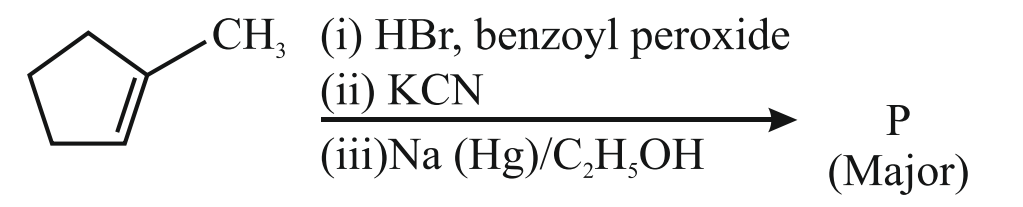
Peroxide effect adds Br at C-2 (anti-Markovnikov). Nucleophilic substitution with KCN yields 2-methylcyclopentanecarbonitrile. Reduction by Na(Hg)/EtOH (Mendius reduction) yields (2-methylcyclopentyl)methanamine.
Reaction step 1: Free radical anti-Markovnikov addition of HBr in the presence of benzoyl peroxide to 1-methylcyclopentene gives 1-bromo-2-methylcyclopentane (Br attaches to the less substituted carbon). Reaction step 2: Cyanide substitution ($S_N2$) with KCN replaces Br by CN, yielding 2-methylcyclopentanecarbonitrile. Reaction step 3: Reduction of nitrile group with $\text{Na(Hg)}/\text{C}_2\text{H}_5\text{OH}$ (Mendius reaction) reduces $-\text{CN}$ to $-\text{CH}_2\text{NH}_2$, producing (2-methylcyclopentyl)methanamine.
Diazonium salt reactions (Sandmeyer-type reaction with KI)
-
The major product X formed in the following reaction sequence is:
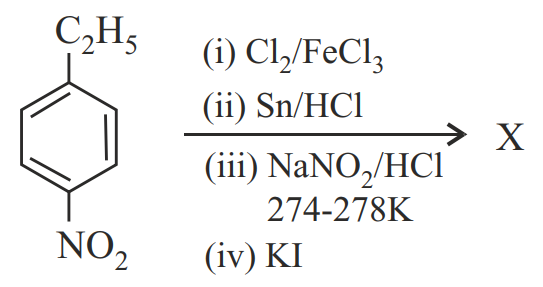 $Cl_2/FeCl_3$ chlorinates the ring ortho to the $-NO_2$ group (A); $Sn/HCl$ reduces $-NO_2$ to $-NH_2$ (B); $NaNO_2/HCl$ at $274$-$278$ K converts $-NH_2$ to a diazonium salt (C); reaction of the diazonium salt with KI replaces $-N_2^+$ with $-I$, giving the major product X with $Cl$ and $I$ substituents on the ethyl-substituted benzene ring.
Friedel-Crafts reaction and carbylamine test
-
The compound that does not undergo Friedel-Crafts alkylation reaction but gives a positive carbylamine test is:Aniline's $-NH_2$ group forms a salt with the Lewis acid catalyst ($AlCl_3$) used in Friedel-Crafts reactions, deactivating the ring towards Friedel-Crafts alkylation. Since aniline is a primary amine, it gives a positive carbylamine (isocyanide) test with $CHCl_3/KOH$. N-methylaniline and triethylamine are secondary/tertiary amines and do not give the carbylamine test.
Hofmann bromamide degradation reaction
-
Reaction of propanamide with ethanolic sodium hydroxide and bromine will giveIn the Hofmann bromamide degradation reaction, an amide $RCONH_2$ reacts with $Br_2$ and alcoholic $NaOH$ to give a primary amine with one carbon less than the starting amide: $CH_3CH_2CONH_2$ (propanamide) $\rightarrow CH_3CH_2NH_2$ (ethylamine).
Basicity of nitrogen-containing carbonyl/guanidine derivatives
-
Which amongst the following compounds/species is least basic?Among these related structures, the species shown in option (2) — a protonated (cationic) form with a hydroxyl group — is the least stabilised by resonance/least favourable to form further by protonation, making it the least basic species among the given options.
Sandmeyer-type reduction sequence - deamination via diazonium salt
-
Choose the correct sequence of reagents in the conversion of 4-nitrotoluene to 2-bromotoluene.4-nitrotoluene is first brominated ortho to the nitro group (electrophilic substitution guided by $-NO_2$, using $Br_2$) to give 2-bromo-4-nitrotoluene; the nitro group is then reduced to amine ($Sn/HCl$); the amine is converted to a diazonium salt ($NaNO_2/HCl$); and finally the diazonium group is replaced by hydrogen using $H_3PO_2/H_2O$ (deamination), giving 2-bromotoluene. Sequence: $Br_2\to Sn/HCl\to NaNO_2/HCl\to H_2O/H_3PO_2$.
Acetylation of aniline and reduction of amides
-
The product formed from the following reaction sequence is:
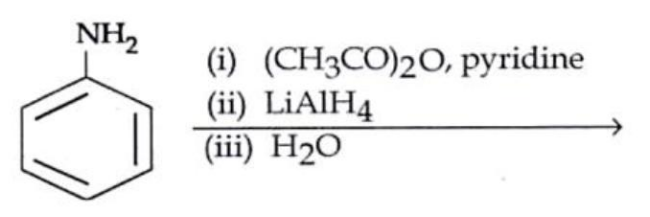 Aniline is acetylated by acetic anhydride/pyridine to acetanilide ($C_6H_5NHCOCH_3$). $LiAlH_4$ reduces the amide C=O to $CH_2$, giving N-ethylaniline ($C_6H_5NHCH_2CH_3$).
Hinsberg's test
-
The amine that reacts with Hinsberg's reagent to give an alkali insoluble product is:Secondary amines react with benzenesulphonyl chloride to give N,N-dialkylbenzenesulphonamides with no acidic H on N, so they are insoluble in alkali: $[(CH_3)_2CH]_2NH+ClSO_2Ph\rightarrow[(CH_3)_2CH]_2NSO_2Ph+HCl$. Primary amines give alkali-soluble products and tertiary amines do not react.
Preparation of aniline
-
Identify the reactions which give aniline as the major product.
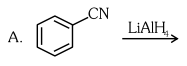
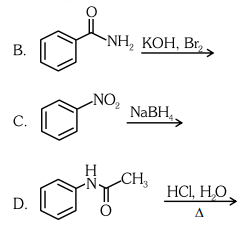
Choose the correct answer from the options given below.A. $C_6H_5CN\xrightarrow{LiAlH_4}C_6H_5CH_2NH_2$ (benzylamine, not aniline). B. $C_6H_5CONH_2\xrightarrow{KOH,\ Br_2}C_6H_5NH_2$ (Hoffmann bromamide degradation gives aniline). C. $C_6H_5NO_2\xrightarrow{NaBH_4}$ no reaction. D. $C_6H_5NHCOCH_3\xrightarrow{HCl,\ H_2O,\ \Delta}C_6H_5NH_2$ (hydrolysis of acetanilide gives aniline). So B and D only.
Effect of substituents on acidity and basicity
-
Given below are two statements: Statement-I: Oxidation of p-nitrotoluene with acidic $KMnO_4$ gives an acid that is stronger than benzoic acid. Statement-II: Reduction of p-nitrotoluene with Sn/HCl followed by neutralization gives an amine that is more basic than aniline. In light of the above statements, choose the most appropriate answer from the options given below.S-I: p-nitrotoluene $\xrightarrow{KMnO_4/H^+}$ p-nitrobenzoic acid, which is a stronger acid than benzoic acid (electron-withdrawing $-NO_2$) - correct. S-II: p-nitrotoluene $\xrightarrow{Sn/HCl}$ p-toluidine, which is more basic than aniline (electron-donating $-CH_3$) - correct.
Hoffmann bromamide degradation
-
In a set of reactions propionic acid yielded a compound D.
$CH_3CH_2COOH \xrightarrow{SOCl_2} B \xrightarrow{NH_3} C \xrightarrow[Br_2]{KOH} D$
The structure of D would be :-Step 1: thionyl chloride converts the carboxylic acid into the acid chloride.
$CH_3CH_2COOH \xrightarrow{SOCl_2} CH_3CH_2COCl$ (B, propanoyl chloride) $+ SO_2 + HCl$
Step 2: ammonia converts the acid chloride into the amide.
$CH_3CH_2COCl \xrightarrow{NH_3} CH_3CH_2CONH_2$ (C, propanamide)
Step 3: the amide on treatment with $Br_2$ and KOH undergoes Hoffmann bromamide degradation, giving a primary amine with one carbon atom less than the amide.
$CH_3CH_2CONH_2 + Br_2 + 4KOH \rightarrow CH_3CH_2NH_2 + K_2CO_3 + 2KBr + 2H_2O$
So D is ethylamine, $CH_3CH_2NH_2$. -
Intermediates formed during reaction of $RCONH_2$ with $Br_2$ and KOH are : -This is the Hoffmann bromamide degradation, which converts an amide into a primary amine with one carbon less.
Step 1: Bromination of the amide nitrogen gives an N-bromoamide: $RCONH_2 + Br_2 + KOH \rightarrow RCONHBr + KBr + H_2O$
Step 2: The base removes the remaining N–H proton, and the R group migrates from carbon to nitrogen with loss of $Br^-$, forming an isocyanate: $RCONHBr \rightarrow R-N=C=O$
Step 3: Hydrolysis of the isocyanate gives the amine: $RNCO + 2KOH \rightarrow RNH_2 + K_2CO_3$
So the intermediates are RCONHBr (N-bromoamide) and RNCO (alkyl isocyanate).
Nitro compounds – reaction with nitrous acid
-
Which one of the following nitro-compounds does not react with nitrous acid?
Reaction with $HNO_2$ needs an $\alpha$-hydrogen.
A 3° nitro compound does not react with $HNO_2$ because of the absence of $\alpha$-H.
Diazonium salts – coupling reaction
-
A given nitrogen-containing aromatic compound A reacts with Sn/HCl, followed by $HNO_2$ to give an unstable compound B. B, on treatment with phenol, forms a beautiful coloured compound C with the molecular formula $C_{12}H_{10}N_2O$. The structure of compound A is:
Reduction, diazotisation and coupling with phenol give an azo dye.
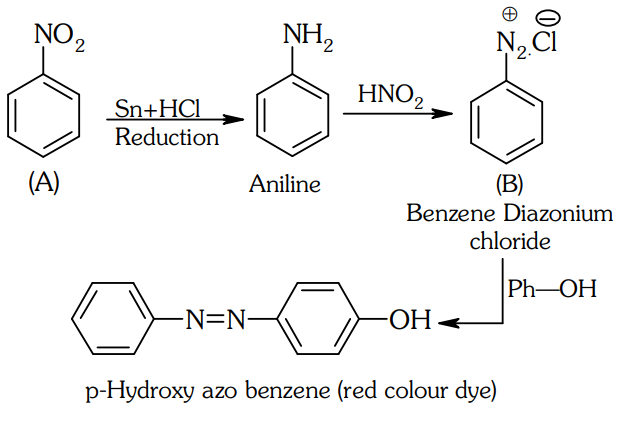
$C_6H_5NO_2$ (A) $\xrightarrow{Sn + HCl\ (reduction)}$ $C_6H_5NH_2$ (aniline) $\xrightarrow{HNO_2}$ $C_6H_5N_2^+Cl^-$ (B, benzene diazonium chloride)
B + phenol → p-hydroxyazobenzene, $C_6H_5-N=N-C_6H_4-OH$ (C, coloured dye)
So A is nitrobenzene.
Reduction of nitro compounds
-
The electrolytic reduction of nitrobenzene in strongly acidic medium produces:In strongly acidic medium nitrobenzene is reduced to phenylhydroxylamine, which rearranges to p-aminophenol.
$C_6H_5NO_2 \xrightarrow{\text{strongly acidic medium}} C_6H_5NHOH \xrightarrow{\text{rearrangement}} p\text{-}HOC_6H_4NH_2$ -
What is the product obtained in the following reaction?
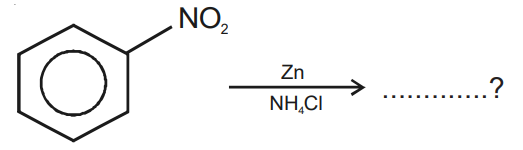 The product of reduction of nitrobenzene depends on the medium.
In acidic medium (Sn/HCl or Fe/HCl) nitrobenzene is reduced completely to aniline, $C_6H_5NH_2$.
In neutral medium (Zn dust with aqueous $NH_4Cl$) the reduction stops at the hydroxylamine stage: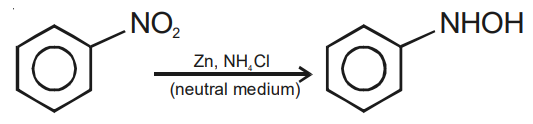
In alkaline medium, bimolecular products such as azoxybenzene, azobenzene and hydrazobenzene are formed.
Hence the product with $Zn/NH_4Cl$ is N-phenylhydroxylamine, $C_6H_5NHOH$.
Reactions of amines
-
An organic compound ($C_3H_9N$) (A), when treated with nitrous acid, gave an alcohol and $N_2$ gas was evolved. (A) on warming with $CHCl_3$ and caustic potash gave (C) which on reduction gave isopropylmethylamine. Predict the structure of (A).
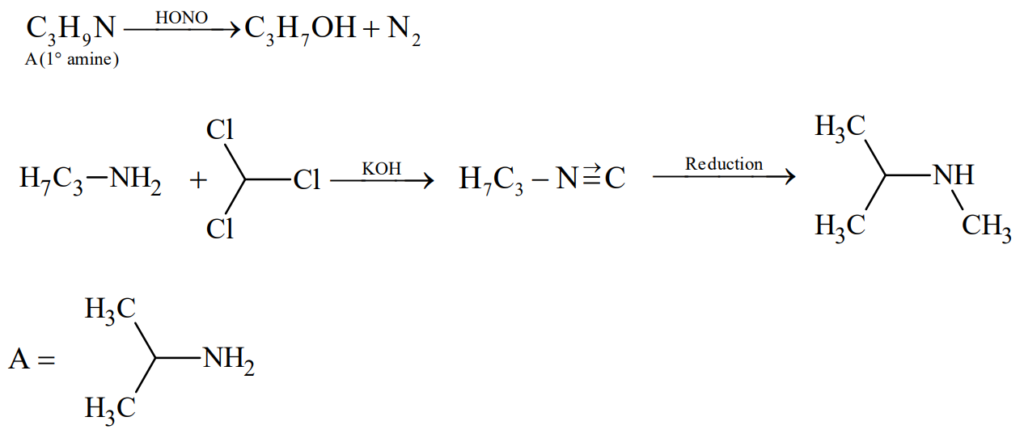
A gives an alcohol and $N_2$ with nitrous acid, so A is a primary aliphatic amine: $C_3H_7NH_2 \xrightarrow{HONO} C_3H_7OH + N_2$
A primary amine warmed with $CHCl_3$ and KOH gives an isocyanide (carbylamine reaction): $C_3H_7NH_2 \xrightarrow{CHCl_3/KOH} C_3H_7-N\overset{\rightarrow}{=}C$ (C)
Reduction of an isocyanide gives a secondary amine with an N-methyl group: $C_3H_7-NC \xrightarrow{reduction} C_3H_7-NH-CH_3$
The product is isopropylmethylamine, $(CH_3)_2CH-NH-CH_3$, so the $C_3H_7$ group is isopropyl.
A is isopropylamine, $(CH_3)_2CH-NH_2$.
Reactions of amines with nitrous acid
-
Predict the product:
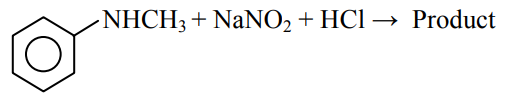 $NaNO_2$ and HCl generate nitrous acid, $HNO_2$, in situ.
N-methylaniline is a secondary amine (the nitrogen carries one H).
Secondary amines, aliphatic or aromatic, react with nitrous acid to give N-nitrosoamines, which separate as yellow oily liquids: $R_2NH + HONO \rightarrow R_2N-N=O + H_2O$
$C_6H_5NHCH_3 + HONO \rightarrow C_6H_5-N(CH_3)-N=O + H_2O$
Ring nitrosation (at the para position) is characteristic of tertiary aromatic amines, not secondary ones.
Hence the product is N-nitroso-N-methylaniline, $C_6H_5-N(CH_3)-N=O$.
Diazonium Salts and Coupling Reactions
-
In a reaction of aniline a coloured product (C) was obtained.
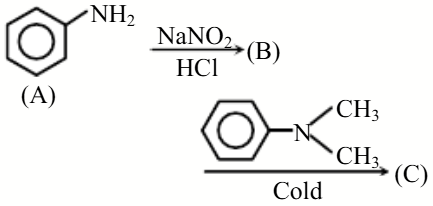
The structure of (C) would be -Step 1 (diazotisation): aniline reacts with nitrous acid ($NaNO_2 + HCl$) in the cold to give benzenediazonium chloride.
$C_6H_5NH_2 \xrightarrow{NaNO_2,\ HCl} C_6H_5-N\equiv N^+Cl^-$ (B)
Step 2 (coupling): the benzenediazonium ion is a weak electrophile. It attacks the strongly activated ring of N,N-dimethylaniline in the cold.
The $-N(CH_3)_2$ group is ortho, para directing; because of its bulk the attack takes place at the para position.
$C_6H_5-N_2^+Cl^- + C_6H_5-N(CH_3)_2 \xrightarrow{\text{Cold}} C_6H_5-N=N-C_6H_4-N(CH_3)_2 + HCl$
The product (C) is p-dimethylaminoazobenzene, a yellow azo dye known as butter yellow.
The colour is due to the extended conjugation through the $-N=N-$ (azo) group.
Preparation of Amines by Reduction
-
Electrolytic reduction of nitrobenzene in weakly acidic medium gives :-The reduction of nitrobenzene takes place in steps: $C_6H_5NO_2 \rightarrow C_6H_5NO$ (nitrosobenzene) $\rightarrow C_6H_5NHOH$ (N-phenylhydroxylamine) $\rightarrow C_6H_5NH_2$ (aniline).
The final product depends on the medium.
In a weakly acidic medium the reduction goes to completion, and the product of electrolytic reduction is aniline: $C_6H_5NO_2 + 6H^+ + 6e^- \rightarrow C_6H_5NH_2 + 2H_2O$
In a strongly acidic medium (conc. $H_2SO_4$), the intermediate N-phenylhydroxylamine rearranges to p-aminophenol (p-hydroxyaniline).
In a neutral medium (for example with Zn and $NH_4Cl$), N-phenylhydroxylamine is the main product.
So electrolytic reduction in weakly acidic medium gives aniline.
Reductive Amination
-
The major organic product formed from cyclohexanone in the following reaction
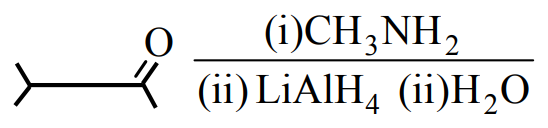 is:-Step 1: methylamine, a primary amine, adds to the carbonyl group of cyclohexanone. The addition product (a carbinolamine) loses a molecule of water to form an imine (a Schiff base).
$C_6H_{10}=O + CH_3NH_2 \rightarrow C_6H_{10}=N-CH_3 + H_2O$ (N-methylcyclohexanimine)
Step 2: $LiAlH_4$ reduces the C=N double bond of the imine.
Step 3: hydrolysis (work-up with water) gives the secondary amine.
$C_6H_{10}=N-CH_3 \xrightarrow{LiAlH_4,\ H_2O} C_6H_{11}-NH-CH_3$
The carbinolamine is only an unstable intermediate and is not the final product, and no N-O bond is formed.
So the major product is N-methylcyclohexylamine (N-methylcyclohexanamine).
Diazonium Salts and their Reactions
-
Aniline in a set of reactions yielded a product D
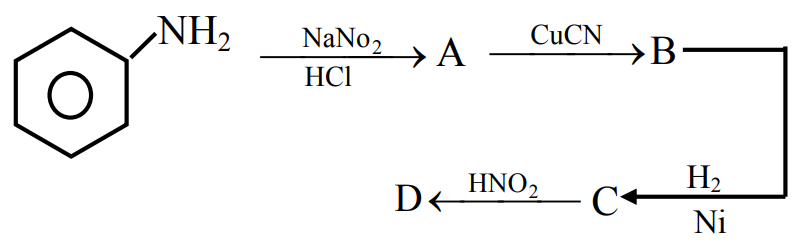
The structure of the product D would be -Step 1 (diazotisation): $C_6H_5NH_2 \xrightarrow{NaNO_2,\ HCl,\ 273-278\ K} C_6H_5N_2^+Cl^-$ (A, benzenediazonium chloride)
Step 2 (Sandmeyer reaction): $C_6H_5N_2^+Cl^- \xrightarrow{CuCN} C_6H_5CN$ (B, benzonitrile) $+ N_2$
Step 3 (reduction): $C_6H_5CN \xrightarrow{H_2/Ni} C_6H_5CH_2NH_2$ (C, benzylamine)
Step 4: benzylamine is a primary aliphatic amine (the $NH_2$ is on a $CH_2$ group, not on the ring). With nitrous acid it gives an unstable aliphatic diazonium salt, which loses nitrogen and gives the alcohol.
$C_6H_5CH_2NH_2 + HNO_2 \rightarrow C_6H_5CH_2OH + N_2 + H_2O$
So D is benzyl alcohol, $C_6H_5CH_2OH$.
Preparation and Acylation of Amines
-
$CH_3CH_2Cl \xrightarrow{NaCN} X \xrightarrow{Ni/H_2} Y \xrightarrow{\text{acetic anhydride}} Z$. Z in the above reaction sequence is : -Step 1: Nucleophilic substitution by cyanide gives propanenitrile (X): $CH_3CH_2Cl + NaCN \rightarrow CH_3CH_2CN + NaCl$
Step 2: Catalytic hydrogenation reduces the nitrile to a primary amine (Y): $CH_3CH_2C\equiv N + 2H_2 \xrightarrow{Ni} CH_3CH_2CH_2NH_2$ (n-propylamine)
Step 3: Acetic anhydride acetylates the amine to an amide (Z): $CH_3CH_2CH_2NH_2 + (CH_3CO)_2O \rightarrow CH_3CH_2CH_2NHCOCH_3 + CH_3COOH$
So Z is N-propylacetamide, $CH_3CH_2CH_2NHCOCH_3$.
Carbylamine Reaction
-
A $\xrightarrow{reduction}$ B $\xrightarrow{CHCl_3/KOH}$ C $\xrightarrow{reduction}$ N-methyl aniline, then A is :Reduction of an isocyanide gives a secondary amine with a methyl group on nitrogen: $C_6H_5N\equiv C + 4[H] \rightarrow C_6H_5NHCH_3$. So C is phenyl isocyanide.
An isocyanide is formed from a primary amine by the carbylamine reaction: $C_6H_5NH_2 + CHCl_3 + 3KOH \rightarrow C_6H_5NC + 3KCl + 3H_2O$. So B is aniline.
Aniline is formed by reduction of nitrobenzene: $C_6H_5NO_2 + 6[H] \xrightarrow{Sn/HCl} C_6H_5NH_2 + 2H_2O$. So A is nitrobenzene.
Sequence: $C_6H_5NO_2 \rightarrow C_6H_5NH_2 \rightarrow C_6H_5NC \rightarrow C_6H_5NHCH_3$
So A is nitrobenzene.
That is every question in Amines for this filter.
Want a score?
Answers here are not saved. Practise as a test to be marked and see your progress.
Practise as a test