Looking for classes? Ksquare Career Institute, Bengaluru →

Chemistry
Chemical Kinetics
80 questions from 37 papers, each with its answer.
- 80 questions
- 37 papers
- 4.55% of Chemistry
Arrhenius Equation and Activation Energy
-
Given below is an expression for the rate constant of a first order reaction occurring at a certain temperature, T (K). $\ln k = 14.34 - \frac{1.25 \times 10^4}{T}$ The energy of activation in kcal $mol^{-1}$ for the reaction is: [Given: k in $s^{-1}$, $R = 1.987$ cal $mol^{-1}\,K^{-1}$]$\ln k = 14.34 - \frac{1.25 \times 10^4}{T}$ Comparing with $\ln k = \ln A - \frac{E_a}{RT}$: $\frac{E_a}{R} = 1.25 \times 10^4$ $E_a = 1.25 \times 10^4 \times \frac{1.987}{1000}\ kcal\,mol^{-1}$ $E_a = 24.84\ kcal\,mol^{-1}$
-
Activation energy of any chemical reaction can be calculated if one knows the value ofThe activation energy of a reaction can be determined by evaluating the rate constants at two different temperatures, using the Arrhenius equation: $\log\frac{k_2}{k_1} = \frac{E_a}{2.303R}\left(\frac{T_2 - T_1}{T_1T_2}\right)$
Arrhenius Equation Graph
-
Which plot of $\ln k$ vs $\frac{1}{T}$ is consistent with Arrhenius equation?Arrhenius equation: $k = Ae^{-E_a/RT}$
$\ln k = \ln A - \frac{E_a}{R}\left(\frac{1}{T}\right)$
This is a straight line ($y = mx + c$) with slope $-\frac{E_a}{R}$ (negative) and intercept $\ln A$ (positive).
So the plot of $\ln k$ vs $\frac{1}{T}$ is a straight line with a negative slope.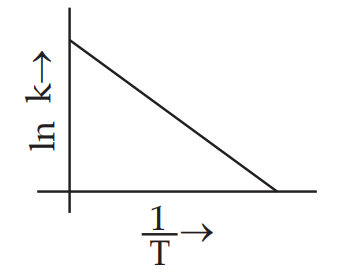
Integrated Rate Equations – Zero and First Order
-
The given graph is a representation of kinetics of a reaction.
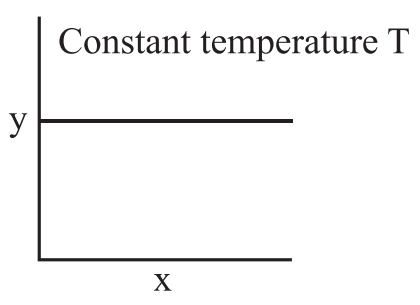 The y and x axes for zero and first order reactions, respectively areThe graph is a horizontal line (y independent of x). Zero order: rate is constant and does not depend on concentration, so y = rate and x = concentration. First order: $t_{1/2} = \frac{0.693}{k}$ does not depend on concentration, so y = $t_{1/2}$ and x = concentration.
Integrated Rate Equation for a First Order Reaction
-
For a first order reaction $A\rightarrow$ Products, initial concentration of A is 0.1 M, which becomes 0.001 M after 5 minutes. Rate constant for the reaction in $min^{-1}$ isFor a first order reaction: $k = \frac{2.303}{t}\log\frac{[A]_0}{[A]_t}$ $k = \frac{2.303}{5}\log\frac{0.1}{0.001} = \frac{2.303}{5} \times 2$ $k = 0.9212\ min^{-1}$
-
The rate constant for a first order reaction is $4.606\times10^{-3}\ s^{-1}$. The time required to reduce 2.0 g of the reactant to 0.2 g is:For a first order reaction: $k = \frac{2.303}{t}\log\frac{A_0}{A}$ $4.606 \times 10^{-3} = \frac{2.303}{t}\log\frac{2}{0.2}$ $t = \frac{2.303}{4.606 \times 10^{-3}} \times \log 10 = \frac{10^3}{2} = 500$ s
Activation Energy – Potential Energy Profile
-
For a reaction $A\rightarrow B$, enthalpy of reaction is $-4.2\ kJ\ mol^{-1}$ and enthalpy of activation is $9.6\ kJ\ mol^{-1}$. The correct potential energy profile for the reaction is shown in option.$\Delta H$ is negative, so the reaction is exothermic: product B lies lower in energy than reactant A, with an activation energy barrier of 9.6 kJ $mol^{-1}$ above A.
Temperature Dependence of Rate – Arrhenius Equation
-
The slope of Arrhenius Plot ($\ln k$ v/s $1/T$) of first order reaction is $-5\times10^3$ K. The value of $E_a$ of the reaction is. Choose the correct option for your answer. [Given $R=8.314\ JK^{-1}\ mol^{-1}$]$\ln k = \ln A - \frac{E_a}{R}\left(\frac{1}{T}\right)$, so the slope of $\ln k$ vs $\frac{1}{T}$ is $-\frac{E_a}{R}$ $-5 \times 10^3 = -\frac{E_a}{8.314}$ $E_a = 5 \times 10^3 \times 8.314 = 41570$ J $mol^{-1} \approx 41.5$ kJ $mol^{-1}$
Rate of a Chemical Reaction
-
For the chemical reaction $N_2(g)+3H_2(g)\rightleftharpoons2NH_3(g)$ the correct option is:$N_2+3H_2\rightleftharpoons2NH_3$ Rate of reaction $=-\frac{d[N_2]}{dt}=-\frac{1}{3}\frac{d[H_2]}{dt}=+\frac{1}{2}\frac{d[NH_3]}{dt}$ So $-\frac{d[N_2]}{dt}=\frac{1}{2}\frac{d[NH_3]}{dt}$ is correct.
-
The rate of the reaction $2N_2O_5 \rightarrow 4NO_2 + O_2$ can be written in three ways:
$\frac{-d[N_2O_5]}{dt} = k[N_2O_5]$
$\frac{d[NO_2]}{dt} = k'[N_2O_5]$
$\frac{d[O_2]}{dt} = k''[N_2O_5]$
The relationship between k and k′ and between k and k″ areFor $2N_2O_5 \rightarrow 4NO_2 + O_2$: Rate $= -\frac{1}{2}\frac{d[N_2O_5]}{dt} = \frac{1}{4}\frac{d[NO_2]}{dt} = \frac{d[O_2]}{dt}$
Substituting the three given expressions: $\frac{1}{2}k[N_2O_5] = \frac{1}{4}k'[N_2O_5] = k''[N_2O_5]$
$\frac{k}{2} = \frac{k'}{4} = k''$
From $\frac{k}{2} = \frac{k'}{4}$: $k' = 2k$
From $\frac{k}{2} = k''$: $k'' = \frac{k}{2}$
So k′ = 2k and k″ = k/2.
Order of reaction and units of rate constant
-
Match List I with List II:
Pick the matching item from Column II for each row.
Column I
- i. Zero order
- ii. First order
- iii. Second order
- iv. Third order
Column II
- a. $mol^{-1}\,L\,s^{-1}$
- b. $mol^{-2}\,L^2\,s^{-1}$
- c. $s^{-1}$
- d. $mol\,L^{-1}\,s^{-1}$
Correct answer: i → d, ii → c, iii → a, iv → b
Unit of k = $mol^{1-n}\,L^{n-1}\,time^{-1}$ Zero order (n = 0): $mol\,L^{-1}\,s^{-1}$ First order (n = 1): $s^{-1}$ Second order (n = 2): $mol^{-1}\,L\,s^{-1}$ Third order (n = 3): $mol^{-2}\,L^2\,s^{-1}$ Correct match: i-d, ii-c, iii-a, iv-b.
Zero order reaction - integrated rate law
-
For a certain reaction $R \rightarrow$ Product, the plot of concentration [R] vs time has a negative slope as shown. The order of reaction is:
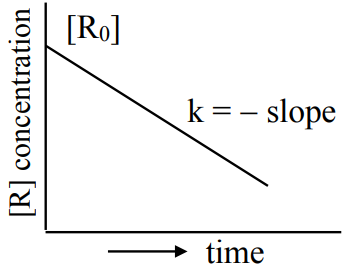 [Reactant] vs time graph is linear (straight line with negative slope, slope = $-k$) only for a zero order reaction: $[R] = [R]_0 - kt$ $\therefore$ order = 0
Determining order of reaction from rate data
-
Following data is for a reaction between reactants A and B: Rate (mol L$^{-1}$ s$^{-1}$): $2\times10^{-3}$ at [A]=0.1 M, [B]=0.1 M; $4\times10^{-3}$ at [A]=0.2 M, [B]=0.1 M; $1.6\times10^{-2}$ at [A]=0.2 M, [B]=0.2 M. The order of the reaction with respect to A and B, respectively, areLet Rate $=k[A]^x[B]^y$. Comparing rows 1 and 2 (B constant): $\dfrac{4\times10^{-3}}{2\times10^{-3}}=\left(\dfrac{0.2}{0.1}\right)^x\Rightarrow2=2^x\Rightarrow x=1$. Comparing rows 2 and 3 (A constant): $\dfrac{1.6\times10^{-2}}{4\times10^{-3}}=\left(\dfrac{0.2}{0.1}\right)^y\Rightarrow4=2^y\Rightarrow y=2$. So order w.r.t. A is 1 and w.r.t. B is 2.
Arrhenius equation - graphical representation
-
Which of the following plot represents the variation of $\ln k$ versus $\dfrac{1}{T}$ in accordance with Arrhenius equation?Arrhenius equation: $k=Ae^{-E_a/RT}\Rightarrow\ln k=\ln A-\dfrac{E_a}{R}\cdot\dfrac{1}{T}$. This is a straight line ($y=mx+c$) with slope $m=-\dfrac{E_a}{R}$ (negative) and intercept $\ln A$, i.e. $\ln k$ decreases linearly as $1/T$ increases.
Arrhenius equation - calculating activation energy from two rate constants
-
Rate constants of a reaction at 500 K and 700 K are 0.04 $s^{-1}$ and 0.14 $s^{-1}$, respectively; then, activation energy of the reaction is: (Given: $\log3.5=0.5441$, $R=8.31\ J\,K^{-1}mol^{-1}$)$\ln\dfrac{k_2}{k_1}=\dfrac{E_a}{R}\left[\dfrac{1}{T_1}-\dfrac{1}{T_2}\right]$. $\ln\dfrac{0.14}{0.04}=\log3.5\times2.303=0.5441\times2.303$. So $0.5441\times2.303=\dfrac{E_a}{8.31}\left[\dfrac{1}{500}-\dfrac{1}{700}\right]=\dfrac{E_a}{8.31}\times\dfrac{1}{1750}$. Solving, $E_a=0.5441\times2.303\times8.31\times1750\approx18219$ J.
Zero order reaction - half-life
-
The half-life for a zero order reaction having 0.02 M initial concentration of reactant is 100 s. The rate constant (in mol L$^{-1}$ s$^{-1}$) for the reaction isFor a zero order reaction, $t_{1/2}=\dfrac{[A_0]}{2k}\Rightarrow k=\dfrac{[A_0]}{2t_{1/2}}=\dfrac{0.02}{2\times100}=1.0\times10^{-4}\ mol\,L^{-1}s^{-1}$.
Collision theory of reaction rates
-
In collision theory of chemical reaction, $Z_{AB}$ representsIn collision theory, $Z_{AB}$ represents the collision frequency of the reactants A and B, i.e. the number of collisions per unit time per unit volume.
Rate expressions for reactants and products
-
For a reaction $3A\rightarrow2B$ The average rate of appearance of B is given by $\dfrac{\Delta[B]}{\Delta t}$. The correct relation between the average rate of appearance of B with the average rate of disappearance of A is given in option:$r=-\dfrac{1}{3}\dfrac{\Delta[A]}{\Delta t}=+\dfrac{1}{2}\dfrac{\Delta[B]}{\Delta t}\Rightarrow\dfrac{\Delta[B]}{\Delta t}=-\dfrac{2}{3}\dfrac{\Delta[A]}{\Delta t}$.
Overall order of reaction
-
The correct options for the rate law that corresponds to overall first order reaction isOverall order = sum of the individual orders. For $r=k[A]^{-1/2}[B]^{3/2}$: order $=-\dfrac{1}{2}+\dfrac{3}{2}=\dfrac{2}{2}=1$, i.e. overall first order.
Rate of reaction and stoichiometry
-
For a chemical reaction $4A+3B\rightarrow6C+9D$, rate of formation of C is $6\times10^{-2}$ mol L$^{-1}$ s$^{-1}$ and rate of disappearance of A is $4\times10^{-2}$ mol L$^{-1}$ s$^{-1}$. The rate of reaction and amount of B consumed in interval of 10 seconds, respectively will be:$r=-\frac{1}{4}\frac{d[A]}{dt}=\frac{1}{6}\frac{d[C]}{dt}=\frac{1}{6}\times6\times10^{-2}=1\times10^{-2}$ mol L$^{-1}$ s$^{-1}$. $-\frac{d[B]}{dt}=3r=3\times10^{-2}$ mol L$^{-1}$ s$^{-1}$, so B consumed in 10 s $=3\times10^{-2}\times10=30\times10^{-2}$ mol L$^{-1}$.
Arrhenius equation
-
What is the activation energy for a reaction if its rate doubles when the temperature is raised from $20^\circ C$ to $35^\circ C$? (R = 8.314 J $mol^{-1}K^{-1}$)$\log\frac{K_2}{K_1} = \frac{E_a}{2.303R}\left[\frac{1}{T_1} - \frac{1}{T_2}\right]$, with $\frac{K_2}{K_1} = 2$
$\log2 = \frac{E_a}{2.303\times8.314\times10^{-3}}\left[\frac{1}{293} - \frac{1}{308}\right]$
$E_a = 34.7$ kJ $mol^{-1}$ -
The rate constants $k_1$ and $k_2$ for two different reactions are $10^{16}\cdot e^{-2000/T}$ and $10^{15}\cdot e^{-1000/T}$, respectively. The temperature at which $k_1 = k_2$ is :$k_1 = 10^{16}\,e^{-2000/T}$ and $k_2 = 10^{15}\,e^{-1000/T}$
The temperature at which $k_1 = k_2$ will be given by: $10^{16}\,e^{-2000/T} = 10^{15}\,e^{-1000/T}$
$\dfrac{e^{-2000/T}}{e^{-1000/T}} = \dfrac{10^{15}}{10^{16}}$
$e^{-1000/T} = 10^{-1}$
Taking natural logarithm: $\ln e^{-1000/T} = \ln 10^{-1}$
$2.303 \times \log e^{-1000/T} = 2.303 \times \log 10^{-1}$
$-\dfrac{1000}{T} = -2.303$
On solving, we get $T = \dfrac{1000}{2.303}$ K
Zero order reactions
-
$2A\xrightarrow{k}B$ is a zero-order reaction, where k = 1.0 mol L$^{-1}$ min$^{-1}$. If the initial concentration of A is 2 M, then the time taken to complete 75% of the reaction will be$2A\xrightarrow{k}B$, zero order: rate $=\frac{1}{2}\left(-\frac{d[A]}{dt}\right)=k \Rightarrow -\frac{d[A]}{dt}=2k \Rightarrow [A]_0-[A]_t=2kt$. For 75% completion, $[A]_t=0.25\times2=0.5$ M: $2-0.5=2(1)t_{75\%} \Rightarrow t_{75\%}=0.75$ min.
First order kinetics – half-life from rates
-
The rate of a first-order reaction is 0.04 mol $L^{-1}s^{-1}$ at 10 sec and 0.03 mol $L^{-1}s^{-1}$ at 20 sec after initiation of the reaction. The half-life period of the reaction is
For first order, rate ∝ concentration.
For a first order reaction, $K = \frac{2.303}{t_2 - t_1}\log\frac{[A]_1}{[A]_2} = \frac{2.303}{t_2 - t_1}\log\frac{[rate]_1}{[rate]_2}$
$K = \frac{2.303}{20 - 10}\log\frac{0.04}{0.03} = 0.0287\ s^{-1}$
$\therefore T_{1/2} = \frac{0.693}{K} = \frac{0.693}{0.0287} = 24.14$ s
Rate law
-
In a reaction, A + B → Product, rate is doubled when the concentration of B is doubled, and rate increases by a factor of 8 when the concentrations of both the reactants (A and B) are doubled. Rate law for the reaction can be written as:Let rate $r_1 = k[A]^x[B]^y$
Doubling B: $r_2 = k[A]^x[2B]^y = 2r_1 \Rightarrow 2^y = 2 \Rightarrow y = 1$
Doubling both: $r_3 = k[2A]^x[2B]^y = 8r_1 \Rightarrow 2^x\times2^y = 2^3$
$2^x = 2^2 \Rightarrow x = 2$
Rate = $k[A]^2[B]$
Rate law and order
-
During the kinetic study of the reaction $2A + B \rightarrow C + D$, following results were obtained:
Run I: [A] = 0.1 mol $L^{-1}$, [B] = 0.1 mol $L^{-1}$, initial rate of formation of D = $6.0\times10^{-3}$ mol $L^{-1}min^{-1}$
Run II: [A] = 0.3, [B] = 0.2, rate = $7.2\times10^{-2}$
Run III: [A] = 0.3, [B] = 0.4, rate = $2.88\times10^{-1}$
Run IV: [A] = 0.4, [B] = 0.1, rate = $2.40\times10^{-2}$
Based on the above data which one of the following is correct?Let rate = $k[A]^a[B]^b$.
Runs II and III have the same [A] (0.3) while [B] changes from 0.2 to 0.4: $\frac{7.2\times10^{-2}}{2.88\times10^{-1}} = \left(\frac{0.2}{0.4}\right)^b$
$\frac{1}{4} = \left(\frac{1}{2}\right)^b$, so b = 2
Runs I and IV have the same [B] (0.1) while [A] changes from 0.1 to 0.4: $\frac{6.0\times10^{-3}}{2.40\times10^{-2}} = \left(\frac{0.1}{0.4}\right)^a$
$\frac{1}{4} = \left(\frac{1}{4}\right)^a$, so a = 1
Rate law: rate = $k[A][B]^2$
Rate Law from Initial Rate Data
-
The bromination of acetone that occurs in acid solution is represented by this equation.
$CH_3COCH_3(aq.) + Br_2(aq.) \rightarrow CH_3COCH_2Br(aq.) + H^+(aq.) + Br^-(aq.)$
These kinetic data were obtained for given reaction concentrations.
Initial concentrations (M) of $[CH_3COCH_3]$, $[Br_2]$, $[H^+]$ and the initial rate of disappearance of $Br_2$ (M s$^{-1}$):
Experiment 1: 0.30, 0.05, 0.05; rate $= 5.7 \times 10^{-5}$
Experiment 2: 0.30, 0.10, 0.05; rate $= 5.7 \times 10^{-5}$
Experiment 3: 0.30, 0.10, 0.10; rate $= 1.2 \times 10^{-4}$
Experiment 4: 0.40, 0.05, 0.20; rate $= 3.1 \times 10^{-4}$
Based on these data, the rate equation is :Let Rate $= k[CH_3COCH_3]^a[Br_2]^b[H^+]^c$.
Experiments 1 and 2: $[Br_2]$ is doubled (0.05 to 0.10) while the other two concentrations are constant, and the rate remains unaffected ($5.7 \times 10^{-5}$ in both).
So the order of reaction with respect to $Br_2$ is zero: $b = 0$.
Experiments 2 and 3: $[H^+]$ is doubled (0.05 to 0.10) and the rate becomes $\dfrac{1.2 \times 10^{-4}}{5.7 \times 10^{-5}} \approx 2$ times.
So the order with respect to $H^+$ is one: $c = 1$.
Experiments 1 and 4: $[CH_3COCH_3]$ becomes $\dfrac{0.40}{0.30} = \dfrac{4}{3}$ times and $[H^+]$ becomes 4 times; the rate becomes $\dfrac{3.1 \times 10^{-4}}{5.7 \times 10^{-5}} \approx 5.4$ times.
$\left(\dfrac{4}{3}\right)^a \times 4 = 5.4 \Rightarrow \left(\dfrac{4}{3}\right)^a = 1.35 \Rightarrow a = 1$
The rate law for the reaction is therefore: Rate $= k[CH_3COCH_3][H^+]$
This agrees with the mechanism: the slow step is the acid catalysed enolisation of acetone, and bromine reacts in a later fast step.
Reaction Mechanism and Rate Law
-
The reaction of hydrogen and iodine monochloride is given as:
$H_2(g) + 2ICl(g) \rightarrow 2HCl(g) + I_2(g)$
The reaction is of first order with respect to $H_2(g)$ and $ICl(g)$; following mechanisms were proposed.
Mechanism A:
$H_2(g) + 2ICl(g) \rightarrow 2HCl(g) + I_2(g)$
Mechanism B:
$H_2(g) + ICl(g) \rightarrow HCl(g) + HI(g)$; slow
$HI(g) + ICl(g) \rightarrow HCl(g) + I_2(g)$; fast
Which of the above mechanism(s) can be consistent with the given information about the reaction?The reaction is first order with respect to both $H_2$ and $ICl$, so the experimental rate law is $r = k[H_2][ICl]$.
Mechanism A is a single step involving one molecule of $H_2$ and two molecules of $ICl$. It would give $r = k[H_2][ICl]^2$, i.e. second order in $ICl$, which does not agree with the given information.
In mechanism B, the slowest step is the rate determining step.
The slow step involves one molecule of $H_2$ and one molecule of $ICl$, so the rate can be expressed as $r = k[H_2][ICl]$.
This shows that the reaction is first order with respect to both $H_2$ and $ICl$, which agrees with the given information.
So only mechanism B is consistent.
Integrated Rate Equation for First Order Reactions
-
If 60% of a first order reaction was completed in 60 minutes, 50% of the same reaction would be completed in approximately
($\log 4 = 0.60$, $\log 5 = 0.69$)For a first order reaction: $k = \dfrac{2.303}{t}\log\dfrac{a}{a - x}$
When $t = 60$ min, $x$ = 60 percent of $a$:
$k = \dfrac{2.303}{60}\log\dfrac{100}{100 - 60} = \dfrac{2.303}{60}\log\dfrac{100}{40}$
$\log\dfrac{100}{40} = \log 10 - \log 4 = 1 - 0.60 = 0.40$
$k = \dfrac{2.303 \times 0.40}{60} = 0.0153$ min$^{-1}$
Now for 50 percent completion: $t_{1/2} = \dfrac{2.303}{0.0153}\log\dfrac{100}{100 - 50} = \dfrac{2.303}{0.0153} \times \log 2$
$t_{1/2} = \dfrac{2.303}{0.0153} \times 0.3010$
$t_{1/2} = 45.31$ min, i.e. approximately 45 minutes
First Order Reactions
-
The reaction A → B follows first order kinetics. The time taken for 0.8 mole of A to produce 0.6 mole of B is 1 hour. What is the time taken for conversion of 0.9 mole of A to produce 0.675 mole of BFor a first order reaction, $t = \dfrac{2.303}{k}\log\dfrac{[A]_0}{[A]}$. The time depends only on the fraction converted, not on the initial amount.
Case 1: 0.8 mol A gives 0.6 mol B, so A left $= 0.2$ mol. Fraction converted $= \dfrac{0.6}{0.8} = 0.75$, and $\dfrac{[A]_0}{[A]} = \dfrac{0.8}{0.2} = 4$.
Case 2: 0.9 mol A gives 0.675 mol B, so A left $= 0.225$ mol. Fraction converted $= \dfrac{0.675}{0.9} = 0.75$, and $\dfrac{[A]_0}{[A]} = \dfrac{0.9}{0.225} = 4$.
Both cases correspond to 75% conversion (two half lives), so the time taken is the same.
So the time taken is 1 hour.
Rate of a Reaction
-
For the reaction $5Br^- + BrO_3^- + 6H^+ \rightarrow 3Br_2 + 3H_2O$, which of the following relations correctly represents the consumption and formation of reactants and products :The balanced equation is $5Br^- + BrO_3^- + 6H^+ \rightarrow 3Br_2 + 3H_2O$.
Rate $= -\dfrac{1}{5}\dfrac{d[Br^-]}{dt} = +\dfrac{1}{3}\dfrac{d[Br_2]}{dt}$
$\Rightarrow \dfrac{d[Br^-]}{dt} = -\dfrac{5}{3}\dfrac{d[Br_2]}{dt}$
Note: the source prints the reaction unbalanced (as $H^+ + BrO_3^- + 3Br^- \rightarrow 5Br_2 + H_2O$) and its key gives $\dfrac{d[Br^-]}{dt} = -\dfrac{3}{5}\dfrac{d[Br_2]}{dt}$, which follows from those printed coefficients (3 $Br^-$ and 5 $Br_2$). The equation here is balanced, so the correct answer is changed to $-\dfrac{5}{3}$.
Catalysis and Activation Energy
-
When a biochemical reaction is carried out in laboratory outside the human body in the absence of enzyme, then the rate of reaction obtained is $10^{-6}$ times, then activation energy of reaction in the presence of enzyme is : -An enzyme is a biological catalyst. It provides an alternative reaction path with a lower activation energy.
Without the enzyme (in the laboratory), the rate is only $10^{-6}$ times the rate with the enzyme, which shows that the activation energy without the enzyme is much higher.
From the Arrhenius equation, $\dfrac{k_{enzyme}}{k_{lab}} = e^{(E_{a,lab} - E_{a,enzyme})/RT} = 10^6$, so $E_{a,lab} - E_{a,enzyme} = 2.303 \times 6RT$.
So the activation energy in the presence of the enzyme is different from (lower than) the $E_a$ obtained in the laboratory.
That is every question in Chemical Kinetics for this filter.
Want a score?
Answers here are not saved. Practise as a test to be marked and see your progress.
Practise as a test