Looking for classes? Ksquare Career Institute, Bengaluru →

Chemistry
Structure of Atom
62 questions from 37 papers, each with its answer.
- 62 questions
- 37 papers
- 3.52% of Chemistry
Bohr Model Energy Levels for Hydrogen-like Species
-
The energy of an electron in the ground state ($n=1$) for $He^+$ ion is $-x$ J, then that for an electron in $n=2$ state for $Be^{3+}$ ion in J is:$E_n = -13.6\frac{Z^2}{n^2}$ eV For $He^+$ (Z = 2), n = 1: $E = -13.6 \times \frac{2^2}{1^2} = -13.6 \times 4 = -54.4$ eV $= -x$ For $Be^{3+}$ (Z = 4), n = 2: $E = -13.6 \times \frac{4^2}{2^2} = -13.6 \times 4 = -54.4$ eV So the energy for $Be^{3+}$ in n = 2 is $-x$ J.
Sub-atomic Particles and Isotopes
-
Select the correct statements from the following: A. Atoms of all elements are composed of two fundamental particles. B. The mass of the electron is $9.10939\times10^{-31}$ kg. C. All the isotopes of a given element show same chemical properties. D. Protons and electrons are collectively known as nucleons. E. Dalton's atomic theory, regarded the atom as an ultimate particle of matter. Choose the correct answer from the options given below:
An atom has three fundamental particles; nucleons are protons and neutrons, so A and D are wrong.
An atom has three fundamental particles – electron, proton and neutron. The mass of the electron is $9.10939\times10^{-31}$ kg. Neutrons and protons, both are collectively known as nucleons. All the isotopes of a given element show same chemical properties. Dalton's atomic theory regarded atom as an ultimate particle of matter.
Bohr's Model for Hydrogen-like Species
-
If radius of second Bohr orbit of the $He^+$ ion is 105.8 pm, what is the radius of third Bohr orbit of $Li^{2+}$ ion?From Bohr's model, $r \propto \frac{n^2}{Z}$ $\frac{(r_3)_{Li^{2+}}}{(r_2)_{He^+}} = \frac{n_1^2}{n_2^2} \times \frac{Z_2}{Z_1} = \frac{3 \times 3}{2 \times 2} \times \frac{2}{3}$ $(r_3)_{Li^{2+}} = 105.8 \times \frac{3}{2} = 158.7$ pm
Quantum Mechanical Model – Energies of Orbitals ((n+l) Rule)
-
4d, 5p, 5f and 6p orbitals are arranged in the order of decreasing energy. The correct option is:Using the $(n+l)$ rule: 4d = 4 + 2 = 6; 5p = 5 + 1 = 6; 5f = 5 + 3 = 8; 6p = 6 + 1 = 7 For equal $(n+l)$, higher n has higher energy, so 5p > 4d. Order of decreasing energy: 5f > 6p > 5p > 4d
Quantum numbers and orbital designation
-
Match List with List II:
Pick the matching item from Column II for each row.
Column I
- i. n=2, l=1
- ii. n=4, l=0
- iii. n=5, l=3
- iv. n=3, l=2
Column II
- a. 3d
- b. 2p
- c. 4s
- d. 5f
Correct answer: i → b, ii → c, iii → d, iv → a
n = 2, l = 1 $\rightarrow$ 2p n = 4, l = 0 $\rightarrow$ 4s n = 5, l = 3 $\rightarrow$ 5f n = 3, l = 2 $\rightarrow$ 3d Correct match: i-b, ii-c, iii-d, iv-a.
Photon energy and particle nature of light
-
A bulb is rated at 150 watt, converting 8% energy into light. If energy of one photon is $4.42 \times 10^{-19}$ J, how many photons are emitted by the bulb per second?Power rating of bulb = 150 W Energy converted into light per second $= 150 \times \frac{8}{100} = 12$ J Number of photons emitted per second $= \frac{Total\ energy}{Energy\ of\ one\ photon} = \frac{12}{4.42 \times 10^{-19}}$ $= 2.71 \times 10^{19}$
Quantum numbers and (n+l) rule for orbital energy
-
The quantum numbers of four electrons are given below: I. $n=4;\ l=2;\ m_l=-2;\ s=-\dfrac12$; II. $n=3;\ l=2;\ m_l=1;\ s=+\dfrac12$; III. $n=4;\ l=1;\ m_l=0;\ s=+\dfrac12$; IV. $n=3;\ l=1;\ m_l=-1;\ s=+\dfrac12$. The correct decreasing order of energy of these electrons isOrbital energy order is decided by the $(n+l)$ rule; a higher $(n+l)$ value means higher energy, and if $(n+l)$ is the same, higher $n$ means higher energy. I: $n+l=6$ (4d); II: $n+l=5$ (3d); III: $n+l=5$ (4p); IV: $n+l=4$ (3p). Between II and III (same $n+l=5$), III has higher $n$, so III > II. Decreasing order: I > III > II > IV.
Hydrogen spectrum (Balmer series) and blackbody radiation (Wien's law)
-
Given below are two statements: Statement I: The Balmer spectral line for H atom with lowest energy is located at $\dfrac{5}{36}R_H\ cm^{-1}$ ($R_H$ = Rydberg constant). Statement II: When the temperature of blackbody increases, the maxima of the curve (intensity and wavelength) shifts to shorter wavelength. In the light of the above statements, choose the correct answer from the options given below:For the Balmer series, the lowest energy (longest wavelength) transition is $n=3\to n=2$: $\bar\nu=R_H\left(\dfrac{1}{4}-\dfrac{1}{9}\right)=\dfrac{5}{36}R_H\ cm^{-1}$, so Statement I is true. By Wien's displacement law, as blackbody temperature increases, the wavelength of maximum intensity shifts to shorter wavelengths, so Statement II is also true.
Angular and radial nodes in orbitals
-
The number of angular nodes and radial nodes in 3s orbital areFor an ns orbital, angular nodes $=l=0$. Radial nodes $=n-l-1=3-0-1=2$. So 3s has 0 angular nodes and 2 radial nodes.
Rules governing quantum numbers
-
Incorrect set of quantum numbers from the following is:For $n=5,\ l=2$, the possible values of $m_l$ range from $-l$ to $+l$, i.e. $-2,-1,0,+1,+2$ — five values in total. Option (2) omits $m_l=0$, making this set of quantum numbers incorrect.
Isoelectronic species
-
Which one of the following represents all isoelectronic species?Isoelectronic species have the same total number of electrons. $Ca^{2+}$ (18), $Ar$ (18), $K^+$ (18), $Cl^-$ (18) — all have exactly 20... (checking: $Ca$ has 20 electrons, $Ca^{2+}$ has 18; $Ar$ has 18; $K$ has 19, $K^+$ has 18; $Cl$ has 17, $Cl^-$ has 18) — all four species have 18 electrons, making them isoelectronic.
Wave function and probability density
-
Given below are two statements: Statement I: The value of wave function, $\Psi$ depends upon the coordinates of the electron in the atom. Statement II: The probability of finding an electron at a point within an atom is proportional to the orbital wave function. In the light of the above statements, choose the correct answer from the options given below:The wave function $\Psi$ does depend on the coordinates of the electron (Statement I is true). However, the probability of finding an electron at a point is proportional to $\Psi^2$ (the square of the wave function, i.e. probability density), not $\Psi$ itself — so Statement II is false.
Photoelectric effect - work function
-
When electromagnetic radiation of wavelength 300 nm falls on the surface of a metal, electrons are emitted with the kinetic energy of $1.68\times10^5$ J mol$^{-1}$. What is the minimum energy needed to remove an electron from the metal? ($h=6.626\times10^{-34}$ Js, $c=3\times10^8$ ms$^{-1}$, $N_A=6.022\times10^{23}$ mol$^{-1}$)$E_p=\frac{hc}{\lambda}N_A=\frac{6.626\times10^{-34}\times3\times10^8}{300\times10^{-9}}\times6.022\times10^{23}=3.99\times10^5$ J mol$^{-1}$. $\phi=E_p-KE=(3.99-1.68)\times10^5\approx2.31\times10^5$ J mol$^{-1}$.
de Broglie wavelength in Bohr orbits
-
In hydrogen atom, the de Broglie wavelength of an electron in the second Bohr orbit is: [Given that Bohr radius, $a_0=52.9$ pm]$n\lambda=2\pi r$ with $r=\frac{n^2}{Z}a_0$. For $n=2$: $2\lambda=2\pi\times4\times52.9 \Rightarrow \lambda=2\pi\times2\times52.9=211.6\pi$ pm.
Radial nodes and wave functions
-
Consider the following schematic plots of orbital wavefunction $\psi(r)$ against distance (r) from the nucleus.
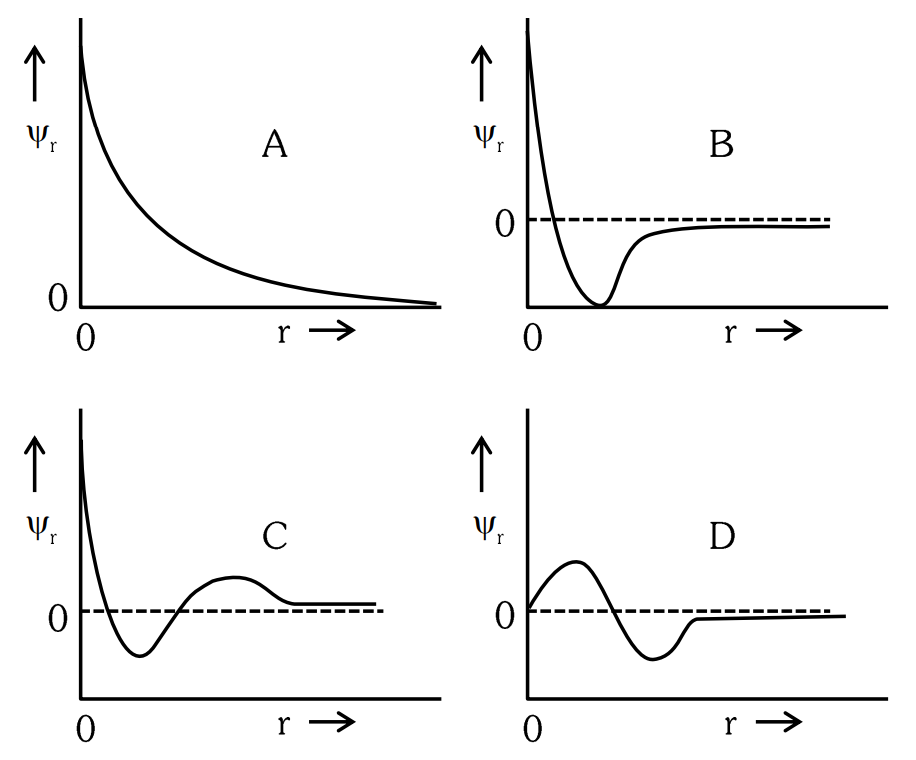 The figure representing two radial nodes in the orbital isThe number of radial nodes equals the number of times the wavefunction curve crosses the r-axis (excluding r = 0 and infinity). In figure C the curve cuts the axis twice, so it represents two radial nodes.
Energies of orbitals, de Broglie and uncertainty principle
-
Which one is the wrong statement?
In one-electron species, orbitals with the same n are degenerate.
The energies of the 2s-orbital and 2p-orbital in hydrogen-like atoms are equal (energy depends only on n). So the statement that 2s is lower in energy than 2p for hydrogen-like atoms is wrong.
Aufbau principle
-
If n = 6, the correct sequence of filling of electrons will beFor n = 6 the orbitals concerned are 6s, 4f [(n − 2)f], 5d [(n − 1)d] and 6p.
By the (n + l) rule, orbitals are filled in increasing order of (n + l); for equal (n + l), the orbital with lower n is filled first.
6s: n + l = 6 + 0 = 6
4f: n + l = 4 + 3 = 7; 5d: n + l = 5 + 2 = 7; 6p: n + l = 6 + 1 = 7
6s has the lowest value and is filled first. Among 4f, 5d and 6p (all 7), the order follows increasing n: 4f, then 5d, then 6p.
Sequence: $6s \rightarrow 4f \rightarrow 5d \rightarrow 6p$, i.e., $ns \rightarrow (n-2)f \rightarrow (n-1)d \rightarrow np$
Bohr model
-
Based on equation $E = -2.178\times10^{-18}\ J\left(\frac{Z^2}{n^2}\right)$ certain conclusions are written. Which of them is not correct?For n = 1 the electron has a more negative energy than for n = 6, which means it is more tightly (less loosely) bound in the smallest allowed orbit.
So the statement that it is more loosely bound is not correct.
Heisenberg's Uncertainty Principle
-
If uncertainty in position and momentum are equal, then uncertainty in velocity is -According to the Heisenberg uncertainty principle: $\Delta p \cdot \Delta x \geq \dfrac{h}{4\pi}$
Given $\Delta x = \Delta p$, so $(\Delta p)^2 \geq \dfrac{h}{4\pi}$
Since $\Delta p = m\,\Delta v$: $(m\,\Delta v)^2 \geq \dfrac{h}{4\pi}$
$m\,\Delta v \geq \sqrt{\dfrac{h}{4\pi}} = \dfrac{1}{2}\sqrt{\dfrac{h}{\pi}}$
$\Delta v \geq \dfrac{1}{2m}\sqrt{\dfrac{h}{\pi}}$
So the uncertainty in velocity is $\dfrac{1}{2m}\sqrt{\dfrac{h}{\pi}}$. -
Given: The mass of electron is $9.11 \times 10^{-31}$ kg, Planck constant is $6.626 \times 10^{-34}$ J s, the uncertainty involved in the measurement of velocity within a distance of 0.1 Å is :-Heisenberg's uncertainty principle: $\Delta x \times \Delta v \geq \dfrac{h}{4\pi m}$
$\Delta x = 0.1$ Å $= 0.1 \times 10^{-10}$ m $= 1 \times 10^{-11}$ m
$\Delta v \geq \dfrac{h}{4\pi m \times \Delta x}$
$\Delta v \geq \dfrac{6.626 \times 10^{-34}}{4 \times 3.14 \times 9.11 \times 10^{-31} \times 10^{-11}}$
$\Delta v \geq \dfrac{6.626 \times 10^{-34}}{1.144 \times 10^{-40}}$
$\Delta v \geq 5.79 \times 10^{6}$ m s$^{-1}$
Bohr's Model for Hydrogen Atom
-
The frequency of radiation emitted when the electron falls from n = 4 to n = 1 in a hydrogen atom will be (Given ionization energy of H = $2.18 \times 10^{-18}$ J atom$^{-1}$ and h = $6.625 \times 10^{-34}$ Js):Energy of the nth level of hydrogen: $E_n = -\dfrac{2.18 \times 10^{-18}}{n^2}$ J (the ionisation energy is the energy needed to remove the electron from n = 1).
$\Delta E = E_4 - E_1 = 2.18 \times 10^{-18}\left(\dfrac{1}{1^2} - \dfrac{1}{4^2}\right)$
$= 2.18 \times 10^{-18} \times \dfrac{15}{16} = 2.044 \times 10^{-18}$ J
Frequency: $\nu = \dfrac{\Delta E}{h} = \dfrac{2.044 \times 10^{-18}}{6.625 \times 10^{-34}}$
$\nu = 3.08 \times 10^{15}$ s$^{-1}$
(This line belongs to the Lyman series in the ultraviolet region.)
That is every question in Structure of Atom for this filter.
Show all 62 questions Next: Classification of Elements and Periodicity in Properties
Want a score?
Answers here are not saved. Practise as a test to be marked and see your progress.
Practise as a test